Employers trust cognitive ability tests for a straightforward reason: decades of research support their predictive validity for job performance better than most available alternatives. This guide covers the research evidence behind that trust, how cognitive tests compare to other selection methods, their genuine limitations, and how they fit into modern hiring practice. For practical guidance on how recruiters apply these tests, see How Recruiters Use IQ Tests in the Hiring Process.
The Research Foundation: Why Cognitive Ability Predicts Job Performance
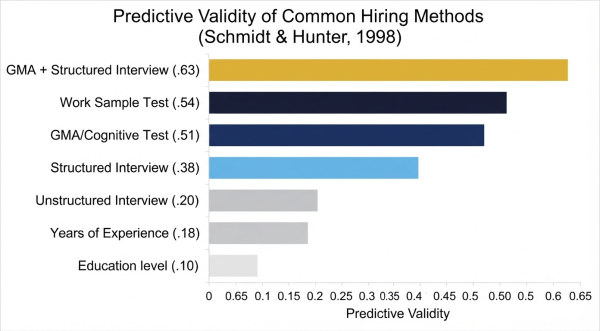
The scientific case for cognitive ability testing in employment rests primarily on validity research — studies examining how well different selection methods predict actual job performance outcomes. Schmidt and Hunter's landmark 1998 meta-analysis, covering hundreds of studies across numerous occupations and industries, remains the most comprehensive such review available. Its findings:
- General Mental Ability (GMA) / cognitive tests: Validity coefficient of approximately .51 for job performance — the highest single predictor in the study
- Work sample tests: ~.54 (similar to GMA, but more role-specific and expensive to administer at scale)
- Structured interviews: ~.38
- Unstructured interviews: ~.20
- Years of experience: ~.18
- Education level: ~.10
- GMA + Structured Interview combined: ~.63 — the highest combination validity in the study
The key finding is not that cognitive ability tests are perfect predictors — they aren't — but that they outperform most available selection alternatives per unit of cost and time, particularly at scale. This predictive relationship is strongest for cognitively demanding roles but holds across most occupational categories.
Why Cognitive Tests Have Practical Advantages for Employers
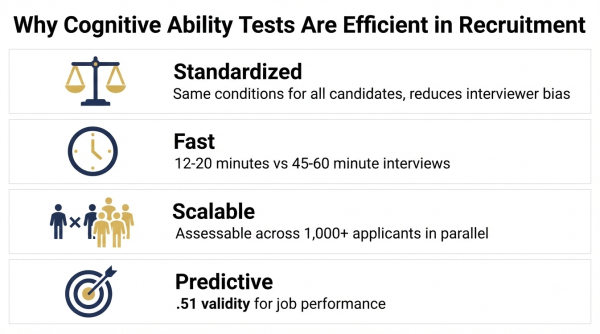
Beyond predictive validity, cognitive tests offer practical advantages that explain their continued use in modern hiring:
- Standardization: Every candidate is assessed under identical conditions, reducing the interviewer bias that significantly degrades unstructured interview validity. Cognitive tests don't favor candidates who present well in conversation but have lower job-relevant ability
- Speed and efficiency: A 12–20 minute cognitive assessment provides predictive data that correlates better with job performance than a 45–60 minute unstructured interview — at a fraction of the cost per candidate
- Scalability: Cognitive tests can be administered to thousands of candidates in parallel without quality degradation — critical for high-volume recruitment
- Early-stage filtering: Cognitive tests identify candidates unlikely to meet the role's learning demands before investing in expensive interview rounds
For context on the specific tests employers use, see Types of IQ Tests Used in Employment Screening.
How IQ Tests Compare to Alternatives
Employers who have considered alternatives to cognitive testing typically find that:
- Unstructured interviews feel comprehensive but have validity ~.20 — they primarily measure interview presentation skill and are heavily influenced by interviewer bias and candidate socioeconomic background
- Work sample tests have similar validity to GMA (~.54) but are expensive to develop, role-specific, and harder to scale — practical mainly for high-volume roles with standardized tasks
- Structured interviews improve on unstructured interviews substantially (~.38) and are the most evidence-supported interview format — but cognitive tests combined with structured interviews (~.63 combined) outperform either alone
- Personality assessments predict specific job performance dimensions (conscientiousness predicts performance across roles) but have lower overall validity than cognitive tests for general job performance
- References have very low predictive validity in research, partly due to inflation bias from selective provision
Most high-quality selection processes combine cognitive testing with structured interviews, trading off the complementary strengths of each. See IQ vs EQ for how cognitive and emotional assessment compare across different role demands.
The Real Limitations Employers Should Know
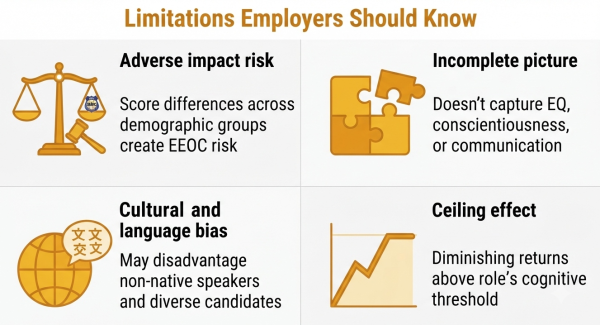
A balanced perspective requires acknowledging the genuine limitations of cognitive ability testing in hiring:
- Adverse impact risk: Cognitive ability tests consistently show average score differences across demographic groups — particularly by race and socioeconomic background. This creates legal exposure under EEOC guidelines when tests produce disparate outcomes. This is the primary legal risk of cognitive testing and requires careful management
- Incomplete picture: Cognitive tests don't assess conscientiousness, communication ability, emotional intelligence, creativity, or cultural fit — all of which matter for role success. An over-reliance on cognitive scores produces systematic errors in selection
- Cultural and linguistic bias: Many commercially deployed cognitive tests favor candidates with language and educational backgrounds aligned with the test's development context. Culture-fair alternatives reduce but don't eliminate this issue. See recruitment vs culture-fair IQ tests
- Ceiling effects: Above the cognitive threshold required for a given role, additional cognitive ability predicts diminishing returns on job performance. Using a very high cognitive bar for a role that doesn't require it excludes capable candidates without improving hire quality
- Test anxiety suppression: Candidates with high ability but test anxiety can perform below their actual level, causing the test to underestimate their capabilities
Best-Practice Use in Modern Hiring
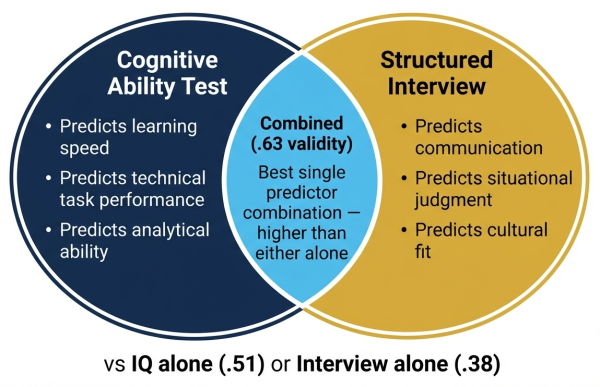
Research and legal guidance consistently point toward multi-method selection as best practice:
- Use cognitive tests as one input among several — not as a sole screen-out criterion
- Combine with structured interviews, which complement cognitive test data and capture abilities cognitive tests miss
- Calibrate cognitive thresholds to the actual cognitive demands of the specific role
- Monitor for adverse impact and consider culture-fair alternatives for international or diverse applicant pools
- Ensure tests are validated against the specific role or role category being assessed
The combination of GMA testing and structured interviewing (~.63 combined validity) represents the most practical high-validity selection approach for most employers. For candidates preparing to face cognitive tests in hiring, see the recruitment IQ test preparation guide.
Frequently Asked Questions
Why do employers trust IQ tests?
Decades of research — most comprehensively Schmidt and Hunter's 1998 meta-analysis — show that cognitive ability tests have validity coefficients of approximately .51 for job performance, making them the strongest single predictor of general job performance available. They are also standardized (reducing interviewer bias), efficient (12–20 minutes vs. hours of interviews), and scalable across large applicant pools.
Are IQ tests better than interviews?
Research shows cognitive tests outperform interviews alone: .51 validity vs. .38 for structured interviews and .20 for unstructured interviews. However, the combination of cognitive tests with structured interviews (.63 combined validity) outperforms either alone. This is why most evidence-based selection processes use cognitive tests as part of a multi-method approach, not as the sole criterion.
What are the limitations of IQ tests in hiring?
Key limitations: adverse impact risk (group score differences create EEOC exposure), incomplete picture (doesn't measure EQ, conscientiousness, or communication), cultural and linguistic bias, ceiling effects above the role's cognitive threshold, and test anxiety suppression of actual ability. These limitations argue for using cognitive tests as one input in a multi-method selection process, not as a sole criterion. See recruitment vs culture-fair IQ tests.
Do IQ tests predict long-term career success?
Cognitive ability predicts job performance strongly at entry-level and early career stages. For long-term career outcomes — senior leadership, sustained excellence, entrepreneurship — non-cognitive factors like conscientiousness, EQ, and domain expertise become increasingly important predictors. The threshold hypothesis: once a minimum cognitive level for a role is met, additional IQ points predict diminishing returns. See IQ vs EQ.

Comments
Share Your Thoughts