Cognitive ability testing has become a standard component of recruitment at many companies, from tech startups to global consulting firms. Understanding how these tests work — what they actually measure, which specific assessments employers use, the legal framework governing their use, and how to prepare — benefits both employers designing assessment processes and candidates preparing for them. For the foundational cognitive science, see What Is IQ? and the Recruitment IQ Test guide.
Why Employers Use Cognitive Ability Tests
The research basis for cognitive ability testing in employment is well-established. Schmidt and Hunter's 1998 meta-analysis, covering decades of research across hundreds of studies, found that general mental ability (GMA) has validity coefficients of approximately .51 for job performance — making it one of the strongest single predictors available to recruiters, particularly for cognitively demanding roles.
Cognitive tests offer employers several practical advantages:
- Standardization — every candidate is assessed under the same conditions, reducing the interviewer bias that affects unstructured interviews
- Predictive validity — performance on cognitive assessments correlates with on-the-job learning speed, problem-solving quality, and adaptability to new situations
- Efficiency — a 20-minute cognitive assessment can provide predictive data that an hour-long interview may not match
- Scalability — cognitive tests can be administered at scale during early-stage screening before investing in interviews
The strongest effect sizes appear for roles with high cognitive demands: engineering, data science, finance, consulting, research, and complex operational management. For lower-complexity roles, the added value of cognitive testing is smaller, and other predictors may matter more. See also why employers trust IQ tests and IQ vs soft skills in hiring.
Common Cognitive Ability Tests Used in Recruitment
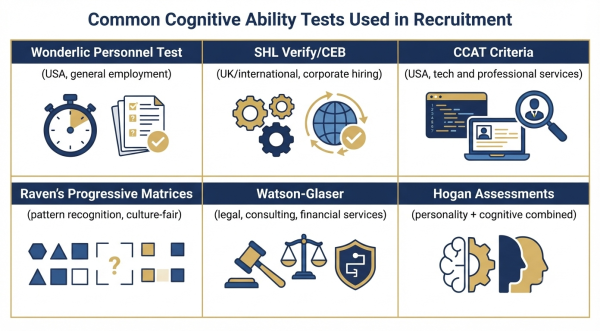
Unlike clinical IQ tests (WAIS, Stanford-Binet), recruitment cognitive assessments are specifically designed for employment screening — typically shorter, faster to administer, and focused on the cognitive abilities most relevant to job performance. Common tests include:
| Test | Common Use | What It Measures |
| Wonderlic Personnel Test | US general employment, NFL Scouting Combine | Broad cognitive ability, 50 questions in 12 minutes |
| SHL Verify / CEB Cognitive Battery | UK and international corporate hiring | Numerical, verbal, inductive reasoning (separate modules) |
| CCAT (Criteria Cognitive Aptitude Test) | US tech and professional services | Mixed cognitive reasoning, 50 questions in 15 minutes |
| Raven's Progressive Matrices | Culture-fair screening, international hiring | Abstract pattern recognition, fluid reasoning |
| Watson-Glaser Critical Thinking | Legal, consulting, financial services | Verbal reasoning, critical thinking, inference evaluation |
| Hogan Cognitive Ability Test | Leadership and executive assessment | Verbal, numerical, figural reasoning combined |
These are not clinical IQ tests and do not produce the same type of IQ score as a WAIS or Stanford-Binet assessment. A high score on a Wonderlic or CCAT does not equal a specific IQ number, and they are not interchangeable. For context on how clinical IQ assessments differ, see the WAIS-IV guide.
What Different Tests Measure — and What They Don't
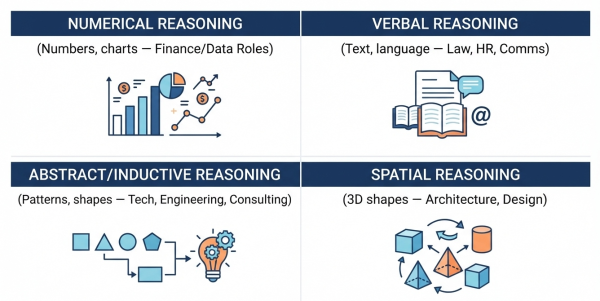
Recruitment cognitive tests typically cover four primary domains:
- Numerical reasoning: Interpreting data, performing calculations, reading charts and tables. Most relevant for finance, data analysis, and operations roles
- Verbal reasoning: Reading comprehension, logical inference from written passages, vocabulary and language structure. Most relevant for legal, HR, communications, and management consulting
- Abstract/inductive reasoning: Identifying patterns and rules in non-verbal material. Measures fluid reasoning — one of the most role-generalizable cognitive abilities — and is relevant across engineering, tech, and management roles
- Spatial reasoning: Visualizing and mentally manipulating 2D and 3D shapes. Relevant for architecture, engineering design, and technical roles
What cognitive tests cannot measure: emotional intelligence, work ethic, creativity in open-ended contexts, communication ability, resilience, or interpersonal judgment. This is why effective hiring processes use cognitive tests alongside rather than instead of other assessments. See IQ vs EQ for the research on how these predictors compare.
The Legal Framework: What Employers Must Know
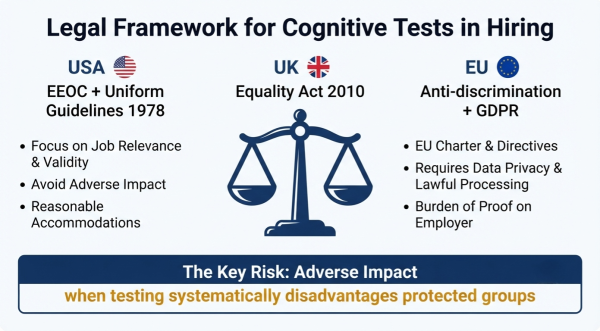
Cognitive ability testing in employment is legal in most jurisdictions but subject to important requirements:
United States
The EEOC's Uniform Guidelines on Employee Selection Procedures (1978) govern cognitive testing in US employment. Key requirements: tests must be job-relevant (validated against the specific role or role category), must not create unjustified adverse impact against protected groups (defined as a selection rate for a protected group below 80% of the highest-selecting group — the "4/5ths rule"), and employers must be able to demonstrate business necessity if adverse impact exists.
United Kingdom
The Equality Act 2010 prohibits discriminatory use of assessments. Tests must be applied consistently and must not systematically disadvantage protected characteristic groups without business justification.
European Union
EU anti-discrimination directives and GDPR apply. Data from cognitive tests must be handled in accordance with data protection requirements, and automated decision-making based solely on testing may require human review.
The primary legal risk for employers is adverse impact — when cognitive testing creates systematic disparities in selection rates across protected groups. This risk exists even without discriminatory intent and is the reason culture-fair tests (like Raven's Progressive Matrices) have gained preference in some organizations. For more on testing in different employment contexts, see types of IQ tests in employment screening.
How Recruiters Actually Use Test Scores
In practice, recruiters use cognitive test scores in several ways:
- Initial screening threshold: Setting a minimum score required to advance to interview. This is most common in high-volume recruitment where cognitive ability is a clear job prerequisite
- Ranking and comparison: Using scores to rank candidates at similar experience levels where other qualifiers are roughly equal
- Interview preparation: Structured interview questions can be calibrated based on cognitive test results — probing areas where the test showed relative weakness
- Combined profile assessment: Integrating cognitive scores with personality assessments, work samples, and structured interview data to build a complete candidate profile
Best practice is to use cognitive test scores as one input in a multi-source assessment process, not as an automatic screen-out tool. For more on how this fits within overall hiring strategy, see IQ in the hiring process and recruitment vs culture-fair IQ tests.
How Candidates Should Prepare
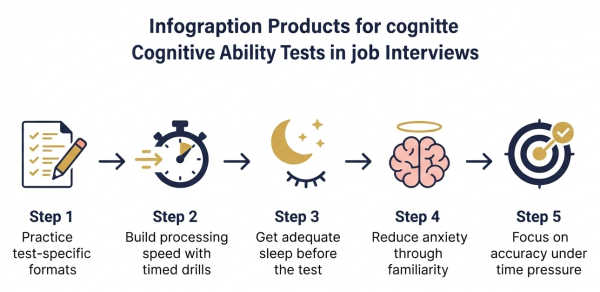
Preparation for recruitment cognitive tests is both possible and valuable:
- Practice with test-specific formats: Each test has a distinctive question style. Find out which test your target employer uses and practice with representative question sets. The Recruitment IQ Test provides preparation for the abstract and verbal reasoning components common across most recruitment assessments
- Build processing speed: Most recruitment tests are strictly timed and reward fast processing. Regular practice under timed conditions improves performance more reliably than studying content
- Sleep adequately: Cognitive test performance is significantly impaired by sleep deprivation. See sleep and IQ research for the underlying science
- Reduce test anxiety through familiarity: Test anxiety specifically impairs working memory — one of the primary abilities cognitive tests assess. Familiarity with the format through practice reduces anxiety's performance impact
- Understand what's being tested: Numerical reasoning requires practice with data interpretation; verbal reasoning requires practice with inference and logical deduction from passages; abstract reasoning is most improved through timed pattern recognition practice. See how to prepare for a recruitment IQ test
Frequently Asked Questions
Why do employers use IQ tests in hiring?
General mental ability (GMA) is one of the strongest validated predictors of job performance, particularly for complex roles. Schmidt and Hunter's 1998 meta-analysis found GMA validity coefficients of approximately .51 for job performance. Cognitive tests provide standardized, objective data that complements interviews and references. See why employers trust IQ tests.
What cognitive ability tests do employers commonly use?
Common recruitment cognitive tests include the Wonderlic Personnel Test (US general employment), SHL Verify/CEB (UK and international corporate hiring), CCAT (US tech and professional services), Raven's Progressive Matrices (culture-fair, international hiring), Watson-Glaser (legal, consulting, financial services), and Hogan Cognitive Ability Test (leadership assessment). These differ from clinical IQ tests like the WAIS and are not interchangeable with them.
Are IQ tests in hiring legal?
Yes, with requirements. In the US, the EEOC's Uniform Guidelines (1978) require tests to be job-relevant and not create unjustified adverse impact. In the UK, the Equality Act 2010 applies. In the EU, anti-discrimination directives and GDPR govern testing. The primary legal risk is adverse impact — systematic disparities in selection rates across protected groups. See types of IQ tests in employment screening.
How should I prepare for a cognitive test in a job application?
Practice with test-specific formats, build processing speed through timed drills, sleep adequately before the test, and reduce anxiety through familiarity with the format. Find out which specific test your employer uses and practice representative questions. See the full recruitment IQ test preparation guide.
What's the difference between a recruitment cognitive test and a clinical IQ test?
Recruitment tests (Wonderlic, CCAT, SHL) are designed specifically for employment screening — shorter, faster, and focused on abilities predictive of job performance. Clinical IQ tests (WAIS, Stanford-Binet) are administered by licensed psychologists for comprehensive cognitive assessment. A recruitment test score does not equal a clinical IQ score and cannot be used to determine a "true IQ." See the WAIS-IV guide for comparison.

Comments
Share Your Thoughts