When employers choose which cognitive assessment to use in hiring, they face a fundamental tradeoff: tests that directly measure job-relevant reasoning tend to include language and cultural elements that introduce bias; tests designed to minimize that bias tend to be less specific to language-dependent job demands. Understanding this tradeoff helps both employers designing assessment processes and candidates facing different test types. For the broader context of how recruiters use cognitive tests, see How Recruiters Use IQ Tests in the Hiring Process.
What Recruitment IQ Tests Measure
Recruitment IQ tests are cognitive assessments designed specifically for employment screening. They typically include a mix of:
- Verbal reasoning: Reading passages and drawing logical conclusions; vocabulary and language comprehension
- Numerical reasoning: Data interpretation, percentage calculations, basic mathematical operations under time pressure
- Abstract/inductive reasoning: Pattern recognition in visual sequences
- Mixed general ability: Combined format tests like the Wonderlic and CCAT that blend all three
These tests are timed (typically 12–20 minutes), designed to create performance pressure similar to real workplace conditions, and calibrated against job-relevant norm groups. Their primary advantage is that they directly predict performance on the cognitive demands of the job itself — verbal, numerical, and analytical tasks that most professional roles require. See the complete breakdown at Types of IQ Tests Used in Employment Screening.
What Culture Fair IQ Tests Measure
Culture fair tests — most prominently Raven's Progressive Matrices and the Cattell Culture Fair Intelligence Test (CFIT) — are designed to assess fluid reasoning while minimizing the influence of language, cultural knowledge, and educational background on test performance.
They work by using entirely non-verbal, visual pattern material:
- Each question presents a matrix of shapes with one piece missing
- The candidate must identify the rule governing the pattern and select the correct missing piece
- No language, vocabulary, cultural knowledge, or educational content is required
- The test measures the ability to identify rules and relationships in novel visual material — a direct measure of fluid reasoning
Raven's has two main versions: the Standard Progressive Matrices (SPM) for general workforce screening, and the Advanced Progressive Matrices (APM) for roles requiring stronger abstract reasoning — the APM provides finer discrimination at the upper range of ability.
What "Cultural Bias" in Testing Actually Means
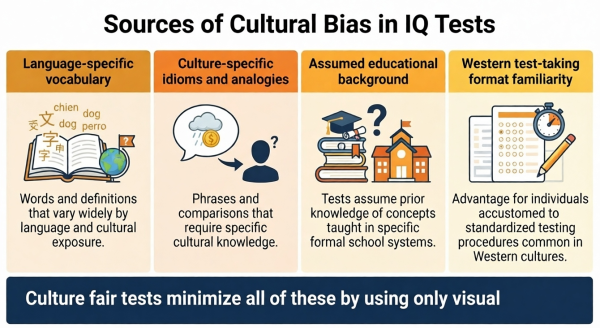
Cultural bias in a cognitive test means the test systematically produces score differences that reflect background differences rather than genuine differences in the cognitive ability being measured. Specific sources include:
- Language-specific vocabulary: Word problems or verbal analogies that use terms more familiar to native English speakers or to specific educational backgrounds
- Cultural idioms and references: Analogies or examples drawn from specific cultural contexts (sports metaphors common in the US, British idioms, etc.)
- Assumed educational content: Mathematical conventions, notation systems, or reasoning patterns that are taught differently across educational systems
- Test format familiarity: Western academic test-taking conventions (multiple-choice format, time pressure, specific question phrasing) are more familiar to candidates who have experienced them extensively
Culture fair tests eliminate all of these sources by using only visual pattern material that doesn't depend on any of the above. No language acquisition, no cultural knowledge, no specific educational background is needed — only the ability to identify visual rules. For the research on what IQ tests actually measure, see What Is IQ?
Side-by-Side Comparison
| Dimension | Recruitment IQ Test | Culture Fair Test |
| Primary purpose | Employment screening | Bias-reduced cognitive measurement |
| Language requirement | High (verbal tests) to moderate (mixed) | None |
| Content type | Verbal, numerical, abstract | Visual patterns only |
| Cultural bias risk | Moderate to high | Low |
| Adverse impact risk | Higher | Lower |
| Typical duration | 12–20 minutes | 30–60 minutes |
| Best suited for | Role-specific, language-intensive jobs | Diverse/international hiring, fluid reasoning focus |
Why Some Employers Are Moving to Culture Fair Tests
Several factors drive employer adoption of culture fair and lower-bias assessment approaches:
- Legal risk reduction: Assessments with lower adverse impact — systematic score differences across protected groups — face less legal scrutiny under EEOC guidelines in the US and equivalent laws in the UK and EU. Culture fair tests generally show smaller differences across demographic groups than verbal-heavy tests. For the legal framework, see how recruiters use IQ tests
- International hiring: For organizations hiring across language backgrounds, a non-verbal assessment avoids systematic disadvantage to candidates whose first language isn't English
- Diversity and inclusion objectives: Organizations seeking to build cognitively diverse teams need screening tools that don't systematically disadvantage particular groups
- Fluid reasoning emphasis: Research supports that non-verbal abstract reasoning predicts learning speed and job adaptability effectively — particularly relevant for roles requiring rapid skill acquisition
The Limits of Culture Fair Tests
Culture fair tests are not universally superior to recruitment tests. Their limitations include:
- For roles where verbal communication, written reasoning, and numerical analysis are core job requirements, a purely non-verbal test may be less predictive than a test that directly assesses those skills
- Pattern recognition tests may not predict verbal job performance as well as verbal tests, even if they predict fluid reasoning effectively
- Some research suggests that group differences are not entirely eliminated by culture fair tests — only reduced
Many employers address this by combining approaches: using Raven's or another culture fair test as a first-stage screen for basic cognitive capacity, followed by role-specific verbal and numerical assessments for finalists.
What This Means for Candidates
If you're facing a recruitment test (Wonderlic, CCAT, SHL), prepare with test-type-specific practice under timed conditions. See the complete preparation guide. The Recruitment IQ Test provides realistic practice.
If you're facing a culture fair assessment (Raven's APM or similar), prepare by practicing visual pattern completion tasks. The core skill is identifying multiple simultaneous rules in a matrix — what changes row by row and column by column simultaneously. Format familiarity matters more than content review, since there's no content to learn. The International Standard IQ Test includes abstract pattern reasoning components relevant to this preparation.
Frequently Asked Questions
What is the difference between a recruitment IQ test and a culture fair IQ test?
Recruitment IQ tests screen for job-relevant cognitive ability and typically include verbal, numerical, and mixed reasoning tasks under strict time pressure. Culture fair tests use non-verbal visual pattern tasks to measure fluid reasoning with minimal cultural or linguistic bias. Recruitment tests optimize for predictive validity in specific job contexts; culture fair tests optimize for equitable measurement across diverse populations.
What does "cultural bias" in an IQ test actually mean?
Cultural bias means the test produces score differences that reflect background differences (language, education, cultural familiarity) rather than genuine differences in cognitive ability. Sources include language-specific vocabulary, cultural idioms, assumed educational content, and test format conventions. Culture fair tests minimize these by using only non-verbal visual pattern material.
Why are employers using culture fair tests?
Legal risk reduction (lower adverse impact risk under EEOC and equivalent laws), international hiring needs, diversity and inclusion objectives, and fluid reasoning emphasis all drive adoption. Culture fair tests generally show smaller score differences across demographic groups, reducing legal exposure while maintaining predictive validity for abstract reasoning and learning speed.
What is Raven's Progressive Matrices?
Raven's is the leading culture fair cognitive assessment — a non-verbal test of abstract pattern recognition and fluid reasoning. Two main versions: SPM (Standard) for general workforce screening; APM (Advanced) for roles requiring stronger abstract reasoning at the upper range. Because it uses no language whatsoever, it is the most widely used culture fair assessment in both employment and research contexts.
Do culture fair tests predict job performance as well as recruitment tests?
For roles emphasizing learning speed and abstract reasoning, yes — research supports Raven's as a valid job performance predictor. For roles where verbal communication and numerical analysis are core demands, purely non-verbal tests may be less predictive than tests that directly assess those language-dependent skills. Many employers combine both approaches: culture fair screen first, role-specific test for finalists.

Comments
Share Your Thoughts