Not all recruitment cognitive tests are the same. A numerical reasoning test for a financial analyst role has different demands from an abstract reasoning test for an engineering position, which in turn differs from the critical thinking assessment used by law firms. Understanding which types of tests are used — and what each specifically measures — is the most valuable preparation you can do as a candidate. For the broader context of how employers use these tests, see How Recruiters Use IQ Tests in the Hiring Process.
Five Categories of Cognitive Tests in Employment
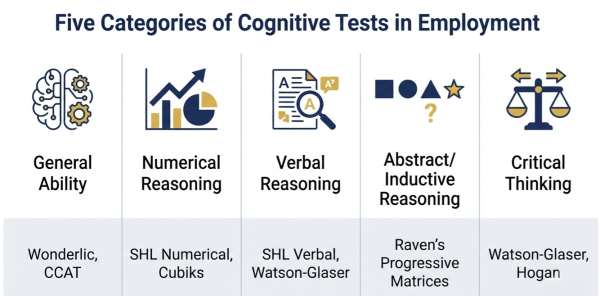
Employment cognitive screening generally falls into five categories, which may be administered separately or combined:
- General cognitive ability tests — broad assessments of overall cognitive capacity under time pressure (Wonderlic, CCAT)
- Numerical reasoning tests — interpreting data, charts, percentages, and quantitative scenarios (SHL Numerical, Cubiks, Talent Q)
- Verbal reasoning tests — logical inference from written passages; not just reading comprehension (SHL Verbal, Watson-Glaser)
- Abstract/inductive reasoning tests — identifying patterns in visual sequences without relying on language or knowledge (Raven's Progressive Matrices, SHL Inductive)
- Critical thinking assessments — structured analysis of arguments, assumptions, and inference validity (Watson-Glaser)
1. Wonderlic Personnel Test (WPT)
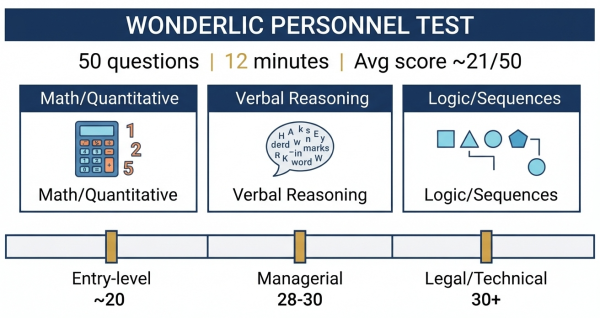
Used by: Corporate employers across most sectors in the US; famously used in NFL Scouting Combine
Format: 50 questions in 12 minutes — math, verbal reasoning, logic sequences
Average score: ~20–22 out of 50 for the general working population
The Wonderlic is one of the most widely used pre-employment cognitive assessments in the United States. Its primary value is speed — it assesses general cognitive ability efficiently under time pressure, which correlates with how quickly candidates learn new information and solve novel problems on the job.
Benchmark scores vary by role. Entry-level positions typically require approximately 20; managerial and professional positions 28–30+; legal and highly technical roles often 30 and above. The test is not designed to generate an IQ score and Wonderlic results should not be compared directly to WAIS or Stanford-Binet scores — they are not the same instrument. For preparation, the Recruitment IQ Test covers similar cognitive domains.
2. Raven's Progressive Matrices
Used by: International organizations, multicultural teams, culture-fair screening contexts
Format: Visual pattern sequences — multiple choice, select the missing piece
Editions: SPM (Standard — general workforce), APM (Advanced — higher-complexity roles)
Raven's Progressive Matrices is arguably the most culture-fair of all cognitive assessments — it uses no language whatsoever, relying entirely on visual pattern recognition to measure fluid reasoning. This makes it particularly valuable for international hiring and diverse recruitment pools where linguistic or educational background might disadvantage candidates on verbal or numerical tests.
Raven's APM (Advanced Progressive Matrices) is the version used for more complex roles requiring high-level abstract reasoning. It measures one of the core capacities that IQ tests assess — the ability to identify rules and relationships in novel material without prior knowledge. See the guide on what IQ actually measures for the cognitive science framework.
3. SHL Verify / CEB Cognitive Battery
Used by: Fortune 500 companies, FTSE 100 firms, large-scale graduate recruitment in UK and internationally
Format: Separate modules — Numerical Reasoning (~25 min), Verbal Reasoning (~17 min), Inductive Reasoning (~25 min)
Scoring: Percentile-ranked against relevant norm groups (management, graduate, etc.)
SHL assessments are the standard for corporate volume recruitment in the UK and internationally. The three modules assess distinct cognitive abilities and are typically used in combination for graduate schemes and management roles. The key characteristic of SHL Verify is that it is unsupervised (online, at home) but candidates who pass are often invited to verify their scores in a supervised session — making cheating ineffective. For context on the abilities they measure, see recruitment vs culture-fair IQ tests.
4. Watson-Glaser Critical Thinking Appraisal
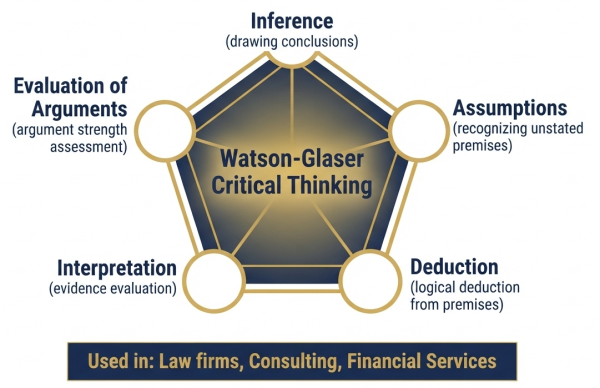
Used by: Law firms, management consulting, investment banking, graduate programs in professional services
Format: Written passages followed by questions in five areas of critical thinking
Five dimensions assessed: Inference, Recognition of Assumptions, Deduction, Interpretation, Evaluation of Arguments
Watson-Glaser is the dominant critical thinking assessment in professional services hiring. Unlike pattern recognition tests, it is entirely verbal — candidates read written passages and answer questions about what conclusions can and cannot be drawn, what assumptions are being made, and how strong particular arguments are.
This is a fundamentally different cognitive demand from numerical or abstract reasoning. Candidates who excel at quantitative reasoning sometimes find Watson-Glaser difficult because it requires strict logical discipline applied to language — distinguishing between what a passage literally states versus what it implies or assumes. For preparation, practice reading passages and asking "does this conclusion actually follow from what was stated?" before selecting answers.
5. CCAT (Criteria Cognitive Aptitude Test)
Used by: US tech companies, SaaS businesses, professional services, remote-first employers
Format: 50 questions in 15 minutes — mixed: math, verbal, spatial, and logic
Average score: Approximately 24–26 out of 50 across applicants
The CCAT is widely used in US tech hiring as a brief but demanding cognitive screener. Its mix of question types — mathematical word problems, verbal analogies, spatial reasoning, and logical sequences — requires rapid switching between cognitive modes, which itself tests cognitive flexibility. The time pressure is severe: completing all 50 questions is not expected for most candidates. For preparation on the cognitive flexibility this test emphasizes, see the relevant guide.
6. Thomas International GIA (General Intelligence Assessment)
Used by: Engineering firms, sales organizations, executive selection
Format: 5 short subtests — reasoning, perceptual speed, number speed and accuracy, word meaning, spatial visualization
Distinctive feature: Measures learning speed and cognitive processing rate alongside ability
Unlike most recruitment cognitive tests, Thomas GIA explicitly focuses on learning speed — how quickly someone can process new information and procedures — rather than accumulated cognitive ability. This makes it particularly valuable for roles requiring rapid skill acquisition, adaptation to new systems, or quick onboarding. For context on the cognitive flexibility this relates to, see whether IQ and cognitive speed can be improved.
Quick Reference: Which Test for Which Context
| Test | Best Context | Primary Ability | Duration |
| Wonderlic WPT | US corporate, finance, logistics | General ability + speed | 12 min |
| Raven's APM | International, culture-fair, complex roles | Fluid/abstract reasoning | 40–60 min |
| SHL Numerical | Finance, data, management roles | Data interpretation | ~25 min |
| SHL Verbal | Management, HR, communications | Verbal inference | ~17 min |
| Watson-Glaser | Law, consulting, financial services | Critical thinking | 30–40 min |
| CCAT | US tech, SaaS, remote hiring | Mixed reasoning + speed | 15 min |
| Thomas GIA | Engineering, sales, executive | Learning speed | ~30 min |
How to Prepare for Each Test Type
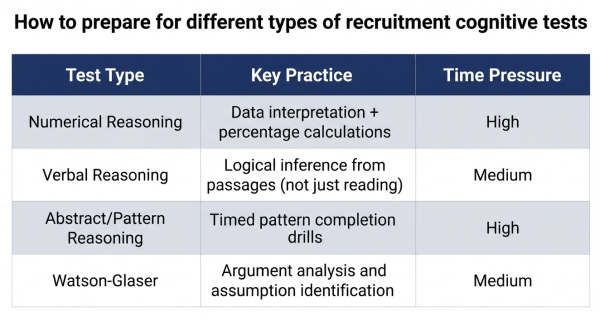
- General ability tests (Wonderlic, CCAT): Practice mixed cognitive tasks under strict time limits. Speed is the primary limiting factor. Take the Recruitment IQ Test to build familiarity with this format
- Numerical reasoning (SHL Numerical, Cubiks): Practice reading tables, charts, and graphs and answering questions under time pressure. Percentage calculations and data interpretation are core skills
- Verbal reasoning (SHL Verbal): Practice drawing strict logical conclusions from written passages — the key error is confusing "what the passage says" with "what seems generally true." This is not a reading comprehension test
- Abstract/inductive reasoning (Raven's APM, SHL Inductive): Practice visual pattern completion under timed conditions. Look for the rule governing each row and column simultaneously
- Critical thinking (Watson-Glaser): Practice analyzing arguments for unstated assumptions and distinguishing strong from weak evidence. Study the five Watson-Glaser dimensions specifically and practice with each question type
See the complete preparation guide at how to prepare for a recruitment IQ test.
Frequently Asked Questions
What types of cognitive tests are used in employment screening?
The main categories are: general cognitive ability tests (Wonderlic, CCAT), numerical reasoning tests (SHL Numerical, Cubiks), verbal reasoning tests (SHL Verbal), abstract/inductive reasoning tests (Raven's Matrices, SHL Inductive), and critical thinking assessments (Watson-Glaser). Most employers use one type selected for the specific cognitive demands of the role.
What is the Wonderlic test?
The Wonderlic Personnel Test is a 50-question, 12-minute general cognitive ability screener widely used in US hiring. It covers math, verbal reasoning, and logic. The average score is approximately 20–22 out of 50. Different roles have different benchmarks — managerial and professional positions typically require 28–30+. It is not a clinical IQ test and Wonderlic scores do not equal WAIS IQ scores.
What is the Watson-Glaser test?
Watson-Glaser is a critical thinking assessment used primarily in legal, consulting, and financial services graduate recruitment. It measures five dimensions: inference, recognition of assumptions, deduction, interpretation, and evaluation of arguments — all applied to written passages. It is entirely verbal and requires strict logical discipline, not quantitative ability.
What is Raven's Progressive Matrices?
Raven's Progressive Matrices is a nonverbal, culture-fair test of fluid reasoning through visual pattern recognition. Because it requires no language or prior knowledge, it is particularly useful for international hiring and diverse recruitment pools. Raven's APM (Advanced) is used for higher-complexity roles; Raven's SPM (Standard) for broader screening.
How should I prepare for an employment cognitive test?
Find out which test your employer uses, then practice with test-type-specific materials. For numerical reasoning, practice data interpretation under time pressure. For verbal reasoning, practice logical inference from passages. For abstract reasoning, practice timed pattern completion. For Watson-Glaser, study the five dimensions and practice argument analysis. See the full preparation guide.

Comments
Share Your Thoughts