You've been invited to take a cognitive ability test as part of a job application. Preparation matters — research consistently shows that format familiarity, reduced test anxiety, and practiced processing speed all improve performance on recruitment cognitive tests. This guide covers seven evidence-based preparation strategies, what to do on the day, and how to think about what score you actually need. For context on what tests you might face, see Types of IQ Tests Used in Employment Screening.
Strategy 1: Identify Which Test You'll Face
This is the most important preparation step and the one most candidates skip. Preparation for a Wonderlic (50 questions, 12 minutes, mixed content) is different from preparation for Watson-Glaser (critical thinking, verbal reasoning, 5 dimensions) or SHL Numerical (data interpretation, charts, percentages).
- Ask your recruiter directly which assessment tool you'll be using — most will tell you
- Check the company's Glassdoor page; candidates often report which test they received
- Research the company's sector — tech startups frequently use CCAT; UK consulting and law firms typically use Watson-Glaser; investment banking often uses SHL Numerical
Once you know the test, practice with representative question types rather than generic IQ test questions. Our Recruitment IQ Test provides practice with the abstract and verbal reasoning components common across most recruitment assessments.
Strategy 2: Build a Structured Preparation Timeline
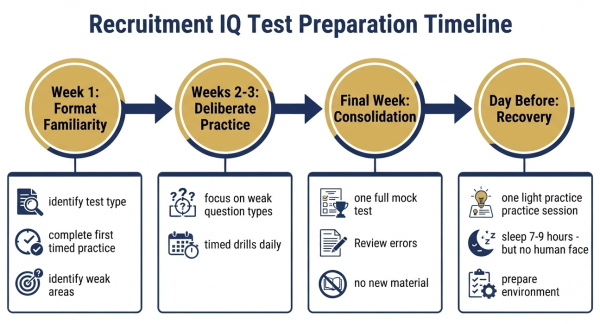
Two to four weeks of consistent practice produces better results than a single intensive session. The brain consolidates practiced cognitive patterns over time — spaced practice is more effective than cramming.
- Week 1 — Format familiarity: Complete your first full timed practice test with zero preparation. This establishes your baseline and identifies your weakest question types
- Weeks 2–3 — Deliberate practice: Focus practice sessions specifically on your identified weak areas. Daily sessions of 20–30 minutes under timed conditions are more effective than occasional longer sessions
- Final week — Consolidation: Complete one full-length mock test. Review errors systematically — understand why the correct answer was correct, not just what it was. Stop learning new material at this stage
- Day before — Recovery: One light practice session to stay warm, then stop. Prepare your testing environment. Sleep 7–9 hours
Strategy 3: Practice Under Time Pressure from Day One
The most common preparation mistake is practicing questions without a timer. Most recruitment cognitive tests are strictly timed, and processing speed under pressure is itself a major part of what they measure. Always set a timer when practicing — including during warm-up exercises.
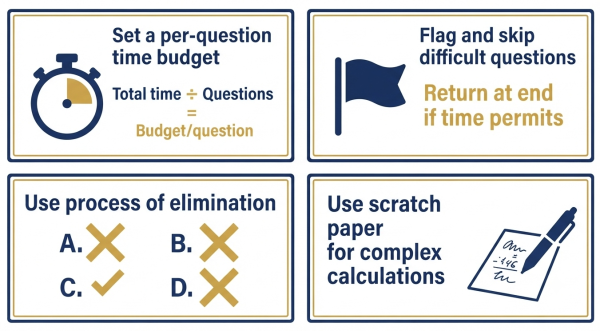
Develop a per-question time budget: total available time ÷ number of questions = target seconds per question. For the Wonderlic (12 minutes, 50 questions), that's approximately 14 seconds per question. For the CCAT (15 minutes, 50 questions), about 18 seconds. Practice abandoning questions that take too long and moving on — returning at the end if time permits. See the guide on cognitive flexibility for the research on switching between cognitive tasks under pressure.
Strategy 4: Address Working Memory Impairment from Test Anxiety
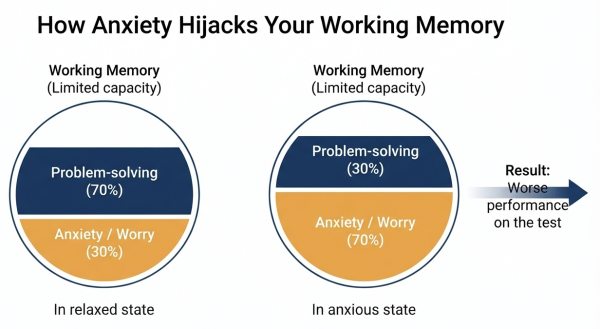
Test anxiety is one of the most significant performance limiters for candidates who have adequate cognitive ability. The mechanism is specific: anxiety consumes working memory capacity. When the brain is allocating cognitive resources to threat-related processing (worry, outcome anticipation, self-monitoring), fewer resources are available for the problem-solving the test actually requires. This directly impairs the working memory performance that cognitive tests measure.
The primary solution is exposure through practice: repeated timed test simulation in conditions similar to the actual test makes the testing environment feel familiar, reducing the novelty response that triggers anxiety. Additional approaches:
- Reframe the test as information-gathering rather than judgment — the score helps both you and the employer understand fit, not just pass/fail
- Brief deep breathing before the test reduces physiological anxiety response and its cognitive effects
- Accept imperfection explicitly — most employers use normative benchmarks, not perfect scores, and completing 70% of questions correctly often places you competitively
Strategy 5: Optimize Sleep and Nutrition
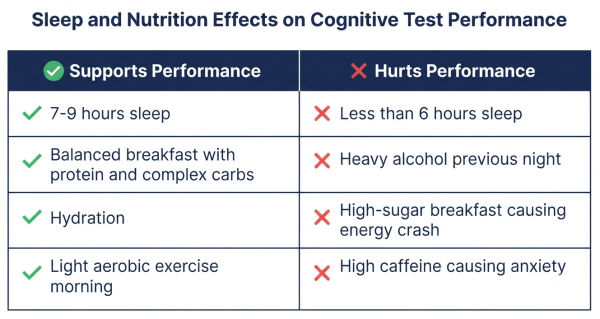
Sleep has a larger impact on cognitive test performance than most candidates realize. Research consistently shows that inadequate sleep (less than 6 hours) produces measurable deficits in working memory, processing speed, and executive function — the three primary capacities that cognitive ability tests measure. Even a single night of inadequate sleep produces deficits equivalent to 2–3 IQ points on standard assessments. See the full research at sleep and IQ.
On test day, prioritize:
- 7–9 hours of sleep the night before
- A balanced breakfast with protein and complex carbohydrates — avoiding high-sugar options that cause mid-morning energy crashes during the test
- Adequate hydration
- Avoid heavy alcohol the previous evening (impairs sleep quality and next-day cognition even when not feeling intoxicated)
- Light aerobic exercise in the morning if possible — 20–30 minutes of aerobic activity is associated with improved working memory and processing speed for several hours afterward (see exercise and the brain)
Strategy 6: Know What Score You Actually Need
Many candidates don't know what score they're targeting, which leads to either over-preparation anxiety or insufficient practice. Most employers use normative benchmarks, not fixed pass scores. General benchmarks by test:
- Wonderlic: Average is ~20–22 out of 50. Managerial and professional positions typically require 28–30+. Technical and legal roles often require 30+
- CCAT: Average is ~24–26 out of 50. Scores above 30 are generally competitive for most professional roles
- SHL assessments: Reported as percentile vs. relevant norm group. Being in the top 25–50% is typically sufficient for most professional positions; more selective roles require top 10–25%
- Watson-Glaser: Reported as percentile vs. norm group. Ask your recruiter for the expected benchmark for the specific role
If you can, ask the recruiter directly whether there is a minimum score threshold for the role — this is common practice and most will tell you.
Strategy 7: Optimize Your Environment and Day-of Execution
On test day, preparation and environment matter:
- Take the test in a quiet, distraction-free space — cognitive performance drops measurably with background noise or interruption
- Ensure stable internet connection, sufficient battery, and any required equipment ready before starting
- Have scratch paper available for calculations and working through complex problems — don't try to hold all working memory in your head
- Read each question fully before selecting an answer — many traps are in the wording
- Use process of elimination on multiple-choice questions: eliminating two obviously wrong answers improves your odds from 25% to 50% on the remaining choices
- Flag questions you're unsure about and return at the end if time permits — don't spend disproportionate time on one question
Frequently Asked Questions
Can you prepare for a recruitment IQ test?
Yes. Format familiarity, reduced test anxiety, and practiced processing speed all improve performance on recruitment cognitive tests. Preparation cannot dramatically change underlying cognitive capacity in a short period, but it ensures you perform at or near your actual potential rather than below it due to anxiety, unfamiliarity, or poor time management. The most valuable preparation is test-type-specific practice under timed conditions.
How many weeks should I prepare?
Two to four weeks with daily sessions of 20–30 minutes is optimal. Week 1: format familiarity and baseline assessment. Weeks 2–3: deliberate practice on weak question types under timed conditions. Final week: one full mock test, error review, then consolidation. Day before: one light session, then sleep.
What score do I need to pass?
It depends on the test and role. For the Wonderlic, managerial and professional roles typically require 28–30+ out of 50. For CCAT, 30+ out of 50 is competitive for most professional roles. For SHL, being in the top 25–50% of the relevant norm group is typically sufficient; more competitive positions require the top 10–25%. Ask your recruiter whether there's a minimum score threshold for the specific role.
Does sleep affect cognitive test scores?
Significantly. Inadequate sleep (less than 6 hours) produces measurable deficits in working memory, processing speed, and executive function — the primary capacities cognitive tests measure. Even one night of poor sleep can reduce performance by the equivalent of 2–3 IQ points. Adequate sleep the night before is one of the highest-leverage preparations you can make. See sleep and IQ.
Why does test anxiety lower my score?
Test anxiety consumes working memory — the same cognitive resource that cognitive ability tests primarily measure. When the brain allocates resources to worry and threat-monitoring, fewer are available for problem-solving. The solution is exposure: repeated timed practice in similar conditions reduces the novelty response that triggers anxiety, freeing more working memory for actual test performance. See how recruiters use cognitive test scores for context on what scores mean to employers.

Comments
Share Your Thoughts