India's estimated average IQ sits at approximately 76–82 in the most widely cited national cognitive datasets — placing it well below the global average and substantially below regional peers like China, Vietnam, and Sri Lanka. Yet India produces a disproportionate share of the world's engineers, scientists, and technology company CEOs. Indian-origin leaders have headed Google, Microsoft, Adobe, IBM, and dozens of other global institutions. IIT graduates are sought by the most selective universities and companies in the world.
This apparent contradiction — a low national average and a world-class cognitive elite — is not actually a contradiction at all. It is the arithmetic of 1.4 billion people, the most extreme educational inequality of any large country, and a cognitive testing infrastructure that measures a population still mid-way through its development trajectory.
This guide covers India's IQ data honestly: what the estimates show, why India has not participated in PISA, what the IIT paradox actually reveals, what environmental factors drive the low national average, and why the current snapshot understates India's cognitive potential as development continues.
India's IQ Data: What the Sources Show — and Their Limitations
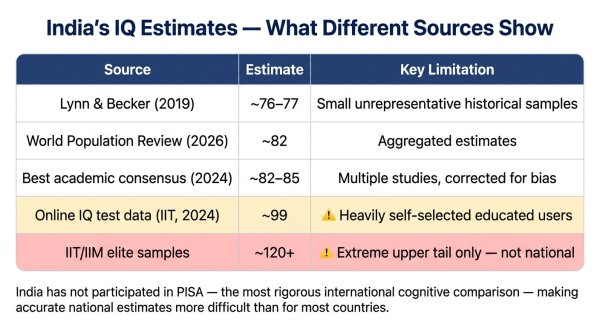
India's national IQ estimate varies significantly across sources, reflecting genuine methodological uncertainty as much as true cognitive differences:
| Source | Estimate | Key Limitation |
| Lynn & Becker (2019) | ~76–77 | Small, unrepresentative historical samples; no PISA data |
| World Population Review (2026) | ~82 | Aggregated estimates with wide uncertainty |
| Academic consensus (2024) | ~82–85 | Multiple corrected studies; more cautious estimate |
| Online IQ test data (2024) | ~99 | ⚠️ Heavily self-selected educated internet users — not representative |
| IIT/elite sample studies | ~120+ | ⚠️ Extreme upper distribution tail — wildly unrepresentative nationally |
A critical fact that compounds India's data uncertainty: India has not participated in PISA — the OECD's Programme for International Student Assessment that provides the most methodologically consistent international cognitive comparison. Without PISA data, India's national estimate relies entirely on academic convenience samples, which are inherently less reliable. The contrast with Vietnam (which has participated in PISA since 2012 and received a substantial upward revision of its estimate as a result) is telling: PISA participation would almost certainly clarify India's national cognitive performance considerably, though it remains unclear whether it would revise the estimate upward or further confirm the current range.
The best available estimate, synthesising academic sources with methodological correction, is approximately 82–85 — with the caveat that this is a rough order-of-magnitude figure rather than a precision measurement, and that it almost certainly understates the cognitive potential of India's educated urban population while accurately reflecting the current reality of its full national population.
The IIT Paradox: How a Low Average Produces World-Class Elites
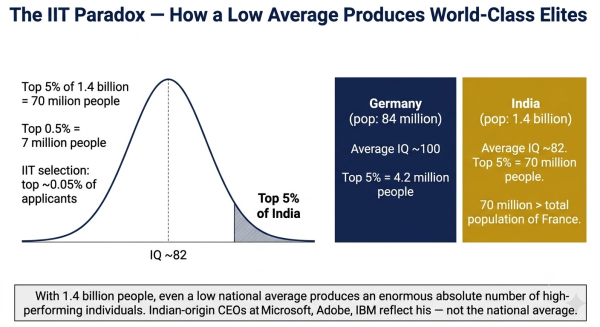
The most common reaction to India's estimated average IQ is: "But how can India have such a low average when it produces so many world-class engineers and scientists?" The answer lies in elementary arithmetic — and reveals something important about what national averages do and do not tell us.
India's 1.4 billion people mean that even a relatively low national average generates an enormous absolute number of high-performing individuals at the upper tail of the distribution. If 5% of India's population performs above IQ 115 (a reasonable estimate for urban educated Indians), that represents approximately 70 million people — more than the total population of France, the UK, or Thailand. If even 1% performs above IQ 130, that is 14 million people — more than the population of Greece or Belgium.
The IITs (Indian Institutes of Technology) make this vivid in specific terms. The JEE Advanced entrance examination — which selects approximately 16,000 students per year for IIT admission — has an acceptance rate of roughly 0.5% of all applicants (approximately 1.5–2 million candidates attempt it annually). These students represent not the average Indian student but an extreme upper tail of a distribution of 1.4 billion people. The cognitive screening that IIT admission represents is among the most intense in the world — and it operates on a population base that, despite its lower average, generates enough absolute numbers at the top to produce a world-class engineering cohort.
The Indian-origin technology leaders who head global companies — Sundar Pichai, Satya Nadella, Shantanu Narayen, Arvind Krishna — are not "average Indians" any more than Terence Tao (IQ 225–230) is an "average American." They represent the far upper tail of a very large population, filtered through India's elite educational pipeline. Their existence says nothing about India's national average IQ; it says something about what happens when 1.4 billion people are sorted by cognitive ability through an extraordinarily competitive examination system.
For context on how cognitive ability distributes within populations, see our IQ scale explained.
What Drives India's Low National Average
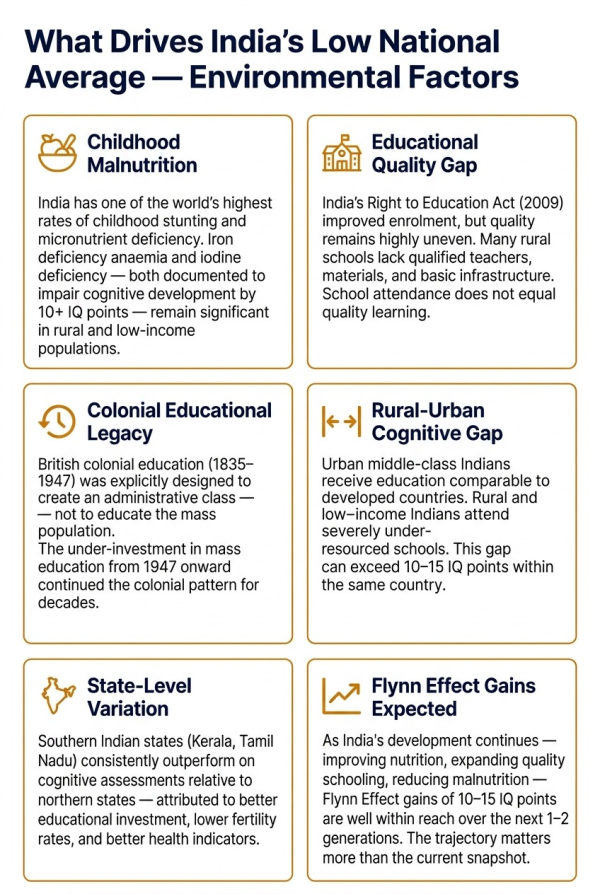
India's ~76–82 national average reflects well-documented environmental factors — not any inherent cognitive limitation of the Indian population:
Childhood malnutrition and micronutrient deficiency. India has historically had high rates of childhood undernutrition, including significant iron deficiency anaemia and iodine deficiency in rural populations. As covered in our guide on nutrition and IQ, iodine deficiency alone is associated with average cognitive reductions of 12–13 IQ points, and iron deficiency in early childhood with measurable working memory and attention impairments. These nutritional deficits — improving but not yet resolved across India's full rural population — represent one of the most significant direct contributions to the low national average.
Educational quality gaps. India's Right to Education Act (2009) guaranteed universal schooling through age 14 and substantially improved enrolment rates. But enrolment is not the same as quality learning. Research consistently documents that many rural Indian schools lack qualified teachers, adequate infrastructure, and effective instructional practices. Students who attend school but receive poor-quality instruction develop substantially less of the cognitive capacity that formal education builds in higher-quality systems. The gap between an IIT-track urban school and a rural government school in Bihar or Uttar Pradesh may exceed 15 IQ points in its cognitive development impact.
Colonial educational legacy. British colonial education policy — most famously articulated in Macaulay's 1835 "Minute on Indian Education" — was explicitly designed to create a small Indian administrative class for colonial service, not to educate the mass population. The colonial period (1835–1947) produced a two-tier system: world-class English-language institutions for a small elite, and systematic neglect of mass primary education. India gained independence in 1947 with very low literacy rates and an inherited two-tier system that continues to shape educational outcomes today. The IITs themselves (established 1951 onward) are part of this inheritance — elite institutions of international standard coexisting with a mass education system still working to raise its quality.
State-level variation. India's cognitive performance is not uniform. Southern Indian states — particularly Kerala and Tamil Nadu — consistently outperform on educational and cognitive indicators compared to northern states such as Bihar, Uttar Pradesh, and Rajasthan. Kerala, with near-universal literacy and high educational investment relative to its income, likely has an average IQ substantially above the national estimate. Bihar, with lower literacy rates and higher rates of malnutrition and educational deprivation, likely substantially drags the national average down. India's national average is the aggregate of extremely diverse state-level realities.
India's Data Gap: The PISA Problem
One of the most significant issues in assessing India's national cognitive performance is the absence of PISA data. India has not participated in PISA, meaning it has no data point from the most methodologically consistent international cognitive comparison available. This matters significantly:
Vietnam's PISA participation (from 2012) allowed researchers to revise its estimate substantially upward — from the implausibly low IQ 78 rural estimate in Becker's dataset to the more accurate ~95–100 national estimate suggested by its actual PISA performance. Without PISA participation, India's estimate rests on academic convenience samples that are particularly susceptible to the sampling bias issues that make the Lynn-Becker dataset less reliable for some countries than others.
Were India to participate in PISA with a nationally representative sample, the resulting data would either confirm the current ~82–85 range or provide a more reliable basis for revision — just as PISA participation did for Vietnam. The academic consensus is that some upward revision from the Lynn-Becker 76–77 figure is warranted, which is why most recent estimates settle closer to 82–85. But without PISA, a precision claim about India's national cognitive average is not possible with current data.
India in Regional and Global Context
| Country | IQ Estimate | PISA | Key Context |
| China | ~104–106 | Yes (urban) | Dramatic development gains; urban data |
| Vietnam | ~95–100 | Yes (national) | Education above economic weight |
| Sri Lanka | ~91 | Limited | Better social indicators than India |
| Bangladesh | ~82 | Limited | Improving rapidly on social indicators |
| India | ~76–82 | No | Largest inequality; no PISA; huge elite-mass gap |
| Pakistan | ~84 | Limited | Similar developmental challenges |
India's position in South Asian context reflects its development trajectory rather than any fixed national characteristic. Sri Lanka — a much smaller country with better social development indicators (near-universal literacy, lower child malnutrition, stronger primary healthcare) — estimates substantially higher than India. This comparison directly illustrates the environmental mechanism: Sri Lanka made different policy choices on education and health investment, and its cognitive assessment performance reflects those choices.
The Flynn Effect trajectory for India is significant. As India's economic development continues — improving nutrition, expanding quality schooling, reducing child malnutrition — the model predicts Flynn Effect gains that could move India's national average upward by 10–15 or more points over one to two generations. This is not speculation but the same trajectory documented in Japan (post-WWII), South Korea (1960s–1990s), and Vietnam (1990s–2020s). For more on how development drives cognitive gains, see our Vietnam IQ guide and our discussion of the Flynn Effect in Japan's history.
India's estimated average IQ of ~76–82 reflects the current reality of a country with 1.4 billion people, enormous educational inequality, significant childhood malnutrition in rural areas, and a colonial educational legacy that systematically under-invested in mass schooling for over a century. It does not reflect the cognitive potential of the Indian people — it reflects the environmental conditions under which that potential is currently being developed. The IIT paradox is not a contradiction: it is the arithmetic of a billion-plus population, where even a low national average generates tens of millions of high-performing individuals through the upper tail of the distribution. As India's development trajectory continues, the Flynn Effect gains seen in every country that has made similar investments in education, nutrition, and healthcare should move India's national average substantially upward.
For related guides, see our China IQ guide, our Vietnam IQ guide, and our nutrition and IQ guide. For context on how education shapes cognitive performance, see our average IQ by education guide. Take our free IQ test — no registration, results in under 20 minutes.
Frequently Asked Questions
What is the average IQ in India?
India's estimated average IQ is approximately 76–82 across major sources, with the academic consensus settling around 82–85 after correcting for the most obvious sampling biases in the Lynn-Becker dataset. India has not participated in PISA, making a precise national estimate more difficult than for most countries. The national average conceals enormous internal diversity, from world-class IIT graduates to rural populations with limited educational access.
Why is India's average IQ lower than China's?
The ~23–30 point gap reflects differences in educational access and quality, nutrition, and healthcare coverage — not inherent cognitive differences. China achieved near-universal schooling, dramatically improved nutrition, and invested heavily in educational quality across its population. India has made substantial progress but still has significant gaps in rural school quality and childhood nutrition that directly impact the national cognitive average.
How does India produce world-class engineers if the average IQ is low?
The "IIT Paradox" is arithmetic: 5% of 1.4 billion = 70 million people. Even with a low national average, India's population generates an enormous absolute number of high-performing individuals at the upper tail of the distribution. IIT graduates represent an extreme upper fraction of a percent selected through one of the most competitive examinations in the world — they reflect the tail of India's distribution, not its average.
What factors explain India's low average IQ?
Key environmental factors: childhood malnutrition (iron and iodine deficiency impair cognitive development); educational quality gaps between urban and rural schools; colonial educational legacy of systematic under-investment in mass schooling; and significant state-level variation. These are all environmentally driven, not genetic — Sri Lanka and Kerala (with better social indicators) score substantially higher.
Is India's IQ estimate accurate?
The estimate carries significant uncertainty. India has not participated in PISA, and most data comes from academic convenience samples. Online IQ test data massively overestimates (~99) due to self-selected educated users. The academic consensus of ~82–85 is the best available estimate, but it should be understood as a rough order-of-magnitude indication, not a precision measurement.

Comments
Share Your Thoughts