An IQ of 160 sits at approximately the 99.997th percentile of the general population — meaning roughly 1 in 30,000 people score at this level or above. It represents 4 standard deviations above the population mean of 100, using the standard deviation of 15 applied by the Wechsler Adult Intelligence Scale and most other modern standardised assessments.
It is also, by a meaningful coincidence, approximately the ceiling of what most clinical IQ tests can reliably measure. Above IQ 160, standardised instruments like the WAIS and Stanford-Binet begin to run out of sufficiently difficult questions and sufficiently large comparison groups to anchor their scores reliably. This means that when you see IQ claims above 160 — whether for celebrities, historical figures, or online test results — they are being produced by different methodologies (childhood ratio scores, high-range tests, historiometric estimation) that are not directly comparable to clinical adult assessments.
This article covers everything established by research about what IQ 160 actually means: the population statistics, the cognitive profile, the real-world outcomes, the specific challenges documented by giftedness research, and who has it.
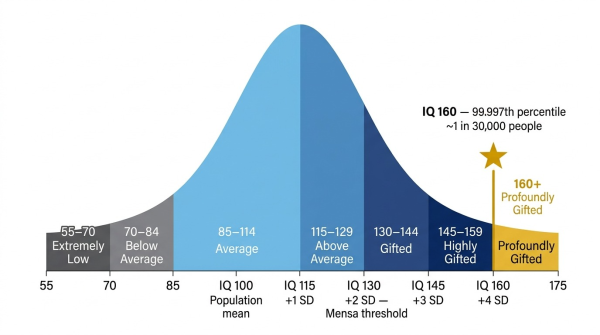
IQ 160 in Numbers: How Rare Is It?
| Metric | Value at IQ 160 |
| Standard deviations above mean | 4.0 SD |
| Percentile | 99.997th |
| Frequency in general population | ~1 in 30,000 |
| In a city of 3 million | ~100 people |
| In the United States (~335M) | ~11,000 people |
| Globally (~8B) | ~267,000 people |
| Wechsler classification | Profoundly Gifted |
| Above Mensa threshold (IQ 132) by | 28 points |
For comparison: the Mensa threshold of IQ 132 represents the top 2% of the population — approximately 1 in 50 people. IQ 146 corresponds to the Triple Nine Society's top 0.1% threshold (1 in 1,000). IQ 160 at 1 in 30,000 is more than 600 times rarer than Mensa eligibility. To put it concretely: in a school of 500 children, you would expect to find 10 who qualify for Mensa — and zero who score at IQ 160.
For the full context of how IQ 160 fits into the distribution, see our guide on the IQ scale explained. For a comparison with adjacent scores, see our guides on IQ 145 and IQ 150.
The Measurement Problem: Why IQ 160 Is at the Edge of the Clinical Scale
A crucial technical fact about IQ 160 that most popular articles overlook: it is approximately the effective ceiling of the Wechsler Adult Intelligence Scale (WAIS) and the current Stanford-Binet.
The reason is statistical. IQ tests are calibrated against the population — to produce reliable scores at a given level, the test needs enough people at that level in its normative sample to establish meaningful statistical anchors. At IQ 160, the expected frequency is 1 in 30,000. Producing a nationally representative normative sample large enough to reliably discriminate between, say, IQ 160 and IQ 175 would require a sample of several million people — far beyond what any test publisher has administered in standardised conditions.
As a result, clinical psychologists are generally cautious about IQ estimates above 155–160 from standard instruments. The scores can be produced mathematically from raw performance, but their precision is lower than scores in the average-to-gifted range. This is why serious psychometricians (like Dr. Russell T. Warne at RiotIQ) are sceptical of very specific high IQ claims — a test that reports "IQ 172" or "IQ 185" is extrapolating beyond its validated range.
This technical limitation is important for understanding the celebrity IQ claims you will encounter on this site and elsewhere. When we say Bill Gates has an estimated IQ of ~157–160, that estimate is consistent with the upper end of what clinical assessment can reliably confirm. When sources claim historical figures had IQs of 200, 225, or 300, those numbers involve different methodologies (childhood ratio IQs, historiometric estimation, high-range tests) that cannot be directly compared to clinical adult assessments. For a full explanation, see our guide on the highest IQ of all time.
The Cognitive Profile at IQ 160
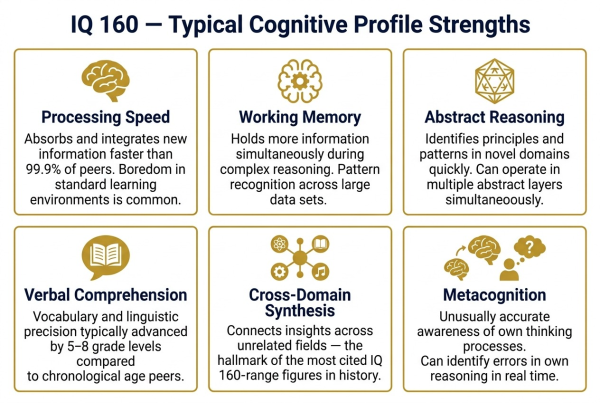
IQ 160 does not produce a single uniform cognitive experience. Different people at this level have different cognitive profiles — high scores on all major cognitive factors, or extraordinarily high on some and less extreme on others. However, research on profoundly gifted individuals (those in the top 0.1% and above) consistently identifies several characteristic cognitive features:
Exceptional Processing Speed
Information is absorbed and integrated unusually fast. This manifests in childhood as completing assignments rapidly, in academic settings as reading and retaining material after a single exposure, and in professional settings as understanding complex systems or arguments faster than colleagues with typical or even above-average IQ. Paradoxically, this speed can create problems — standard educational pacing designed for average learners provides so little challenge that boredom, disengagement, and underachievement become risks.
Superior Working Memory
Working memory — the ability to hold multiple pieces of information in mind simultaneously while performing complex operations — is strongly correlated with general intelligence and predictive of academic and professional performance. At IQ 160, working memory capacity allows for the maintenance and manipulation of significantly more complex cognitive structures than the average person can sustain. This underlies the ability to track multiple variables in a complex problem, to maintain awareness of multiple layers of argument simultaneously, and to identify interactions between components of a system that a person with average working memory would need to address sequentially.
Advanced Verbal Comprehension
Vocabulary, reading comprehension, and linguistic precision are typically advanced by several grade levels compared to chronological age. This can create social difficulties in childhood — a 10-year-old reasoning at the 18-year-old level does not share the conversational interests or the emotional concerns of same-age peers — and professional advantages in adulthood, where precision in communication is broadly valuable.
Cross-Domain Pattern Recognition
The ability to recognise that a pattern in one domain applies in another — to see that a problem in biology has the same underlying structure as a problem in economics — is one of the most distinctive features of very high IQ. This is the cognitive operation that underlies many of history's most celebrated intellectual breakthroughs: Darwin seeing that Malthusian population theory applied to natural variation; Steve Jobs seeing that calligraphy principles applied to computer typography. At IQ 160, this cross-domain transfer operates fluidly and automatically in ways that require deliberate effort at lower cognitive levels.
The Real-World Challenges: What Research Documents
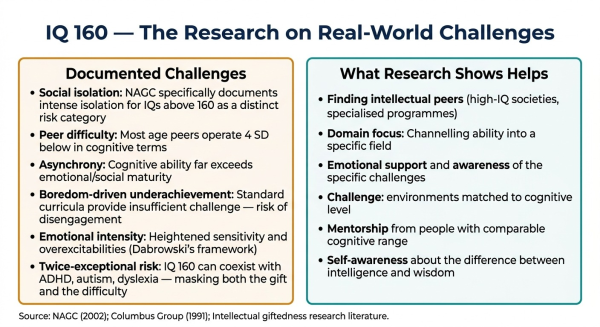
The popular narrative about very high IQ focuses almost exclusively on advantages. The research literature tells a more nuanced story — one that includes specific, documented challenges that are particularly intense at IQ 160 and above.
Social Isolation
The National Association for Gifted Children (NAGC) specifically documents "intense social isolation and stress" as a distinct risk category for individuals with IQs above 160 — singling out this level as qualitatively different even from the already-challenging experience of high giftedness. The reason is simple arithmetic: at IQ 160, approximately 1 in 30,000 people share the cognitive level. Most environments — schools, workplaces, social groups — will not contain any such peers. Social connection with same-age cognitive peers, which most people take for granted, is genuinely rare for someone at this level.
Asynchronous Development
The Columbus Group (1991) defined giftedness as "asynchronous development in which advanced cognitive abilities and heightened intensity combine to create inner experiences and awareness that are qualitatively different from the norm." This asynchrony is particularly pronounced at IQ 160 and above: a child may reason at an adult level while experiencing emotions at an age-appropriate level, creating internal contradictions that neither the child nor the adults around them know how to navigate.
Twice-Exceptionality
Research on the twice-exceptional (2e) population — individuals who are simultaneously gifted and neurodivergent — consistently finds higher than expected co-occurrence of very high IQ with ADHD, autism spectrum conditions, and learning disabilities. At IQ 160, the cognitive gifts can mask the difficulties (allowing a gifted autistic child to perform adequately in standard settings despite significant challenges) or the difficulties can mask the gifts (a gifted dyslexic child whose difficulties obscure their reasoning ability). Recognition and appropriate support for both dimensions is often delayed or absent. For more on this intersection, see our guide on multiple intelligences.
The IQ-Wisdom Gap
Research on profoundly gifted adults consistently finds that high IQ does not automatically produce high wisdom, good judgment in human relationships, or the emotional regulation skills needed for effective adult functioning. Isaac Newton — estimated IQ 190 — spent 30 years on alchemy and pursued vendettas against rivals with obsessive persistence. Chris Langan — IQ 195–210 — lacked the practical social intelligence to negotiate a class schedule change. Analytical intelligence and practical wisdom are different cognitive capacities, and very high IQ does not guarantee either emotional intelligence or the ability to navigate social and institutional systems. For more on this distinction, see our guide on IQ vs EQ.
What IQ 160 Predicts — and What It Doesn't
The research on very high IQ and life outcomes provides a clearer picture than popular accounts suggest:
What IQ 160 Predicts Well
- Academic performance — IQ at this level almost universally predicts exceptional academic performance when the environment is appropriately challenging. The SMPY (Study of Mathematically Precocious Youth) longitudinal study found that individuals in the top 0.01% of cognitive ability at age 12 went on to produce PhDs, patents, publications, and professional achievements at rates dramatically above those of the already-gifted top 1%
- Complex problem-solving speed — novel technical, mathematical, and analytical problems are solved faster and with higher accuracy
- Learning rate — new domains are mastered faster, making career transitions and self-directed learning unusually efficient
What IQ 160 Does Not Reliably Predict
- Happiness — research shows no simple positive relationship between IQ above 120–130 and life satisfaction or wellbeing. At very high levels, IQ can create challenges that reduce wellbeing without the commensurate advantages that motivate conventional achievement
- Financial success — above approximately IQ 120–130, incremental IQ points explain diminishing variance in income outcomes. Motivation, conscientiousness, and social skills explain more of the remaining variance. See our guide on IQ and income
- Creative genius — exceptional creative output (in art, music, literature, or science) requires IQ sufficient to master a domain — typically 120–130 — but above that level, domain expertise, intrinsic motivation, and personality traits like openness to experience explain more of the variance in creative achievement than additional IQ
- Good judgment in relationships and life decisions — emotional intelligence, social intelligence, and wisdom are independent capacities, not functions of analytical IQ
As Warren Buffett — estimated IQ ~155 — has put it: "Investing is not a game where the guy with the 160 IQ beats the guy with the 130 IQ." Above a cognitive threshold sufficient for the task, the variables that matter most shift from analytical intelligence to character, discipline, and emotional regulation.
Famous People With IQ Around 160
IQ 160 is most commonly cited as the estimate for several well-known public figures. In all cases, these are estimates without verified clinical test records — the specific numbers are inferences from documented achievements and academic records:
- Albert Einstein (~160) — retroactive estimate; never took a standardised IQ test
- Bill Gates (~157–160) — estimated from SAT 1590/1600 and Harvard Mathematics performance
- Steve Jobs (~160) — derived from a 4th-grade school test scoring at high school sophomore level
- Dolph Lundgren (~160) — supported by Sydney MSc Chemical Engineering and MIT Fulbright Scholarship
- Ashton Kutcher (~160) — based on biochemical engineering enrollment and VC investment performance
Historical figures with estimates in the IQ 160 range or slightly above include Charles Darwin (~165, Cox 1926), and Marie Curie (~185) and Isaac Newton (~190, or ~168–170 Flynn-adjusted) for the highest academic estimates. Explore more in our full Celebrity IQ database.
IQ 160 and High-IQ Societies
An IQ of 160 qualifies for every major high-IQ society currently in existence:
| Society | IQ Threshold | Percentile | IQ 160 Eligible? |
| Mensa International | ~132 | Top 2% | ✅ Yes |
| Intertel | ~137 | Top 1% | ✅ Yes |
| Triple Nine Society | ~146 | Top 0.1% | ✅ Yes |
| Prometheus Society | ~164 | Top 0.003% | ✅ Yes (marginally) |
| Mega Society | ~176 | Top 0.0001% | ❌ No — below threshold |
For more on high-IQ societies and their membership requirements, see our guides on high-IQ societies and what is Mensa.
Should You Care About Your IQ Score?
IQ scores — at any level — are best understood as a measure of specific cognitive capacities at a specific moment in time, not as a fixed measure of a person's worth or potential. An IQ of 160, if accurately measured, tells you something real and useful about how your mind processes analytical information. It does not tell you whether you will be happy, whether you will achieve what matters to you, whether you will be kind or wise or good to the people you love.
The most consistent finding in the research on very high IQ is that above approximately 120–130, the incremental predictive value of additional IQ points decreases substantially, while the importance of non-cognitive factors — motivation, emotional regulation, conscientiousness, social skills, and the wisdom to deploy analytical ability effectively — increases. Darwin beat his estimated IQ of 165 through five cognitive habits, not through five additional IQ points. Chris Langan, with the highest publicly tested IQ in history, spent 20 years as a bouncer.
The number is real. What you do with it is not predetermined.
IQ 160 places you at the 99.997th percentile — roughly 1 in 30,000 people. It sits at the effective ceiling of clinical IQ assessment and represents extraordinary analytical capacity that predicts exceptional academic and professional performance in appropriately challenging environments. It also brings specific documented challenges: social isolation, asynchronous development, and the IQ-wisdom gap that no test has ever been able to measure. The number is the beginning of understanding, not the end.
Find out where you sit on the IQ scale with our free IQ test — no registration required, results in under 20 minutes. For adjacent scores, see our guides on IQ 145, IQ 150, and IQ 140. For how this level compares to the very highest estimates in history, see our guide on the highest IQ of all time.
Frequently Asked Questions
What does an IQ of 160 mean?
An IQ of 160 falls in the Profoundly Gifted range — approximately the 99.997th percentile, corresponding to roughly 1 in 30,000 people. It represents 4 standard deviations above the population mean (SD = 15) and sits at approximately the ceiling of what clinical adult IQ tests can reliably measure. It indicates exceptional analytical, abstract reasoning, verbal comprehension, and working memory capacity.
How rare is an IQ of 160?
IQ 160 is extremely rare: approximately 1 in 30,000 people in the general population. In the entire United States, approximately 10,000–11,000 people would be expected to score at this level. Globally, approximately 267,000 people. In a school of 500 children, you would expect zero students at this level.
Is IQ 160 considered genius?
Yes — IQ 160 far exceeds most definitions of the "genius" threshold. Most frameworks identify genius-level intelligence beginning at IQ 140 or above. IQ 160 exceeds this threshold by 20 points, corresponding to a rarity 50–100 times greater than the minimum genius definition. However, genius-level outcomes require more than IQ — motivation, domain focus, opportunity, and emotional regulation all contribute significantly.
Which celebrities have an IQ of 160?
Notable figures with IQ estimates around 160 include Albert Einstein (~160), Bill Gates (~157–160), Steve Jobs (~160), Dolph Lundgren (~160), and Ashton Kutcher (~160). All figures are estimates without verified clinical test records.
What are the real-world challenges of IQ 160?
Research specifically documents intense social isolation as a distinct risk for IQs above 160 (NAGC, 2002). Additional challenges include: asynchronous development (cognitive ability far ahead of emotional maturity), difficulty finding intellectual peers, boredom-driven underachievement in standard environments, emotional intensity and heightened sensitivity, and the twice-exceptional intersection where IQ 160 can co-occur with ADHD, autism, or learning disabilities.

Comments
Share Your Thoughts