The phrase "genius threshold" appears constantly in popular writing about intelligence. The idea is simple: IQ 140 is the point at which a person crosses from merely very smart into genius territory. Dozens of celebrity IQ claims use it as a reference point. Shakira reportedly confirmed her 140 IQ on Jimmy Kimmel as evidence of Mensa eligibility. Napoleon Bonaparte is placed at exactly 140 in Catharine Cox's 1926 study. The threshold appears so often it feels like a natural law of cognitive science.
It is not. The "IQ 140 = genius" label originated from a single researcher's practical decision in 1916 — Lewis Terman's choice to use 140 as a convenient cutoff for his landmark longitudinal study of gifted children. No modern psychometric organisation uses "genius" as a formal diagnostic label. The Wechsler Adult Intelligence Scale — the most widely used clinical IQ assessment — classifies scores above 130 as "Very Superior" or "Extremely High" and stops there. The word genius does not appear in its technical manual.
This does not mean IQ 140 is unimportant. An IQ of 140 corresponds to approximately the 99.6th percentile — roughly 1 in 261 people. It is genuinely rare, genuinely predictive of exceptional academic and professional performance in demanding fields, and genuinely associated with a specific set of cognitive advantages. What it is not is a magic threshold after which a person automatically becomes a genius. This guide examines what the research actually says.
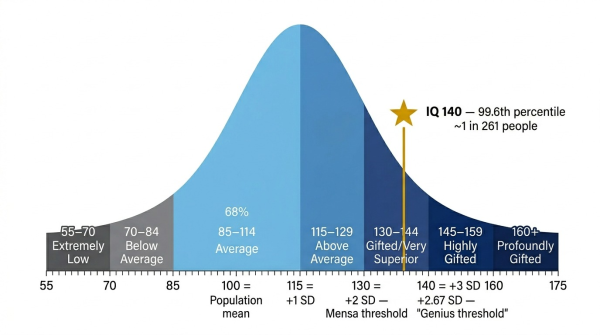
IQ 140 in Numbers: The Statistics
| Metric | Value at IQ 140 |
| Standard deviations above mean | 2.67 SD |
| Percentile | ~99.6th |
| Frequency in general population | ~1 in 261 |
| In a city of 1 million | ~3,800 people |
| In the United States (~335M) | ~1.3 million people |
| Wechsler classification | Very Superior / Gifted |
| Above Mensa threshold (IQ 132) by | 8 points |
| Below IQ 160 (1 in 30,000) by | 20 points |
The comparison between IQ 140 and adjacent scores is worth pausing on. IQ 130 — the Mensa threshold — corresponds to approximately 1 in 50 people (98th percentile). IQ 140 at 1 in 261 is roughly five times rarer. IQ 150 at approximately 1 in 2,330 is nine times rarer than IQ 140. And IQ 160 at 1 in 30,000 is more than 100 times rarer. The normal distribution concentrates most people near the centre and drops off sharply in the tails — each 10-point increment above 130 represents a meaningful and non-linear jump in rarity.
For adjacent score comparisons, see our guides on IQ 145, IQ 150, and IQ 160. For the full context, see our IQ scale explained.
The History of the "Genius Threshold" Label
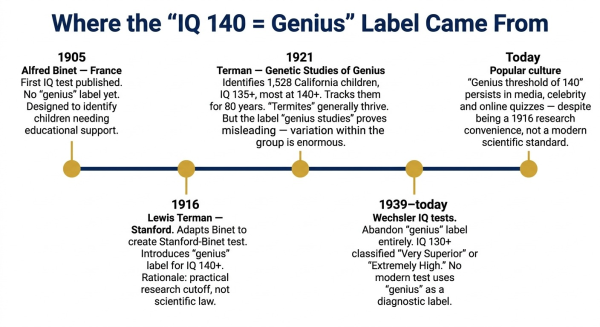
The label "genius" for IQ 140 has a specific and traceable origin. In 1916, Lewis Terman of Stanford University published the Stanford-Binet Intelligence Scale — his adaptation of Alfred Binet's original test for American use. In his classification system, Terman applied the label "genius or near genius" to scores of 140 and above. This was a classification decision, not a scientific finding — Terman drew the line at 140 because it represented the top tier of his normative sample in a way that made the label feel appropriate.
In 1921, Terman launched what became the most famous long-term study in psychology: the Genetic Studies of Genius. He identified 1,528 children in California with IQs of 135 or above — most at 140 or higher — and followed their lives for over 80 years. The participants became known as the "Termites." His choice of 140 as his effective cutoff cemented the association between that specific number and the genius concept in both scientific and popular consciousness.
The problem is that subsequent generations of test developers did not maintain this label. The Wechsler Intelligence Scales — which supplanted the Stanford-Binet as the clinical standard for adult assessment in the mid-20th century — classify scores above 130 as "Very Superior" or (in the most recent version) "Extremely High." The word genius does not appear. The modern Stanford-Binet 5 similarly uses "Very Advanced" as its highest label for gifted scores. As Dr. Russell T. Warne at RiotIQ and others have noted: "Any cutoff point will be arbitrary. There is no natural break point that serves as a dividing line between 'genius' and 'non-genius' scores."
The "genius threshold at 140" survives as cultural residue from a 1916 classification choice — useful as a rough reference point, but not a scientific boundary. For more on how IQ labels work, see our guide on what IQ actually measures.
What Terman's Termites Actually Found
The Genetic Studies of Genius is the most comprehensive long-term study of high-IQ individuals ever conducted, and its results are both encouraging and sobering. The 1,528 "Termites" were tracked through 80+ years of follow-up surveys and interviews. The headline findings were positive:
- Over 90% married and more than 80% had children — comparable to the general population
- Well over half completed university degrees at a time when only approximately 8% of Americans did so
- They remained healthier than the general population through middle age and beyond, with lower rates of mental illness than the prevailing stereotype of "troubled genius" predicted
- They achieved professional success at significantly higher rates than the general population — academics, scientists, lawyers, doctors, and business leaders were over-represented
- Their children and grandchildren showed above-average IQ and achievement, consistent with the heritability of intelligence
These findings dismantled the popular myth that gifted children were socially maladjusted, physically weak, or emotionally unstable. The Termites were, on average, healthier and better-adjusted than their peers.
But within the group, variation was enormous. Some became Nobel-level scientists. Others led entirely ordinary lives. Some experienced significant failures, divorces, and career disappointments. High IQ predicted better-than-average outcomes on average — it did not guarantee exceptional achievement for any individual. The most famous illustration: the study initially excluded two California children whose childhood IQs fell just below Terman's 140 cutoff — William Shockley (who went on to win the Nobel Prize in Physics for co-inventing the transistor) and Luis Alvarez (who won the Nobel Prize in Physics for his work in particle physics). Both were excluded from the "Genetic Studies of Genius" for not being intelligent enough.
What IQ 140 Does and Doesn't Predict
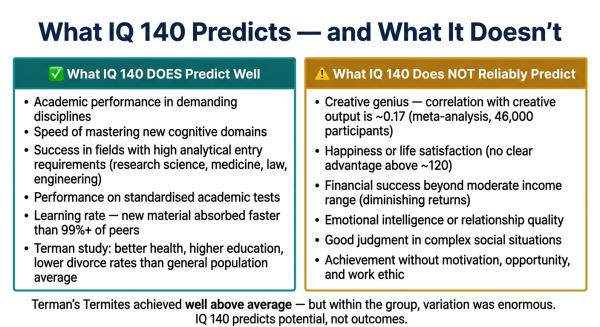
The research evidence on what IQ 140 actually predicts is more nuanced than the "genius threshold" label suggests:
What IQ 140 Predicts Well
Academic performance in demanding disciplines. IQ 140 is highly predictive of exceptional performance in fields with high analytical entry requirements — mathematics, theoretical physics, medicine, law, and research science. Vanderbilt University's SMPY (Study of Mathematically Precocious Youth) longitudinal research has shown that individuals in the top 0.1% of cognitive ability at age 12 produce PhDs, patents, and professional achievements at dramatically higher rates than even the already-gifted top 1%.
Learning rate. New material in complex domains is mastered faster at IQ 140 than at lower IQ levels. This advantage compounds over time — a person who absorbs new information 50% faster than the average person will, over a career, build a substantially deeper and broader knowledge base in the same number of working hours.
Occupational complexity. Research consistently shows that IQ is the best single predictor of performance in cognitively complex jobs — military officer roles, research positions, senior management, and professional practice. At IQ 140, essentially all occupational cognitive demands fall comfortably within the individual's capacity.
What IQ 140 Does Not Reliably Predict
Creative genius. The correlation between IQ and creative output is positive but surprisingly modest. A meta-analysis of nearly 46,000 participants found a correlation of approximately 0.17 between IQ and creative achievement. Above approximately IQ 120, domain expertise, intrinsic motivation, openness to experience, and persistence explain far more variance in creative output than additional IQ points.
Happiness. Multiple studies have found no significant positive relationship between IQ scores above approximately 120–130 and reported wellbeing or life satisfaction. At very high IQ levels, the social isolation associated with cognitive mismatch can actually reduce wellbeing in the absence of appropriate environments and peers.
Financial success above a moderate threshold. IQ predicts income up to a point — roughly to a comfortable professional salary. Above that threshold, personality traits (conscientiousness, extraversion in client-facing roles), risk tolerance, social connections, and luck explain substantially more variance than additional IQ. As Warren Buffett has noted, above IQ 130, temperament matters more than intelligence for investment outcomes.
For more on these distinctions, see our guides on IQ vs EQ, IQ and income, and IQ vs creativity.
IQ 140 and the Cognitive Experience
What does IQ 140 actually feel like from the inside? While individual variation is significant, several cognitive characteristics appear consistently in research on individuals at this level:
Rapid information absorption. New concepts in familiar and unfamiliar domains are grasped quickly, often after a single explanation or reading. Standard educational pacing — designed for the 50th to 75th percentile — can feel significantly slower than comfortable, creating boredom and sometimes the counterproductive pattern of disengaging from material that is too easy to engage.
Awareness of complexity others miss. At IQ 140, conversations and arguments that peers find satisfyingly complete often appear incomplete or question-begging. This can create the social experience of feeling that important things are being left unsaid — or the professional experience that obvious solutions are being overlooked by otherwise competent colleagues.
Facility with abstraction. Abstract concepts — mathematical structures, logical relationships, systemic patterns — that require significant cognitive effort at lower IQ levels feel more naturally navigable. This underlies the advantage in domains like mathematics, philosophy, law, and theoretical science.
The peer problem. In most everyday environments — schools designed for the average student, workplaces staffed at typical IQ distributions — individuals at IQ 140 are significantly cognitively ahead of the majority of their peers. This is rarely experienced as triumphant; more often it is experienced as isolation, difficulty connecting with age peers, and the chronic frustration of environments that do not provide adequate challenge. For parents navigating this for children, see our guide on gifted vs high achiever.
Notable Figures With IQ Estimates Around 140
Several notable public figures have IQ estimates in or around the 140 range. It is worth noting that IQ 140 as the "genius threshold" makes it a magnetically attractive number for celebrity IQ claims — many figures end up cited at exactly 140 without clear methodological basis:
- Napoleon Bonaparte (~140–145) — Catharine Cox's 1926 study placed him at approximately 140, the lowest estimate of any major military or political genius in the sample — yet he won 48 of 60 battles and his legal code is still in force
- Shakira (~140) — self-confirmed on Jimmy Kimmel; the original Mensa claim in the 2013 HuffPost article was denied by Mensa itself
- Kim Kardashian — IQ unknown; cited online as anywhere from 95 to 190; baby bar exam passage suggests above average but no verified score
- Charles Darwin (~165) — significantly above 140, but described himself as "mediocre" — demonstrating that achievement at IQ 140+ depends heavily on cognitive habits, not just the number
The range of outcomes among these figures illustrates the central truth about IQ 140: it is a real and meaningful cognitive threshold, but the outcomes of people who share it vary enormously. Napoleon built an empire and wrote a legal code still used today. Darwin overperformed his own IQ through decades of patient evidence accumulation. The number creates potential; what happens with it depends on character, focus, circumstance, and will. Explore more in our full Celebrity IQ database.
IQ 140 and High-IQ Societies
An IQ of 140 qualifies for Mensa (threshold ~132) with considerable room to spare, and for most intermediate high-IQ societies. The key thresholds:
| Society | IQ Threshold | Percentile | IQ 140 Eligible? |
| Mensa International | ~132 | Top 2% | ✅ Yes |
| Intertel | ~137 | Top 1% | ✅ Yes |
| Triple Nine Society | ~146 | Top 0.1% | ❌ Below threshold |
| Prometheus Society | ~164 | Top 0.003% | ❌ Below threshold |
IQ 140 clears Mensa and Intertel. It does not reach the Triple Nine Society's threshold of approximately 146. This is a useful reminder that "genius threshold" language somewhat overstates the rarity of IQ 140 — it is rare enough to qualify for the two most accessible high-IQ societies, but well below the thresholds that require one-in-a-thousand or one-in-ten-thousand rarity. For more information, see our guide on high-IQ societies.
The Myths About IQ 140 — Debunked
Myth: IQ 140 means you are automatically a genius. The label is a 1916 research convenience, not a scientific fact. No modern psychometric test uses the word "genius." IQ 140 indicates exceptional analytical ability; creative genius requires additional factors that no IQ test measures.
Myth: You'll be the smartest person in every room. In most everyday settings — yes. In selective environments (top research universities, specialised technical laboratories, elite graduate programmes), the average IQ can be significantly above 130, making IQ 140 comparatively much less exceptional. Percentile figures are population-wide; within a selected group, the distribution shifts.
Myth: IQ 140 guarantees career success. Terman's Termites showed wide variation in outcomes despite all having IQs above 135. IQ predicts academic performance and success in cognitively demanding fields; it predicts career outcomes far less perfectly, with motivation, conscientiousness, social skills, and opportunity explaining substantial additional variance.
Myth: An online test score of 140 is the same as a clinical score of 140. It is not. Online IQ tests vary enormously in quality, norming procedures, and validity. Many inflate scores systematically to produce results that feel satisfying. A clinical IQ assessment administered by a licensed psychologist using standardised instruments (WAIS-IV, Stanford-Binet 5) is the only reliable way to obtain an IQ score that can meaningfully be compared to population norms. See our guide on how accurate are IQ tests?
IQ 140 is genuinely rare — approximately 1 in 261 people. It is genuinely predictive of exceptional performance in analytically demanding environments. It is genuinely the boundary Lewis Terman called the "genius threshold" in 1916, and that label has stuck through popular culture for over a century. What it is not is a guarantee of genius-level achievement, happiness, wisdom, or social success. The research on 1,528 Termites followed for 80 years shows that IQ 140 predicts an above-average life — not an automatically exceptional one. The exceptional ones, in Terman's sample and out of it, were the ones who did something with it.
Find out where you sit on the scale with our free IQ test — no registration required, results in under 20 minutes. For adjacent scores, see our guides on IQ 145, IQ 150, and IQ 160. For broader context on what IQ scores mean, see our IQ scale explained.
Frequently Asked Questions
What does an IQ of 140 mean?
An IQ of 140 falls in the Very Superior or Gifted range on the Wechsler scale, corresponding to approximately the 99.6th percentile — roughly 1 in 261 people. It is 2.67 standard deviations above the population mean of 100. It is commonly called the "genius threshold" — a label that originates from Lewis Terman's 1916 research classification, not from any modern psychometric standard.
How rare is an IQ of 140?
IQ 140 corresponds to approximately 1 in 261 people — about 0.38% of the population. In a city of 1 million people, roughly 3,800 people would be expected to score at or above this level. In the United States, approximately 1.3 million people would be expected to score at IQ 140 or higher.
Why is IQ 140 called the genius threshold?
The label originates from Lewis Terman's 1916 Stanford-Binet classification, which applied the label "genius or near genius" to scores of 140 and above. Terman then used 140 as the effective cutoff for his landmark Genetic Studies of Genius (1921). No modern psychometric test uses "genius" as a formal diagnostic label — the Wechsler scales classify scores above 130 as "Very Superior" or "Extremely High."
What did Terman's study find about people with IQ 140+?
Terman's 1,528 high-IQ Termites were generally healthier, better educated, and more professionally successful than the general population average. But variation within the group was enormous — high IQ did not guarantee exceptional achievement for any individual. Most famously, the study excluded William Shockley and Luis Alvarez — both future Nobel Prize winners in Physics — whose childhood IQs fell below the 140 cutoff.
What careers are associated with IQ 140?
IQ 140 is associated with success in highly demanding fields including research science, medicine, law, engineering (particularly research roles), theoretical mathematics, philosophy, and senior strategic leadership. However, IQ 140 individuals are found across virtually all career paths — the association with demanding fields reflects probability, not exclusivity. Motivation, conscientiousness, social skills, and opportunity all contribute substantially to career outcomes beyond IQ.

Comments
Share Your Thoughts