The question “IQ of men vs women” has been debated for decades. Many wonder: are men smarter than women, or vice versa? In this article, we delve into the scientific evidence — what studies show about average scores, variability, cognitive strengths, and the factors that drive apparent gender differences in IQ. For readers unfamiliar with how IQ is measured, taking a modern IQ test can provide useful context before diving deeper.
What IQ Measures and Why Gender Comparison Matters
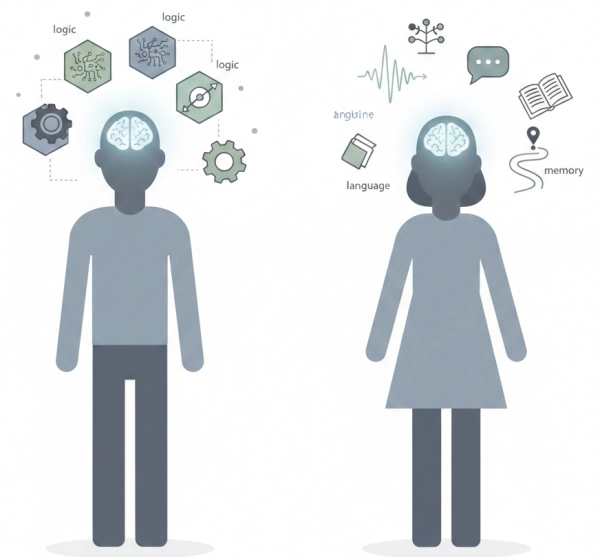
IQ, or Intelligence Quotient, is a standardized score designed to assess human intelligence through various cognitive domains such as logical reasoning, problem-solving, memory, and verbal comprehension. A clear explanation of how IQ works can be found in our complete guide to IQ. However, IQ is not a complete measure of intelligence — it does not account for emotional intelligence (EQ), creativity, social intelligence, or practical problem-solving skills. If you’re curious about non-IQ factors, exploring an EQ test can offer a broader perspective.
Historically, misconceptions about male and female intelligence have shaped educational opportunities and leadership roles. By examining IQ data scientifically, we can distinguish biological differences from cultural or environmental influences. In essence, exploring IQ differences between men and women is less about “who is smarter” and more about understanding how human intelligence develops and expresses itself under different conditions.
Average IQ Scores: Are There Gender Differences?
Modern science consistently shows that average IQ scores between men and women are nearly identical. To understand how different scores compare, you can review standardized interpretations in our IQ score rankings, or explore how specific IQ values are defined, such as IQ 110 or IQ 143. Research also suggests that when tests are redesigned to remove gender bias — like those used in culture-fair IQ testing — male and female averages become nearly identical. A comprehensive study published in Nature Reviews Neuroscience reinforces that while cognitive profiles can differ, overall IQ averages remain virtually the same. In summary, the best available evidence shows that men and women share equal cognitive potential, with differences in older data generally explained by environmental context, methodology, or cultural influence, not innate ability.
Variability: The “Greater Male Variability Hypothesis”
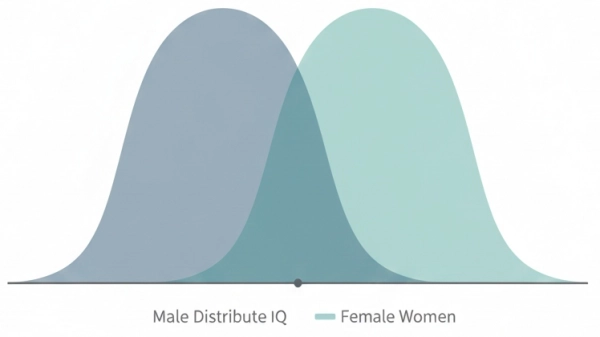
While the average IQ between men and women appears nearly identical, researchers have long debated whether men show greater variability in intelligence scores — meaning more men are found at both the highest and lowest ends of the IQ spectrum. This idea is known as the Greater Male Variability Hypothesis (GMVH). The hypothesis dates back to 19th-century psychology, with early observations suggesting that male performance was more “spread out” across the intelligence curve, whereas female performance tended to cluster closer to the mean. In statistical terms, men may have a wider standard deviation, leading to higher representation among both gifted individuals (IQ above 130) and those with intellectual disabilities (IQ below 70).
Modern studies provide mixed evidence. Some large-scale analyses, such as those by Johnson et al. (2008) and Deary et al. (2007), found slight male overrepresentation at the extremes. However, the differences are often small and vary significantly across cultures, educational systems, and test designs. Critics argue these findings might reflect environmental influences or testing bias rather than innate biology — boys are often encouraged to take risks and explore problem-solving activities (which may develop broader variability), while girls are sometimes socialized toward verbal and cooperative learning. Cross-cultural studies show that societies with greater gender equality tend to display less variability difference, suggesting social and educational environments play a major role. In summary, the greater male variability hypothesis remains intriguing but far from conclusive.
Cognitive Strengths: Differences in Specific Abilities

Even though average IQ scores are equal, men and women often demonstrate distinct cognitive profiles. These differences do not imply that one gender is more intelligent than the other; rather, they highlight how diverse brain development and learning experiences can shape performance.
1. Spatial and Mathematical Skills
Research often finds that men, on average, score higher on spatial reasoning, 3D visualisation, and certain mathematical problem-solving tasks. These skills are associated with brain regions related to spatial awareness and navigation. Evolutionary psychologists suggest this may stem from historical roles, though environmental training — such as exposure to engineering activities or sports — can also enhance spatial skills in both genders.
2. Verbal and Memory Abilities
Women tend to excel in verbal fluency, language comprehension, and episodic memory. MRI studies indicate that female brains often have more developed connectivity between hemispheres, enhancing communication and linguistic processing. This contributes to better social interaction, emotional expression, and multitasking abilities.
3. Emotional and Social Intelligence
Beyond cognitive metrics, women often outperform men in emotional intelligence (EQ) — the ability to perceive, understand, and regulate emotions. EQ is not part of standard IQ tests but plays a major role in leadership, communication, and interpersonal success.
4. Analytical and Systemising Tendencies
Some men exhibit stronger systemising skills — the ability to understand and predict systems or mechanical processes — which can lead to higher representation in fields such as physics, computer science, or engineering. Importantly, these differences represent averages, not absolutes. As neuroscientist Gina Rippon emphasises in The Gendered Brain (2019), cognitive differences between men and women are small, overlapping, and highly plastic — experience and environment can shape and even erase these gaps. Men and women may excel in different cognitive arenas, but these variations complement rather than compete.
Self-Perception and Gender Bias in IQ Estimation
Research consistently shows that men tend to overestimate their own intelligence, while women tend to underestimate theirs — even when their actual IQ scores are identical. A large-scale meta-analysis by Furnham et al. (2001) found that men, across various cultures, rated their own IQ an average of 5 to 10 points higher than women rated theirs. This discrepancy reflects differences in self-concept, social expectations, and gender conditioning rather than real ability. Men are often socialised to value confidence and assertiveness; women are frequently encouraged toward humility, which can lower self-assessment despite equal performance.
Such biases have real-world consequences: women may be less likely to apply for jobs requiring high cognitive skills even when qualified, while men may overestimate competence and take riskier decisions. As psychologist Adrian Furnham notes:
“There are no significant gender differences in actual IQ — only in how intelligence is perceived and expressed.”
Separating measurable cognitive performance from subjective self-belief helps prevent stereotypes and supports a more accurate understanding of human intelligence across genders.
The Role of Biology and Environment
The question of whether men or women are “smarter” cannot be answered by genetics alone. Intelligence results from a complex interplay between biological and environmental factors.
1. Biological Factors
Men tend to have slightly larger overall brain volume (even after adjusting for body size), while women often exhibit greater cortical thickness and denser white matter connectivity, enhancing communication between brain hemispheres. A 2014 paper in PNAS found that male brains showed more intra-hemispheric connections (optimised for motor and spatial skills), while female brains displayed more inter-hemispheric connectivity (supporting communication and memory). However, neuroscientists emphasise that size does not equal intelligence — efficiency, not volume, determines cognitive performance. MRI research shows both sexes use different brain regions to achieve similar IQ results, reinforcing the idea of cognitive equivalence through different neurological pathways.
2. Environmental Factors
While biology sets the framework, environment shapes the outcome. Access to quality education strongly correlates with higher IQ development in early childhood. Poor nutrition and stress during childhood can hinder brain growth. Societies that restrict educational or career opportunities for women often see lower average female IQ scores — not due to genetics, but limited exposure to cognitive challenges. And some traditional IQ tests may unintentionally favour culturally masculine skill sets like spatial reasoning. Numerous longitudinal studies confirm that environmental enrichment can significantly raise IQ, particularly during developmental years. In essence, genes may provide the blueprint, but experience, education, and motivation build the architecture of intelligence.
Implications for Education and Workplace
Understanding that average IQ levels between men and women are nearly identical — and that each gender may demonstrate different cognitive strengths — has important consequences for how we design education systems and workplace policies.
1. Education
Schools and universities should focus on developing individual strengths rather than perpetuating outdated beliefs about gender-based intelligence differences. While boys may often show stronger spatial reasoning, these can be improved in girls through targeted STEM education. Likewise, girls’ strengths in verbal and social reasoning can enhance collaborative learning across all genders. Research has shown that when social and environmental barriers are removed, the gender gap in math and science performance narrows significantly.
2. Workplace
In professional environments, recognising that cognitive potential is not determined by gender supports fair hiring, promotion, and leadership practices. Companies that emphasise diversity in thought, skill, and perspective often outperform those relying on biased models of talent. Training and mentorship programmes should address implicit gender biases — for example, assumptions that men are more analytical or women more empathetic. These stereotypes limit career growth and reduce innovation. For further reading on how IQ applies in professional contexts, see our articles on how recruiters use IQ tests and the culture-fair IQ test comparison.
3. Societal Impact
Recognising the equality of intellectual capacity between men and women encourages societies to challenge long-standing stereotypes. Such misconceptions can discourage women from pursuing leadership or STEM careers and equally restrict men from developing emotional intelligence or communication skills. The key lies in how opportunities, education quality, and cultural expectations shape intellectual development over time.
Final Thoughts
So, what is the answer to “IQ of men vs women”? The best evidence indicates no meaningful difference in average IQ between genders. Some differences exist in variability and specific cognitive abilities, but these do not translate into overall intellectual superiority of one gender. Gender differences in IQ are small or negligible, and more importantly, they are heavily influenced by environmental, educational, and cultural factors. Instead of focusing on which gender is smarter, the real question is how we create environments that allow everyone’s cognitive potential — regardless of gender — to flourish. Explore more evidence-based articles in our IQ Guides collection.
References
- Kanazawa, S., & Reyniers, D. J. (2009) – The role of height in the sex difference in intelligence.
- Irwing, P., Lynn, R., & Der, G. (2004) – Intelligence: is there a sex difference in IQ scores?

Comments
Share Your Thoughts