An IQ of 143 is one of the rarest cognitive profiles measurable on a standard intelligence test. But what does it actually mean — and is "genius" the right word for it? This guide gives you the precise statistics, the research-backed giftedness framework, the honest answer on the genius debate, and what this score realistically means for career, social life, and long-term outcomes. For broader context on all IQ ranges, see the IQ Scores guide.
IQ 143: The Exact Statistics
On the standard IQ scale (mean = 100, standard deviation = 15), a score of 143 sits 2.87 standard deviations above the population mean. That places you at the 99.83rd percentile — meaning you score higher than approximately 998 out of every 1,000 people tested. Roughly 1 in 500 people reach this level.
| IQ Score | Percentile | SD Above Mean | Rarity |
| 130 | 98th | +2.0 | 1 in 50 |
| 135 | 99th | +2.33 | 1 in 100 |
| 140 | 99.6th | +2.67 | 1 in 261 |
| 143 | 99.83rd | +2.87 | ~1 in 500 |
| 145 | 99.87th | +3.0 | 1 in 741 |
| 160 | 99.997th | +4.0 | 1 in 31,560 |
On the Wechsler scale (WAIS-IV), the formal classification at this level is Very Superior. In educational psychology, IQ 143 falls in what is typically called Exceptionally Gifted territory — a step above the Highly Gifted range (130–140) and just below the Profoundly Gifted threshold (~145+). To understand the full classification framework, read The IQ Scale Explained and the WAIS-IV complete guide.
Is IQ 143 "Genius"? The Honest Answer
The word "genius" appears constantly in discussions of high IQ — but here is the scientific reality: genius is not a formal psychometric classification. In the early 20th century, Lewis Terman used IQ 140+ as a threshold for "genius" in his Stanford studies. That definition has since been retired. Modern psychometrics does not include "genius" as an official IQ category.
Today, most researchers reserve the term "genius" for a combination of factors: extraordinary domain-specific ability, creative output that transforms a field, and demonstrable cultural or scientific impact — none of which can be measured by a single IQ test. By this definition, genius is behavioral, not statistical.
IQ 143 gives you the cognitive hardware to perform at genius-level. Whether that potential becomes genius-level output depends on direction, discipline, and the depth of engagement you bring to a specific domain.
What IQ 143 does tell you statistically: you are operating at a level of abstract reasoning, pattern recognition, and working memory that is measurably present in roughly 0.17% of the population. That is exceptional by any practical definition — regardless of what label you attach to it. For perspective on where some of history's most famous minds are estimated to have scored, see the highest IQ in history guide.
Dr. Ruf's Five Levels of Giftedness: Where IQ 143 Fits
One of the most useful frameworks for understanding scores in this range is Dr. Deborah Ruf's Five Levels of Gifted model, which maps IQ ranges to developmental patterns and educational needs. IQ 143 falls squarely in Level 4 — Exceptionally Gifted.
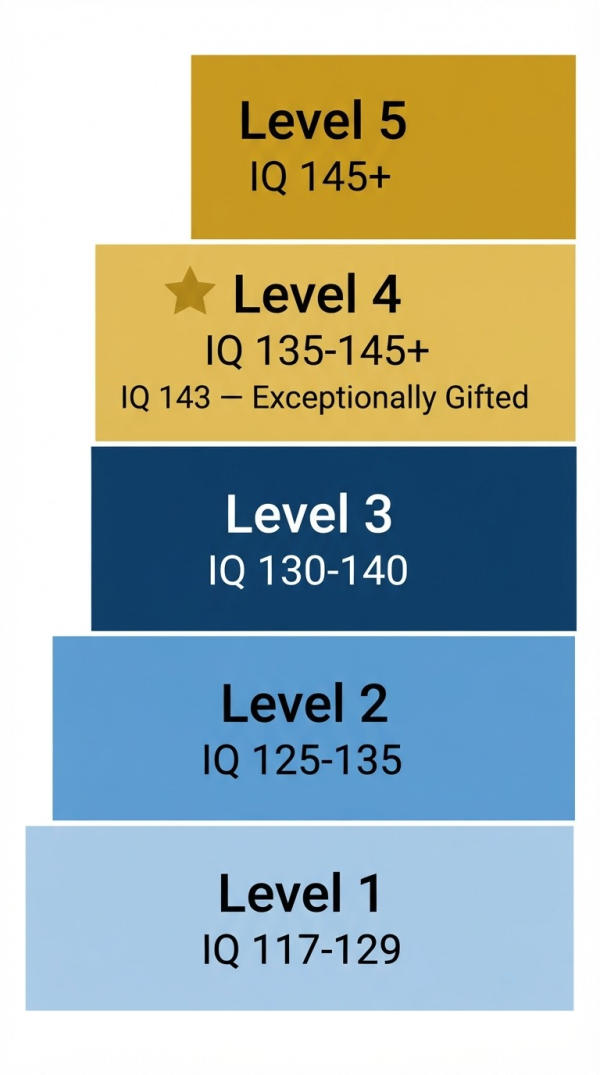
Key characteristics of Level 4 in Ruf's framework include:
- Mastery of most kindergarten academic skills by age 3–4
- Spontaneous reading before formal instruction
- Strong existential curiosity and concern for life's purpose from early elementary school
- Approximately 1–2 students at this level per grade level in a typical school system
- Often the only student of similar ability in a gifted program
This framework matters because it contextualizes why IQ 143 individuals often feel fundamentally different from even other "gifted" classmates — not just smarter, but cognitively operating at a categorically different pace and depth. To explore how giftedness manifests in children specifically, see signs of a gifted child and supporting gifted children after an IQ test.
High-IQ Society Eligibility at IQ 143
| Society | Percentile Required | ~IQ Threshold (SD-15) | IQ 143 Eligible? |
| Mensa International | 98th | 130 | ✔ Yes |
| Intertel | 99th | ~137 | ✔ Yes |
| Triple Nine Society | 99.9th | ~146 | Close — borderline |
| Mega Society | 99.9999th | ~176 | ✘ No |
IQ 143 comfortably qualifies for Mensa and Intertel. The Triple Nine Society (99.9th percentile) requires a score of approximately 146 on SD-15 tests, making IQ 143 borderline depending on test and measurement variance. Learn more in the What Is Mensa guide and the full High IQ Societies overview. If you want to challenge your score at this range, the High Range IQ Test is designed specifically for above-average cognitive profiles.
Cognitive Traits at IQ 143: What Research Shows
A score of 143 is not just "smarter" — it reflects a qualitatively different cognitive profile. Research on individuals in this range consistently identifies several distinguishing characteristics:
1. Extreme Processing Speed and Pattern Detection
People at this level absorb structural information in new domains almost intuitively — after minimal exposure they grasp not just the content but the underlying architecture of a system. This is measurably distinct from simply learning quickly: it is a different mode of information integration, driven by high working memory capacity and processing speed. See IQ and Memory for the research behind this.
2. Advanced Metacognition
Individuals at IQ 143 consistently evaluate and refine their own reasoning processes in real time. They notice logical errors in their own thinking before others point them out, model multiple competing hypotheses simultaneously, and adjust their cognitive approach based on ongoing self-assessment. This metacognitive sophistication is a key differentiator between Very Superior and High Average intelligence.
3. The Ceiling Effect Problem
Here is a nuance most articles skip: standard IQ tests are poorly calibrated at this score level. Most tests are normed for the general population, which means their "ceiling" — the maximum score the test can reliably distinguish — is often around 140–150. At IQ 143, you may be near the top of what the test can measure, which means your true cognitive range may be compressed or understated by the score itself. This is one reason high-range tests exist — they use more difficult items to spread out the top-end distribution. Explore this further in the guide on cognitive benchmarking.
4. Intense Curiosity With Existential Depth
Individuals at this level rarely find surface-level answers satisfying. They pursue topics to unusual depth, often across multiple domains simultaneously, and frequently experience what researchers describe as "overexcitability" — an intense psychological and intellectual reactivity to ideas, experiences, and moral questions. This is a strength and a challenge: it fuels mastery but can make ordinary environments feel chronically understimulating.
5. Perfectionism and the Competence Paradox
A well-documented pattern in highly gifted adults is the perception of being "not that smart" despite objectively exceptional performance. The mechanism is the same as described for IQ 132 — but intensified: because individuals at this level set extremely high internal standards and gravitate toward environments where everyone around them is also highly capable, their own abilities frequently feel unremarkable. This is not a psychological problem to fix — it is a calibration artifact of operating near the top of the cognitive distribution. Our IQ and mental health guide covers the research on this intersection.
Best Career Paths for IQ 143
At IQ 143, the primary career risk is not underperformance — it is chronic understimulation. Research on gifted adults consistently shows that highly intelligent individuals in low-complexity roles experience significantly higher rates of disengagement, burnout, and career dissatisfaction. The question is not "what can I do?" but "what will keep my mind genuinely challenged over the long term?"
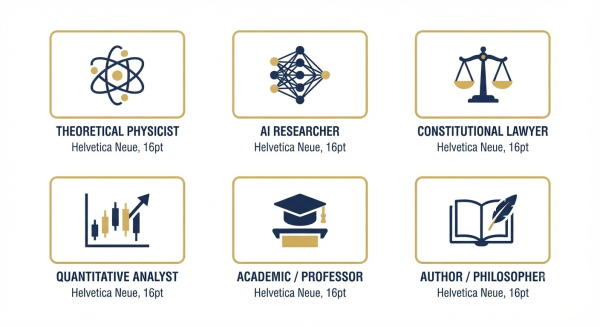
Research and Hard Sciences
- Theoretical Physicist / Mathematician: Abstract modeling, open-ended problems, no ceiling on complexity.
- AI / Machine Learning Researcher: Systems thinking, novel architecture design, rapidly evolving frontier. See IQ for software engineers.
- Neuroscientist / Cognitive Researcher: Deep theoretical and empirical complexity, direct intersection with intelligence itself.
Law, Strategy, and Finance
- Constitutional Lawyer / International Law: Multi-layered argumentation, high intellectual stakes, novel precedent-setting work.
- Quantitative Analyst / Hedge Fund Strategist: Mathematical modeling, probabilistic reasoning under uncertainty.
- Innovation Consultant / Systems Designer: Cross-domain synthesis, organizational complexity.
Academia and Philosophy
- University Professor / Research Fellow: Intellectual autonomy, long-form mastery, mentorship of future thinkers.
- Author / Philosopher: High-concept writing — scientific non-fiction, speculative fiction, ethical philosophy — where depth and originality are the product itself.
For more on matching score level to career access, see careers requiring IQ above 130, high IQ low EQ career pitfalls, and jobs for IQ 130–140. Also compare neighboring score profiles: IQ 138, IQ 140, and IQ 145.
The Social Experience at IQ 143
The social dimension of IQ 143 is one of the least discussed and most practically significant aspects of this score. Research on gifted adults documents a consistent pattern: the higher the IQ, the smaller the pool of people who naturally operate at the same cognitive pace. At IQ 143, that pool is roughly 0.17% of the population — meaning that in a random group of 600 people, you might find one other person at this level.
This does not mean gifted individuals lack social skills — research explicitly debunks that myth. What it does mean is that finding genuine intellectual peers requires deliberate effort. Most social environments are not calibrated for this level, which creates persistent mild friction: conversations that resolve too quickly, discussions that don't reach depth, and a sense of operating at reduced capacity in everyday interactions.
The practical solution is not to become isolated but to build selectively — research communities, specialized professional networks, or intellectual groups where depth and curiosity are the shared currency. Understanding your emotional profile alongside your cognitive one is also valuable: take the EQ Test, explore IQ vs EQ, and see how emotional intelligence and cognitive ability interact in the EQ vs IQ in the workplace guide.
IQ 143 and Neuroplasticity: Is This a Fixed Score?
No score is completely fixed. Research on neuroplasticity confirms that the brain continues adapting throughout adulthood based on the cognitive demands placed on it. The Flynn Effect — documented across dozens of countries over the 20th century — demonstrates that measured IQ at the population level rose substantially in response to environmental changes: better nutrition, expanded education, and more cognitively demanding daily environments. Read the full guide on The Flynn Effect for context.
At the individual level, IQ 143 reflects current performance on a standardized assessment — not a biological ceiling. Domain expertise, sleep, nutrition, and sustained cognitive challenge all influence test performance measurably. And as noted above, standard tests may already be understating the upper end of your range due to ceiling effects.
Frequently Asked Questions
What percentile is IQ 143?
IQ 143 corresponds to the 99.83rd percentile on the standard bell curve (mean = 100, SD = 15). It sits 2.87 standard deviations above the population mean — meaning approximately 1 in 500 people score at this level or above.
Is IQ 143 considered genius?
"Genius" is not a formal psychometric classification in modern psychology. Historically associated with IQ 140+, the term has been retired as a scientific label. IQ 143 is classified as Very Superior / Exceptionally Gifted — a top-0.2% score associated with extraordinary cognitive performance. Whether someone achieves "genius-level" outcomes depends on focus, persistence, and domain engagement — not IQ alone.
What high-IQ societies does IQ 143 qualify for?
IQ 143 comfortably qualifies for Mensa (98th percentile / IQ 130 threshold) and Intertel (99th percentile / ~IQ 137). It falls just short of the Triple Nine Society threshold (~99.9th percentile / IQ 146), making it borderline depending on test measurement variance. See the full High IQ Societies guide for details on each organization.
Why might someone with IQ 143 feel average or not particularly smart?
This is well-documented among exceptionally gifted adults. High internal standards, exposure to other high-performing environments, and a deep awareness of one's own knowledge gaps all contribute to a persistent sense of inadequacy. The mechanism is the same as described for lower gifted ranges — but amplified by the rarity of finding true intellectual peers. It is a calibration effect, not an accurate self-assessment.
What celebrities or historical figures had an IQ around 143?
Estimated historical IQ scores are reconstructed from biographical records and are inherently speculative. That said, IQ 143 is within ranges commonly cited for figures like Marie Curie, Leonardo da Vinci, and various modern scientists and philosophers. Explore the Celebrity IQ Database for detailed breakdowns — and the highest IQ in history guide for the most extreme documented scores.

Comments
Share Your Thoughts