The question "what is the IQ of a dolphin?" is one of the most searched intelligence questions on the internet — and one of the most fundamentally unanswerable, if answered literally.
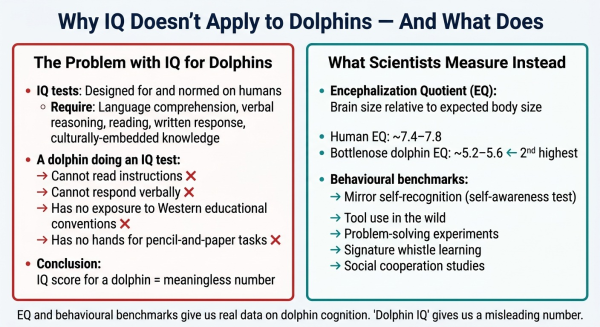
Dolphins don't have an IQ. Not because they aren't intelligent — they almost certainly are, by any reasonable definition of the word. But because IQ tests are measuring instruments designed by humans, for humans, calibrated against human populations. An IQ score has meaning only in relation to other IQ scores produced by the same instrument on the same population. Applying it to a bottlenose dolphin — who cannot read, cannot hold a pencil, cannot understand verbal instructions delivered in English, and has no exposure to Western educational conventions — produces a number so divorced from any meaningful comparison that it tells you nothing at all about the dolphin.
What science does have is something more interesting than a number: a detailed and surprising body of research on dolphin cognitive abilities that places dolphins among the most cognitively complex non-human animals ever studied. This article covers what that research actually shows.
Why You Can't Give a Dolphin an IQ Test
This is not a trivial point — it gets at something important about what IQ tests actually measure and why the question of "animal IQ" is inherently confused.
IQ tests measure specific cognitive abilities: verbal comprehension, perceptual reasoning, working memory, and processing speed, as assessed through tasks that require language comprehension, written response, abstract pattern recognition using human visual symbols, and culturally embedded knowledge. Every IQ test ever developed for humans was built around the assumption that the person taking it speaks a human language, has been educated in a human cultural context, and can receive and respond to instructions in a standardised format.
A dolphin lacks every one of these prerequisites. It cannot read the instructions. It cannot respond in writing or speech. It has no access to the culturally embedded knowledge that many IQ test items presuppose. And even its perceptual world — dominated by echolocation and 3D acoustic information processing — is so fundamentally different from the visual, language-dominated perceptual world that IQ tests assume, that a "score" derived from applying such a test would be meaningless in both directions: you couldn't conclude the dolphin was brilliant based on a high score any more than you could conclude it was limited based on a low one.
As one researcher puts it on Quora: "Comparing a dolphin's intelligence to a human IQ score is inherently approximate and metaphorical because IQ tests measure specific human cognitive abilities shaped by language, culture, and formal schooling."
What science uses instead is a combination of the Encephalization Quotient (EQ) and behavioural benchmarks from controlled experimental research. For more on what IQ tests do measure, see our guide on what IQ actually measures.
The Encephalization Quotient: The Best Proxy We Have
The Encephalization Quotient (EQ) measures an animal's brain size relative to what would be expected for an animal of its body size. A higher EQ indicates more brain tissue available for cognitive processing than the baseline metabolic and motor demands of the animal's body require. It is not a perfect measure of intelligence — it does not account for brain structure, neuron density, or connectivity — but it has been shown in multiple studies to correlate with cognitive abilities, and it gives a comparative framework that applies across species.
The EQ rankings for the most cognitively advanced species:
| Species | Approximate EQ | Rank |
| Humans | 7.4–7.8 | 1st (highest of any species) |
| Bottlenose dolphin | 5.2–5.6 | 2nd |
| Chimpanzee | ~3.0 | Among the highest primates |
| Orca (killer whale) | ~2.9 | High among cetaceans |
| Elephant | ~1.8–2.0 | High among land mammals |
| Crow / Raven | ~2.5 | Exceptionally high for birds |
The bottlenose dolphin's EQ of approximately 5.2–5.6 — second only to humans among all animals — is striking. It indicates that dolphins have substantially more brain tissue dedicated to cognitive processing than their body size would require for basic metabolic and motor function. A 2016 study from Michigan State University published in the Proceedings of the National Academy of Sciences confirmed experimentally that larger relative brain size in mammals does predict better problem-solving ability — providing empirical support for EQ as a proxy for cognitive capacity.
But EQ alone doesn't tell the full story. What researchers have learned from decades of behavioural experiments fills in the picture in remarkable detail.
What Dolphins Can Actually Do: The Research Evidence
Mirror Self-Recognition
The mirror self-recognition test is one of the most widely used measures of self-awareness in animal cognition research. An animal passes the test if it demonstrates that it understands a mirror image is a reflection of itself — typically evidenced by using the mirror to investigate marks placed on its own body that it cannot see directly.
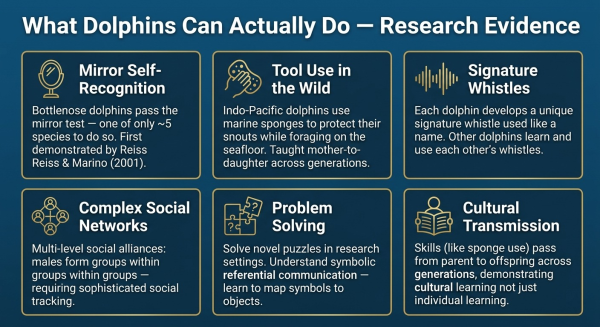
Bottlenose dolphins pass this test. Research by Diana Reiss and Lori Marino, published in 2001, demonstrated that bottlenose dolphins showed contingency testing (moving to investigate when they saw their reflection move), mirror-guided body inspection (using the mirror to examine parts of their own bodies they couldn't otherwise see), and marked interest in marks placed on their bodies. This places dolphins on the very short list of species showing mirror self-recognition: humans, great apes (chimpanzees, bonobos, orangutans, and gorillas), Asian elephants, and European magpies, in addition to dolphins.
Signature Whistles: The Closest Thing to a Name
Each bottlenose dolphin develops a unique signature whistle — a specific acoustic pattern used consistently as a self-identifier. Research has shown that dolphins not only produce their own signature whistles, but learn and reproduce other dolphins' whistles — using them apparently to address specific individuals. This is functionally analogous to the use of names in human communication: individual identifiers that other community members can use to address specific individuals rather than making generic contact calls. Signature whistles are learned (not genetically determined), suggesting a form of vocal learning that parallels how humans acquire names.
Tool Use in the Wild
Indo-Pacific bottlenose dolphins in Shark Bay, Western Australia, have been observed carrying marine sponges in their beaks while foraging on the seafloor. The sponge appears to protect their snouts from abrasive seafloor sediment and stinging invertebrates. What makes this remarkable is not the tool use itself but its cultural transmission: the sponge-using behaviour passes predominantly from mothers to daughters over multiple generations, without all members of the population adopting it. This is evidence of cultural learning — knowledge that is transmitted socially across generations rather than being genetically encoded.
Complex Social Networks
Male bottlenose dolphins in Shark Bay form a pattern of social alliance that has no clear parallel in any other non-human animal except humans. Males form alliances within alliances within alliances — what researchers call third-order alliances. To participate effectively in this social structure, an individual dolphin must track not just its own direct relationships, but the relationships between others and the relationships between groups. This requires the kind of sophisticated social cognition — what researchers call Machiavellian intelligence — that has been directly linked to neocortical size and cognitive complexity in primates.
Problem Solving and Symbolic Communication
In controlled experimental settings, dolphins have demonstrated the ability to understand artificial symbolic communication systems — mapping gestures or visual symbols to objects and actions, following instructions delivered through these symbolic systems, and generalising learned rules to novel problems. They understand pointing as a referential gesture (something only apes and dogs reliably do among non-human animals), and can follow instructions to perform actions on specific objects. They also demonstrate what researchers call "meta-cognitive" abilities — showing uncertainty responses when facing tasks they haven't been trained on, suggesting some awareness of what they do and do not know.
How Dolphin Intelligence Compares to Other Animals
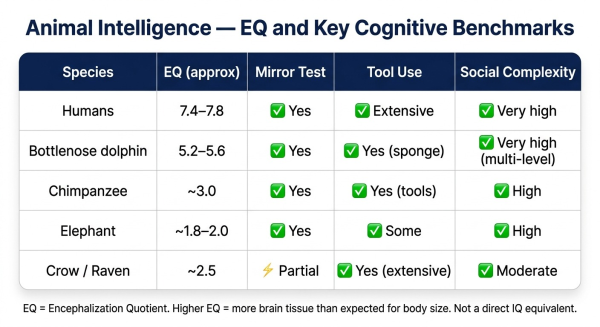
Placing dolphin intelligence in the broader animal cognition landscape reveals both the strengths and the limitations of any cross-species cognitive comparison:
Chimpanzees share approximately 98.7% of human DNA and demonstrate the cognitive profile closest to humans among non-human animals — including complex tool manufacture, symbolic communication, theory of mind (understanding that others have different mental states from their own), and extensive social learning. Where chimpanzees excel over dolphins is in manual dexterity and three-dimensional object manipulation. Where dolphins may equal or exceed chimpanzees is in social alliance complexity and acoustic learning.
Elephants pass the mirror test, demonstrate empathy and mourning behaviour, use tools, and show complex long-term memory for individuals. Their social structures — matriarchal herds with multi-generational knowledge transmission — have parallels with dolphin social complexity.
Corvids (crows and ravens) are the most cognitively sophisticated birds, demonstrating tool manufacture (New Caledonian crows), causal reasoning, future planning, and theory of mind elements that were previously thought to require primate-level neocortical development. Their high EQ relative to other birds (~2.5) reflects the apparent independence of cognitive complexity from body plan.
What the comparison reveals is a consistent finding from modern animal cognition research: high cognitive complexity has evolved independently in multiple lineages — mammals (primates, cetaceans, elephants), birds (corvids, parrots), and even invertebrates (octopuses). Intelligence is not a single ladder with humans at the top; it is a collection of cognitive capabilities that different species have developed in different combinations for different ecological reasons.
What Dolphin Intelligence Can Teach Us About Intelligence Itself
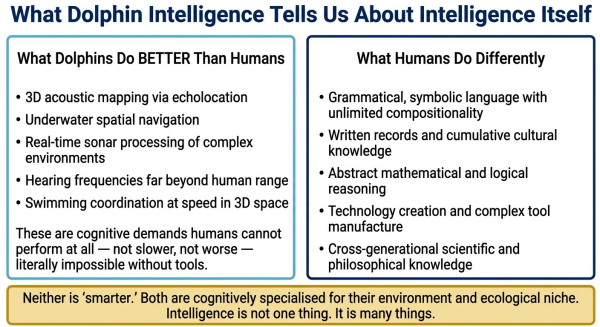
Perhaps the most important insight from dolphin intelligence research is what it reveals about the concept of intelligence itself. Dolphins excel at cognitive tasks that humans cannot perform at all — not because humans are bad at these tasks, but because humans don't have the biological apparatus for them:
- 3D acoustic mapping via echolocation — building a real-time three-dimensional model of an environment from sound reflection, including detecting objects hidden inside other objects
- Underwater spatial navigation — tracking position and movement in three dimensions over large ranges without landmarks
- Real-time sonar processing — interpreting rapid acoustic returns at millisecond resolution to identify objects, distances, and densities
- Hearing frequencies far beyond human range — processing information in acoustic channels that don't exist for human perception
A dolphin doing human cognitive tasks will score at zero. A human doing dolphin cognitive tasks will also score at zero. The comparison is not one animal being smarter than another — it is two animals with radically different cognitive architectures, each exquisitely adapted to the demands of their own ecological niche.
This has direct implications for how we think about human IQ. The IQ test measures a specific subset of human cognitive abilities — the ones most relevant to the demands of formal education and complex modern professional life. It does not measure echolocation, 3D spatial navigation, or acoustic pattern recognition. It does not measure emotional intelligence, practical wisdom, physical coordination, or creative imagination in most of their forms. It is a powerful and useful tool for its specific purpose. It is not a measure of intelligence as a universal property of minds. For more on this, see our guide on what IQ actually measures and our guide on multiple intelligences.
The IQ of a dolphin is not a number. It is a question that — when answered honestly — reveals something important about the limits of IQ as a concept. Dolphins have the second-highest Encephalization Quotient of any animal, pass mirror self-recognition tests, use tools in the wild, use signature whistles analogously to names, form third-order social alliances, and demonstrate cultural transmission across generations. These are remarkable cognitive achievements by any measure. What they are not is IQ — because IQ is a human instrument, designed for human purposes, normed on human populations. Intelligence turns out to be many things, shaped by evolutionary history and ecological context, and not well summarised by any single number for any species, including our own.
For more on how intelligence is measured in humans, see our guides on the Wechsler IQ test and the Binet IQ test. For how the IQ scale works, see our IQ scale explained. To find out where your own cognitive profile sits, take our free IQ test — no registration, results in under 20 minutes.
Frequently Asked Questions
What is the IQ of a dolphin?
Dolphins do not have an IQ in the human sense. IQ tests are designed for and normed on humans — they require language comprehension, written response, and culturally embedded knowledge that dolphins cannot access. Applying an IQ test to a dolphin produces a meaningless number. What science does have is detailed evidence of dolphin cognitive complexity: an Encephalization Quotient (EQ) of approximately 5.2–5.6 (second only to humans), mirror self-recognition, tool use, signature whistles analogous to names, and complex third-order social alliances.
Are dolphins smarter than humans?
By most meaningful measures, dolphins are not as cognitively sophisticated as humans — particularly in abstract language, symbolic reasoning, and cumulative cultural knowledge. However, dolphins demonstrate cognitive capabilities (3D acoustic mapping, echolocation-based environmental modelling, complex social alliance tracking) that humans cannot perform at all. A more accurate framing: dolphins and humans are both cognitively sophisticated, in different ways, adapted to different ecological niches.
What is the EQ of a dolphin?
Bottlenose dolphins have an Encephalization Quotient (EQ) of approximately 5.2–5.6 — the second highest of any animal species after humans (EQ ~7.4–7.8). EQ measures brain size relative to what would be expected for an animal of that body size. A high EQ indicates more brain tissue available for cognitive processing beyond basic body-maintenance demands.
Can dolphins recognise themselves in mirrors?
Yes. Bottlenose dolphins pass the mirror self-recognition test — first demonstrated by Reiss and Marino (2001). They show mirror-guided body inspection and responses to marks placed on their bodies. Mirror self-recognition has been documented in only about five animal groups: humans, great apes, Asian elephants, European magpies, and dolphins.
Which animal has the highest IQ?
IQ as a measurement only applies to humans. If the question is which non-human animal has the most complex cognitive profile overall, most researchers cite chimpanzees (closest cognitive profile to humans, sharing 98.7% of human DNA), bottlenose dolphins (highest EQ among non-primates, complex social cognition, mirror self-recognition), and elephants (empathy, long-term memory, tool use, mirror recognition). Different species excel in different cognitive domains — intelligence is not a single scale.

Comments
Share Your Thoughts