In 1983, Harvard developmental psychologist Howard Gardner published Frames of Mind: The Theory of Multiple Intelligences, proposing that human intelligence is not a single general ability but a collection of at least eight distinct types. The book changed the way educators think about children's potential and launched a movement that continues to influence classrooms worldwide.
It also attracted immediate and sustained criticism from the psychometric community — criticism that has, if anything, intensified with time. A 2023 paper in Frontiers in Psychology labeled multiple intelligences theory a "neuromyth": a popular but scientifically unsupported claim about the brain. A PubMed search for "validity Gardner multiple intelligences" covering 1983–2022 returned only two published papers — neither of which were proper validity studies.
The story of multiple intelligences theory is, in this sense, the story of an idea that was pedagogically valuable and scientifically problematic in different but equally important ways. This guide covers what the theory claims, what the evidence shows, what Gardner got genuinely right, and where the scientific case breaks down.
What Gardner Proposed: The Eight Intelligences
Gardner originally proposed seven intelligences in 1983 and added an eighth (naturalistic) in 1999. He also explored the possibility of existential intelligence but did not formally include it. Each intelligence, he argued, meets a set of criteria for being a distinct module of mind:
- Potential for isolation by brain damage — the ability can be selectively impaired by specific lesions
- The existence of prodigies and savants — people who show exceptional ability in one domain with normal or below-average ability in others
- An identifiable core set of operations
- A distinctive developmental trajectory
- Evolutionary plausibility — a role in ancestral environments
- Support from experimental psychology and psychometric findings
- Susceptibility to encoding in a symbol system
The Eight Intelligences Defined
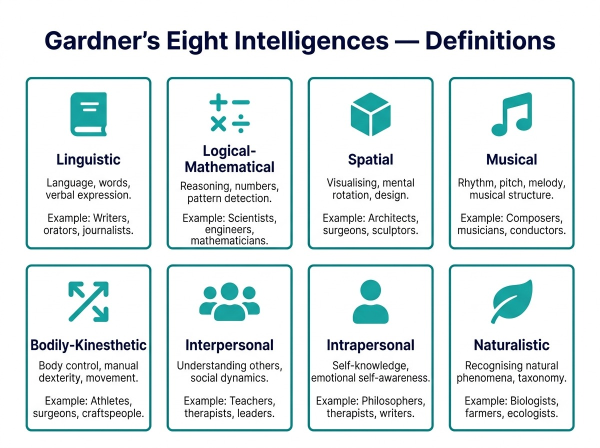
Linguistic intelligence — the sensitivity to spoken and written language, the ability to learn languages, and the capacity to use language to accomplish goals. Writers, orators, and poets typically show high linguistic intelligence.
Logical-mathematical intelligence — the capacity to analyse problems logically, carry out mathematical operations, and investigate issues scientifically. Scientists, mathematicians, and engineers typically show high logical-mathematical intelligence — and this is also what IQ tests most directly measure.
Spatial intelligence — the ability to visualise three-dimensional space, mentally rotate objects, and understand spatial relationships. Architects, surgeons, sculptors, and navigators typically show high spatial intelligence. It corresponds closely to what the WAIS-IV Perceptual Reasoning Index measures.
Musical intelligence — sensitivity to rhythm, pitch, melody, and musical structure. Composers, performers, and conductors typically show high musical intelligence.
Bodily-kinesthetic intelligence — the ability to use one's body skillfully to express ideas or feelings and to produce or transform things. Athletes, dancers, surgeons, and craftspeople typically show high bodily-kinesthetic intelligence.
Interpersonal intelligence — the capacity to understand the intentions, motivations, and desires of other people and to work effectively with others. Teachers, therapists, salespeople, and political leaders typically show high interpersonal intelligence. This is what is commonly called "people skills" and overlaps substantially with what emotional intelligence (EQ) frameworks describe. For more on this, see our guide on IQ vs EQ.
Intrapersonal intelligence — the capacity to understand oneself, to appreciate one's own feelings, fears, and motivations, and to use this self-knowledge in regulating one's life. Philosophers, therapists, and reflective writers typically show high intrapersonal intelligence.
Naturalistic intelligence (added 1999) — the ability to recognise, categorise, and draw upon certain features of the natural environment. Biologists, farmers, hunters, and ecologists typically show high naturalistic intelligence.
What Multiple Intelligences Theory Got Right
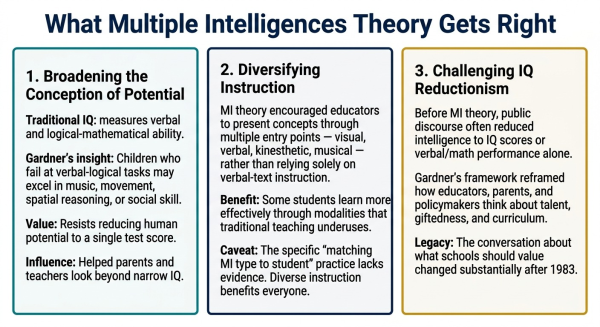
Even critics of the scientific claims of multiple intelligences theory typically acknowledge that Gardner made several genuine and lasting contributions:
Broadening conceptions of human potential. Before MI theory, public discourse about intelligence was dominated by IQ scores and verbal-mathematical performance. Gardner helped parents, educators, and policymakers recognise that a child who struggles with formal academic tasks may have genuine and valuable cognitive strengths in music, spatial reasoning, interpersonal dynamics, or bodily skill that conventional schooling undervalues. This reframing had real practical value in reducing the harm done by treating IQ scores as comprehensive assessments of human worth or potential.
Diversifying instruction. MI theory encouraged educators to present concepts through multiple entry points — visual, verbal, kinesthetic, musical — rather than relying exclusively on verbal-text instruction. The specific "match teaching style to a student's MI type" practice lacks empirical support (the learning styles hypothesis is itself well-critiqued), but the general principle that diverse instructional approaches benefit all learners has research support independently of Gardner's specific framework.
Challenging IQ reductionism. Gardner's critique of narrow IQ-based conceptions of intelligence arrived at a time when such a critique was needed. The misuse of IQ scores to make categorical judgments about children's potential — sometimes with permanent educational consequences — was a real problem, and Gardner's framework provided language for opposing it. The conversation about what schools should value, and which human capabilities deserve recognition, changed substantially after 1983.
The Scientific Criticism: What the Evidence Shows
The empirical case for the specific scientific claims of multiple intelligences theory is weak, and the criticisms from the psychometric community are substantive.
The Positive Manifold Problem
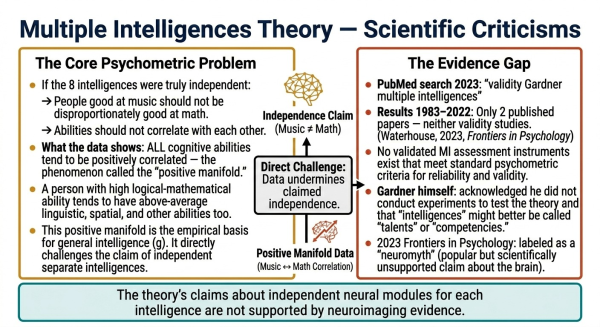
The central empirical challenge to MI theory is the existence of the positive manifold: the finding, replicated across hundreds of studies and multiple countries, that all cognitive abilities tend to be positively correlated with each other. A person who performs well on verbal tasks tends to perform better than average on spatial, numerical, and reasoning tasks as well — not perfectly, but reliably. This is not what would be predicted if the eight intelligences were truly independent modules. It is precisely what would be predicted if a common general factor (g) underlies all cognitive performance.
The positive manifold is the empirical foundation for the g factor — the statistical entity at the centre of mainstream intelligence research. The psychometric community's primary response to Gardner's theory is that his "intelligences" are not independent but are themselves correlated, and that their shared variance is largely captured by g. What Gardner calls distinct intelligences, psychometricians would call broad abilities within a hierarchical model where g sits at the top. For more on how g relates to IQ testing, see our guide on what IQ actually measures.
The Evidence Gap
A PubMed search in January 2023 for "validity Gardner multiple intelligences" covering 1983–2022 yielded only two published papers — neither of which were validity studies (Waterhouse, 2023, *Frontiers in Psychology*). No validated MI assessment instruments exist that meet standard psychometric criteria for reliability and validity. Self-report MI inventories (such as the MIDAS) have not demonstrated the reliability and validity standards expected of cognitive ability measures. Gardner himself has expressed skepticism about standardised MI tests and acknowledged that he did not conduct rigorous experimental research to validate the theory.
Gardner has also acknowledged, in various interviews and writings, that he chose the word "intelligences" rather than "talents" or "competencies" partly to challenge psychologists' ownership of the intelligence concept — an admission that the choice of terminology was partly strategic rather than purely empirical.
The Neuromyth Debate
Waterhouse's 2023 paper in *Frontiers in Psychology* labeled MI theory a "neuromyth" — a commonly accepted but unscientific claim about brain function — on the grounds that there is no evidence supporting Gardner's proposal for independent brain-based intelligences for different types of cognitive abilities. Gardner's response has been to argue that he never claimed MI was a neurological theory — but critics note that the neural independence criterion was one of the original criteria he used to identify distinct intelligences in 1983, which creates a tension.
The Misapplication Problem
Perhaps the most practically significant criticism is that MI theory, as widely applied in classrooms, has generated a problematic derivative: the learning styles hypothesis. Many educators have interpreted MI theory as suggesting that students have a single dominant intelligence or learning style and that instruction should be tailored to match it. This specific claim — "visual learners learn best from visual instruction; kinesthetic learners from kinesthetic instruction" — has been extensively studied and consistently not supported by evidence. The application of MI theory as learning styles theory has been called one of the most consequential neuromyths in education.
Gardner himself has criticised the learning styles interpretation as a misapplication of his work. He emphasises that everyone has all eight intelligences in varying degrees, not that each person has a single dominant type.
MI Theory vs the g Factor vs the CHC Model
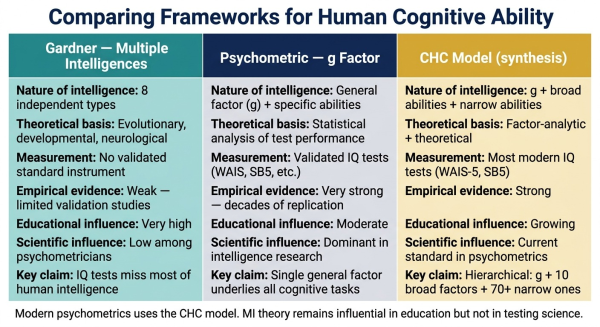
Understanding multiple intelligences theory requires placing it in the context of the competing frameworks that psychometrics uses:
The g factor model — the dominant framework in intelligence research — holds that a single general factor of cognitive ability underlies performance on all cognitive tasks. It is extracted statistically from the correlations among cognitive tests and explains substantial variance in real-world outcomes. The g factor is not a specific ability but a general capacity that modulates performance across all cognitive domains. This is directly at odds with Gardner's claim of independent intelligences.
The Cattell-Horn-Carroll (CHC) model — the current standard framework in psychometric intelligence research, used as the theoretical basis for modern IQ tests including the WAIS-5 and SB5 — is a hierarchical model with g at the top, approximately 10 broad ability factors (Gf, Gc, Gv, Gs, Gwm, etc.) at the second level, and approximately 70+ narrow abilities at the third level. This model acknowledges that there are meaningfully distinct cognitive abilities — corresponding to some of what Gardner calls intelligences — while maintaining that they are hierarchically related through g. The CHC model is consistent with the existence of musical ability, spatial ability, and interpersonal skill as real and distinct cognitive dimensions, while also insisting that these dimensions share variance through a common factor. For more on the CHC model, see our Wechsler IQ test guide and our Binet IQ test guide.
The CHC framework can be seen as a psychometrically rigorous way of capturing much of what Gardner was trying to describe — acknowledging the genuine diversity of human cognitive strengths — while insisting on the empirical constraints that the positive manifold imposes.
The Honest Verdict: What to Take from Multiple Intelligences Theory
The honest assessment of multiple intelligences theory is layered:
The core insight is valid. People genuinely have different cognitive strengths. Human potential is not adequately captured by verbal and logical-mathematical ability alone. Music, spatial reasoning, interpersonal skill, physical coordination, and self-awareness are real and valuable human capacities that IQ tests do not fully measure. Gardner was right to insist on this, and the educational culture has benefited from his insistence.
The specific empirical claims are not well-supported. The eight intelligences do not appear to be neurologically independent modules. They are not measured by validated psychometric instruments. The positive manifold is real, and it poses a serious challenge to the claim of independent intelligences. The learning styles application of MI theory — the most widespread practical application — is not supported by evidence.
The contribution to language and culture is real even if the science is incomplete. Gardner gave educators and parents a richer vocabulary for thinking about children's strengths. This is not a trivial gift — even if the specific scientific framework does not hold up under rigorous scrutiny, the cultural shift it helped produce moved conversations about education in more humane and inclusive directions.
Multiple intelligences theory proposed something genuinely important — that human potential is broader than IQ tests measure, and that schools should honour diverse forms of cognitive strength. The educational legacy of this insight has been largely positive. The scientific legacy is more troubled: the specific claim that there are eight neurologically independent intelligences lacks empirical support, the theory has not generated validated assessment instruments, and the positive manifold remains a significant challenge to the independence hypothesis. The honest position is to accept the insight (human cognitive ability is genuinely multidimensional), acknowledge the scientific limitations (the specific framework is not well-validated), and use the CHC model and IQ assessments where precision matters while keeping Gardner's broader humanistic vision in view.
For more on how IQ tests measure cognitive ability across multiple dimensions, see our guides on the WAIS-IV and Wechsler IQ test. For context on what IQ does and doesn't measure, see our guide on what IQ actually measures and our IQ vs EQ guide. Take our free IQ test to find out where your own cognitive profile sits.
Frequently Asked Questions
What is the theory of multiple intelligences?
Howard Gardner's theory of multiple intelligences, first proposed in Frames of Mind (1983), proposes that intelligence is not a single general ability but a collection of eight distinct types: linguistic, logical-mathematical, spatial, musical, bodily-kinesthetic, interpersonal, intrapersonal, and naturalistic. Gardner argued that traditional IQ tests measure only a narrow subset of human cognitive potential.
What are the 8 types of intelligence according to Gardner?
Gardner's eight intelligences: Linguistic (language and verbal expression), Logical-Mathematical (reasoning and numbers), Spatial (visualisation and spatial manipulation), Musical (rhythm, pitch, and melody), Bodily-Kinesthetic (body control and dexterity), Interpersonal (understanding others), Intrapersonal (self-knowledge), and Naturalistic (recognising natural phenomena).
Is the theory of multiple intelligences scientifically supported?
The empirical evidence is weak. A 2023 paper in Frontiers in Psychology called it a "neuromyth." A PubMed search (1983–2022) found only two papers on MI validity — neither actual validity studies. The main scientific problem: all cognitive abilities correlate positively (the "positive manifold"), suggesting a common factor (g) rather than independent intelligences. Gardner himself acknowledged he did not conduct rigorous experiments to test the theory.
What is the difference between MI theory and IQ?
IQ tests measure cognitive ability through standardised, validated instruments with decades of psychometric research. Gardner's intelligences have not been operationalised into validated assessment tools of comparable reliability. IQ tests are grounded in the empirical g-factor model and CHC framework; MI theory is a philosophical reconceptualisation of potential with limited empirical validation.
Is multiple intelligences theory useful even if not fully proven?
Yes — its core pedagogical contribution is genuine: human potential is broader than IQ tests measure, and education should honour diverse cognitive strengths. Where it falls short is in the specific empirical claims about neurological independence and in the unsupported learning styles applications derived from it. The insight is valuable; the specific scientific framework is not well-validated.

Comments
Share Your Thoughts