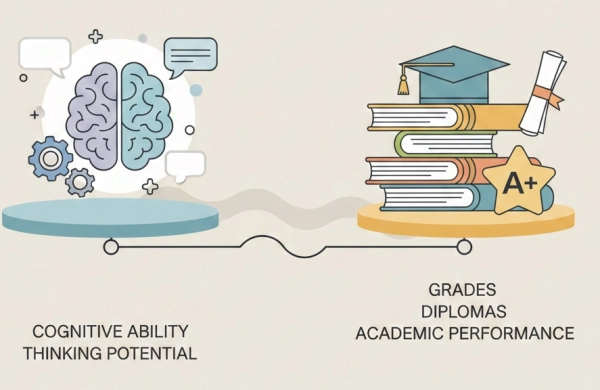
The debate between IQ and academic achievement has existed for decades. Parents, students, and employers often wonder which one truly predicts intelligence, success, and long-term potential. Is a high IQ more important than good grades? Or does academic performance matter more in real life? The answer is more nuanced than choosing one over the other. Understanding how IQ and academic achievement differ — and how they work together — can help you better evaluate cognitive ability and personal potential.
What Is IQ?
IQ (Intelligence Quotient) is a standardised score designed to measure core cognitive abilities that influence how a person thinks, learns, and solves problems. Rather than testing knowledge gained from school or life experience, IQ assessments focus on mental processing and reasoning ability, as explained in what is IQ: a complete guide to intelligence quotient.
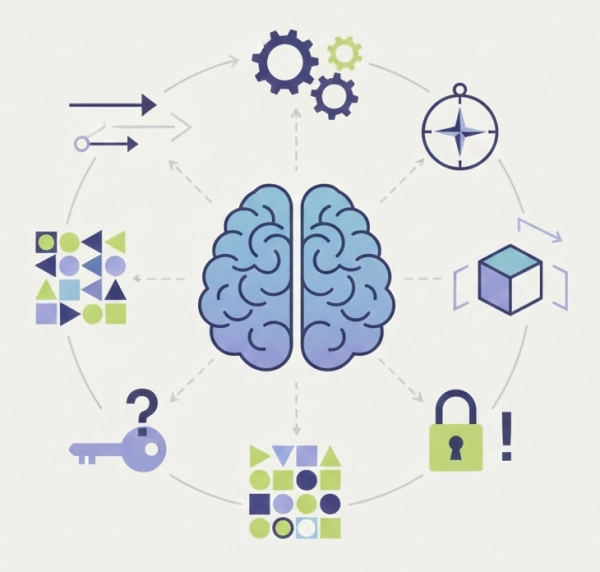
Most modern IQ tests evaluate logical and abstract reasoning, pattern recognition, problem-solving ability, spatial awareness, and processing speed. Well-designed assessments rely on verbal and nonverbal tests of intelligence to minimise the influence of language, schooling, and cultural background — allowing the test to measure how someone thinks rather than what they have memorised.
A strong IQ score often reflects learning potential. People with higher IQ scores typically grasp new concepts faster, adapt more easily to complex situations, and reason more efficiently under pressure. However, IQ has clear limitations: it does not measure motivation, discipline, creativity, emotional intelligence, social skills, or practical life experience — all of which play a major role in real-world success.
What Is Academic Achievement?
Academic achievement refers to measurable performance within formal educational systems. It represents how well a person meets established academic standards over time, typically evaluated through grades and GPA, standardised examinations, degrees, diplomas, and certifications, and classroom tests, projects, and coursework. Unlike IQ, academic achievement is built over months and years through consistent effort, attendance, time management, and behavioural factors. It is also shaped by external influences such as course difficulty, teacher standards, and access to educational resources.
How IQ and Academic Achievement Are Related
IQ and academic achievement are related, but they are not the same thing. A higher IQ can make learning faster and more intuitive, but an average or lower IQ does not prevent strong academic success — and high academic achievers are not always high-IQ individuals. Research consistently shows a moderate correlation between IQ and academic performance, especially in early education. However, as students grow older, non-cognitive factors such as motivation, effort, and self-discipline play an increasingly important role. This mirrors patterns seen in standardised testing, including the relationship explored in IQ vs SAT score.
In simple terms, IQ represents potential while academic achievement represents execution. One reflects capacity, the other reflects applied performance over time.

Which One Matters More?
The importance of IQ versus academic achievement depends heavily on context. In education, academic achievement usually matters more because it determines grades, academic rankings, scholarships, and admissions decisions — educational institutions reward measurable performance within their systems. In learning and adaptability, IQ plays a larger role in how quickly a person can understand complex ideas and adapt to unfamiliar or rapidly changing situations. In careers and real life, long-term success depends on cognitive ability, knowledge and credentials, emotional intelligence (EQ), communication skills, work ethic, consistency, and resilience. These dimensions are explored further in emotional intelligence and self-awareness.
Why Measuring IQ Still Matters
Understanding your IQ can provide meaningful insight into how your mind works. A well-designed IQ test can help you identify your cognitive strengths and weaknesses, how you process information and solve problems, your natural reasoning and learning style, and learning strategies that suit you best. When interpreted correctly, an IQ score is not a label or limitation — it is a tool for self-understanding and growth. Knowing where you fall on the IQ scale from low to genius can help guide educational choices, career paths, and learning strategies.
Final Thoughts
The question is not whether IQ or academic achievement matters more — it is how they work together. IQ influences how you learn; academic achievement reflects how you apply that ability; and real success comes from combining intelligence with effort, discipline, and self-awareness. By understanding both, you gain a clearer picture of your abilities and how to use them effectively. Explore more in our IQ Guides collection.

Comments
Share Your Thoughts