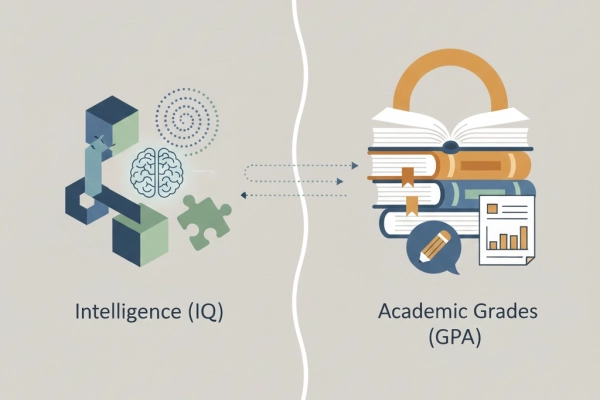
Many students and parents assume that higher intelligence naturally leads to better grades. While intelligence does play a role in academic performance, the relationship between IQ and GPA is far more complex than it appears. This article explores how IQ and GPA are connected, where they differ, and why intelligence alone does not determine academic success.
What Is an IQ Score?
An IQ (Intelligence Quotient) score is designed to measure general cognitive ability, often referred to in psychological research as g. Rather than assessing learned knowledge or school performance, IQ tests focus on how effectively an individual reasons, analyses information, and solves unfamiliar problems, as explained in what is IQ: a complete guide to intelligence quotient.
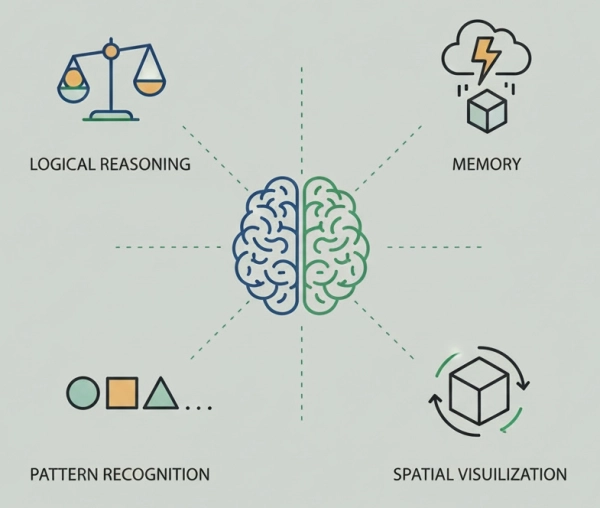
Modern IQ tests evaluate core mental processes including logical and abstract reasoning, pattern recognition (identifying visual or numerical sequences), working memory (holding and manipulating information over short periods), spatial visualisation, and problem-solving speed and accuracy. Well-known systems such as Raven’s Progressive Matrices and the Wechsler scales rely heavily on verbal and nonverbal intelligence tests to reduce bias from language, education, and cultural background.
IQ scores are statistically standardised so that average IQ = 100 and standard deviation = 15. Importantly, an IQ score reflects general learning capacity and reasoning potential — not effort, motivation, personality traits, or academic behaviour.
What Does GPA Measure?
GPA (Grade Point Average) represents a student’s overall academic performance over time, typically across a semester, year, or entire academic programme. Unlike IQ, GPA is not based on a single assessment but on the accumulation of grades earned across multiple subjects and evaluations. GPA reflects subject knowledge and understanding, homework completion and consistency, exam, quiz, and project performance, classroom participation and engagement, and adherence to deadlines and academic expectations. It is also influenced by course difficulty, teacher grading standards, and school resources and environment. In short, GPA measures academic achievement and consistency, not raw intellectual ability.
Are IQ and GPA Correlated?
Yes, research consistently finds a moderate correlation between IQ and GPA, but the relationship is far from deterministic. Most studies report correlation coefficients in the range of 0.3 to 0.5, meaning that students with higher IQs tend to earn higher GPAs on average, but IQ explains only a portion of the differences in academic performance. This mirrors patterns seen in other educational measures, such as those discussed in IQ vs SAT score. Intelligence contributes, but effort, preparation, and context matter greatly.
Why IQ Does Not Fully Predict GPA
1. Motivation and Work Ethic Matter More Than IQ
Grades reward consistent effort, regular studying, organisation and follow-through, and discipline over long periods. A student with strong cognitive ability but low motivation may underperform academically. Conversely, a highly motivated student with average intelligence can often outperform peers through persistence, planning, and effective study habits.
2. GPA Reflects Long-Term Behaviour, Not Just Ability
IQ tests measure performance during a short testing session. GPA, however, reflects months or years of sustained effort, attendance and classroom participation, and responsibility, reliability, and time management.

These long-term behaviours are crucial for academic success but fall entirely outside the scope of IQ testing.
3. Learning Styles and Teaching Methods Differ
Some students think deeply and creatively but struggle with memorisation-heavy exams, rigid grading rubrics, or traditional lecture-based instruction. High intelligence does not always align with standardised educational systems, which may favour certain learning styles over others.
4. Emotional and Social Factors Influence Academic Performance
Academic performance is strongly affected by stress and anxiety, confidence and self-regulation, and emotional resilience under pressure. This is why emotional skills — explored in IQ vs EQ and emotional intelligence and self-awareness — often play a decisive role in academic outcomes.
Can Someone Have a High IQ but a Low GPA?
Yes — this pattern is more common than many people expect. Possible explanations include boredom or lack of intellectual stimulation in school, weak study habits or poor time management, test anxiety or performance pressure, learning differences such as ADHD or dyslexia, and personal, family, or environmental challenges. High intelligence alone does not guarantee strong academic engagement or consistent performance.
Can Someone with Average IQ Have a High GPA?
Absolutely. Students with average IQ scores frequently excel academically by using effective and structured study strategies, managing time efficiently, seeking academic support when needed, and maintaining consistency and discipline. In many educational settings, these skills can outweigh raw cognitive ability.
Which Is a Better Predictor of Future Success?
Neither IQ nor GPA alone can reliably predict long-term success. Research suggests that achievement in education and career depends on a combination of cognitive ability, emotional intelligence (EQ), motivation and perseverance, social skills and adaptability, and access to opportunities, mentorship, and support. This understanding has led many universities and employers to adopt holistic evaluation approaches, reducing reliance on grades or test scores alone.
Key Takeaways
IQ and GPA are related, but the correlation is moderate (0.3 to 0.5). IQ measures general cognitive ability while GPA measures academic performance over time. Motivation, discipline, and learning environment strongly affect grades, which means high IQ does not guarantee a high GPA — and GPA does not fully reflect intelligence, potential, or future success.
Final Thoughts
Intelligence provides the capacity to learn, but grades reflect how that capacity is used over time. Understanding the difference between IQ and GPA helps reduce misconceptions and encourages a more balanced view of academic success. True achievement comes from combining ability with effort, emotional awareness, and consistent engagement — qualities that no single number can fully capture. Explore more in our IQ Guides collection.

Comments
Share Your Thoughts