IQ and problem-solving skills are often assumed to be the same thing, but they are not identical. While IQ measures certain cognitive abilities that support problem-solving, real-world problem-solving involves a broader set of skills that extend beyond what traditional IQ tests capture. Understanding the difference helps explain why some highly intelligent individuals struggle with practical challenges, while others with average IQs excel at finding effective solutions.
What Is IQ?
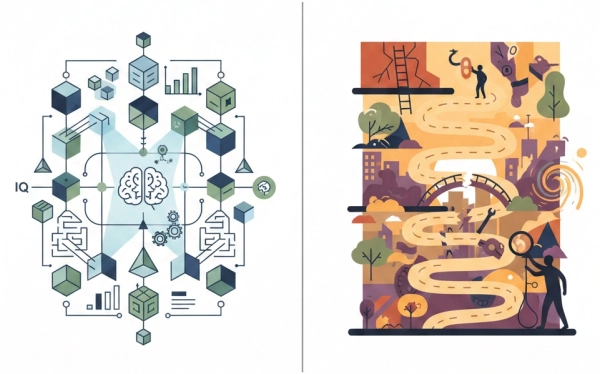
IQ (Intelligence Quotient) is a standardised score designed to assess general cognitive ability. Rather than measuring what a person knows, IQ focuses on how efficiently the brain processes information, reasons through problems, and identifies patterns under controlled and time-limited conditions. A comprehensive overview can be found in What Is IQ? A Complete Guide to Intelligence Quotient.
Most IQ tests evaluate logical and abstract reasoning (understanding rules, relationships, and cause-and-effect), pattern recognition (detecting structure and regularity in visual or numerical information), processing speed (how quickly the brain interprets and responds to information), and spatial and numerical reasoning (mental manipulation of shapes, quantities, and symbols). These abilities are central to standardised assessments such as verbal and nonverbal tests of intelligence.
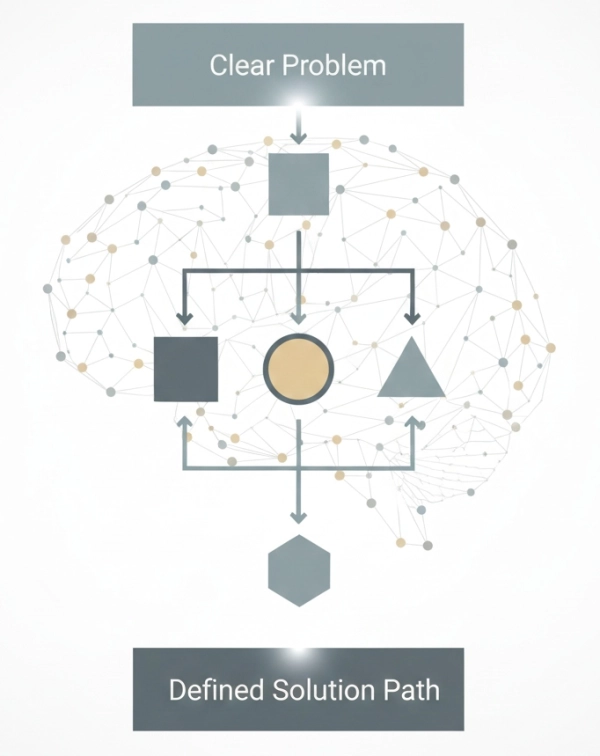
IQ is particularly relevant in structured environments where problems are clearly defined and correct solutions exist. Fields such as mathematics, engineering, programming, and technical analysis often reward the types of reasoning measured by IQ, which is why cognitive benchmarks are frequently used in recruitment IQ tests and technical hiring. However, IQ reflects cognitive potential, not guaranteed performance — a high IQ indicates capacity for learning and reasoning, but it does not automatically translate into effective action or successful outcomes in complex, real-world situations.
What Are Problem-Solving Skills?
Problem-solving skills refer to the ability to identify, analyse, and resolve challenges in practical, often unpredictable contexts. These skills go beyond mental speed or logical accuracy and involve applying thinking to real situations where variables may be unclear or constantly changing. Unlike IQ, problem-solving skills are highly situational and context-dependent, often requiring the ability to define problems that are vague, incomplete, or poorly structured; apply existing knowledge in creative or unconventional ways; adapt to shifting constraints, limited resources, or unexpected obstacles; learn from trial and error rather than relying on predefined solutions; and manage uncertainty, ambiguity, and incomplete information.
This adaptability is closely linked to cognitive flexibility — a key factor in real-world reasoning that traditional IQ scores do not directly measure. Effective problem solvers are not just fast thinkers; they are flexible thinkers who can adjust their approach when initial strategies fail.
How IQ Supports Problem-Solving
IQ plays an important supporting role in problem-solving, especially in cognitively demanding tasks. Higher IQ can contribute to faster comprehension of complex or abstract information, stronger logical reasoning and inference-making, more efficient mental processing under time pressure, and better recognition of underlying patterns and relationships. In technical, mathematical, or analytical tasks where the problem structure is well-defined, a higher IQ often leads to faster and more accurate solutions. This is particularly evident in areas involving problem-solving aptitude tests or analytical reasoning benchmarks.
Where IQ Falls Short
Despite its benefits, IQ does not measure many critical components of real-world problem-solving. Specifically, it does not capture creativity and unconventional thinking (essential for novel solutions), emotional regulation (especially when problems involve stress, conflict, or pressure), persistence and motivation (which determine whether someone continues working through difficulty), practical judgement and experience (developed through real-life exposure), or social and collaborative problem-solving (where communication and negotiation matter). These gaps help explain why IQ vs EQ is such an important distinction in leadership, teamwork, and decision-making environments.
Why Average-IQ Individuals Can Be Excellent Problem Solvers
People with average IQ scores often become highly effective problem solvers by developing complementary skills: strong intuition built from experience, willingness to experiment, iterate, and learn from failure, practical decision-making grounded in real-world constraints, and effective collaboration, communication, and teamwork. This is why many individuals succeed in business, leadership, and creative fields despite not having exceptionally high IQ scores.
IQ vs Problem-Solving in Real Life
In everyday life and most careers, successful problem-solving depends on a combination of factors: cognitive ability (IQ), which provides a reasoning foundation; domain knowledge and technical expertise; emotional intelligence and stress management; creativity, flexibility, and adaptability; and experience, perseverance, and learning from mistakes. Intelligence alone is not enough — IQ sets the stage, but problem-solving skills are developed through practice, exposure, and context.

Final Perspective
IQ and problem-solving skills are closely related but not interchangeable. IQ measures how efficiently the mind handles structured cognitive tasks, while problem-solving reflects how effectively a person navigates complex, real-world challenges. True problem-solving excellence comes not from intelligence alone, but from the ability to adapt, persist, and apply thinking in unpredictable environments. Explore more in our IQ Guides collection.

Comments
Share Your Thoughts