Many people wonder whether intelligence changes as we get older. Is my IQ normal for my age? Am I smarter than most people in my age group? Understanding average IQ by age can help put your cognitive abilities into perspective and explain why some skills improve over time while others naturally decline. If you want a deeper explanation of how IQ scores are defined and standardised, explore our complete guide on what IQ is and how it is measured.

Does IQ Change With Age?
IQ tests are carefully designed so that the average score is 100 at every age. This is because IQ is age-adjusted, meaning your score reflects how you perform compared to others in your same age group, not compared to people who are younger or older than you. A 20-year-old and a 60-year-old with the same IQ score performed similarly relative to their peers, even though their raw cognitive abilities may differ. This age-norming system is explained further in our breakdown of the IQ scale from low to genius.
While the overall IQ score remains standardised across age groups, specific cognitive abilities do change over time. Research in cognitive science and neuroplasticity of the brain shows that some mental skills peak early, while others continue to strengthen with experience. Psychologists generally divide intelligence into two major components: fluid intelligence (the ability to reason quickly, solve novel problems, recognise patterns, and think abstractly) and crystallised intelligence (accumulated knowledge, vocabulary, factual understanding, and experience-based skills).
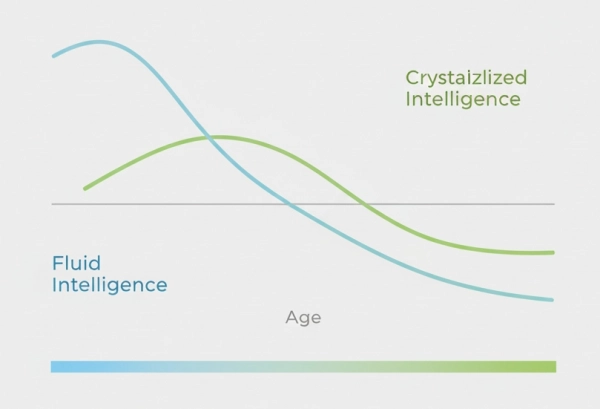
Fluid intelligence tends to peak in early adulthood and slowly decline, while crystallised intelligence often grows over time through learning and life experience. This distinction is closely related to concepts such as cognitive flexibility and real-world problem-solving ability.
Average IQ by Age Group
Although IQ scores always average 100, studies of raw cognitive performance reveal clear age-related patterns in how different abilities develop and change across the lifespan.
Children and Adolescents (Ages 6–17)
Childhood and adolescence are periods of rapid cognitive growth. Reasoning ability develops quickly, memory capacity expands, processing speed improves year by year, and attention span and problem-solving skills become more refined. By the mid-teen years, many reasoning abilities approach adult levels, even though emotional regulation and executive control are still developing. This is why results from child-focused assessments, such as an IQ test for kids, are always interpreted relative to age. Average IQ (age-adjusted): ~100.
Young Adults (Ages 18–25)
Young adulthood is typically the peak period for fluid intelligence. People in this age range often show fast reaction times, strong abstract reasoning, high mental flexibility, and excellent performance on timed and logic-based tasks. This explains why younger adults often score well on traditional assessments like the International Standard IQ Test. Average IQ: ~100. Key strengths: speed, logic, mental flexibility.
Adults (Ages 26–40)
In early to mid-adulthood, cognitive performance becomes more balanced. While raw processing speed may begin to stabilise, adults in this age group benefit from growing real-world experience, improved strategic thinking, stronger decision-making skills, and better integration of knowledge and reasoning. This combination often leads to strong performance in practical and professional contexts, especially in roles where problem-solving aptitude matters more than raw speed. Average IQ: ~100. Key strengths: reasoning combined with experience.
Middle Age (Ages 41–60)
During middle age, subtle cognitive changes may begin to appear, including a slight decline in processing speed and slower reaction times compared to younger adults, alongside continued growth in vocabulary and general knowledge. Crystallised intelligence is often very strong at this stage, supporting judgement and long-term planning. Average IQ: ~100. Key strengths: knowledge, strategy, decision-making.
Older Adults (Ages 60+)
In later adulthood, age-related cognitive changes become more noticeable, but they do not affect all abilities equally. Older adults may experience slower reaction times, reduced short-term memory efficiency, and difficulty with highly timed tasks. However, verbal ability and accumulated knowledge often remain strong. Emotional skills may also improve, which aligns with research on emotional intelligence and self-awareness. Average IQ: ~100. Key strengths: wisdom, verbal ability, long-term knowledge.
Why Everyone’s Average IQ Is 100

If IQ always averages 100 at every age, why does age matter at all? The answer is simple: IQ is a relative score. When you take an IQ test, your results are compared only to people in your age group. A 60-year-old and a 20-year-old with the same IQ score did not answer the same questions equally fast or in the same way — but they performed similarly compared to others their age. This age-norming system allows IQ tests to provide fair and meaningful comparisons across different stages of life.
Are You Smarter Than Your Peers?
To understand where you stand, focus on classifications rather than the number itself. Below 85 is below average for your age group; 85–99 is average (lower range); 100–114 is average to slightly above; 115–129 is above average; 130+ is gifted. You can explore detailed explanations in our IQ Guides. If your IQ is above 100, you are performing better than at least half of people your age. If your score is 115 or higher, you are clearly above average relative to your peers.
Why Older Adults Often Feel “Less Smart”
Many adults report feeling less intelligent as they age, but this perception is often misleading. What usually changes is speed (not intelligence), memory recall (not understanding), and reaction time (not reasoning ability). Older adults may process information more slowly, but they often compensate with better judgement, deeper understanding, stronger emotional intelligence, and more effective decision-making strategies. As a result, real-world performance often remains high despite changes in test-based measures.
Can You Improve Cognitive Performance at Any Age?
Yes. Research shows that habits such as regular learning, physical exercise, and mental challenges can help maintain or improve cognitive function. Our article on can IQ be improved explores this in detail. Helpful strategies include lifelong learning and regular reading, mental challenges such as puzzles and strategy games, regular physical exercise, quality sleep and stress management, and social interaction and meaningful relationships. These behaviours support both fluid and crystallised intelligence across the lifespan.
The Bottom Line
Your IQ score already answers whether you are smarter than your peers — relative to your age group. IQ does not simply decline as you get older; instead, different cognitive strengths shift over time. An IQ around 100 is normal at any age, scores above 115 indicate above-average performance, and intelligence is broader than any single test score. Understanding average IQ by age allows you to evaluate your abilities fairly and reminds you that intelligence evolves rather than disappears throughout life. Explore more in our IQ Guides collection.

Comments
Share Your Thoughts