Average IQ of Lawyers: The 115–130 Range, the LSAT Connection, and Why Emotional Intelligence May Matter More Than IQ Once You're Admitted

Updated: Jun 21, 2026

Lawyers occupy a high position in the occupational IQ literature. Most credible studies and LSAT-to-IQ conversion research place the average IQ of lawyers between 115 and 130, with a central estimate near IQ 120–125. This places the average lawyer above approximately 84–95% of the general adult population — well into the High Average to Superior classification on the Wechsler scale.

But two findings from the research complicate the simple "lawyers are smart" narrative in ways worth understanding. First, the LSAT — the cognitive gateway to law school — has been found to predict approximately 0.9% of variance in attorney on-the-job performance. The cognitive credentials that determine who enters the profession are essentially uncorrelated with how well those people practise law. Second, research from the American Bar Association suggests that lawyers on average score below the general population mean on emotional intelligence (EQ), testing at approximately 85–95 compared to the population average of 100.

This is the lawyer paradox: a profession that selects for high cognitive ability, where additional IQ above the entry threshold predicts career success poorly, and where the emotional intelligence that research identifies as crucial for effective lawyering is actually below the population average. This guide covers the IQ data, the LSAT-IQ connection, the EQ paradox, and what actually predicts success as a lawyer.

Bell curve showing the distribution of IQ scores within the legal profession from 25th to 75th percentile compared to general population

The Data: Average IQ of Lawyers

The estimate of IQ 115–130 for lawyers comes from several converging sources:

Source Type Estimate Notes
Occupational IQ mapping studies ~IQ 120–125 (central estimate) Uses educational attainment, test-score norms, occupational cognitive demands
LSAT-to-IQ conversion research ~IQ 115–130 (range) LSAT measures overlapping cognitive skills; conversion approximate
NLSY79 professional data ~IQ 120–125 AFQT-based cognitive measure in longitudinal tracking
Career research platforms (2026) 25th %ile: ~109 | 50th: ~114 | 75th: ~124 Distribution estimates within profession

The within-profession distribution is important: there is no single IQ that defines a lawyer. The distribution spans approximately IQ 100 to 145+, with the 25th percentile sitting around IQ 109 (High Average), the median near IQ 114 (High Average), and the 75th percentile near IQ 124 (Superior). This means a substantial portion of practising lawyers have IQs in the Average or High Average range — entry into the profession does not require the highest levels of cognitive ability.

For context: the general adult population has mean IQ 100, SD 15. An IQ of 115 sits at the 84th percentile — better than 84% of the population. An IQ of 125 sits at the 95th percentile. The lawyer average range (115–130) corresponds to approximately the 84th–98th percentile. For more on what these score ranges mean, see our guides on IQ 115, IQ 120, and IQ 128.

How Law School Admission Filters for Cognitive Ability

Diagram showing the correlation between LSAT scores and IQ and the much weaker relationship between LSAT and actual on-the-job legal performance

Unlike some professions where cognitive filtering happens through directly administered IQ tests, law school admission in the United States uses the LSAT (Law School Admission Test) as its primary cognitive filter. The LSAT is not an IQ test — it measures logical reasoning, analytical reasoning, and reading comprehension specifically — but it correlates substantially with general cognitive ability.

Mensa, the high-IQ society with membership requiring a score in the top 2% of the general population, accepts qualifying LSAT scores for membership applications. This official recognition confirms the LSAT's status as a meaningful proxy for cognitive ability. However, the conversion between LSAT percentiles and general population IQ percentiles is approximate and non-linear: the average LSAT taker is already substantially above average in cognitive ability (only those who anticipate going to law school take it), so LSAT percentile ranks do not translate directly to general population percentile ranks.

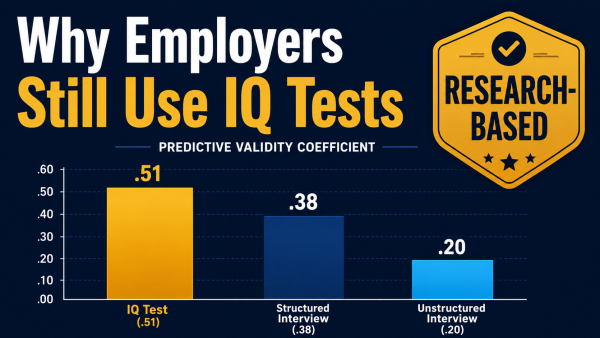
The LSAC's own research (2020–2024 Correlation Studies) finds the LSAT has a predictive validity of approximately 60% for first-year law school GPA — meaning it is the best available predictor of academic performance in 1L year, the critical filter that determines academic standing, law review selection, and job offer prospects from elite firms.

However, a more important question is what the LSAT predicts about actual legal practice. Here the answer is striking: internal research from legal performance assessment platforms suggests that LSAT scores predict approximately 0.9% of variance in on-the-job attorney performance. Law school GPA fares only slightly better, explaining approximately 2.2% of job performance variance. The cognitive gatekeeping function of law school admission has essentially no predictive power for how effective a lawyer someone becomes.

This finding led the American Bar Association in November 2022 to vote to eliminate the LSAT requirement for law schools, effective 2025 — a significant policy shift acknowledging that the standard cognitive admissions credential does not predict what it was implicitly believed to predict: quality of legal practice.

The EQ Paradox: High IQ, Low Emotional Intelligence

Comparison showing lawyers above average on IQ but often below average on EQ emotional intelligence illustrating the lawyer paradox

One of the most interesting findings about the legal profession is that lawyers score substantially below the general population average on emotional intelligence. Research associated with the American Bar Association found that lawyers on average score approximately 85–95 on EQ assessments, compared to the general population mean of 100. This places the average lawyer in approximately the 16th to 37th percentile for emotional intelligence — below the majority of the general population.

This creates what might be called the lawyer paradox: a profession that selects for above-average cognitive ability contains people who are, on average, emotionally less capable than the general public they serve.

Several mechanisms likely contribute:

Selection effects. Legal culture and training reward adversarial analytical thinking — constructing arguments, identifying weaknesses, maintaining emotional detachment. People drawn to this culture may already have lower EQ tendencies, or develop them through professional socialisation.

Personality patterns. Lawyers are disproportionately introverted — approximately 60% identify as introverts in survey data — and introversion is associated with lower scores on some EQ dimensions, particularly social engagement and interpersonal warmth.

Professional risk factors. Legal practice has well-documented rates of stress, depression, and substance abuse above most professional comparators. These mental health patterns may both select for lower EQ and be exacerbated by legal culture's discouragement of emotional expression.

The irony is compounded by research on what actually makes lawyers effective. An empirical study on lawyer effectiveness identified 26 factors predicting attorney quality — and many of the strongest predictors were EQ-adjacent: communication ability, conflict resolution skill, empathy with clients, working constructively with others. The skills that predict effectiveness are precisely the ones where lawyers on average are below the norm. For more on the IQ-EQ relationship, see our guide on IQ vs EQ.

Variation Within the Legal Profession

The aggregate 115–130 range conceals substantial variation by legal subspecialty and career trajectory:

Elite litigators, appellate judges, and law professors represent the highest cognitive concentration in the legal world. Supreme Court clerks, top-tier appellate litigators, and law review scholars typically have IQs in the 130–145+ range. The cognitive demands of appellate practice — abstract legal reasoning, pattern recognition across hundreds of precedents, strategic argument construction — cluster the most cognitively capable lawyers at this level.

Big Law corporate attorneys at top firms are filtered through the most selective law schools (median LSAT 170–174), which selects more strongly for cognitive ability than most other legal career pathways. These lawyers typically fall in the IQ 125–140 range.

General practice lawyers and solo practitioners — the majority of the practising bar — draw from a wider range of law schools and thus a wider range of cognitive ability. This population is more likely to be in the IQ 109–120 range, consistent with the 25th–50th percentile distribution estimates.

Public defenders, legal aid attorneys, and non-profit lawyers often come from the full range of law school tiers, and their cognitive profiles reflect this diversity. These careers also select particularly strongly for EQ and mission-orientation — the emotional characteristics that the profession as a whole often lacks.

What Actually Predicts Success as a Lawyer

Overview of factors that predict legal career success beyond IQ showing what research identifies as the strongest predictors of attorney effectiveness

The research consensus on what predicts success in legal practice — distinct from what predicts success in law school — is clear: above the cognitive threshold required for admission, the most important predictors of attorney quality are non-cognitive.

Communication skill. Lawyers work with language as their primary tool. Drafting contracts, writing briefs, examining witnesses, structuring client advice, and negotiating settlements all require exceptional written and verbal communication. These skills correlate with IQ but are not the same as IQ — they require practice, training, and the emotional attunement to understand what an audience needs to hear.

Conscientiousness. Legal practice rewards thoroughness, reliability, and systematic attention to detail above most other character traits. Law school GPA — the best predictor of early career outcomes after LSAT — is substantially a measure of conscientiousness as much as raw cognitive ability. An attorney who is consistently thorough and reliable will outperform a brilliant attorney who is careless and unreliable.

Practical analytical reasoning. The ability to apply abstract legal principles to specific factual situations — reasoning from precedent to novel cases — is the cognitive skill most central to legal practice. This overlaps with IQ but is also domain-specific, developed through case study and practice rather than through general cognitive ability alone.

Client relationship management. Long-term legal career success — making partner, building a practice, retaining clients — depends heavily on the ability to establish trust, understand client needs, and manage the emotional dimensions of client relationships. These are EQ skills that predict partner-track outcomes more strongly than LSAT scores or law school rank.

Lawyers average IQ 115–130 — well into the top 15% of the general population, with a central estimate near IQ 120–125. This above-average cognitive profile reflects genuine selection through demanding academic and professional pathways. But the LSAT, the cognitive gate to law school, predicts barely 1% of variance in on-the-job legal performance — a finding that caused the ABA to eliminate the LSAT requirement in 2025. And lawyers score below the general population on emotional intelligence (EQ 85–95 vs population mean 100), despite research showing EQ-adjacent skills are among the strongest predictors of attorney effectiveness. The picture is consistent: cognitive ability gets lawyers in the door; character, communication, and emotional intelligence determine how far they go once inside.

For context on what this IQ range means cognitively, see our guides on IQ 115, IQ 120, and IQ 128. For how lawyer IQ compares to other professions, see our average IQ by profession guide. For the IQ-EQ relationship, see our IQ vs EQ guide. Take our free IQ test to find out where your own cognitive profile sits.

Frequently Asked Questions

What is the average IQ of a lawyer?

Most research places the average lawyer IQ between 115 and 130, with a central estimate near IQ 120–125. Within the profession: 25th percentile ~IQ 109, median ~IQ 114, 75th percentile ~IQ 124. This places the average lawyer above 84–95% of the general adult population.

What IQ do you need to be a lawyer?

There is no formal IQ requirement. The primary cognitive filter is the LSAT (Law School Admission Test). People with IQs in the Average range (100–115) successfully enter and practise law. The IQ distribution within the legal profession is wide, and non-cognitive factors — work ethic, communication skill, emotional intelligence — explain much more variance in career success than IQ above the admission threshold.

How does lawyer IQ compare to doctors and engineers?

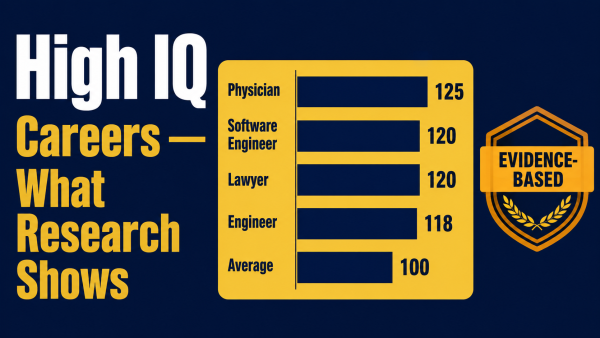
Lawyers (~IQ 115–130) are broadly comparable to physicians (~IQ 120–130) and engineers (~IQ 115–128). All three professions filter through demanding graduate admissions processes that produce similar above-average cognitive profiles. Lawyers tend to score higher on verbal reasoning; engineers higher on spatial and mathematical reasoning.

Do lawyers have high emotional intelligence?

No — research suggests lawyers score below the general population average on EQ (approximately 85–95 vs population mean 100). This creates the lawyer paradox: cognitively above average, emotionally below average. EQ-adjacent skills (communication, conflict resolution, client management) are among the strongest predictors of long-term legal career success.

Does the LSAT predict legal career success?

Barely. The LSAT predicts first-year law school GPA reasonably well (~60% validity). But internal legal performance research finds LSAT explains only approximately 0.9% of on-the-job attorney performance variance. This led the ABA to eliminate the LSAT requirement for law schools in 2025.

David Johnson - Founder of CheckIQFree

About the Author

David Johnson is the founder of CheckIQFree. With a background in Cognitive Psychology, Neuroscience, and Educational Technology, he holds a Master’s degree in Cognitive Psychology from the University of California, Berkeley.

David has over 10 years of experience in psychometric research and assessment design. His work references studies such as Raven’s Progressive Matrices and the Wechsler Adult Intelligence Scale (WAIS) .

Comments

R
Rivaldo 4 months ago
I agree with most points, but I feel that people sometimes overemphasize IQ. I’ve met many highly successful people who probably don’t score above 120.
A
Alaya 4 months ago
How stable is an IQ score around 125 over time? If someone takes the test again after years of learning, does it usually change much?
D
David Johnson 4 months ago
Great question. While core IQ tends to remain relatively stable, functional intelligence can improve significantly through learning, problem-solving practice, and emotional development…
A
Ayush 4 months ago
I took an online IQ test last year and scored 124. Reading this article actually helped me understand why I often feel comfortable with complex problems but still struggle socially sometimes. The section about EQ really resonated with me.

Share Your Thoughts