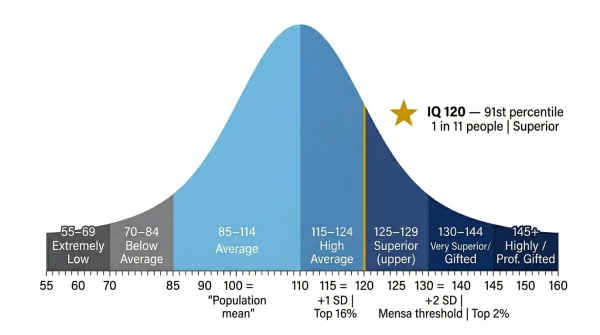
An IQ of 120 places you at approximately the 91st percentile — meaning you score higher than about 91 out of every 100 people in the general population. The Wechsler Adult Intelligence Scale classifies this as Superior intelligence. It sits 20 points above the population mean of 100, representing 1.33 standard deviations above average.
What makes IQ 120 particularly interesting as a score is where it sits in the professional world. Research consistently shows that IQ 120 is a significant threshold: it is the approximate average IQ for professionals in law, medicine, engineering, and executive management. The average IQ of lawyers is estimated around 115–120, physicians around 120–125, and engineers around 115–125. IQ 120 is, in other words, the cognitive centre of professional life in the most demanding white-collar fields — not the ceiling, not the floor, but the mean around which these professions cluster.
This guide covers everything the research establishes about IQ 120: the population statistics, the professional implications, the academic record, the daily-life experience, what comes next on the scale, and what the score does and does not predict.
IQ 120 in Numbers: The Core Statistics
| Metric | Value at IQ 120 |
| Standard deviations above mean | 1.33 SD |
| Percentile | ~91st |
| Frequency in general population | ~1 in 11 |
| In a room of 100 people | ~9 score at or above this level |
| In the United States (~335M) | ~30 million people |
| Wechsler classification | Superior |
| Above population mean by | 20 points |
| Below Mensa threshold (IQ 132) by | 12 points |
The frequency of IQ 120 — roughly 1 in 11 people — positions it differently from the higher scores in our guides. Unlike IQ 140 (1 in 261) or IQ 160 (1 in 30,000), IQ 120 is encountered regularly in professional environments — in university lecture halls, in law firms and hospitals, in technology companies, and in graduate programmes. In selective academic settings, it is below the average of peers rather than above it. This context matters enormously for how people at this level experience their cognitive profile day to day. For the full scale, see our IQ scale explained.
IQ 120 and Professional Life: The Cluster Point
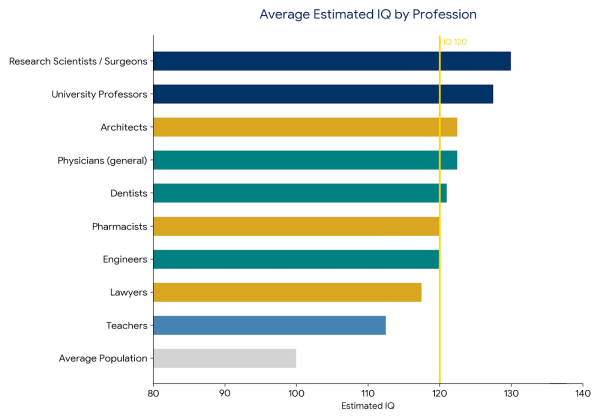
The most practically significant fact about IQ 120 is its position relative to the professions that most people associate with high intelligence. Research on average IQ by occupation consistently finds that the professional occupations requiring the most formal education and complex reasoning cluster in the IQ 115–130 range, with IQ 120 near the centre:
| Profession | Estimated Average IQ |
| Research scientists / surgeons | ~130 |
| University professors | ~125–130 |
| Physicians (general practice) | ~120–125 |
| Engineers (research and design) | ~120–125 |
| Dentists | ~121 |
| Architects | ~120–125 |
| Pharmacists | ~120 |
| Lawyers | ~115–120 |
| Senior managers / executives | ~115–125 |
These are averages — substantial variation exists within every profession, and exceptional practitioners are found across the full IQ range. But the pattern is consistent: mean IQ scores in professional fields vary — the average for physicians is estimated around 120–125, for lawyers around 115–120, for engineers around 115–125. A score of 120 places you comfortably within the cognitive range associated with these fields.
What this means practically: an IQ of 120 does not place you above most of your colleagues in a demanding professional environment. In a hospital, a law firm, an engineering firm, or a research institution, many of your peers will score in the same range or higher. IQ 120 is sufficient for these environments — it is not exceptional within them. This is a useful reality check: in professional environments (especially in tech, academia, or other white-collar fields), you'll regularly encounter people at your level or above. Being the smartest person in the room often means you are in the wrong room for growth.
What IQ 120 Opens — and What Still Requires More
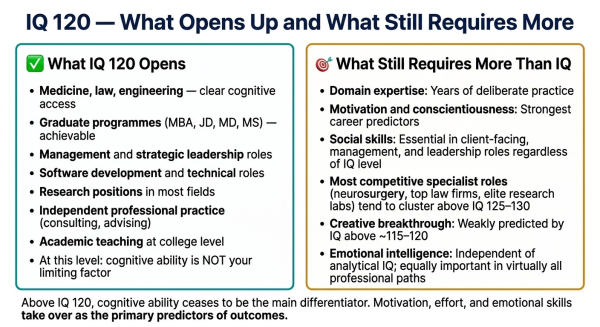
The research is consistent on one point about IQ 120: for virtually any goal a person with an IQ of 120 might reasonably set — academic, professional, creative, entrepreneurial — cognitive ability is not the limiting factor. This is a genuinely important finding that most IQ score guides understate. IQ 120 provides sufficient analytical capacity for essentially any professional or academic path a person might pursue. What differentiates outcomes from this point forward is not whether someone has enough cognitive ability — they do — but whether they have the motivation, conscientiousness, social skills, and domain expertise to deploy it effectively.
Academic pathways
IQ 120 is associated with successful performance at university level across virtually all disciplines. Graduate-level work is achievable — MBA, JD, MD, MS degrees are all within cognitive reach. The most mathematically intensive graduate programmes (theoretical physics, pure mathematics, research-level statistics) tend to attract candidates scoring somewhat higher, but IQ 120 is not a barrier for advanced study in most fields. The research confirms this clearly: IQ 120 is associated with successful completion of graduate-level education (MBA, JD, MD, MS). At IQ 120, standardized test performance typically jumps — SAT scores around 1300+, GRE scores in the 75th+ percentile.
Professional pathways
The list of careers that cognitive ability at IQ 120 supports is essentially unlimited for practical purposes. An IQ of 120 opens doors to virtually any career path. You're intellectually equipped for work that most people would find too demanding. Engineering (mechanical, electrical, civil, software) — you can handle the mathematics, spatial reasoning, and problem-solving these fields require. Business management — strategic planning, operations management, and business analysis suit your analytical abilities. Law, medicine, architecture, software development, accounting, and scientific research are all within the cognitive range. The most competitive specialist roles within each field — neurosurgery, elite research positions, top-tier legal practice — tend to attract candidates somewhat above IQ 120, but this reflects the selectivity of those positions, not a hard cognitive floor.
What becomes the limiting factor
Above IQ 120, the research on what predicts outcomes is unambiguous. Motivation, conscientiousness, domain expertise, social and emotional skills, and opportunity explain far more variance in who achieves what than additional IQ points. The threshold hypothesis — the idea that above approximately IQ 115–120, incremental IQ has diminishing returns as a predictor of achievement — is one of the most replicated findings in intelligence research. As Warren Buffett noted about IQ and investing: above a basic threshold, temperament matters more than intelligence. This principle applies broadly across professional domains. For more on this research, see our guides on IQ vs EQ and IQ and income.
The Daily Experience of IQ 120
What does an IQ of 120 actually feel like to live with? The answer differs substantially depending on the environment — because IQ 120 is experienced very differently depending on whether the surrounding context is the general population or a selective professional or academic community.
In general population contexts
In environments drawn from the general population — neighbourhood communities, casual social settings, many workplaces — IQ 120 registers as a noticeable cognitive advantage. Information is processed more quickly than most peers. Complex problems that others find daunting feel more manageable. Explanations that others need repeated register on first hearing. Academic content that the majority of students find challenging feels relatively straightforward. This creates a comfortable experience of intellectual competence in most everyday settings.
In selective professional and academic environments
In environments specifically selected for high cognitive ability — elite universities, competitive graduate programmes, research institutions, leading law firms and hospitals — IQ 120 sits near or below the average of the peer group. Here the experience shifts: others absorb material at comparable or faster speed, complex problems require genuine effort rather than feel effortless, and the sense of obvious cognitive advantage disappears. This transition — from being clearly above-average in general settings to being average or slightly below in selective ones — is a common and sometimes disorienting experience for people who score around IQ 120.
This context-dependence is important for realistic self-assessment. IQ 120 is genuinely superior to 91% of the general population. Within a PhD programme in mathematics or a top surgical residency, the same IQ may be at the lower end of the peer distribution. Both things are true simultaneously. For parents navigating this for children, see our guide on signs of a gifted child.
IQ 120 and the Distance to Gifted
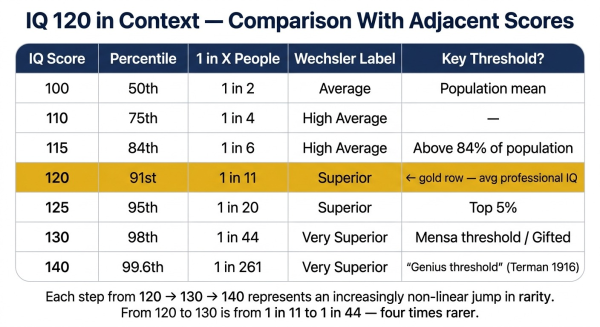
One of the most common questions from people who score around IQ 120 is about the significance of the gap to IQ 130 — the conventional gifted threshold and the Mensa eligibility cutoff. The 10-point difference between 120 and 130 is worth understanding precisely:
- In percentile terms: IQ 120 is at the 91st percentile (1 in 11). IQ 130 is at the 98th percentile (1 in 44). The 10-point increment represents roughly a quadrupling in rarity
- In classification terms: IQ 120 is Superior; IQ 130 is Very Superior. The label changes, but both are comfortably above average
- In practical terms: the difference between IQ 120 and IQ 130 matters more in the most cognitively demanding specialist roles than in the broader range of professional careers. For most professional paths, IQ 120 provides sufficient analytical capacity. The gap becomes most relevant for the highest percentile of research and academic roles
- In terms of Mensa: IQ 120 does not qualify for Mensa (threshold ~132). IQ 130 is on the boundary. For more on high-IQ society thresholds, see our guide on what is Mensa
For the next steps above 120, see our guides on IQ 125 and IQ 140.
What IQ 120 Predicts — and What It Doesn't
The research evidence on what IQ 120 actually predicts tracks the broader literature on IQ and life outcomes:
Solid predictors at IQ 120
- Academic performance across most disciplines. Performance in demanding degree programmes is supported at IQ 120. The most mathematically intensive fields reward higher scores, but IQ 120 supports completion of virtually any undergraduate or graduate programme
- Occupational performance in cognitively complex roles. Research consistently shows that IQ 120 is a significant threshold — it is the approximate average for professionals in law, medicine, engineering, and executive management. Barrick and Mount (1991) found that cognitive ability at this level is one of the strongest predictors of job performance in complex roles.
- Adaptability. Many people with IQs around 120 successfully transition into entirely new fields in their 30s, 40s, or even later. Cognitive flexibility at this level supports career pivots and self-directed learning
What IQ 120 does not guarantee
- Career success within highly selective fields. Top-tier positions in the most competitive environments attract candidates above IQ 120 on average. The score provides access to virtually all professions; it does not guarantee success in the most competitive slots within them
- Creativity or innovation. The correlation between IQ above 115–120 and creative output is approximately 0.17 — modest. Domain expertise, intrinsic motivation, and personality traits predict creative achievement far more reliably above this threshold
- Happiness. No reliable positive relationship exists between IQ above 120 and life satisfaction. Wellbeing is much more strongly predicted by relationships, meaning, autonomy, and physical health than by cognitive ability above the average range
For more on what IQ does and doesn't predict, see our guides on IQ vs creativity, IQ vs EQ, and can IQ be improved?
IQ 120 vs IQ 100 vs IQ 130: Where You Actually Sit
To contextualise IQ 120 clearly, it helps to understand the three-way comparison between average (100), superior (120), and gifted (130):
| IQ Score | Percentile | Rarity | Professional Context |
| 100 | 50th | 1 in 2 | Population average; below average for most degree programmes |
| 120 | 91st | 1 in 11 | Average IQ for lawyers, physicians, engineers |
| 130 | 98th | 1 in 44 | Mensa threshold; above average for most professions |
| 140 | 99.6th | 1 in 261 | Terman's "genius threshold"; rare in any professional setting |
This comparison illustrates the key insight about IQ 120: it is superior to 91% of the population and average for the professional class. These are both true simultaneously. The score is not a ceiling — it is the floor of the range where the most demanding professions cluster, and a very comfortable position from which to build any professional life a person chooses to pursue.
IQ 120 sits at the 91st percentile — the approximate average for doctors, lawyers, engineers, and other major professional groups. It is classified as Superior on the Wechsler scale. It opens essentially every career path and academic programme to cognitive access. And it is the score at which, the research consistently shows, cognitive ability stops being the primary differentiator between people who achieve and people who don't. From IQ 120 upward, what matters most is what you do with it — the motivation, the discipline, the domain expertise, and the wisdom to deploy analytical ability in the right direction, over enough time, with enough persistence.
Find out exactly where you sit with our free IQ test — no registration, results in under 20 minutes. For more on adjacent scores, see our guides on IQ 125, IQ 140, and IQ 160. For broader context on the scale, see our IQ scale explained.
Frequently Asked Questions
What does an IQ of 120 mean?
An IQ of 120 falls in the Superior range on the Wechsler Adult Intelligence Scale, at approximately the 91st percentile. It represents 1.33 standard deviations above the population mean of 100 and is the approximate average IQ for major professional groups including physicians (~120–125), lawyers (~115–120), and engineers (~115–125). It indicates strong analytical reasoning, above-average verbal comprehension, and the cognitive capacity for success in virtually any professional or academic path.
How rare is an IQ of 120?
IQ 120 corresponds to approximately the 91st percentile — roughly 1 in 11 people. In the United States, approximately 30 million people are expected to score at or above this level. In a room of 100 randomly selected people, about 9 would score at IQ 120 or higher. It is significantly rarer than average but much more common than the gifted threshold of IQ 130 (1 in 44).
Is IQ 120 considered gifted?
No. IQ 120 falls below the conventional gifted threshold of IQ 130 (98th percentile, top 2%), which is also approximately the Mensa eligibility cutoff. The Wechsler scale classifies IQ 120 as "Superior" — a strong score meaningfully above average, but below the "Very Superior" classification that begins at IQ 130.
What is the average IQ of a doctor or lawyer?
Estimates vary by study and specialty, but approximate averages are: physicians ~120–125 (surgeons and specialists typically higher at ~125–130); lawyers ~115–120; engineers ~115–125 (research engineers higher); dentists ~121; pharmacists ~120. These are averages — significant individual variation exists within every profession.
What careers are best suited to IQ 120?
An IQ of 120 opens virtually all career paths that require analytical ability: medicine and healthcare, law, engineering, business management, software development, accounting and finance, architecture, academia, pharmacy, and scientific research. Above IQ 120, cognitive ability is generally not the limiting factor in any of these fields — motivation, domain expertise, social skills, conscientiousness, and opportunity become the primary determinants of outcomes.

Comments
Share Your Thoughts