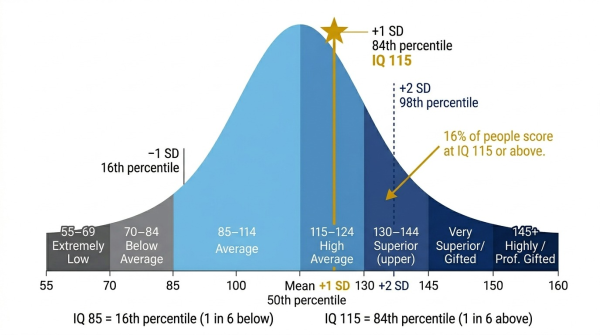
IQ 115 is not just another point on the scale. It occupies a precise and statistically significant position: it is exactly one standard deviation above the population mean of 100. This single fact makes it one of the most meaningful reference points in the entire IQ distribution — the upper boundary of the central 68% of the population, above which roughly 16% of people score.
On the Wechsler Adult Intelligence Scale, IQ 115 is classified as High Average and corresponds to approximately the 84th percentile. About 1 in 6 people score at this level or above. In the United States, approximately 55 million people are expected to meet or exceed this score.
This article covers what the research establishes about IQ 115: the population statistics, the statistical significance of the +1 SD position, what it opens in academic and professional life, the important context effect that determines how this score feels depending on environment, and what comes next on the scale.
IQ 115 in Numbers: The Core Statistics
| Metric | Value at IQ 115 |
| Standard deviations above mean | +1.0 SD (exactly) |
| Percentile | ~84th |
| Frequency in general population | ~1 in 6 |
| In a room of 100 people | ~16 score at or above this level |
| In the United States (~335M) | ~55 million people |
| Wechsler classification | High Average |
| Upper boundary of central 68% range (IQ 85–115) | Yes — IQ 115 is exactly this boundary |
| Gap to Superior range (IQ 120) | 5 points |
| Gap to Mensa threshold (~IQ 132) | 17 points |
The symmetry of IQ 115's position is worth understanding clearly. The normal distribution of IQ scores has a mean of 100 and a standard deviation of 15. Exactly 68% of the population falls within one standard deviation of the mean — between IQ 85 and IQ 115. This means IQ 115 is the upper boundary of this central band: above it are the approximately 16% of people who score in the top portion of the distribution, and below it are the 84% who score lower. IQ 85 (the lower boundary of the same band) is its perfect mirror: 1 SD below the mean, 16th percentile. For more, see our IQ scale explained.
Why +1 Standard Deviation Is a Meaningful Benchmark
The statistical significance of exactly +1 standard deviation makes IQ 115 one of the most interpretively useful scores on the distribution. Several important facts cluster at this point:
The 68-95-99.7 rule. In a normally distributed population, approximately 68% of values fall within ±1 standard deviation of the mean. IQ 115 is the right-hand boundary of this zone. Scoring above 115 means exiting the bulk of the population distribution and entering the upper tail — a meaningfully different statistical territory. Above IQ 115, approximately 16% of people score higher; below it, 84% score lower.
The symmetry with IQ 85. IQ 115 and IQ 85 are perfectly symmetric around the mean of 100. Both are 1 SD from average, in opposite directions. Both correspond to a frequency of approximately 1 in 6. Understanding this symmetry makes the score's position clearer: just as IQ 85 marks the lower edge of where most people cluster, IQ 115 marks the upper edge of the same cluster. Above IQ 115, the population thins rapidly with each additional point.
The beginning of meaningful divergence in academic outcomes. Research on the relationship between IQ and academic performance consistently shows that the predictive power of IQ begins to increase meaningfully above IQ 110–115. Below this range, motivational, behavioural, and environmental factors dominate academic outcomes more than raw cognitive ability. Above 115, the correlation between IQ and academic achievement becomes stronger. This is why many educational psychologists treat IQ 115–120 as a practical threshold for "above-average academic aptitude" rather than the more technically correct but less practically useful comparison to the population mean.
What IQ 115 Opens in Academic and Professional Life
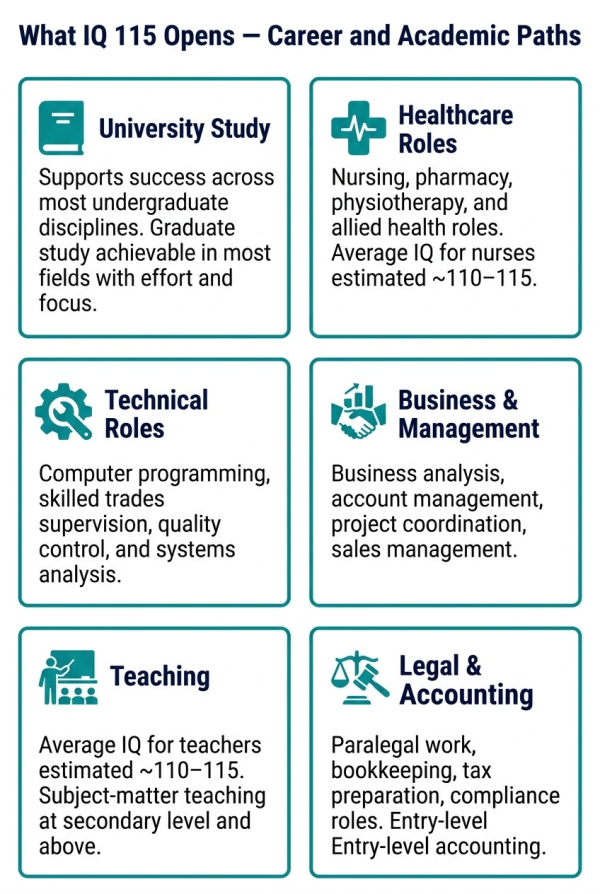
IQ 115 is associated with a broad range of academic and professional success. The research on average IQ by occupation places many common professional roles in the IQ 110–120 range:
- Teaching — average IQ for schoolteachers is estimated around 110–115 across multiple studies. IQ 115 sits comfortably at this professional average
- Nursing and allied health — nursing, physiotherapy, pharmacy technician roles, and allied health positions typically cluster around IQ 110–118
- Computer programming and systems analysis — software development roles are associated with average IQs in the 115–125 range; IQ 115 meets the lower threshold of this range
- Business analysis and management — business analysis, project management, and middle management roles cluster around IQ 110–120
- Accounting and finance — bookkeeping, accountancy, and finance roles typically average around IQ 110–120
- Skilled trades supervision — foremen, supervisors, and skilled trades managers cluster around IQ 110–115
University study at undergraduate level is accessible across most disciplines at IQ 115, with graduate study achievable in most fields through sustained effort. The most mathematically intensive graduate programmes (theoretical physics, pure mathematics, advanced research statistics) tend to attract candidates averaging above IQ 120–125, but IQ 115 is not a hard barrier for advanced study in most fields.
The research on IQ and career outcomes consistently shows that at IQ 115, cognitive ability provides a genuine advantage in cognitively complex roles. Barrick and Mount's meta-analysis (1991) — covering over 100 studies on cognitive ability and job performance — found that above IQ 115, cognitive ability is a strong predictor of performance in jobs requiring learning, reasoning, and novel problem-solving. At this level, you are above 84% of the population on these tasks.
Critically: IQ 115 is also the level at which non-cognitive factors begin to explain an increasingly large share of outcomes. At this cognitive level, motivation, conscientiousness, domain expertise, social skills, and opportunity all matter at least as much as the IQ advantage. For more on this, see our guides on IQ vs EQ and IQ and income.
The Context Effect: Why IQ 115 Feels Different in Different Rooms
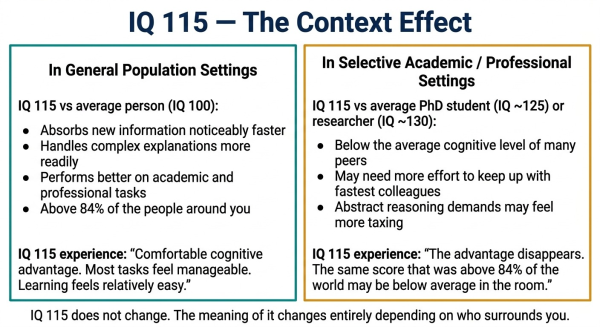
One of the most practically important things to understand about IQ 115 is the context effect — the way the experience of having this cognitive level varies dramatically depending on who surrounds you.
In general population environments
In environments drawn from the general population — most workplaces, most social settings, most communities — IQ 115 is a genuine and noticeable cognitive advantage. The gap between IQ 115 and the population mean of 100 represents a full standard deviation of cognitive performance. Information is absorbed faster, complex explanations are followed more easily, novel problems are approached with greater facility, and academic content is processed more efficiently. The everyday experience of this advantage is real.
A person with an IQ of 115 will likely be in the lowermost brackets when compared to a room full of nuclear physicists (average IQ likely 130+), even though they are above average relative to the general population. This contrast is the essence of the context effect.
In selective academic or professional environments
In environments specifically selected for cognitive ability — elite universities, competitive graduate programmes, leading research institutions, top-tier professional firms — IQ 115 sits below the average of the peer group. The cognitive advantage that existed relative to the general population disappears or reverses. In a PhD programme where the average entering student is at IQ 125, a person at IQ 115 is one standard deviation below the environment's mean — the same relative position as IQ 85 in the general population.
This context-dependence is not a flaw in how IQ 115 works — it is a fundamental feature of how relative cognitive positioning functions in different environments. The same score that makes you cognitively comfortable in most everyday settings can create genuine challenge in highly selective academic or research environments. Neither experience is wrong; both reflect the reality of IQ 115 accurately in context. For more on this effect, see our IQ 120 guide which discusses the same dynamic at a slightly higher cognitive level.
What IQ 115 Is — and Is Not
A consistent risk in interpreting any IQ score is overreading or underreading what it implies. For IQ 115, several specific misconceptions are worth addressing directly:
IQ 115 is not gifted. The gifted threshold in most educational frameworks begins at IQ 130 — 15 points above IQ 115, and a full standard deviation higher. IQ 115 is solidly above average but does not reach what educational psychologists call gifted. One common error is to treat IQ 115 as if it automatically means gifted. That can create unrealistic expectations in educational contexts.
IQ 115 is not merely average. Some people who score 115 are disappointed to be "only High Average" — comparing themselves to the gifted threshold rather than the population mean. But a score at the 84th percentile is genuinely above average, and above-average cognitive ability is a real advantage that produces real outcomes in real professional settings. The classification "High Average" reflects statistical position, not a judgment of the person's value or potential.
IQ 115 does not determine outcomes. Research on IQ and life outcomes consistently shows that at this cognitive level, non-cognitive factors are at least as important as the IQ score itself. A person with IQ 115 and high conscientiousness, strong motivation, and domain expertise will typically outperform a person with IQ 125 and low conscientiousness, low motivation, and shallow expertise. IQ 115 is a cognitive advantage — not a guarantee, and not a ceiling. As one analyst summarised: a person can have IQ 115 and still fail a class, avoid difficult tasks, write poorly, procrastinate, or lack domain knowledge. Those outcomes do not erase the score; they show that cognition is only one part of performance.
For more on what IQ does and doesn't predict, see our guides on IQ vs creativity, IQ vs EQ, and can IQ be improved?
IQ 115 in Context: The Full Comparison
| IQ Score | Percentile | Rarity | Classification | Key Note |
| 85 | 16th | 1 in 6 | Below Average | Symmetric partner of IQ 115 — lower boundary of central 68% |
| 100 | 50th | 1 in 2 | Average | Population mean |
| 110 | 75th | 1 in 4 | High Average | +0.67 SD |
| 115 | 84th | 1 in 6 | High Average | +1 SD — upper edge of central 68% |
| 120 | 91st | 1 in 11 | Superior | Professional average (doctors, lawyers, engineers) |
| 128 | 97th | 1 in 33 | Superior | 4 points from Mensa |
| 130 | 98th | 1 in 44 | Very Superior | Gifted threshold / Mensa |
The table illustrates that IQ 115 sits in a wide and well-populated band of "High Average" intelligence — between IQ 110 and IQ 120. The step from 115 to 120 (Superior classification) is 5 points; the step from 115 to gifted (IQ 130) is 15 points, or a full additional standard deviation. For adjacent score guides, see our pages on IQ 120, IQ 128, and IQ 140.
The Gap to the Next Thresholds
People who score 115 often ask what they would need to reach the next meaningful thresholds. The honest answer:
- To IQ 120 (Superior): 5 points. At this level, you enter the range associated with the professional average for doctors, lawyers, and engineers. This is within normal test variability — a retest or a different test might produce a score of 120
- To IQ 130 (Gifted / Mensa): 15 points — a full standard deviation. This is a meaningful gap. Moving from IQ 115 to IQ 130 is the same relative cognitive distance as moving from IQ 100 (average) to IQ 115. It is not an overnight retest difference
- To IQ 136 (Intertel borderline): 21 points — nearly 1.5 standard deviations. This is a large gap that represents a fundamentally different population frequency (from 1 in 6 to 1 in 122)
IQ scores are relatively stable in adulthood, and large movements between retests are uncommon in properly normed clinical assessments. For more on this, see our guide on can IQ be improved?
IQ 115 is exactly +1 standard deviation above the population mean — the 84th percentile, 1 in 6 people, the upper boundary of the central 68% range. It is classified as High Average on the Wechsler scale. It opens a broad range of professional and academic paths, places you above 84% of the people you will encounter in general population settings, and provides a genuine cognitive advantage in most everyday environments. In highly selective academic or professional settings, that advantage narrows or disappears. What IQ 115 represents is potential that requires effort, domain expertise, and character to realise — the same truth that applies at every IQ level on the scale.
Find out where you sit with our free IQ test — no registration, results in under 20 minutes. For adjacent scores, see our guides on IQ 120 and IQ 128. For the full distributional context, see our IQ scale explained.
Frequently Asked Questions
What does an IQ of 115 mean?
An IQ of 115 is exactly +1 standard deviation above the population mean of 100. On the Wechsler scale, it is classified as High Average, at approximately the 84th percentile. It marks the upper boundary of the central 68% range of the IQ distribution (IQ 85–115). It is genuinely above average but below the Superior range (IQ 120+) and well below the Gifted threshold (IQ 130).
How rare is an IQ of 115?
IQ 115 corresponds to approximately the 84th percentile — roughly 1 in 6 people score at this level or above. In a room of 100 randomly selected people, approximately 16 would score at 115 or higher. In the United States, approximately 55 million people are expected to score at or above IQ 115.
Is IQ 115 considered above average?
Yes. IQ 115 is above average by definition, at the 84th percentile. On the Wechsler scale it is classified as High Average — above average but below Superior (IQ 120+). In general population environments, it provides a genuine and noticeable cognitive advantage. In highly selective academic or professional environments where peers average above 120–130, this advantage narrows significantly.
What careers are associated with IQ 115?
IQ 115 is associated with the average estimated IQ for teaching (~110–115), nursing and allied health (~110–115), and entry-level roles in computer programming, business analysis, accounting, and skilled trades supervision. It opens most undergraduate and many graduate academic pathways. At this cognitive level, motivation, conscientiousness, domain expertise, and social skills are at least as important as IQ in determining career outcomes.
What is the difference between IQ 115 and IQ 130?
IQ 130 is exactly one full standard deviation above IQ 115 — the same gap as between IQ 100 (average) and IQ 115. IQ 130 corresponds to the 98th percentile (1 in 44); IQ 115 corresponds to the 84th percentile (1 in 6). IQ 130 qualifies for Mensa; IQ 115 does not. The classification labels differ: Very Superior (130) vs High Average (115). The gap is meaningful — not a retest difference but a different cognitive tier.

Comments
Share Your Thoughts