An IQ of 128 occupies a specific and psychologically distinctive position on the intelligence scale. It sits at approximately the 97th percentile — meaning you score higher than roughly 97 out of every 100 people in the general population. The Wechsler Adult Intelligence Scale classifies this as Superior intelligence. It is 1.87 standard deviations above the population mean.
What makes IQ 128 particularly interesting — and what drives much of the search traffic to this page — is its position relative to the thresholds above it. It sits just 2 points below IQ 130, the conventional lower boundary of the Very Superior or gifted range. And just 4 points below approximately IQ 132, the Mensa eligibility cutoff. These gaps are smaller than the standard error of measurement on most professionally administered IQ tests.
This article covers what the research says about IQ 128: the population statistics, the cognitive profile, what it predicts, how measurement error interacts with threshold scores, and how to think about the 4-point question that most people scoring 128 are quietly asking.
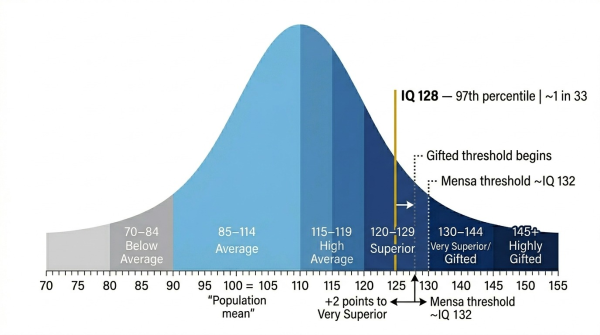
IQ 128 in Numbers: The Core Statistics
| Metric | Value at IQ 128 |
| Standard deviations above mean | 1.87 SD |
| Percentile | ~97th |
| Frequency in general population | ~1 in 33–40 |
| In a room of 100 people | ~3 score at or above this level |
| In the United States (~335M) | ~8–10 million people |
| Wechsler classification | Superior |
| Gap to gifted threshold (IQ 130) | 2 points |
| Gap to Mensa threshold (~IQ 132) | 4 points |
The comparison with adjacent scores helps contextualise IQ 128's position. IQ 120 (1 in 11) is roughly three times more common. IQ 130 (1 in 44) is slightly rarer — about 25% less common than 128. The differences between these scores in percentile and rarity are real but smaller than popular accounts suggest. For the full distributional context, see our IQ scale explained.
The 4-Point Question: IQ 128 and the Mensa Threshold
The most common question from people who score 128 is a version of: "How close am I to Mensa?" The honest answer requires understanding two things — the threshold itself, and the measurement error of IQ tests.
What the Mensa threshold actually is
Mensa International requires a score at or above the 98th percentile on a qualifying standardised intelligence test. On the Wechsler scale (SD = 15), the 98th percentile corresponds to approximately IQ 130–132 depending on the specific test and norming version. Mensa accepts scores from a range of qualifying tests, each with slightly different numerical thresholds that all target the same 98th percentile concept. For more on how Mensa qualification works, see our guide on what is Mensa.
The measurement error reality
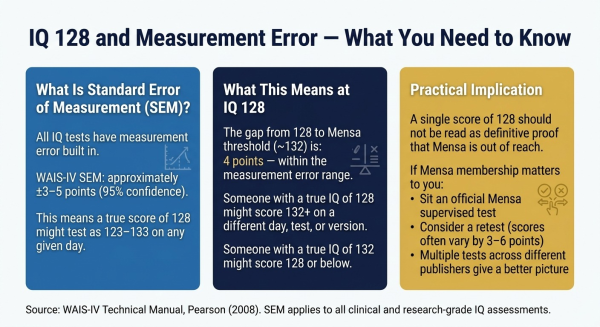
All IQ tests carry a standard error of measurement (SEM) — a statistical term describing the expected variability in a person's score across different testing occasions. For the WAIS-IV, the most widely used clinical adult IQ assessment, the SEM is approximately 2.16 points for the Full Scale IQ at the 95% confidence interval. This means a person's reported score is best understood not as a single precise number but as a range: a reported score of 128 on the WAIS-IV implies a 95% confidence interval of approximately 124–132.
The practical implications for someone scoring IQ 128:
- The gap from 128 to the Mensa threshold (~132) is 4 points — within the confidence interval of the reported score
- A person with a true cognitive ability level corresponding to IQ 128 might score anywhere from approximately 124 to 132 on a given testing occasion, depending on testing conditions, examiner, fatigue, and other factors
- A person with a true ability level of IQ 132 might similarly score 128 on a given day
This means that a single score of 128 is not definitive evidence that Mensa is out of reach. If Mensa membership is of genuine interest, the most appropriate steps are: sitting an official Mensa-supervised test (which will be scored independently), considering a retest after time has passed (scores often vary by 3–6 points between tests), and exploring whether other Mensa qualifying tests might produce slightly different results.
That said: it is equally important not to overstate this point. Not everyone who scores 128 on a first test will score 132 on a retest. Some will score higher, some lower. The measurement error creates a range of uncertainty around any score — it does not guarantee movement in any specific direction.
The Cognitive Profile at IQ 128
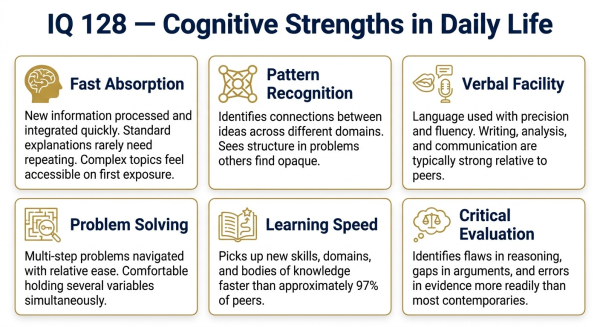
IQ 128 reflects a specific and consistently documented cognitive profile. At this level, several capabilities are reliably above average to a degree that affects daily intellectual experience:
Fast information absorption. New material is absorbed and integrated quickly. Standard explanations in educational and professional settings rarely need repeating. Complex topics feel accessible after a first exposure. At IQ 128, you are processing new information at a speed that exceeds approximately 97% of the people around you — a meaningful practical advantage in most learning environments.
Verbal facility. Language — written and spoken — is typically deployed with precision and fluency. Analysis, communication, and writing come more naturally than for the majority of peers. This is reflected in the research: IQ 128 tends to correlate with strong performance on verbal tasks, reading comprehension, and written expression.
Pattern recognition across domains. The ability to identify structural similarities between apparently unrelated problems — to see that a challenge in one domain has the same underlying shape as a challenge in another — is more accessible at IQ 128 than at lower cognitive levels. This cross-domain transfer is one of the most practically valuable cognitive capabilities in complex professional environments.
Comfort with abstraction. Abstract concepts — logical structures, mathematical relationships, theoretical frameworks — that require significant cognitive effort at IQ 100–115 are navigated more naturally at IQ 128. This underlies the advantage in demanding academic and professional settings.
Critical evaluation. Identifying flaws in arguments, gaps in evidence, and errors in reasoning happens more readily at IQ 128 than in the general population. This is a double-edged advantage: it produces better analytical output, and it can make it harder to be satisfied with the quality of discourse in many everyday environments. For more on how these specific cognitive strengths relate to measured intelligence, see our guide on what IQ actually measures.
IQ 128 in Professional and Academic Life
IQ 128 places a person at the top tier of most professional environments and well above the average for most demanding fields. To understand where it sits, the reference points from our IQ 120 guide are helpful: the estimated average IQ of physicians is approximately 120–125, lawyers 115–120, engineers 115–125, and research scientists and surgeons approximately 130. IQ 128 sits at or above the average for most major professions and just below the average for the most analytically intensive research roles.
In practical terms:
- University-level study: IQ 128 comfortably supports demanding undergraduate study across all disciplines, and graduate-level work in most fields. The most mathematically intensive PhD programmes tend to attract candidates scoring somewhat higher, but IQ 128 is not a barrier to advanced study
- Professional practice: Law, medicine, engineering, software development, finance, architecture, and business strategy are all within cognitive reach at IQ 128. In most of these environments, IQ 128 will place a person at or above the cognitive average of their colleagues
- Research and academia: IQ 128 is below the average for research scientists and full professors (~125–130) at elite institutions, but within the range regularly found in academic settings at most universities and research organisations
Crucially: at IQ 128, cognitive ability is almost certainly not the limiting factor in professional achievement. The research on the threshold effect is clear — above approximately IQ 115–120, incremental IQ points explain diminishing variance in outcomes, while motivation, conscientiousness, domain expertise, social skills, and resilience become increasingly important. As discussed in our guide on IQ vs EQ, emotional intelligence and social competence predict career success at least as powerfully as IQ above this level.
IQ 128 and the Experience of Being Close to Gifted
One of the most psychologically interesting features of scoring at IQ 128 is the experience of sitting just below a culturally significant threshold. People who score 128 often arrive at this information having heard or assumed that they are gifted or highly intelligent — only to find that they are 2 points below the conventional gifted threshold and 4 points below the Mensa cutoff. This can produce a specific form of disappointment that is worth examining rationally.
The 2-point gap between IQ 128 and IQ 130 is, cognitively, very small. On the full distribution from 70 to 145, this is an increment of less than 1.5% of the range — within normal day-to-day measurement variation. The practical cognitive experience of someone at IQ 128 and someone at IQ 130 is not meaningfully different in most real-world contexts. Both are in the top 2–3% of the general population. Both will outperform the vast majority of their peers on analytical tasks. Both will find most professional and academic environments comfortably within their cognitive reach.
The classification label "Superior" versus "Very Superior" is a psychometric convenience, not a description of two qualitatively different types of mind. What changes across the IQ 125–135 range is primarily statistical rarity and eligibility for specific high-IQ societies — not the fundamental nature of one's cognitive experience or capabilities. For more on how these labels are constructed, see our guide on IQ 140 and our IQ scale explained.
IQ 128 in Context: The Full Picture
| IQ Score | Percentile | Rarity | Classification | Key Threshold? |
| 100 | 50th | 1 in 2 | Average | Population mean |
| 115 | 84th | 1 in 6 | High Average | +1 SD |
| 120 | 91st | 1 in 11 | Superior | Professional average |
| 125 | 95th | 1 in 20 | Superior | Top 5% |
| 128 | 97th | 1 in 33 | Superior | 4 pts from Mensa |
| 130 | 98th | 1 in 44 | Very Superior | Gifted threshold |
| 132 | 98.5th | 1 in 67 | Very Superior | Mensa threshold |
| 140 | 99.6th | 1 in 261 | Very Superior | "Genius" threshold (Terman) |
The table makes clear that IQ 128 represents a genuinely rare cognitive level — in the top 3% of the general population, approximately three times rarer than the professional average at IQ 120. The 4-point gap to Mensa is real but small relative to both the scale and the measurement error of IQ tests. For adjacent score guides, see our pages on IQ 120, IQ 125, and IQ 140. For what comes above the gifted threshold, see IQ 160.
What IQ 128 Predicts — and What Comes Next
The research on what IQ 128 specifically predicts tracks closely with the evidence on the broader 115–130 range:
- Academic achievement: Strong predictor of performance across demanding undergraduate and most graduate programmes. Top-tier research positions and the most mathematically intensive PhDs tend to attract higher averages, but IQ 128 provides sufficient cognitive access for virtually all academic pathways
- Occupational complexity: Comfortable handling of cognitively complex roles. At IQ 128, essentially all professional cognitive demands fall within comfortable reach. The question of career success shifts fully to non-cognitive factors
- Learning efficiency: Absorbing new domains and skills faster than 97% of the general population. This advantage compounds — faster learning across a career builds substantially deeper expertise in the same time investment
What IQ 128 does not reliably predict beyond the patterns already well-established for IQ 120: creative breakthrough, happiness, financial success beyond a comfortable professional level, or exceptional leadership achievement. Above IQ 120, the predictive power of additional IQ points diminishes substantially. For more on this, see our guides on IQ vs EQ, IQ and income, and IQ vs creativity.
IQ 128 sits at the 97th percentile — in the top 3% of the general population, well above average, and 4 points below the Mensa threshold. The cognitive profile it reflects is genuinely exceptional by population standards: fast information absorption, strong verbal facility, comfortable abstraction, and above-average critical evaluation. The 4-point gap to Mensa is real — and well within the measurement error of any single administration of a clinical IQ test. What the score does not determine is what happens with the capabilities it reflects. That remains, as at every IQ level, a function of motivation, character, domain focus, and the choices made across a lifetime.
Find out exactly where you sit with our free IQ test — no registration, results in under 20 minutes. For adjacent scores, see our guides on IQ 125 and IQ 140. For understanding the gifted threshold directly above you, see what is Mensa.
Frequently Asked Questions
What does an IQ of 128 mean?
An IQ of 128 is classified as Superior on the Wechsler scale, at approximately the 97th percentile. It represents 1.87 standard deviations above the population mean of 100. IQ 128 sits 2 points below the gifted threshold (IQ 130) and approximately 4 points below the Mensa eligibility cutoff (~IQ 132). It indicates strong analytical ability, fast information absorption, and above-average verbal comprehension and problem-solving capability.
How rare is an IQ of 128?
IQ 128 corresponds to approximately the 97th percentile — roughly 1 in 33 to 40 people. In a room of 100 randomly selected people, approximately 3 would score at this level or above. In the United States, approximately 8–10 million people are expected to score at or above IQ 128.
Is IQ 128 close to gifted?
Yes. IQ 128 sits 2 points below IQ 130 (the conventional gifted threshold) and 4 points below the Mensa threshold (~IQ 132). Given that the standard error of measurement on most IQ tests is approximately ±3–5 points, these gaps are within normal testing variability. A person scoring 128 on one test might score 132 on another, or on a retest under slightly different conditions.
Does IQ 128 qualify for Mensa?
No — IQ 128 falls approximately 4 points below the Mensa International threshold of approximately IQ 132 (top 2%). However, given measurement error, anyone scoring near 128 who is interested in Mensa should consider sitting an official Mensa supervised test, as scores regularly vary by 3–6 points across testing occasions.
What careers are best suited to IQ 128?
IQ 128 supports virtually all demanding professional fields: engineering, law, medicine, software development, scientific research, business strategy, architecture, finance, and academia. At IQ 128, cognitive ability is unlikely to be a limiting factor in any professional or academic path — above IQ 115–120, motivation, domain expertise, conscientiousness, and social skills become the primary determinants of outcomes.

Comments
Share Your Thoughts