Average IQ by Profession: The Research Data, What It Means, and Why IQ Is Only Part of the Story

Updated: Jun 18, 2026

What is the average IQ of a doctor? A lawyer? A teacher? An engineer? These are among the most common IQ questions asked online — and the data to answer them does exist, albeit with important methodological limitations. This guide presents the best available research estimates, explains where the data comes from, and — crucially — contextualises what these averages actually mean for anyone trying to understand their own cognitive standing relative to demanding professions.

The short orientation: professional IQ averages are real patterns in the data — cognitively demanding professions that require extensive education and abstract reasoning do draw from the higher-IQ portion of the population on average. But averages are not thresholds, the ranges within professions are very wide, and IQ alone explains only a fraction of who succeeds within any field once entry has been achieved.

Where the Data Comes From: Methodology First

Overview of the main research sources used to estimate average IQ by profession including NLSY79 Hauser study and other longitudinal datasets

All estimates of average IQ by profession come from research studies that involve practical constraints and methodological limitations. Understanding these constraints is essential for interpreting the numbers correctly.

National Longitudinal Study of Youth (NLSY79). The most cited large-sample source for occupational IQ data in the United States is Robert Hauser's analysis of the NLSY79 — a longitudinal study tracking approximately 12,000 Americans from youth through their careers. The cognitive measure used is the Armed Forces Qualifying Test (AFQT), which correlates substantially with IQ but is not a full clinical IQ assessment. It primarily measures verbal and mathematical ability. The NLSY79 data have the major advantage of a large, nationally representative sample and longitudinal tracking, but the AFQT-IQ correlation means the resulting estimates carry uncertainty.

Historical military data. The Henmon-Nelson data and related studies from the 1940s–1960s, collected during and after World War II when large military populations were tested, provide some of the earliest occupational IQ estimates. These are now decades old and may not reflect modern professional composition, but they are often cited as foundational references.

Direct measurement studies. Some researchers have administered standard IQ assessments or cognitive batteries to occupational samples. Rindermann and Ceci's 2009 analysis of teacher cognitive ability is one of the more recent and careful examples. These studies provide more direct measurement but typically involve smaller and potentially non-representative samples.

Standardised admissions test proxies. GRE, LSAT, MCAT, and GMAT score distributions by field provide indirect cognitive ability estimates for graduate-level professionals, since standardised admissions tests correlate approximately 0.7–0.8 with full IQ assessments. These are widely used as supporting evidence for professional IQ estimates, particularly for the highest-IQ fields.

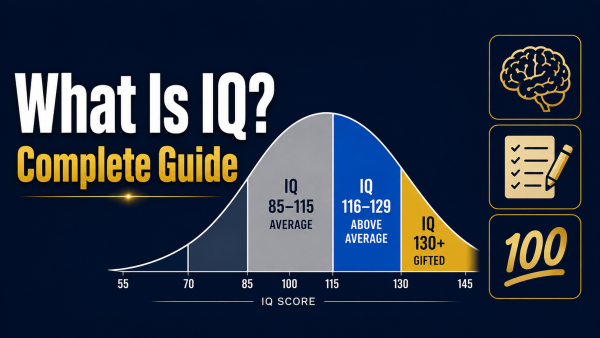
All estimates in this guide reflect ranges derived from multiple sources with these methodological considerations in mind. They are best understood as order-of-magnitude approximations rather than precise measurements. For context on the IQ scale these ranges refer to, see our IQ scale explained.

Average IQ by Profession: The Research-Based Estimates

Profession Estimated IQ Range Classification
Research scientists (STEM) 125–135 Superior to Very Superior
Physicians / Surgeons 120–130 Superior to Very Superior
Lawyers / Judges 115–128 High Average to Superior
Engineers (all types) 115–128 High Average to Superior
Dentists 118–125 Superior
Accountants / CPAs 112–124 High Average to Superior
Pharmacists 112–120 High Average
Software developers 110–125 High Average to Superior
Secondary school teachers 108–120 Average to High Average
Business managers 105–118 Average to High Average
Primary school teachers 105–115 Average to High Average
Nurses / allied health 105–115 Average to High Average
Skilled tradespeople 95–110 Average to High Average
Clerical / administrative 95–108 Average
Service workers 90–105 Average
Unskilled labour / farming 85–100 Average to Low Average

Sources: Hauser NLSY79 analysis; Rindermann & Ceci (2009); Henmon-Nelson historical data; GRE/LSAT/MCAT score distributions. All ranges are estimates with uncertainty; exact values vary by study, country, and year.

Deeper Profiles: The High-IQ Professions

Research Scientists and University Professors — IQ 125–135

Academic researchers in STEM disciplines and university professors consistently score at or near the top of occupational IQ studies. Robert Hauser's NLSY79 analysis places professors and researchers at the high end, and GRE score distributions for doctoral programmes in mathematics, physics, and philosophy support IQ estimates in the 125–135 range for this group. The range is wide because "researcher" spans everything from a postdoctoral researcher in computational biology (likely above IQ 130) to a lecturer in a non-STEM field (perhaps IQ 115–120). For context on what IQ 130+ means cognitively, see our IQ 134 guide.

Physicians and Surgeons — IQ 120–130

Physicians rank among the highest cognitive ability occupational groups consistently across studies. The MCAT — required for medical school admission in the US and Canada — correlates strongly with IQ-type cognitive ability and has a mean converted score corresponding to approximately IQ 120–125 for admitted medical students. Surgeons and academic physicians who pursue research tend to score above the general physician average. At the top of occupational IQ lists, in the low 130s, are either physicians and surgeons or professors and researchers, depending on the study. For context on what this cognitive range means, see our IQ 120 guide.

Lawyers — IQ 115–128

Lawyers and judges consistently score above average in occupational IQ research. LSAT performance (required for US law school admission) correlates strongly with verbal and analytical reasoning ability. Mean LSAT scores at top law schools correspond to approximately IQ 125–130 for admitted students; the overall bar-admitted lawyer population likely averages around IQ 120–125. The range is wide: a corporate litigator at a top firm versus a small-town solo practitioner represent very different cognitive profiles despite sharing the same occupational label.

Engineers — IQ 115–128

Engineering spans a wide range of cognitive demands — from research engineering (closer to IQ 125–130) to production engineering (closer to IQ 110–115). GRE scores for engineering graduate programmes suggest a mean of approximately IQ 120–128 for graduate-level engineers. For context on what this range means, see our IQ 120 guide and our IQ 128 guide.

Teachers — IQ 105–120

Teacher IQ averages are highly context-dependent. Secondary school teachers in academic subjects (mathematics, sciences, languages) tend to average higher than primary school or generalist teachers. Rindermann and Ceci (2009) estimated primary and secondary school teachers at approximately IQ 105–115. Teachers generally fall in the 105–115 range, above the population average. International variation is substantial: countries where teaching is a high-status, selective profession (Finland, Singapore, South Korea) likely have teacher averages closer to IQ 120+.

Nurses and Allied Health — IQ 105–115

Nursing and allied health professionals consistently score above average in occupational studies, with most estimates placing the group at approximately IQ 105–115. These professions require significant analytical skill — medication calculation, patient assessment, clinical protocol adherence — while also demanding substantial interpersonal and emotional competency. For context, see our IQ 112 guide.

What These Averages Actually Mean

Diagram showing the wide overlap in IQ ranges across professions demonstrating that IQ average does not determine who enters any given profession

The single most important point about occupational IQ averages is also the one most frequently missing from popular discussions: averages are not thresholds.

If the average IQ of physicians is approximately 125, this does not mean that an IQ below 125 disqualifies someone from medicine. The distribution of IQ among physicians is wide — typically spanning 30–50 IQ points. Physicians with IQ 108 exist and practice effectively. Physicians with IQ 145 also exist. The professional group shares a label and a training pathway, not a narrow cognitive range. As one overview notes, these averages reflect that "people with higher IQs gravitate to more intellectually stimulating work" — they describe a population-level correlation, not an individual-level requirement.

The mechanism is probabilistic filtering, not gatekeeping by IQ score. Medical school admission depends on undergraduate GPA, MCAT scores, research experience, recommendations, and interviews — not on IQ testing. The MCAT correlates with IQ, which is why the resulting admitted population has an above-average IQ. But the filter is indirect and imperfect, and many people with lower IQs navigate through it successfully via compensatory strengths.

This is why individual-level predictions from occupational IQ averages are unreliable. Knowing that the average lawyer has IQ 120 does not tell you whether a specific person with IQ 110 can succeed in law. Many do. For context on how scores in the professional range relate to real-world cognitive demands, see our guides on IQ 115, IQ 119, and IQ 120.

Why IQ Is Only Part of the Story

Comparison showing the relative contribution of IQ and non-cognitive factors to career success within a profession showing both matter

The relationship between IQ and career success follows a well-documented pattern: IQ is the strongest individual predictor of entry into cognitively demanding professions, but its relative importance decreases within any professional group as cognitive ability becomes a shared baseline.

The landmark Schmidt and Hunter (1998) meta-analysis — covering decades of occupational psychology research — confirmed that general cognitive ability (GCA/IQ) is the single best predictor of job performance across occupational categories, with a corrected validity of approximately 0.51 for complex professional jobs. But this means IQ explains approximately 26% of the variance in job performance — leaving 74% explained by other factors. Within a professional group where everyone has met a cognitive threshold, the remaining variance in performance is even more dominated by non-cognitive factors.

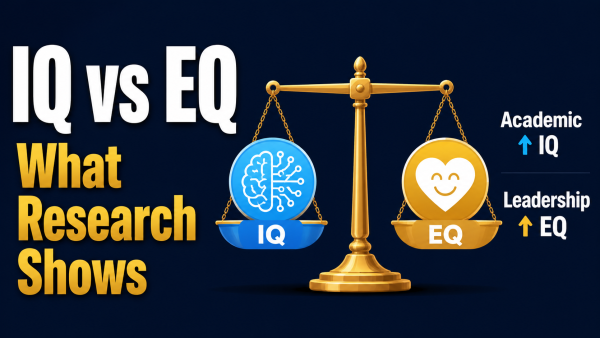
The Barrick and Mount (1991) meta-analysis identified conscientiousness as the only personality trait that consistently predicts job performance across all occupational categories — independently of, and comparably to, cognitive ability. Domain expertise, emotional intelligence, interpersonal skill, resilience, and motivation explain substantial additional variance beyond what IQ predicts. As explored in detail in our guides on IQ vs EQ and IQ and income, above approximately IQ 115–120, incremental IQ points explain diminishing variance in outcomes while non-cognitive factors explain increasingly more.

Warren Buffett (IQ ~155) has stated explicitly that above IQ 130, temperament matters more than intelligence for investment success. Charles Darwin (~IQ 165) attributed his achievements to habits of observation, patience, and honest self-assessment rather than raw cognitive ability. The research supports them: exceptional professional achievement requires both a sufficient cognitive foundation and the non-cognitive character to deploy it effectively.

Using This Information Honestly

The appropriate use of occupational IQ averages is as descriptive statistics about group distributions — not as prescriptive thresholds for individual decisions. If you are wondering whether your IQ is "enough" for a demanding profession, the honest answer is: probably yes, if the profession interests you and you are willing to invest the effort. The cognitive filter imposed by professional training is real but not as narrow as IQ averages suggest. More importantly, the non-cognitive factors that explain the majority of variance in career success are, to a much greater extent than IQ, within your control.

The average IQ of physicians is approximately 120–130. The average IQ of lawyers is approximately 115–128. The average IQ of teachers is approximately 105–115. These are real patterns in the data — cognitively demanding professions draw from the higher-IQ portion of the population on average. But average is not threshold. The ranges within any profession are wide. Averages describe group distributions, not individual requirements. And within any profession, once cognitive threshold has been met, conscientiousness, domain expertise, emotional intelligence, and work ethic explain more of the variance in career success than additional IQ points. The number matters — and then other things matter more.

For context on what specific IQ scores mean for professional access, see our guides across the IQ score series: IQ 105, IQ 112, IQ 115, IQ 120, IQ 128, and beyond. Take our free IQ test to find out where your own profile sits.

Frequently Asked Questions

What is the average IQ for doctors?

Physicians and surgeons average approximately IQ 120–130 across occupational IQ studies, placing them among the highest-IQ professional groups. Research physicians and surgeons tend toward the higher end of this range; general practitioners may average closer to IQ 120.

What is the average IQ of lawyers?

Lawyers and judges typically average approximately IQ 115–128 across studies, with most estimates centering around IQ 120–125. This places the average lawyer in the Superior classification on the Wechsler scale.

What is the average IQ of teachers?

Teachers average approximately IQ 105–120, depending on level (primary vs secondary) and subject. Most studies place the average around IQ 110–115. Secondary teachers in academic subjects average higher than primary or generalist teachers.

Which profession has the highest average IQ?

Research scientists and university professors in STEM disciplines consistently compete with physicians and surgeons for the highest average IQ, with estimates around IQ 125–135. The exact top ranking varies by study.

Does a higher IQ guarantee career success?

No. IQ is the strongest single predictor of entry into cognitively demanding professions, but within a profession, it explains only about 26% of performance variance (Schmidt & Hunter, 1998). Conscientiousness, domain expertise, emotional intelligence, and work ethic explain at least as much — and more at senior levels. Above approximately IQ 115–120, additional IQ points explain diminishing variance in career outcomes.

David Johnson - Founder of CheckIQFree

About the Author

David Johnson is the founder of CheckIQFree. With a background in Cognitive Psychology, Neuroscience, and Educational Technology, he holds a Master’s degree in Cognitive Psychology from the University of California, Berkeley.

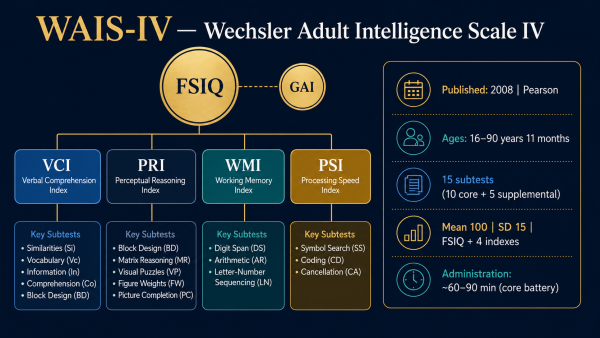
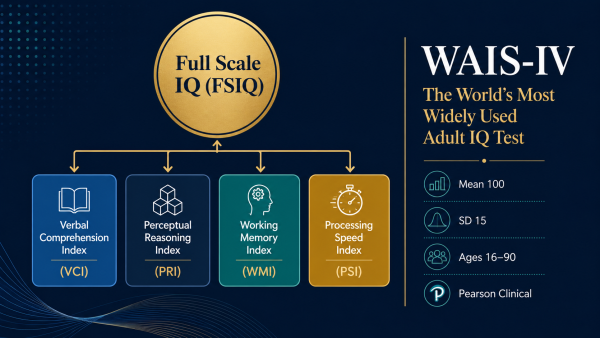
David has over 10 years of experience in psychometric research and assessment design. His work references studies such as Raven’s Progressive Matrices and the Wechsler Adult Intelligence Scale (WAIS) .

Comments

R
Rivaldo 4 months ago
I agree with most points, but I feel that people sometimes overemphasize IQ. I’ve met many highly successful people who probably don’t score above 120.
A
Alaya 4 months ago
How stable is an IQ score around 125 over time? If someone takes the test again after years of learning, does it usually change much?
D
David Johnson 4 months ago
Great question. While core IQ tends to remain relatively stable, functional intelligence can improve significantly through learning, problem-solving practice, and emotional development…
A
Ayush 4 months ago
I took an online IQ test last year and scored 124. Reading this article actually helped me understand why I often feel comfortable with complex problems but still struggle socially sometimes. The section about EQ really resonated with me.

Share Your Thoughts