Christopher Michael Langan speaks in full sentences before he turns one. He reads by himself at three. By 12, he has exhausted everything his local Montana school can teach him and moves to self-directed study of mathematics, physics, and philosophy. In high school, he reportedly achieves a perfect score on the SAT while falling asleep during the exam. He earns full scholarship offers to Reed College and the University of Chicago.
Then his mother forgets to file the financial aid paperwork, and he loses the Reed scholarship. Then a dean at Montana State University refuses to adjust his morning class schedule when his car breaks down. Then he drops out and spends the next twenty years working the door at Long Island bars.
Chris Langan's IQ is estimated at 195–210 — the highest publicly reported score in history from any administered test. It could not help him navigate a missed deadline or a dean who would not move a class to the afternoon. This is his story, and the most important lesson about intelligence that no IQ test will ever measure.
What Is Chris Langan's IQ?
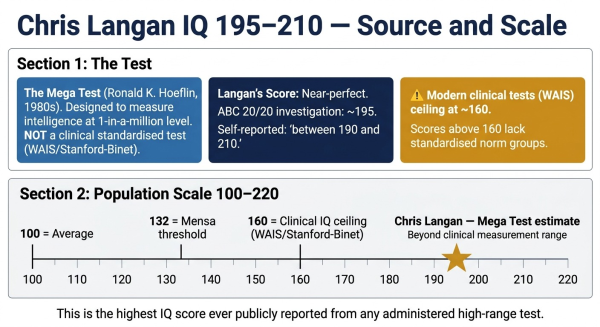
Chris Langan's IQ is most commonly cited as 195–210, derived primarily from his near-perfect score on the Mega Test — a high-ceiling intelligence test designed by Ronald K. Hoeflin in the 1980s specifically to measure cognitive ability at the one-in-a-million level. ABC's 20/20 investigation reported a score of approximately 195 after independently examining his test results. Langan himself has stated the figure is "somewhere between 190 and 210."
Before engaging with what this number means, one technical clarification is essential: the Mega Test is not a clinical standardised IQ assessment like the Wechsler Adult Intelligence Scale (WAIS) or the modern Stanford-Binet. Clinical tests ceiling at approximately IQ 160 for adults — above that level, the standardised norm group is too small to anchor reliable comparisons. The Mega Test was designed specifically to work above that ceiling, using mathematical and logical puzzles administered by post, but it lacks the standardised administration conditions and validation data of clinical instruments.
This does not mean Langan's score is fake — his performance on the Mega Test is extraordinary, and multiple sources corroborate exceptional results across every administered test. It means the specific number 195 or 210 should be understood as a high-range assessment estimate, not as a clinically verified IQ score in the conventional sense. For more on why extreme IQ claims require this caveat, see our guide on the highest IQ of all time and the IQ scale explained.
What can be said without qualification: Chris Langan scores at the absolute ceiling of every cognitive assessment he has ever taken, and his performance places him in a statistical category shared by almost no one alive.
The Childhood That No IQ Could Protect
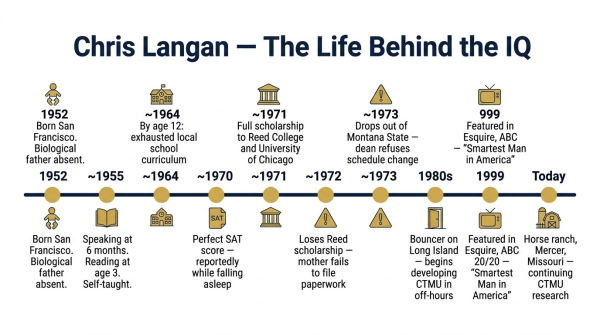
Christopher Michael Langan was born in 1952 in San Francisco, California. His biological father abandoned the family before his birth. His mother Mary married three more times — her second husband was murdered, her third died by suicide. The fourth husband, who gave Langan his surname, was physically abusive. The family lived in poverty, moving frequently through rural Montana. Langan has described his childhood environment as one of profound instability.
Against this backdrop, his early cognitive development was extraordinary. He was speaking at six months, reading at three, and by his own account was asking questions about the existence of God at five. By 12, he had taught himself everything his school curriculum could offer and moved to independent study of advanced mathematics and philosophy. He taught himself foreign languages, including Latin and Greek.
His high school SAT result — reportedly perfect, reportedly achieved while drowsy during the exam — produced full scholarship offers from Reed College in Oregon and the University of Chicago. Here, finally, was the institutional pathway that his intelligence seemed to have earned.
What happened next is documented in detail in Malcolm Gladwell's 2008 book Outliers: The Story of Success, and it is more instructive than any IQ score.
The Two Scholarships He Lost
Langan enrolled at Reed College in the early 1970s on a full academic scholarship. During his first semester, his mother failed to file the required financial aid renewal paperwork. The scholarship lapsed. The college did not reach out. Langan did not know how to advocate for himself within the institutional system. He dropped out.
He later enrolled at Montana State University in Bozeman, where he excelled academically. Then his car broke down, and he could no longer make his morning classes. He approached his advisor and then a dean to request a schedule change — moving his classes to the afternoon so he could commute reliably. The dean refused, citing his Reed transcript and his lack of demonstrable sacrifice.
He dropped out again. This time permanently.
Two things are striking about these two episodes. First, both problems were, in principle, solvable. Reed College — a small liberal arts institution known for accommodating individual students — had systems for exactly the kind of financial aid complication Langan encountered. Montana State had the administrative flexibility to adjust a class schedule. Neither outcome was structurally inevitable. Second, Langan's response in both cases was withdrawal rather than negotiation. He did not escalate, lobby, appeal, or find alternative routes. He left.
Gladwell's conclusion: this was not a failure of intelligence. It was a failure of what psychologist Robert Sternberg calls practical intelligence — the ability to navigate social systems, advocate for oneself, persuade authority figures, and read institutions well enough to get what you need from them. For more on this distinction, see our guide on IQ vs EQ.
The Langan-Oppenheimer Contrast: Gladwell's Central Argument
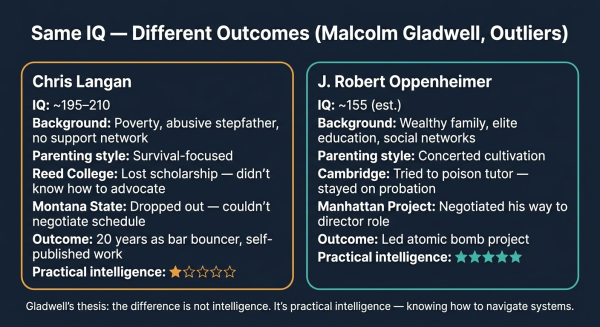
To illustrate his thesis, Gladwell compares Langan with J. Robert Oppenheimer — the physicist who led the Manhattan Project and is often considered one of the most consequential scientific figures of the 20th century. Oppenheimer's estimated IQ of approximately 155 is significantly lower than Langan's. Yet Oppenheimer's career trajectory produced outcomes of civilisational significance, while Langan's produced a self-published philosophical treatise and a horse ranch in Missouri.
The difference, Gladwell argues, was not intelligence. It was the social capital and practical intelligence that Oppenheimer's privileged upbringing gave him. At Cambridge University, Oppenheimer attempted to poison his tutor with a cyanide-laced apple. He was placed on probation — not expelled. The institution accommodated him because he knew how to navigate it, and because the people around him knew how to advocate for him. When he was later affiliated with Communist Party figures during a paranoid Cold War era, he negotiated his way into leading the most important scientific programme in American history.
Langan lost a scholarship because of a missed form. Oppenheimer tried to murder someone and kept his scholarship. The difference was not their brains — it was their environments, their social resources, and the practical intelligence that each had developed through their respective upbringings.
Gladwell traces this to sociologist Annette Lareau's distinction between concerted cultivation — the active, intensive parenting style of middle-class and wealthy families that teaches children how to advocate for themselves in institutional settings — and accomplishment of natural growth — the more hands-off approach of working-class and impoverished families that, whatever its other strengths, does not produce the same institutional navigation skills. Langan grew up in poverty without a stable adult model for how to engage with systems. Oppenheimer grew up with every resource needed to learn that skill.
The Bouncer Years: Intellectual Monasticism
Without a degree, Langan spent the better part of two decades working as a bouncer at bars in Long Island, New York. He also worked construction, clam-boating, factory work, and forest firefighting. He describes this period — particularly the bouncing years — as what he calls "intellectual monasticism": physically present in the world, but mentally operating in a separate space.
Every night he worked the door, he was simultaneously working on his theoretical project — the framework that would become the Cognitive-Theoretic Model of the Universe. He developed a technique he called the "Force Strategy" for removing difficult patrons: using physics and leverage to guide them out the door without injury. He read deeply in mathematics, physics, and philosophy in his off-hours. He joined Mensa and then higher-tier high-IQ societies, publishing early theoretical work in their journals.
His first published paper on the CTMU — "The Resolution of Newcomb's Paradox" — appeared in the December 1989–January 1990 issue of Noesis, the journal of the Noetic Society. He was working a bar door when it was published. The intellectual work had been continuous throughout the bouncing years — invisible to the world, but real.
The CTMU: A Theory of Everything From a Bar Doorway
The Cognitive-Theoretic Model of the Universe (CTMU, pronounced "cat-mew") is Chris Langan's self-developed theoretical framework, which he describes as a Theory of Everything that unifies physics and metaphysics by treating reality as a self-simulation. He began developing it in the mid-1980s while working as a bouncer.
The CTMU draws on category theory, model theory, and theories of self-reference to argue that the universe is a self-configuring, self-processing language — a structure in which mind and reality are mutually constitutive rather than separate. One of its claimed implications is a logical proof of the existence of God, derived from the formal properties of self-referential systems.
The reception of the CTMU is divided. Several of Langan's papers have been published in peer-reviewed academic journals — most notably Cosmos and History, where he became one of the most-downloaded authors in the journal's history. These publications represent genuine scholarly engagement. However, mainstream physicists and mathematicians have generally found the CTMU's claims either too imprecise or too ambitious to evaluate on standard scientific grounds. The lack of academic credentials has, as Langan himself acknowledges, made institutional engagement difficult — creating a circular problem: the credentials were denied by institutional failures; the work requires credentials for institutional review; the work therefore cannot receive the review that might establish its validity or invalidity.
The 1999 Media Moment and Its Aftermath
In 1999, an Esquire profile brought Langan to national attention. ABC's 20/20 followed with an investigation and concluded his IQ was approximately 195. He was described in numerous outlets as "the smartest man in America" or "the smartest man in the world." He appeared on television and in documentary film.
The media coverage brought recognition but not institutional integration. His work remained outside mainstream academic channels. He founded the Mega Foundation — a non-profit designed to identify and support other highly gifted individuals who had, like himself, fallen through the cracks of the educational and professional systems. He participated in the game show 1 vs. 100 in 2008, winning $250,000, and used the money to purchase the horse ranch in Mercer, Missouri, where he and his wife Gina — a clinical neuropsychologist — continue to live and work.
He has, in recent years, made public statements on political and social topics — including some that have been widely criticised as conspiratorial or fringe — that his supporters find consistent with heterodox independent thinking and his critics find inconsistent with the rational rigour his IQ is supposed to represent. These controversies are part of his public profile but do not alter the core facts of his cognitive story.
What Chris Langan's Story Teaches Us About Intelligence
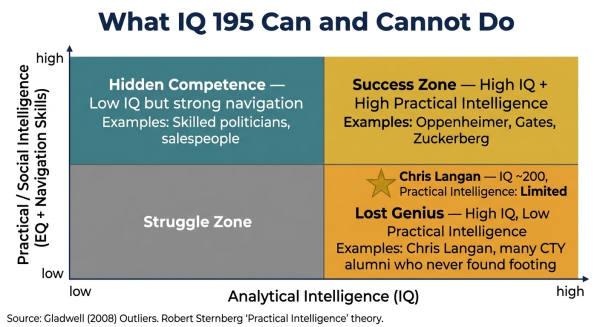
The most important lessons from Chris Langan's biography are not about intelligence — they are about what intelligence requires to become achievement:
- Analytical intelligence and practical intelligence are independent. A person can operate at IQ 200 on abstract reasoning tasks and simultaneously lack the social navigation skills to successfully appeal a missed scholarship deadline. These are not the same cognitive faculty, and high scores on one do not predict high scores on the other. See our guide on IQ vs EQ for more on this distinction
- Environment shapes what intelligence can accomplish. Langan's cognitive ability was as extraordinary at Reed College as it was when he was working the door on Long Island. What changed between those two settings was not his intelligence but the social capital and institutional knowledge he needed to convert that intelligence into recognised achievement. For more on this, see our guide on gifted vs high achiever
- The credential system has a structural blind spot. Langan's case illustrates that academic credentials function as gatekeepers not just for knowledge but for the opportunity to demonstrate knowledge. His CTMU papers — published in peer-reviewed journals despite the absence of institutional affiliation — prove that the work could survive scholarly scrutiny. The system failed to provide him with the pathway to reach that scrutiny at the appropriate stage of his development
- IQ is not destiny. This is the lesson that runs through the comparison between Langan and every other figure in this category — from William James Sidis to Terence Tao. The number predicts potential in specific cognitive domains. It predicts very little about the social, institutional, emotional, and environmental conditions that determine whether that potential is realised. See our guide on the highest IQ of all time for the full comparative picture
Chris Langan has an IQ of 195–210 — the highest publicly tested figure in history from any administered assessment. He spent twenty years as a bouncer because he did not know how to advocate for a schedule change. His story is the most powerful illustration in contemporary life of the difference between intelligence and wisdom, between cognitive ability and social capital, between what the brain can do and what the world will allow it to do. The IQ is real. So is the lesson.
Take our free IQ test — no registration, results in under 20 minutes. For more on how extreme IQ claims compare, see our guide on the highest IQ of all time. Explore our full Celebrity IQ database.
Frequently Asked Questions
What is Chris Langan's IQ?
Chris Langan's IQ is estimated at 195–210, derived primarily from his near-perfect score on the Mega Test, a high-ceiling IQ assessment designed by Ronald K. Hoeflin. ABC's 20/20 reported approximately 195. Langan has stated the figure is "between 190 and 210." These scores come from non-standardised high-range tests, not clinical instruments like the WAIS, which ceiling at approximately IQ 160.
Why did Chris Langan become a bouncer?
Langan lost a full scholarship to Reed College when his mother failed to file financial aid paperwork — he did not know how to navigate the institutional system to recover it. He then dropped out of Montana State when a dean refused to adjust his class schedule. Without a degree, he was locked out of academic careers and worked as a bouncer on Long Island for over 20 years, developing the CTMU during his off-hours.
What is the CTMU?
The Cognitive-Theoretic Model of the Universe (CTMU) is Langan's theoretical framework describing reality as a self-simulation — a self-referential, self-configuring language in which mind and reality are mutually constitutive. He developed it while working as a bouncer in the 1980s. Several papers on the CTMU have been published in peer-reviewed journals, where he became among the most-downloaded authors in Cosmos and History.
What did Malcolm Gladwell say about Chris Langan?
Gladwell featured Langan in Outliers (2008), comparing him with Oppenheimer to argue that success requires more than analytical intelligence. Gladwell attributed Langan's limited institutional success to a lack of "practical intelligence" — the ability to navigate systems and advocate for oneself — which he linked to Langan's poverty-stricken upbringing and the absence of the "concerted cultivation" parenting available to wealthier children.
Did Chris Langan get a perfect SAT score?
Yes. Chris Langan reportedly achieved a perfect SAT score — reportedly while falling asleep during the exam. This earned him full scholarship offers to Reed College and the University of Chicago. The practical consequence was limited: he lost both university opportunities to administrative failures rather than cognitive ones.

Comments
Share Your Thoughts