James Howard Woods was accepted to the Massachusetts Institute of Technology on a full scholarship. He had scored a perfect 800 on the verbal portion of the SAT and 779 on the math — a combined 1579 out of 1600. While still in high school in Rhode Island, he had been permitted to enrol in a linear algebra course at UCLA under an honours student programme. He performed in 36 theatrical productions at MIT, Harvard, and the Theater Company of Boston during his time as a student.
In 1969, months before graduating, he called his mother and told her he was leaving MIT for New York to become an actor.
James Woods has an IQ of 180. He has said so himself, on multiple occasions. IMDB lists the figure — derived from the Stanford-Binet test — in his official trivia. Some sources cite 184. He is a confirmed Mensa member. And whatever the precise number, the underlying cognitive profile is backed by one of the most thoroughly documented academic records of any major Hollywood actor: a perfect SAT verbal score, a full MIT scholarship, and a demonstrated capacity for mathematical and linguistic reasoning that most Ivy League graduates would envy.
This article examines what we actually know about Woods's IQ, how the figure was arrived at, and how the same cognitive profile that earned him a place at MIT shaped one of the most technically precise and intellectually demanding acting careers in American film history.
What Is James Woods's IQ?
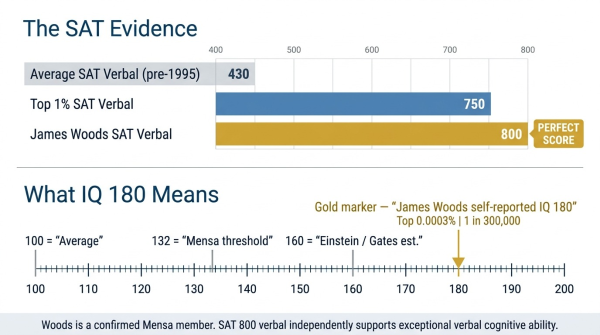
James Woods's IQ is self-reported as 180 — a figure he has stated on the record on multiple occasions. IMDB's official trivia page attributes an IQ of 180 to him based on the Stanford-Binet test; a secondary source cites 184. The range of 180–184 appears consistently across reputable biographical sources.
Unlike many celebrity IQ claims that originate from social media speculation or unverifiable third-party estimates, Woods's figure has several independent supporting anchors:
- Perfect 800 on the SAT verbal section — the highest possible score on what was then the most widely used cognitive assessment for college admissions in the United States. Research by Frey and Detterman (2004) established a strong correlation (approximately 0.82) between SAT scores and general intelligence as measured by standardised IQ tests. A perfect verbal SAT score is consistent with verbal IQ in the range of 160–180+
- 779 on the SAT math section — near-perfect, consistent with high quantitative ability
- Full scholarship to MIT — one of the world's most intellectually selective universities, with acceptance rates in the single digits even in the 1960s
- UCLA linear algebra enrollment in high school — permitted under an honours programme for students whose mathematical ability exceeded what the standard high school curriculum could provide
- Confirmed Mensa membership — independently documented in IMDB, alongside other verified Mensa members including Geena Davis and Sharon Stone. Mensa requires scoring in the top 2% (IQ ~132+)
No official clinical test record has been publicly released. The figure remains self-reported, not independently verified through a published assessment. But the combination of verified academic credentials provides more supporting evidence for the 180 claim than most celebrity IQ figures possess. For context on what scores in this range mean, see our guide on IQ 160 and the IQ scale explained.
The Academic Record: A Prodigy From Rhode Island
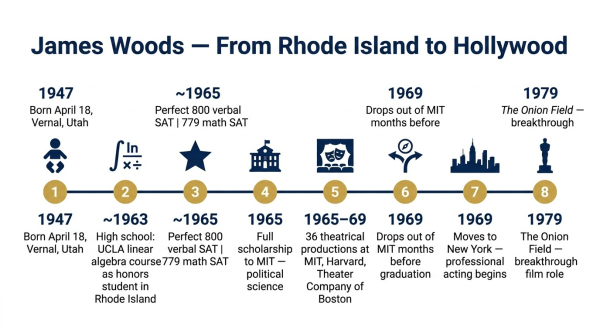
James Howard Woods was born on 18 April 1947 in Vernal, Utah. His father, Gail Peyton Woods, was a United States Army intelligence officer who died unexpectedly in 1960 during routine surgery, leaving Woods's mother Martha to raise him and his brother Michael in Warwick, Rhode Island. The loss of his father at age 13 shaped his early development in ways he has acknowledged in interviews — a young man of exceptional ability navigating a disrupted family environment, channelling his intelligence into academic achievement and, increasingly, performance.
At Pilgrim High School in Warwick, his abilities were recognised early. He was permitted under an honours student grant programme to enrol in a linear algebra course at UCLA while still attending high school in Rhode Island — an accommodation made for students whose mathematical abilities had outpaced the local curriculum. His SAT scores — 800 verbal, 779 math — earned him a full scholarship to MIT.
At MIT, Woods majored in political science — initially with plans to become a surgeon, later redirected toward law and politics. But the acting had already started. During his four years at MIT, he appeared in 36 theatrical productions across MIT, Harvard, and the Theater Company of Boston, also performing summer stock at the Provincetown Playhouse. He pledged Theta Delta Chi fraternity. The acting career was not a departure from his life at MIT — it was growing inside it.
In 1969, with graduation months away, he made the call to New York. His mother's response, as he recalled at a 2006 CBS UpFront: she gave him her blessing on one condition — that he be the best actor he could possibly be.
How IQ 180 Connects to an Acting Career
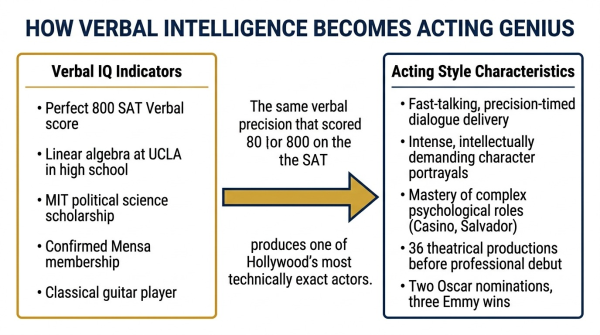
The connection between James Woods's documented cognitive profile and his acting style is not incidental. His most distinctive performance characteristic — the fast-talking, intellectually precise, verbally relentless delivery that defines characters from Lester Diamond in Casino to Richard Boyle in Salvador — is exactly the kind of performance that benefits most directly from exceptional verbal intelligence and processing speed.
Acting at the level Woods operates requires:
- Rapid text acquisition — memorising complex scripts quickly and accurately, retaining them across weeks of production. High working memory and processing speed accelerate this directly
- Character psychology modelling — understanding how a specific character thinks, what their cognitive and emotional patterns are, and producing that consistently under camera. This requires the same kind of abstract modelling that high verbal IQ supports
- Dialogue precision under pressure — Woods's signature fast-talking delivery is technically demanding: it requires maintaining verbal precision, emotional register, and timing simultaneously at high speed. The verbal IQ that scored 800 on the SAT is doing the same cognitive work at higher frequency
- Complex psychological role inhabitation — the roles that earned Woods his Oscar nominations — a journalist in a war zone in Salvador, a murderer's accomplice in The Onion Field, a degenerate hustler in Casino — all require the ability to understand and reproduce complex psychological states from the inside. This is high-order cognitive modelling
The parallel with Rowan Atkinson's Oxford engineering degree is instructive: both men left elite technical academic paths for acting careers, and both demonstrate that the cognitive precision developed through demanding academic training transfers directly into technical acting excellence. For more on how verbal intelligence relates to performance, see our guide on linguistic intelligence.
The Acting Career: Where the Intelligence Shows
James Woods's acting career spans more than 130 screen roles over five decades. The awards record reflects the critical recognition his intelligence-driven approach to performance has generated:
- Two Academy Award nominations — Best Actor for Salvador (1986) and Best Supporting Actor for Ghosts of Mississippi (1996)
- Three Emmy Awards — including Primetime Emmy for Promise (1996) and My Name Is Bill W. (1989), and Daytime Emmy for voice work in Hercules: The Animated Series
- Golden Globe Award — Best Actor in a Miniseries or TV Film for Promise
- Independent Spirit Award for Salvador
His collaboration with Martin Scorsese on Casino (1995) produced one of his most celebrated performances — Lester Diamond, a small-time hustler exploiting Sharon Stone's character, played with the precise combination of intellectual calculation and emotional desperation that Woods excels at. Scorsese specifically sought him for the role, as did Oliver Stone for Salvador. Directors of that calibre are not casting randomly; they are casting someone whose cognitive precision they trust to execute complex character work without losing control of it.
His voice work as Hades in Disney's Hercules (1997) demonstrated a different dimension of the same verbal facility — rapid-fire comedic delivery, linguistic wit, and tonal precision that made the character one of the most memorable Disney villains of the decade. The same verbal IQ that scored 800 on the SAT was doing different work in a recording studio, but the underlying cognitive operation was the same.
The MIT vs Hollywood Decision: What It Tells Us
Woods's decision to leave MIT months before graduation is one of the more interesting data points in understanding his cognitive profile. Most people with MIT scholarships and IQs in the 180 range pursue the obvious paths: engineering, research, medicine, finance, law. The expectation that exceptional analytical intelligence leads to conventional high-status professional outcomes is deeply embedded in how we think about genius.
Woods rejected it entirely. Not because he could not complete the degree — he was months from graduation — but because the acting had already become more important than the credential. This reflects something about intelligence that standardised tests cannot measure: the ability to identify what you actually want and to act on it against the grain of what is expected. For more on this relationship between IQ and unconventional life choices, see our guides on IQ vs academic achievement and what matters more than IQ for success.
The comparison with Dolph Lundgren is striking: another person with exceptional academic credentials and a confirmed elite-institution record who left that path for entertainment. Both men brought the cognitive precision of their academic training into careers that seemed to contradict it — and both produced work of exceptional technical quality as a result. The academic and the artistic were not in conflict; the analytical intelligence that earned the scholarship became the tool that built the acting career.
Poker, Video Games, and the Pattern-Recognition Mind
Outside acting, Woods has become a serious poker player — participating in World Series of Poker events, high-stakes cash games with figures including Norm Macdonald, Nick Cassavetes, and Kevin Pollak, and charity poker tournaments. He has spoken about Pot-Limit Omaha games at $25/$50 stakes with cap structures — not recreational gambling but high-level competitive play.
The connection between elite poker performance and high IQ is well-documented in the research literature. Poker at the level Woods plays requires rapid probability assessment, opponent modelling, deception detection, risk management under incomplete information, and the ability to maintain cognitive discipline under emotional pressure. All of these correlate directly with high analytical IQ and the working memory capacity that supports it. Casino was not just a role for Woods — it was a subject he understood from the inside.
How James Woods Compares to Other Celebrity Geniuses
| Celebrity | Est. IQ | Strongest Academic Evidence |
| James Woods | ~180 | MIT full scholarship + SAT 800 verbal + Mensa |
| Rowan Atkinson | ~178 | Oxford MSc Electrical Engineering |
| Dolph Lundgren | ~160 | Sydney MSc Chemical Engineering + MIT Fulbright |
| Bill Gates | ~157–160 | SAT 1590/1600 + Harvard Mathematics |
| Nolan Gould | 150 | Self-disclosed on Ellen + Mensa membership confirmed |
Among entertainers with documented academic credentials, James Woods and Rowan Atkinson stand in a category of their own — both with elite technical university records (MIT and Oxford respectively) and both with IQ estimates in the 178–180 range supported by those records. The parallel is striking: two of the most technically precise actors of their generation, both of whom abandoned almost-completed elite academic degrees for careers that seemed to contradict everything their transcripts predicted. For a broader view of this group, see our Celebrity IQ database.
James Woods's IQ of 180 is self-reported but supported by better evidence than most celebrity IQ claims: a perfect SAT verbal score, a full MIT scholarship, UCLA linear algebra in high school, and confirmed Mensa membership. What makes his story interesting is not the number — it is that someone with that number looked at MIT and chose the stage instead. And then built a career that made the choice look right.
Curious where your own cognitive profile sits? Take our free IQ test — no registration, results in under 20 minutes. Explore more in our Celebrity IQ database or see what scores around this level look like with our guides on IQ 160 and high-IQ societies.
Frequently Asked Questions
What is James Woods's IQ?
James Woods's IQ is self-reported as 180, listed on IMDB as based on the Stanford-Binet test. Some sources cite 184. The figure is supported by a perfect 800 verbal SAT score, a 779 math SAT score, a full scholarship to MIT, and confirmed Mensa membership. No official clinical test record has been publicly released.
Did James Woods attend MIT?
Yes. James Woods attended MIT on a full scholarship, majoring in political science. He also performed in 36 theatrical productions at MIT, Harvard, and the Theater Company of Boston during his time there. He left in 1969, months before graduation, to pursue an acting career in New York.
What was James Woods's SAT score?
James Woods scored a perfect 800 on the verbal SAT and 779 on the math portion — a combined 1579 out of 1600 on the pre-1995 format. The perfect verbal score is particularly significant as a cognitive indicator, consistent with exceptional verbal IQ in the 160–180+ range.
Is James Woods a Mensa member?
Yes. James Woods is a confirmed Mensa member, as noted by IMDB alongside other entertainers including Geena Davis and Sharon Stone. Mensa requires scoring in the top 2% on a standardised test — typically IQ 132 or above. His self-reported IQ of 180 places him well above this threshold. See our guide on what is Mensa for more.
Why did James Woods leave MIT?
James Woods left MIT in 1969, months before graduation, to pursue acting in New York. He had been performing in theatrical productions throughout his time at MIT and had essentially begun his acting career before leaving. His mother gave him her blessing on the condition that he be the best actor he could possibly be — advice he subsequently followed for five decades.

Comments
Share Your Thoughts