Most people know Rowan Atkinson as Mr. Bean — the accident-prone, socially oblivious Englishman whose silent physical comedy has made him one of the most globally recognised comedic characters of the 20th century. What far fewer people know is that the man behind Mr. Bean holds a Master of Science in Electrical Engineering from The Queen's College, Oxford, was briefly enrolled in a PhD programme, and carries an estimated IQ of 178 — placing him in the top 0.01% of the population.
The gap between what Rowan Atkinson is famous for and what he is intellectually capable of is one of the most striking in entertainment. This article explores the full cognitive picture: the academic record, what his estimated IQ actually means, how it connects to his comedy, and what his unusual career trajectory reveals about the relationship between intelligence and creative choice.
What Is Rowan Atkinson's IQ?
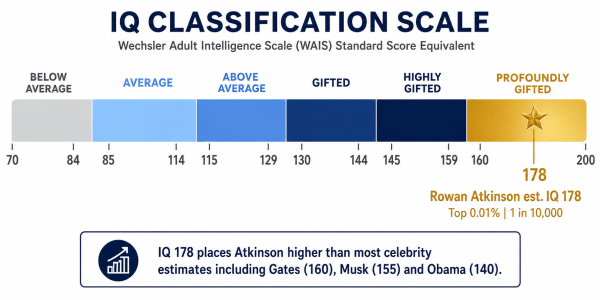
Rowan Atkinson's IQ is widely estimated at 178 across multiple analytical assessments of his cognitive profile. This figure is derived not from a publicly disclosed standardised test — Atkinson has never confirmed sitting a formal IQ assessment — but from the combination of his extraordinary academic record and professional achievement pattern.
An IQ of 178 would place him approximately 5.2 standard deviations above the population mean, in a range shared by roughly 1 in 10,000 people globally. On the Wechsler classification scale, this falls in the profoundly gifted category — well above the thresholds for Mensa membership (IQ 132) and most other high-IQ societies.
Some sources cite a lower estimate of approximately 139, which would still place him in the gifted range (top 1%). The range reflects genuine uncertainty — without a verified test score, any figure is an inference. What is verifiable is the academic credential that underpins the higher estimate: an Oxford MSc in Electrical Engineering is not obtained by average or even above-average intelligence. For context on what IQ scores in the 160–180 range mean in population terms, see our guides on IQ 160 and the IQ scale explained.
The Academic Record: From Newcastle to Oxford
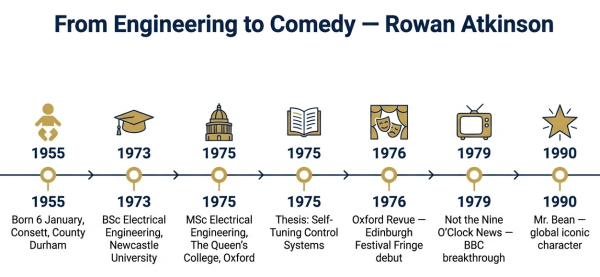
Rowan Sebastian Atkinson was born on 6 January 1955 in Consett, County Durham, England. He attended Durham Cathedral Choristers' School and then St. Bees School before embarking on one of the most academically rigorous paths of any major entertainer alive.
His academic pathway included:
- BSc in Electrical and Electronic Engineering — Newcastle University — one of the UK's leading engineering programmes
- MSc in Electrical Engineering — The Queen's College, University of Oxford — among the most academically demanding postgraduate qualifications available at the world's most selective institutions
- Thesis on Self-Tuning Control Systems — a sophisticated area of control theory involving algorithms that automatically adjust system parameters to maintain optimal performance, requiring advanced mathematical modelling and abstract systems thinking
- Brief doctoral enrolment — Atkinson was enrolled in a PhD programme before his comedy career pulled him away from academia entirely
The subject matter of his thesis is worth noting. Self-tuning control systems sit at the intersection of mathematics, signal processing, and systems engineering. The ability to think rigorously about how systems adapt their own parameters in response to changing conditions — essentially, thinking about thinking in mechanical terms — is a form of abstract reasoning that maps directly onto how comedy works: understanding how an audience's expectations shift in real time, and adjusting the performance to meet or subvert those expectations with precision.
Atkinson was awarded an Honorary Fellowship by The Queen's College, Oxford, in 2006 — a recognition reserved for those who have achieved exceptional distinction in their professional lives.
The Stutter That Shaped a Career
One of the less widely known facts about Rowan Atkinson is that he experienced a significant stutter throughout his childhood and early adult life. The stutter caused him considerable difficulty in ordinary social conversation, created fatigue and stress in school settings, and shaped his relationship with language in ways that would later define his comedy.
The pivotal discovery came at Oxford: when performing in character — playing someone other than himself — the stutter disappeared entirely. Atkinson has stated that this may have been one of the motivations, conscious or otherwise, for pursuing acting. Playing a character offered him a form of fluency he could not access as himself.
This biographical detail reframes his two most famous creations in an interesting light. Mr. Bean has almost no dialogue — the character communicates almost entirely through physical expression, facial contortion, and gesture. Blackadder, by contrast, is relentlessly verbal — a character defined by wit, wordplay, and the precision of language. Both choices reflect something about the relationship between intelligence, communication, and the creative freedom that performance offered someone who struggled with ordinary speech. The stutter appears in a stylised form in certain Blackadder episodes as a deliberate comic device — Atkinson converting a personal difficulty into a comedic tool. For more on how cognitive profile and communication intersect, see our guide on linguistic intelligence.
Two Characters, One Engineering Mind
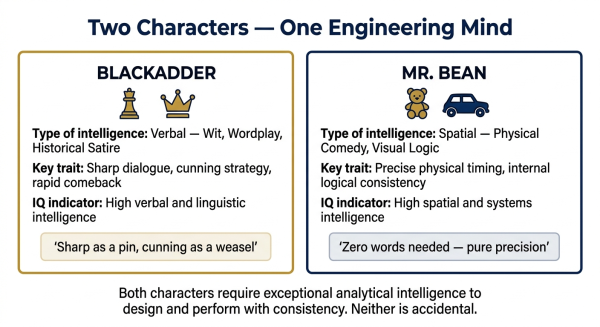
The most intellectually interesting aspect of Atkinson's career is that his two defining characters represent almost diametrically opposite types of intelligence — and both require genuine cognitive sophistication to execute.
Blackadder — Verbal and Strategic Intelligence
Blackadder (BBC, 1983–1989) is a masterwork of verbal comedy. Edmund Blackadder — across four series spanning the Tudor period, the Regency, World War One, and Elizabethan England — is defined by his wit, his contempt for those around him, his elaborate schemes, and his devastating put-downs. The show requires exceptional verbal intelligence to write, perform, and time: rapid wordplay, historical satire, multi-layered irony, and the kind of dialogue architecture that rewards multiple rewatches. Atkinson co-wrote the character with Richard Curtis and Ben Elton, and delivered lines with the precision of a comedian who understands exactly how language creates and releases tension.
Mr. Bean — Spatial and Systems Intelligence
Mr. Bean is almost entirely silent — and far more technically demanding than it appears. Atkinson has described the character as operating within a completely consistent internal logic: Bean has his own rules, his own problem-solving approach, his own relationship with the world. The humour emerges not from randomness but from the precise, systematic collision between Bean's internal logic and the expectations of the world around him.
This is not slapstick in the traditional sense. It is something closer to an engineer designing a system with specific inputs, outputs, and failure modes — then demonstrating, with precision, exactly how those failure modes manifest. The timing in Mr. Bean is not instinctive; it is architectural. Atkinson has compared it to solving engineering problems: there is a correct answer, and the work is finding the path to it.
The parallel with his academic work is not coincidental. A control systems engineer thinks about how systems respond to disturbances, how feedback loops operate, and how to design behaviour under uncertainty. A physical comedian thinks about how an audience's expectations form, how to calibrate the precise moment of subversion, and how to sustain a logical internal world that the audience can track. The cognitive operations are analogous.
The McLaren F1 and the Engineer's Eye
One frequently cited illustration of Atkinson's analytical intelligence is his famous purchase of the McLaren F1 in 1997. At the time, the McLaren F1 was one of fewer than 100 road cars ever built, and public interest in it as a collector's vehicle was limited. Atkinson's engineering background gave him an immediate appreciation of what the car represented technically — the most sophisticated road car ever built at that point, with a carbon fibre monocoque, a naturally-aspirated BMW V12 engine, and a central driving position. He purchased it when its collector value was not yet widely recognised.
He later crashed the car twice — in 1999 and 2011 — and had it repaired both times at a cost exceeding its original purchase price. He ultimately sold it in 2015 for a reported £8 million, having paid approximately £640,000 in 1997. The engineering appreciation that led him to buy it in the first place turned out to be financially vindicated at a scale few anticipated.
How Rowan Atkinson's IQ Compares
| Celebrity | Est. IQ | Strongest Evidence |
| Rowan Atkinson | ~178 | Oxford MSc Electrical Engineering |
| James Woods | ~180 | MIT (dropped out for acting) |
| Dolph Lundgren | ~160 | Sydney MSc Chemical Engineering + MIT Fulbright |
| Bill Gates | ~157–160 | SAT 1590/1600, Harvard Mathematics |
| Elon Musk | ~155 | Physics and Economics degrees |
| Barack Obama | ~140 | Columbia, Harvard Law Review editor |
Among entertainers specifically, Atkinson's academic credential is essentially unmatched. Most celebrity IQ estimates rely on SAT scores, test performance, or analyst inference. The Oxford MSc in Electrical Engineering provides direct evidence of analytical and mathematical ability at the highest level — a qualification that requires sustained performance in abstract mathematics, systems theory, and applied physics over multiple years. For a broader view of this group, see our Celebrity IQ database.
What Rowan Atkinson's Story Tells Us About Intelligence and Creativity
Atkinson's career trajectory — from engineering PhD candidate to global comedy icon — illustrates something important about the relationship between analytical intelligence and creative expression. The two are not opposites. The same cognitive operations that make someone excellent at control systems engineering — precision, systematic thinking, modelling how a system responds to inputs, designing for specific outputs — also make someone excellent at physical comedy.
Mr. Bean is not improvised. It is engineered. The character's logic is internally consistent across every episode, every sketch. Bean's relationship with his teddy bear, his Mini, his hotel room, his exam paper — each is governed by precise rules that Atkinson designed and maintained with the rigour of a systems engineer maintaining a model. The humour is the output of a system operating exactly as designed.
This connection between technical intelligence and creative precision appears across several careers in this genre. It is not coincidental that several of the most technically demanding comedy performers — those whose work holds up to repeated viewing because of its structural precision — come from backgrounds in mathematics, engineering, or the physical sciences. Intelligence in one domain does not transfer automatically to another, but the underlying cognitive operations — pattern recognition, systematic modelling, tolerance for abstract complexity — do.
For more on this relationship, see our guides on multiple intelligences and IQ vs creativity.
Rowan Atkinson's estimated IQ of 178 is supported by one of the strongest academic credentials of any entertainer alive — an Oxford MSc in Electrical Engineering. His career demonstrates that the same mind capable of modelling self-tuning control systems is also capable of designing a character so precisely that it communicates entirely without words. The comedian and the engineer are the same person.
Want to find out where your own cognitive profile sits? Take our free IQ test — no registration, results in under 20 minutes. Explore more in our Celebrity IQ database, or see what scores in this range look like with our guides on IQ 160 and IQ 145.
Frequently Asked Questions
What is Rowan Atkinson's IQ?
Rowan Atkinson's IQ is estimated at 178, based on his academic record and multiple analyst assessments. He holds a BSc in Electrical and Electronic Engineering from Newcastle University and an MSc in Electrical Engineering from The Queen's College, Oxford. No official standardised IQ test result has been made public.
What did Rowan Atkinson study at Oxford?
Rowan Atkinson studied Electrical Engineering at The Queen's College, Oxford, earning an MSc degree. His master's thesis was on Self-Tuning Control Systems — a demanding area of control theory involving algorithms that automatically adjust system parameters for optimal performance. He was briefly enrolled in a PhD programme before his comedy career took precedence.
Is Mr. Bean stupid in real life?
No — the opposite is true. Mr. Bean is played by Rowan Atkinson, who holds an MSc in Electrical Engineering from Oxford with an estimated IQ of 178. The genius of Mr. Bean is that the character operates within a precise internal logic — creating humour through the systematic collision of that logic with the outside world. Designing such a character requires exceptional analytical intelligence.
Did Rowan Atkinson have a stutter?
Yes. Rowan Atkinson experienced a significant stutter throughout his childhood and early life. He has stated that performing in character made the stutter disappear — which may have been one of the motivations for pursuing acting. The stutter appears in stylised form in certain Blackadder episodes as a deliberate comic device, demonstrating his characteristic ability to convert a personal difficulty into a comedic strength.
How does Rowan Atkinson's IQ compare to other celebrity geniuses?
Rowan Atkinson's estimated IQ of 178 places him above most celebrity IQ estimates, including Bill Gates (~160), Elon Musk (~155), and Barack Obama (~140). His Oxford MSc in Electrical Engineering provides more direct evidence of exceptional analytical ability than most celebrity IQ claims, which typically rely on SAT scores or retroactive estimates.

Comments
Share Your Thoughts