When people think of Bill Gates, they picture the co-founder of Microsoft, one of history's most successful software companies, and one of the most influential philanthropists of the modern era. But behind those achievements lies a question that continues to fascinate millions: just how intelligent is Bill Gates, and what is his actual IQ?
While Gates has never officially taken a public IQ test, the evidence he left behind — a near-perfect SAT score, exceptional academic performance at Harvard, and decades of original problem-solving at the highest levels — paints a compelling picture of extraordinary cognitive ability. This article breaks down what we actually know, what experts estimate, and what it all means in the broader context of human intelligence.

What Is Bill Gates' Estimated IQ?
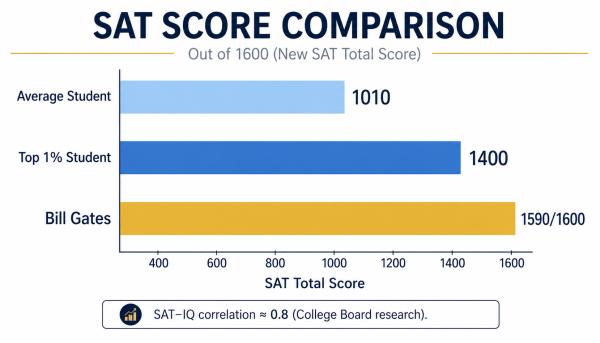
Most researchers and analysts who have studied Gates' cognitive profile place his IQ somewhere between 157 and 170, depending on the methodology used. The most widely cited estimate sits at around 160, derived primarily from his near-perfect SAT score of 1590 out of 1600 — placing him higher than an estimated 99.99% of the adult population.
One statistical analysis using SAT score averages and Harvard major data estimates Bill Gates' IQ at around 157, with a 95% confidence interval of 151 to 163. It is critical to note: no official IQ test result for Bill Gates has ever been made public. Every figure cited online is an estimate derived from academic proxies, not a verified score from a standardised assessment.
| Source of Estimation | Estimated IQ |
| SAT Score (1590 out of 1600) | ~160 |
| Harvard Mathematics Performance | 155–165 |
| Statistical Analysis (CogniDNA, 2025) | 157 ± 6 |
| General Expert Consensus | 160–170 |
For a full understanding of what scores in this range mean, see what an IQ of 150 means and our complete IQ scale explained guide.
Early Signs of Exceptional Intelligence
Bill Gates displayed signs of unusual cognitive ability long before Microsoft existed. At Lakeside School, a private institution known for academic rigour, Gates scored 1590 out of 1600 on the SAT — one of the highest scores ever recorded at the time. He was a National Merit Scholar and was admitted to Harvard University, one of the world's most selective institutions.
At Harvard, Gates enrolled as a pre-law student but immediately loaded up on mathematics and graduate-level computer science courses. He quickly gained academic accolades by developing an algorithm to solve an unsolved problem posed by Professor Harry Lewis in his combinatorics course — a remarkable achievement for any student, let alone a teenager in his first year.
At age 13, Gates wrote his first computer program. By 17, he and Paul Allen had built Traf-O-Data, a real-world traffic analysis system that earned them $20,000 — extraordinary for high school students in the early 1970s.
What Does an IQ of 160 Actually Mean?
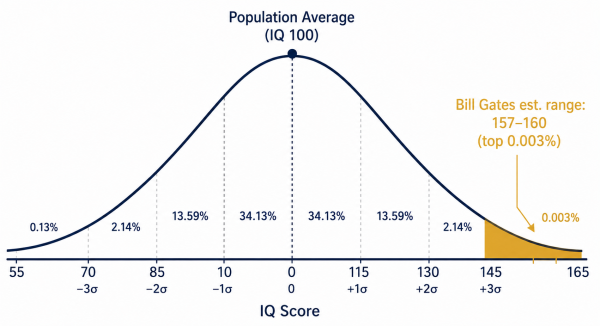
To put Gates' estimated IQ in perspective, it helps to understand the full population distribution. If you have recently taken our free IQ test and received your score, here is how different ranges compare:
| IQ Range | Classification | Population % |
| Below 70 | Significantly Below Average | ~2% |
| 85–114 | Average | ~68% |
| 115–129 | Above Average | ~14% |
| 130–144 | Gifted | ~2% |
| 145–159 | Highly Gifted | ~0.1% |
| 160+ | Profoundly Gifted | ~0.003% |
An IQ of 160 means Gates would score higher than roughly 99.997% of all people. For context, an IQ of 130 is already high enough to qualify for Mensa and many high-IQ societies. Gates' estimated score sits far above even that threshold — in a category occupied by fewer than 1 in 30,000 people globally.
The Harvard Dropout Who Changed the World
One of the most fascinating aspects of Gates' story is what he chose to do with his intelligence. In 1974, he and Paul Allen became captivated by the launch of the Altair 8800, one of the first commercially available personal computers. Seeing its potential, the two contacted the manufacturer claiming they had already written a version of BASIC for the machine — even though they had not yet started.
That calculated risk — staking a claim before the product existed — reflects not just raw IQ, but a rare combination of confidence, vision, and applied intelligence that goes far beyond what any standardised test can measure. Gates left Harvard after two years. Rather than viewing this as an academic failure, it is better understood as the decision of someone whose cognitive abilities had already outpaced the institutional structure around him.
Harvard later awarded him an honorary degree in 2007.
IQ vs. Other Forms of Intelligence: The Full Picture
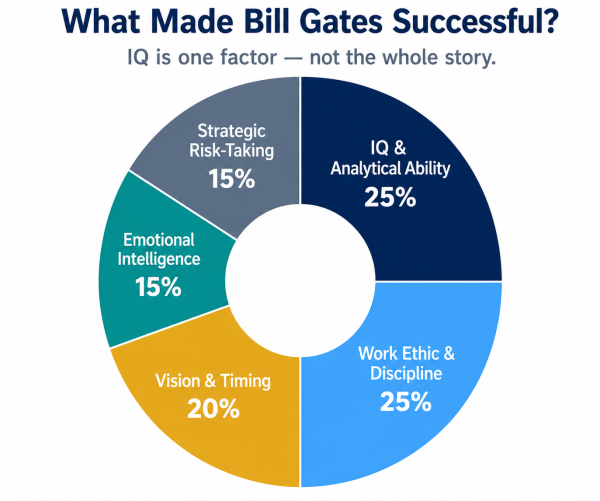
While estimates place Gates' IQ firmly in the genius threshold, raw cognitive ability was only one part of what made him extraordinary. Gates is equally known for several non-IQ traits that shaped his success:
- Reading 50 books per year — a discipline that reflects deep intellectual curiosity and structured self-education
- "Think Weeks" — twice-yearly off-grid retreats where he reads, reflects, and develops strategy without external distractions
- Long-term pattern thinking — the ability to anticipate where technology was heading years before competitors recognised it
- Emotional discipline — decades of sustained partnership with Warren Buffett, a man known more for wisdom than raw IQ, suggests Gates deeply values EQ alongside analytical power
This balance between cognitive intelligence and emotional intelligence is explored in depth in our guide on IQ vs EQ — which matters more? If you are curious about your own emotional intelligence profile alongside your IQ, our free EQ Test offers an instant baseline measurement.
How Does Bill Gates Compare to Other Geniuses?
Gates is often placed alongside a small group of figures whose estimated cognitive ability sits in a similar range. Here is how the comparisons look, keeping in mind that all celebrity IQ figures are estimates:
| Person | Estimated IQ | Notable Cognitive Trait |
| Bill Gates | 157–160 | Logical-mathematical reasoning |
| Albert Einstein | ~160 | Abstract theoretical thinking |
| Stephen Hawking | ~160 | Spatial and theoretical physics |
| Elon Musk | ~155 | Systems and engineering thinking |
| Barack Obama | ~140 | Verbal and analytical reasoning |
For a broader perspective on how the world's most recognised minds are assessed — and why these numbers should always be taken with caution — visit our full Celebrity IQ database.
Three Things We Can Actually Learn From Gates' IQ Story
1. IQ is a starting point, not a destination
Gates' estimated IQ of 160 gave him exceptional raw processing power. But it was his work ethic, intellectual curiosity, and willingness to take calculated risks that converted that potential into generational impact. For more on this dynamic, see our guide on can IQ be improved?
2. Academic credentials are not a reliable proxy for cognitive ability
Gates dropped out of Harvard and built one of the most valuable companies in human history. IQ measures cognitive potential — not institutional compliance. Our guide on IQ vs academic achievement examines this tension in detail.
3. Deep domain focus multiplies the value of high IQ
Gates did not try to be exceptional at everything. He focused obsessively on software and computing at exactly the moment history needed someone to do precisely that. High IQ directed by deep focus is exponentially more powerful than the same intelligence scattered across many domains. See also: IQ vs problem-solving skills.
Where Do You Stand? Discover Your Own IQ
Reading about someone like Bill Gates naturally raises the question: where do I stand cognitively? Our International Standard IQ Test is a free, culture-fair assessment based on visual reasoning — the same type of pattern recognition that underpins most standardised IQ evaluations. It takes around 15–20 minutes, requires no registration, and delivers an instant score with a full classification breakdown.
You can also explore what specific IQ scores mean in practice — for example, what an IQ of 120 or an IQ of 140 looks like in terms of career potential and day-to-day cognitive experience.
Final Verdict: Is Bill Gates a Genius?
By any reasonable definition — yes. Estimates of Bill Gates' IQ consistently fall between 160 and 170, placing him in a category of cognitive ability found in fewer than 1 in 30,000 people globally. But what makes Gates genuinely remarkable is not the number itself. It is the fact that he took extraordinary cognitive ability and paired it with extraordinary discipline, vision, and strategic focus — at exactly the right moment in technological history.
IQ tells you the ceiling. What you build beneath it is entirely up to you.
Frequently Asked Questions
What is Bill Gates' IQ?
Bill Gates' IQ is estimated at approximately 157–160, based primarily on his near-perfect SAT score of 1590/1600 and his academic performance at Harvard. No official verified IQ test result has ever been made public.
Has Bill Gates ever taken an official IQ test?
Not publicly. All estimates of his IQ are derived from indirect evidence — standardised test scores, academic achievements, and professional accomplishments — not from a verified administered assessment.
What was Bill Gates' SAT score?
Gates scored 1590 out of 1600 on the SAT — one of the highest scores recorded at the time, and a strong academic indicator of exceptional cognitive ability.
Is Bill Gates the smartest person alive?
Not necessarily. Many individuals have similar or higher estimated IQ scores. Gates himself has said he does not believe IQ is the most important measure of intelligence or the primary driver of success.
How does Bill Gates' IQ compare to the average?
The average IQ is 100. Gates' estimated IQ of 160 places him approximately four standard deviations above the mean — a level of cognitive ability found in fewer than 1 in 30,000 people worldwide.

Comments
Share Your Thoughts