Leonardo da Vinci never took an IQ test. He could not have — the first standardised intelligence assessment was not developed until 1905, by Alfred Binet in Paris, nearly four centuries after Leonardo's death in 1519. Every figure you will find online — the 180, the 200, the 220 — is a retrospective estimate, derived by scholars attempting to apply a 20th-century psychometric framework backward to a 15th-century Italian polymath whose intellectual world had no equivalent in the modern era.
And yet the question of Leonardo da Vinci's IQ is worth asking — not because the number can tell us something precise, but because the attempt to answer it reveals what conventional IQ tests actually measure, what they miss, and what it truly means to call someone the greatest mind in human history.
What Is Leonardo da Vinci's Estimated IQ?
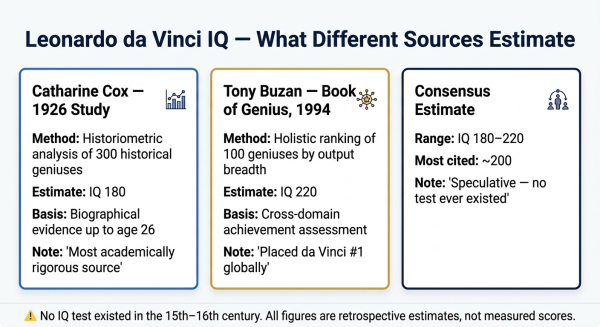
The most commonly cited range for Leonardo da Vinci's IQ is 180–220, with a consensus estimate of approximately 200. These figures originate primarily from two sources:
- Catharine Cox's 1926 study — Early Mental Traits of Three Hundred Geniuses — published as Volume II of Lewis Terman's Genetic Studies of Genius series at Stanford University. Cox estimated IQ scores for 300 eminent historical figures using biographical evidence such as documented early achievements, anecdotal accounts of intellectual precocity, and school records where available. Cox estimated Leonardo's IQ at approximately 180, placing him among the highest-scoring figures in her sample
- Tony Buzan's 1994 Book of Genius — which ranked 100 historical geniuses using a holistic assessment of cross-domain achievement. Buzan placed Leonardo first overall with an estimated IQ of 220, crediting his extraordinary breadth across art, science, and engineering as unmatched in recorded history
The disparity between the two figures — Cox's 180 and Buzan's 220 — reflects the fundamental problem with retrospective IQ estimation: different methodologies produce different numbers, and neither can be validated against any actual test. As Malevus, an art history resource, noted plainly: the 180–220 range is "entirely made up." Not in the sense that it is random — but in the sense that no one measured it, and no methodology for measuring it reliably exists.
What is not made up is the achievement record on which these estimates are based — and that record is genuinely extraordinary. For a full explanation of why retroactive historical IQ estimates are inherently speculative, see our guide on the highest IQ of all time.
The Catharine Cox Study: The Most Academic Source
Catharine Cox's 1926 historiometric study remains the most academically rigorous source for retroactive historical IQ estimation. Working within Lewis Terman's Genetic Studies of Genius programme at Stanford, Cox gathered biographical evidence for 300 eminent historical figures and had panels of trained psychologists estimate their IQ scores based on documented early intellectual development.
The method has genuine academic merit: it applies systematic criteria, uses multiple raters, and acknowledges explicitly that the estimates represent a floor rather than a precise measurement — Cox stated that the figures indicate "a point below which the true IQ probably did not fall." But it has significant limitations that Cox herself acknowledged:
- The quality of estimates depends entirely on the richness of available biographical evidence — figures with better-documented early lives receive more reliable estimates
- The framework applies modern psychometric concepts to cognitive environments that are fundamentally different in terms of available education, knowledge, and cultural context
- Five trained raters disagreed substantially enough that Cox excluded 40% of her data — suggesting the method's reliability is lower than its precision implies
For Leonardo specifically, the biographical record of his early life is relatively thin — he was illegitimate, his early education is poorly documented, and the rich surviving record of his work postdates the developmental period Cox focused on. Her estimate of IQ 180 should be understood as a reasoned lower bound, not a precise measurement. For the broader context of how historical IQ claims should be evaluated, see our guide on the IQ scale explained.
Why Historical IQ Cannot Be Measured: The Four Problems
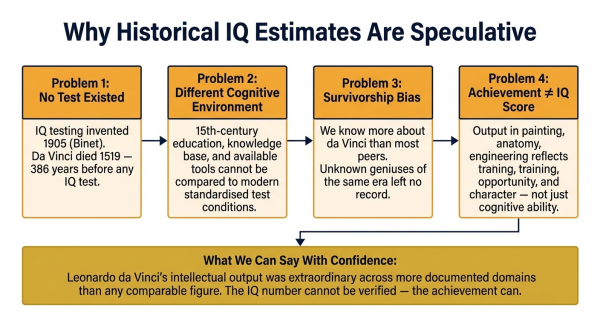
Before examining what Leonardo da Vinci actually achieved, it is worth understanding precisely why assigning him an IQ number is fundamentally different from measuring the IQ of a living person:
Problem 1: No test ever existed. IQ testing was invented in 1905 — 386 years after Leonardo's birth. Any score assigned to him is extrapolated from achievement evidence, not from any administered assessment.
Problem 2: The cognitive environment was completely different. Leonardo lived in 15th-century Italy, in a world without the scientific method as we know it, without printing press access until his twenties, without calculus, without formal anatomy education, and without any of the accumulated knowledge infrastructure that modern IQ tests are calibrated against. Comparing his cognitive performance to a modern test score is like comparing two runners who ran completely different courses at different altitudes in different weather — the times cannot be directly compared.
Problem 3: Survivorship bias. We know about Leonardo because his notebooks survived, his paintings survived, and his patrons documented his work. Countless individuals of comparable or greater native cognitive ability in the same era left no record — they died in wars, were born into serfdom, could not access education, or produced work that did not survive. We are not estimating the IQ of 15th-century Italy's most intelligent person; we are estimating the IQ of 15th-century Italy's most documented extraordinary person.
Problem 4: Achievement reflects more than raw intelligence. Leonardo's output reflects his native cognitive ability, but also his extraordinary curiosity, his access to wealthy patrons, his physical location in Renaissance Florence and Milan at moments of extraordinary cultural productivity, his willingness to dissect human cadavers in violation of social norms, and his unusual personality. IQ captures a component of what produced his output — but only a component. For more on this, see our guide on IQ vs creativity.
What Leonardo Actually Did: The Achievement Record
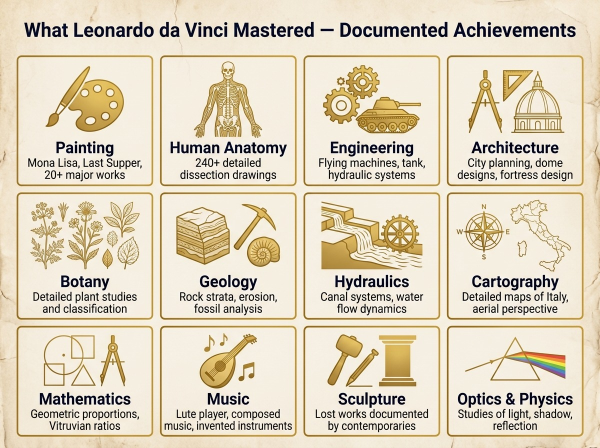
The strongest case for Leonardo's extraordinary intelligence is not any estimated number — it is the documented record of what he actually produced. Leonardo da Vinci (1452–1519) achieved lasting, independently verified contributions in more distinct intellectual domains than any other individual in the European historical record whose work survives in comparable completeness.
Painting and Visual Art
The Mona Lisa remains the most visited painting in the world, studied for centuries for its revolutionary use of sfumato (the technique of blending colour and tone without hard borders), its ambiguous psychological depth, and the landscape behind the subject — which geologist Ann Pizzorusso has identified as a precisely accurate rendering of the area around Lecco in northern Italy. The Last Supper, though badly deteriorated, remains one of the most reproduced and studied paintings in history. The Vitruvian Man is simultaneously a work of art, a mathematical statement about human proportion, and a philosophical claim about the relationship between human geometry and universal harmony.
Human Anatomy
Leonardo produced over 240 detailed anatomical drawings through direct dissection of human and animal cadavers — conducted at a time when such dissection was socially transgressive and practically dangerous. His drawings of the heart, the foetus in the womb, the musculature of the face, and the structure of bones anticipated medical knowledge that would not be independently established for centuries. While his fame initially rested on his achievements as a painter, he has also become known for his notebooks, in which he made drawings and notes on a variety of subjects, including anatomy, astronomy, botany, cartography, painting, and palaeontology. His anatomical work was not published in his lifetime — rediscovered in the 19th century, it astonished medical historians who recognised its accuracy.
Engineering and Invention
Leonardo's notebooks contain designs for flying machines based on his study of bird flight — including an ornithopter and a helical aerial screw (considered a precursor to the helicopter concept). He designed an armoured vehicle, a solar power concentrator, a calculator, a robotic knight, ball bearings, and hydraulic machines. Most were never built in his lifetime; several have been reconstructed from his drawings in the modern era and found to be functional in principle. His designs for moveable barricades at Venice in 1499 were among his few technical achievements actually implemented during his life.
Hydraulics and Water Studies
Leonardo spent years studying water — its flow, turbulence, wave patterns, and erosive properties. He produced detailed drawings of fluid dynamics that anticipated principles not formally described until the 19th and 20th centuries. He designed canal systems and flood control mechanisms for Milan and Florence. His water studies represent some of the earliest documented observation-based fluid mechanics in European history.
Botany, Geology, and Cartography
His notebooks contain detailed botanical studies — plants rendered with the precision of a modern scientific illustrator, accompanied by notes on their structure and growth patterns. His geological observations included analysis of rock strata and fossil formation that challenged the biblical chronology of his era. His maps of Italy and the surrounding region were among the most accurate of their time, created using an aerial perspective that anticipated satellite-style cartography by five centuries.
The Cognitive Profile Behind the Achievement
Rather than a single IQ number, the cognitive profile that Leonardo's documented output suggests is a particular combination of capacities that modern psychologists recognise as extremely rare in combination:
- Exceptional visual-spatial intelligence — the ability to perceive, represent, and mentally manipulate three-dimensional structures with extraordinary precision. His anatomical drawings, engineering designs, and paintings all require this capacity at the highest documented level
- Extraordinary observational acuity — the ability to look at a thing — a bird in flight, a water vortex, a human face, a geological stratum — and perceive structural relationships that are invisible to ordinary observation. This is a form of perceptual intelligence that IQ tests measure only partially
- Cross-domain synthesis — the ability to recognise that insights from one domain apply to another. His study of water turbulence informed his understanding of how hair curls. His anatomical knowledge informed his painting. His observation of birds informed his engineering. This synthetic cross-domain intelligence is what made him a polymath rather than merely a specialist in multiple fields
- Sustained intellectual curiosity — a lifelong, almost compulsive drive to understand how things work. His notebooks were not finished products; they were thinking tools, filled with questions as often as answers. This motivational dimension of his genius is not measured by any IQ test
For more on how these different cognitive capacities relate to measured intelligence, see our guides on multiple intelligences and cognitive flexibility.
How Da Vinci Compares to Other Historical Geniuses
| Historical Figure | Est. IQ Range | Source | Primary Domain |
| Johann W. Goethe | 210–225 | Cox 1926 / Buzan 1994 | Literature, natural science |
| Leonardo da Vinci | 180–220 (~200) | Cox 1926 / Buzan 1994 | Polymath — all domains |
| Isaac Newton | ~190 | Cox 1926 / various | Mathematics, physics |
| Albert Einstein | ~160 | Retroactive estimate | Theoretical physics |
| Nikola Tesla | ~140–160 | Retroactive estimate | Electrical engineering |
The comparison with Einstein is instructive. Einstein's estimated IQ of approximately 160 is itself retroactive — he never took a standardised IQ test either. What separates Leonardo from Einstein in these rankings is primarily the breadth of his achievement: Einstein transformed physics but did not produce work of comparable significance in any other domain. Leonardo transformed multiple fields simultaneously, which is why Buzan ranked him first even though thinkers like Newton and Goethe arguably produced deeper work within their individual specialisations.
The Unfinished Notebooks: A Window Into How He Thought
Perhaps the most revealing evidence of Leonardo's cognitive profile is not his finished paintings or his engineering designs — it is the unfinished notebooks. Approximately 6,000 pages of his notes and drawings survive, representing perhaps one-third of his original output. They are filled not with tidy conclusions but with questions, observations, half-developed ideas, drawings that think through problems rather than illustrate solved ones.
He habitually wrote in mirror script — right to left, readable only in a mirror. Whether this was for secrecy, because he was naturally left-handed (which he was), or because it simply suited how his mind moved, scholars disagree. What the notebooks reveal is a mind that treated drawing as a form of thinking rather than a form of communication — sketches that exist to work something out, not to show someone else what had been worked out. This is cognitively distinctive: the ability to use spatial representation as a reasoning tool, not merely a recording tool.
The notebooks also reveal the breadth of his attention. A single page might contain anatomical studies of the shoulder, a note on the reflection of light in water, a design element for a stage set, a musical notation, and a shopping list. The absence of compartmentalisation — the refusal to separate intellectual domains into categories — is itself a cognitive signature that no IQ test is designed to measure.
Leonardo da Vinci's IQ of approximately 180–220 is a retrospective estimate with no test behind it. What is not estimated is the achievement: the Mona Lisa, the anatomical drawings, the flying machine designs, the hydraulic systems, the geological observations. The number attempts to summarise what those achievements imply about the mind that produced them. But no number can capture a mind that refused, across its entire seventy-seven years, to stay within any single domain long enough for any domain to contain it.
Curious where your own cognitive profile sits relative to history's greatest minds? Take our free IQ test — no registration, results in under 20 minutes. For the full context of how da Vinci fits into the landscape of extreme intelligence claims, see our guide on the highest IQ of all time. Explore our full Celebrity IQ database for more profiles.
Frequently Asked Questions
What was Leonardo da Vinci's IQ?
Leonardo da Vinci's IQ is most commonly estimated at 180–220, with a consensus of approximately 200. The most academic source is Catharine Cox's 1926 historiometric study (Early Mental Traits of Three Hundred Geniuses), which estimated 180. Tony Buzan's 1994 Book of Genius estimated 220 and ranked him first among all historical geniuses. No standardised IQ test existed during his lifetime — all figures are retrospective estimates.
Was Leonardo da Vinci the smartest person in history?
He is widely regarded as one of the most extraordinary intellects in recorded history, and Buzan's 1994 ranking placed him first. However, "smartest person ever" cannot be meaningfully evaluated — different methodologies produce different rankings, and comparing across centuries involves too many confounding variables to produce reliable conclusions. What can be said: his documented output across more domains than any comparable historical figure makes him the most compelling candidate for the title of greatest polymath in European history.
What is the Catharine Cox study?
Catharine Cox's 1926 study Early Mental Traits of Three Hundred Geniuses — published as part of Lewis Terman's Genetic Studies of Genius at Stanford — estimated IQ scores for 300 eminent historical figures using biographical evidence. It is the most academically rigorous source for retroactive historical IQ estimation, but has significant limitations: it relies on available biography, applies modern psychometric concepts to different cognitive environments, and produced substantially different results across raters.
How many fields did Leonardo da Vinci master?
Leonardo produced significant, independently documented work in: painting, human anatomy, engineering, architecture, hydraulics, botany, geology, cartography, mathematics, music, and optics. He is generally considered the most comprehensively documented polymath in European history — achieving lasting contributions in more distinct fields than any other individual whose work survives in comparable detail.
What is Leonardo da Vinci's most impressive intellectual achievement?
This is genuinely difficult to answer. In art: the Mona Lisa and The Last Supper. In science: his anatomical studies, conducted through direct dissection, produced drawings that surpassed contemporary medical understanding and anticipated modern anatomical knowledge by centuries. In engineering: his designs for flying machines and hydraulic systems anticipated principles independently rediscovered hundreds of years later. The case for "most impressive" depends entirely on which domain you value most — which is itself part of what makes him extraordinary.

Comments
Share Your Thoughts