On 7 January 1943, a maid at the Hotel New Yorker discovered the body of Nikola Tesla in Room 3327. He was 86 years old. He had been living alone in the hotel for a decade, his expenses paid by a modest stipend arranged by the Yugoslav government. He had no money of his own. The patents on the AC electricity system that powers virtually every building in the modern world had long since expired. His vision of wireless energy transmission — Wardenclyffe Tower — had been demolished during World War One. His name was barely remembered by most Americans.
Six months after his death, the United States Supreme Court ruled that Nikola Tesla had priority over Guglielmo Marconi in the invention of radio. The ruling that should have secured his fortune and reputation came decades too late to matter to the man himself.
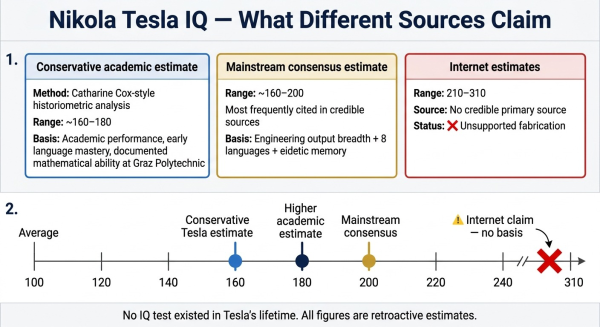
Nikola Tesla's IQ is estimated at 160–200 by most credible sources, with online figures ranging as high as 310. No test ever existed — he died twelve years before any standardised intelligence assessment could have been administered to him. What did exist was a mind that built the electrical infrastructure of the modern world from mental images alone, spoke eight languages, and filed more than 300 patents — while dying in a hotel room without a cent to his name. This article examines what that mind was, what it could do, and what it could not.
What Was Nikola Tesla's IQ?
Nikola Tesla's IQ is impossible to verify — he died before the concept of standardised intelligence testing was even fully established. The Binet-Simon scale, the first published intelligence test, appeared in 1905, when Tesla was already 49 years old. The WAIS, which most people today mean when they say "IQ test," was not developed until 1955. Any specific figure attached to Tesla's name is a retroactive estimate, not a measurement.
The range of estimates reflects the absence of any clean methodological anchor:
- 160–180 — the academically defensible range, using the same historiometric approach as Catharine Cox's 1926 study of historical geniuses (covered in our article on Leonardo da Vinci's IQ). This is based on documented early mathematical ability, multilingual mastery, and documented academic performance at Graz Polytechnic
- 160–200 — the most common consensus estimate across credible analytical sources, incorporating his breadth of engineering output, eidetic memory, and documented spatial visualization ability
- 210–310 — figures appearing on low-quality internet sites with no primary source, no methodology, and no credibility. The 310 figure in particular has no more evidentiary basis than any arbitrarily large number
The most honest answer is: Tesla's cognitive ability was genuinely extraordinary, his spatial and mechanical intelligence may have been unprecedented in the history of electrical engineering, and the specific number attached to any estimate reflects the guesser's assumptions more than any underlying measurement. For more context, see our guide on the highest IQ of all time. For comparison with another historical figure facing the same estimation challenge, see our profile of Leonardo da Vinci's IQ.
The Cognitive Signature That Makes Tesla Unique
Rather than debating an unknowable number, the more productive question is: what specific type of cognitive ability did Nikola Tesla demonstrate, and how extreme was it?
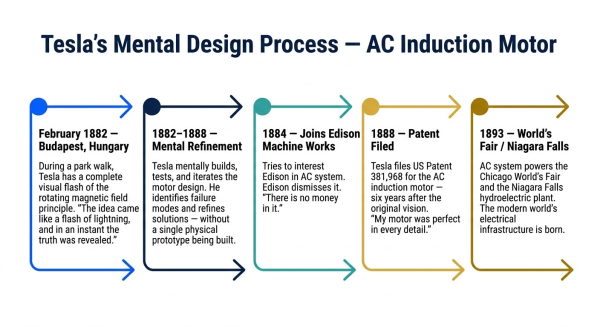
The answer is almost universally agreed upon by biographers and historians of science: Tesla possessed a form of visual-spatial imagination that was, by any standard, extraordinary. In his 1919 autobiography, he described his childhood ability to visualise mechanical systems with such completeness and resolution that he could run them mentally, identify their failure modes, and modify their designs — all without touching physical materials.
He wrote: "I do not rush into actual work. When I get an idea, I start at once building it up in my imagination. I change the construction, make improvements and operate the device in my mind. It is absolutely immaterial to me whether I run my turbine in thought or test it in my shop. The inventions I have conceived in this way have always worked. In thirty years there has not been a single exception."
This is not hyperbole for public consumption. His engineering history confirms it: he filed the patent for the AC induction motor in 1888 — six years after the concept first appeared to him in a mental image during a walk in a Budapest park in 1882. He spent those six years refining the design entirely in his head. The physical machine, when finally built, worked exactly as mentally designed. This is spatial intelligence operating at a level that no standardised test is designed to measure, and that very few humans in history have demonstrated. For more on how spatial intelligence relates to IQ scores, see our guide on multiple intelligences.
From Smiljan to Graz: The Making of an Extraordinary Mind
Nikola Tesla was born on 10 July 1856 in the village of Smiljan, in a region of the Austro-Hungarian Empire now part of Croatia. His father Milutin was a Serbian Orthodox priest; his mother Đuka Tesla was, by his own account, an inventor of household tools and devices who had developed exceptional memory as a necessity of running the household without access to reading materials in her youth. Tesla attributed much of his inventive drive to his mother: "I must trace to my mother's influence whatever inventiveness I possess," he wrote in 1919.
His early mathematical ability was exceptional to the point of appearing dishonest. At the Higher Real Gymnasium in Karlovac, Croatia, his teachers accused him of cheating because he performed complex calculations in his head faster than anyone believed possible without written work. He completed a four-year programme in three years. At Graz Polytechnic in Austria (1875), studying electrical engineering, he observed a demonstration of a direct current generator and almost immediately identified a fundamental inefficiency in its design — the question that would occupy him for the next seven years: why convert alternating current to direct current at all?
He spoke eight languages — Serbian, Croatian, Czech, English, French, German, Hungarian, and Italian. This multilingual profile, combined with his reported eidetic (photographic) memory and ability to memorise entire books, reflects the same exceptional working memory and pattern-acquisition speed that underlies his engineering achievements. The cognitive signature is consistent across domains: he absorbed information at unusual speed, retained it with unusual completeness, and manipulated it with unusual spatial precision.
What He Built: The Documented Achievement Record
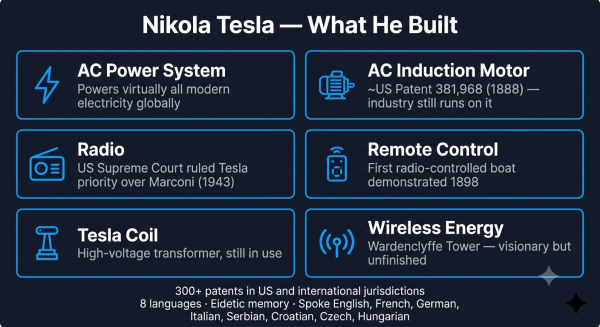
Tesla's documented inventions and patents constitute what is arguably the most consequential engineering legacy of the 19th and early 20th century:
The AC Power System and Induction Motor
The AC polyphase induction motor and power system — patented in 1888 and licensed to George Westinghouse — became the global standard for electrical power transmission. The AC system powered the 1893 Chicago World's Fair (defeating Edison's DC proposal), and the Niagara Falls hydroelectric plant (1895), which demonstrated for the first time that electricity could be transmitted efficiently over long distances. Virtually all electrical infrastructure in the modern world runs on AC principles that Tesla established. The AC induction motor is still in production essentially unchanged from his 1888 design — a 136-year lifespan for a single engineering concept.
Radio — The Supreme Court Ruling
In June 1943, six months after Tesla's death, the United States Supreme Court ruled in Marconi Wireless Telegraph Co. of America v. United States that Tesla's earlier radio frequency patents had priority over Guglielmo Marconi's claims. Marconi had received the Nobel Prize in Physics in 1909 — partly because Tesla had not successfully asserted his patent rights during his lifetime. The ruling recognised Tesla as the legal inventor of radio in the United States, a recognition that came too late to benefit him financially or reputationally in his lifetime.
Remote Control
In 1898, Tesla demonstrated the first radio-controlled vehicle — a small boat operated by wireless remote control at an exhibition in Madison Square Garden. He called it the "telautomaton." The audience assumed he was operating it through a trained monkey. He had actually invented remote control more than a century before the concept became ubiquitous. He filed patents for the principle and offered the concept to the US Navy as a weapons system; they declined.
Additional Patents and Contributions
Tesla filed over 300 patents across the United States and internationally, covering: the Tesla coil (a high-voltage transformer still in use today), fluorescent lighting principles, early X-ray imaging (which he was developing before Röntgen's official discovery), radar principles (a concept he proposed in 1917 for detecting submarines), and the rotating magnetic field principle that underlies modern electric motors of all kinds — including every electric vehicle motor on the road today.
Tesla vs Edison: Two Types of Genius
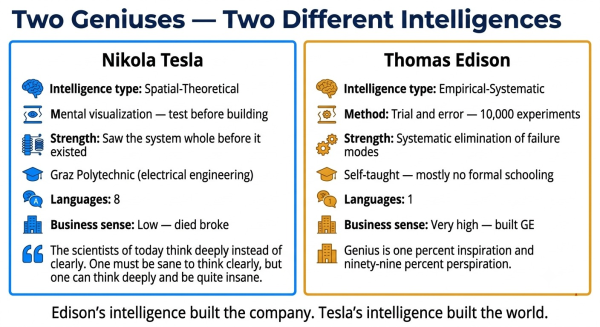
The War of Currents — Edison's public campaign to discredit AC electricity in favour of his DC system in the late 1880s and early 1890s — is the most famous intellectual confrontation in the history of electrical engineering. It is also one of the most instructive comparisons of different types of intelligence in the history of science.
Edison was, by most accounts, a remarkably intelligent man — but his intelligence was primarily empirical. His famous approach was systematic elimination: try 10,000 filament materials, observe which fail, keep going. He famously said: "I have not failed. I've just found 10,000 ways that won't work." His approach required enormous persistence, organisation, and pattern recognition across experimental results — a form of crystallised intelligence driven by systematic observation.
Tesla's intelligence was primarily theoretical and spatial: he saw the complete system before it existed, tested it mentally, and arrived at the solution before touching physical materials. When he observed Edison's men performing unnecessary calculations, he reportedly told him he could solve the problem analytically. Edison's response was: "There is no money in it." Both responses were accurate descriptions of how each man's mind worked.
The War of Currents ended with Tesla's AC system as the clear technical victor — its efficiency advantages over long distances made DC economically unviable for widespread electrical distribution. Edison's company eventually adopted AC. But Edison built General Electric. Tesla died in debt. The technical genius and the commercial genius were not in the same man. For more on how this pattern appears across different types of intelligence, see our guide on IQ vs problem-solving and our profile of Chris Langan — another figure whose analytical intelligence did not translate into practical outcomes.
The Tragedy of Wardenclyffe Tower
Tesla's most ambitious project — and the one whose failure most clearly illustrates the gap between his intellectual vision and his practical situation — was the Wardenclyffe Tower on Long Island, New York. Begun in 1901 with funding from financier J.P. Morgan, it was designed to be the world's first transatlantic wireless communication and energy transmission facility. Tesla envisioned it as the first node of a global wireless network — a system that would transmit information and power to any point on Earth without wires.
The vision was a century ahead of its time. The basic conceptual framework — wireless transmission of information across global distances — describes the internet. Morgan withdrew funding in 1903, reportedly after learning that Tesla's wireless system would make it difficult to charge per unit of use (unlike wired systems). The tower stood uncompleted until 1917, when the US government demolished it, concerned that German spies might use it for communications. Tesla received nothing for its demolition.
He spent his final 25 years in New York hotels — first the Waldorf-Astoria when his finances still permitted it, and eventually the Hotel New Yorker — feeding pigeons in Bryant Park, filing increasingly speculative patents, and maintaining an active intellectual correspondence that few took seriously. He was convinced he had communicated with extraterrestrial intelligence through his wireless transmission experiments. He claimed to have developed a "death ray" particle beam weapon. The line between visionary and delusion is one that his later career made difficult to draw.
The Pigeon He Loved and the Mind That Would Not Rest
In his later years, Tesla described a profound attachment to a specific white pigeon that he had befriended during his daily visits to Bryant Park. He wrote about it with an intensity that disturbed some contemporaries: "I loved that pigeon as a man loves a woman, and she loved me. As long as I had her, there was a purpose to my life." When the pigeon died, he described feeling that something in him had died as well.
This is not mere eccentricity — it is a window into the emotional isolation that accompanied his cognitive singularity. Tesla never married, maintained very few close personal relationships, and by his own account struggled with the social dimensions of human life in ways that his intellectual life never complicated. The pattern — exceptional analytical and spatial intelligence, significant social and emotional isolation, difficulty navigating institutional and commercial systems — appears repeatedly in the biographical literature on extreme cognitive ability. See our guides on IQ vs EQ and signs of a gifted child for more on this pattern.
What Tesla's Story Teaches Us About Intelligence
Nikola Tesla is one of the most instructive figures in the history of intelligence precisely because of the gap between his intellectual output and his life outcomes. He is the man who invented the electrical infrastructure of the modern world — and died broke. Several lessons emerge:
- Extreme spatial intelligence does not transfer to financial intelligence. Tesla's ability to design complex electrical systems mentally had no analogue in his ability to manage contracts, protect his interests, or maintain commercial relationships. He gifted Westinghouse his royalty rights in the 1890s to keep the company solvent during a financial crisis — an act of generosity that cost him an estimated lifetime income of $12 million. He could not construct a mental model of how commercial systems work the way he could construct one of a rotating magnetic field
- Being right too early is commercially equivalent to being wrong. The Wardenclyffe Tower project was conceptually vindicated by the development of the internet a century later. This vindication was useless to Tesla, who needed the financial return in 1903, not in 2003
- Recognition delayed is recognition denied. The Supreme Court ruled in his favour on radio priority six months after he died. The Nobel Prize, which he and Edison were rumoured to have been jointly awarded in 1915, was ultimately not given to either man. He received major recognition from foreign governments (the Yugoslav government, the Czechoslovak government) but died effectively unknown to most of the American public whose electrical infrastructure he had designed
Nikola Tesla's IQ is estimated at 160–200 — a retroactive inference from an extraordinary engineering output and a documented cognitive profile that included eidetic memory, eight languages, and a spatial imagination so precise that he built and tested the AC induction motor entirely in his mind before filing a single patent. What IQ estimates cannot capture is the tragic inverse: the same mind that saw rotating magnetic fields in a Budapest park could not see the financial and political forces that would strip his greatest project down to its foundations while he was still alive to watch.
Take our free IQ test to find out where your own cognitive profile sits. For more on how Tesla compares to other historical geniuses, see our guide on the highest IQ of all time and our profile of Leonardo da Vinci's IQ. Explore our full Celebrity IQ database.
Frequently Asked Questions
What was Nikola Tesla's IQ?
Nikola Tesla's IQ is most commonly estimated at 160–200, with some sources citing up to 310. No IQ test ever existed during his lifetime (1856–1943) — all figures are retroactive estimates. A defensible estimate based on documented cognitive abilities and academic performance would place him in the 160–180 range. The 210–310 figures appearing online have no credible primary source.
What was Tesla's most remarkable cognitive ability?
Tesla's most documented remarkable ability was his extraordinary visual-spatial imagination — the ability to mentally construct, test, and refine complete mechanical and electrical systems without physical prototypes. He designed and tested the AC induction motor entirely in his mind over six years before filing a patent in 1888. He wrote: "In thirty years there has not been a single exception" to his mental models working when physically realised.
How many languages did Tesla speak?
Nikola Tesla reportedly spoke eight languages: Serbian, Croatian, Czech, English, French, German, Hungarian, and Italian. Combined with his reported eidetic memory and ability to memorise entire texts, this multilingual profile reflects the same exceptional working memory and pattern-acquisition capacity that underlies his engineering achievements.
Why did Tesla die broke?
Tesla died alone and in debt on January 7, 1943, in Room 3327 of the Hotel New Yorker. He had gifted Westinghouse his royalty rights in the 1890s to keep the company solvent, costing him an estimated $12 million in lifetime income. J.P. Morgan withdrew funding from his Wardenclyffe Tower project in 1903. He lacked the commercial and legal acumen to protect his financial interests. His final years were supported by a Yugoslav government stipend.
Did Tesla or Marconi invent the radio?
In 1943, the US Supreme Court ruled that Tesla's earlier radio frequency patents had priority over Marconi's, establishing Tesla as the legal inventor of radio in the United States. Marconi had received the Nobel Prize for radio in 1909. The ruling came six months after Tesla's death and did not affect his financial or reputational circumstances during his lifetime.

Comments
Share Your Thoughts