The number 160 is cited as Albert Einstein's IQ on thousands of websites. It appears in textbooks, documentaries, and motivational posters. There is one significant problem: Einstein never took a standardized IQ test, and no verified score exists. This article covers what the historical and scientific record actually shows — including the brain research conducted after his death, the real story of his early academic performance, and what made his mind genuinely extraordinary. For context on how IQ is measured today, see the complete guide to IQ and the Celebrity IQ Database.
The IQ 160 Claim: Where It Comes From
When Einstein was alive (1879–1955), the modern IQ test was in its infancy. The Stanford-Binet scale gained traction in the 1910s and 1920s — by which time Einstein was already a celebrated professor and Nobel laureate. He never participated in standardized psychometric testing and left no record of interest in doing so.
The figure of 160 appears to originate from retrospective estimation — psychologists and science writers extrapolating from his intellectual output what his score might have been. Notably, the same figure of 160 is attributed to Stephen Hawking for the same reason: it functions as cultural shorthand for "the highest measurable genius" rather than as a psychometric fact.
What this means practically: any comparison between Einstein's "IQ 160" and, say, a contemporary's verified score of 145 is comparing an estimate to a measurement — a fundamentally misleading exercise. For more on how celebrity IQ estimates are derived and why they should be interpreted cautiously, see the highest IQ in history guide.
The Early Failures: What the Record Actually Shows
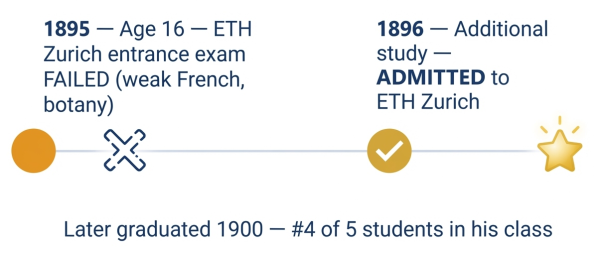
One of the most widely circulated myths about Einstein is that he "failed math in school." This is factually incorrect — Einstein excelled at mathematics and physics throughout his education. What is true:
- 1895, age 16: Einstein failed the entrance examination to the Swiss Federal Polytechnic (ETH Zurich) on his first attempt. The exam required competence across multiple subjects including French language and botany — areas where he was weak. The mathematics and physics sections, however, were reportedly exceptional. He was advised to complete an additional year of secondary school.
- 1896: Einstein was admitted to ETH Zurich after additional study.
- 1900: He graduated from ETH — ranking fourth out of five students in his cohort. Not a failure, but not the top of his class either.
- 1902–1905: Unable to secure an academic position after graduation, Einstein worked as a patent clerk (Technical Expert, Third Class) in Bern — a fact that makes what came next even more remarkable.
This record is consistent with a pattern seen in many historically significant scientific minds: strong but not uniformly exceptional academic performance, combined with exceptional depth of focus in specific domains. It is inconsistent with the myth of a universally perfect student.
The Annus Mirabilis: 1905
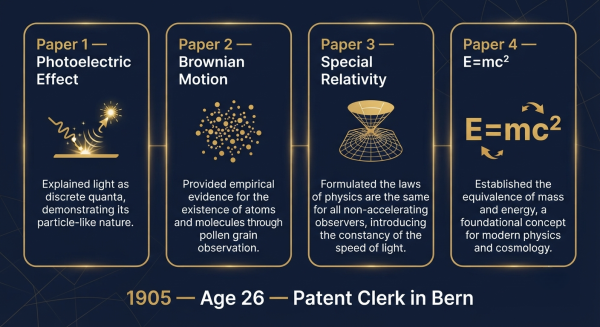
In 1905, while working as a patent clerk, Einstein published four papers in the journal Annalen der Physik — any one of which would have been sufficient for a distinguished scientific career. The four together represent the most productive single year in the history of physics by a single individual:
- The Photoelectric Effect: Proposed that light exists in discrete packets (photons), laying the foundation for quantum mechanics. This paper later earned Einstein the 1921 Nobel Prize in Physics.
- Brownian Motion: Provided mathematical proof of the existence of atoms by explaining the random movement of particles in fluid — settling a debate that had persisted for decades.
- Special Theory of Relativity: Demonstrated that the laws of physics are the same for all non-accelerating observers, and that the speed of light is constant — overturning Newtonian mechanics and establishing that time and space are relative to the observer.
- Mass-Energy Equivalence (E=mc²): Derived from Special Relativity, demonstrating the relationship between mass and energy — arguably the most famous equation in the history of science.
Einstein was 26 years old. He had no academic appointment. He had been working at the patent office for three years. The concentration of insight in a single calendar year remains without parallel in physics. For context on how this type of extraordinary productive output relates to intelligence, see the IQ vs creativity guide.
Einstein's Brain: What the Research Found
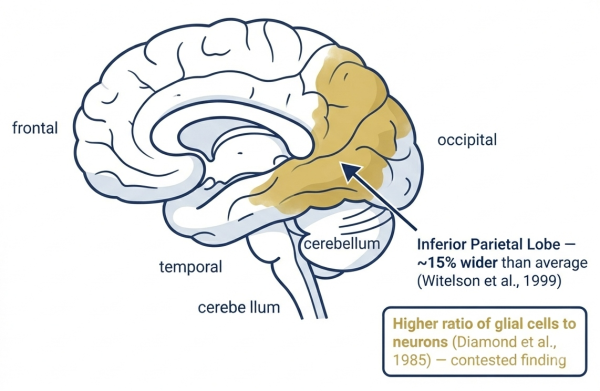
When Einstein died on April 18, 1955, pathologist Thomas Harvey removed his brain during the autopsy — without clear prior consent from the family. Harvey kept the brain for 40 years, releasing sections to researchers periodically. This led to several published studies:
- Diamond et al. (1985): Found a higher ratio of glial cells to neurons in the left parietal association area compared to control brains. This finding is contested — sample size was very small and methodology has been criticized.
- Witelson et al. (1999): Reported that Einstein's inferior parietal lobe — a region associated with mathematical reasoning, spatial visualization, and imagery — was approximately 15% wider than average, with an unusual pattern of a missing fold (the parietal operculum) that may have allowed greater integration between different brain regions.
- Falk et al. (2012): Analyzed previously unphotographed sections of the brain and identified unusual complexity in several frontal lobe regions associated with higher cognitive functions.
The caveat: all of these studies are preliminary, based on single-subject observation, and subject to significant methodological limitations. Neuroscience is cautious about drawing direct lines from brain anatomy to cognitive ability. What the research does suggest — without proving — is that Einstein's brain showed structural features in spatial and mathematical reasoning regions that differed from population norms. This is broadly consistent with his documented cognitive strengths.
What Einstein's Own Descriptions Tell Us
Einstein left written and spoken accounts of how he thought — and these provide more reliable insight into his cognitive style than any retroactive IQ estimate.
Visual-Spatial Reasoning Dominates
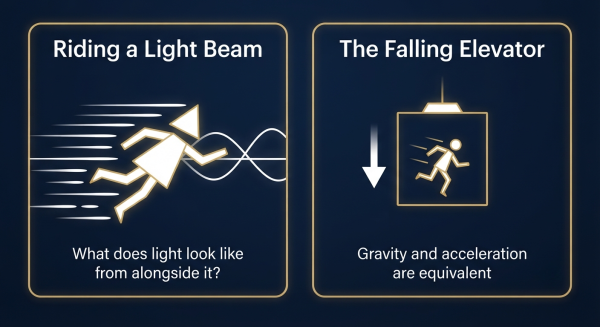
Einstein described his thinking as primarily visual and muscular — he reasoned in mental images and physical sensations before translating insights into mathematics. His famous thought experiments (Gedankenexperimente) — imagining what it would look like to ride alongside a beam of light, or what it would feel like to fall in an elevator — were the origin of his most important theoretical breakthroughs. This visual-spatial dominance is consistent with the Witelson finding about the inferior parietal lobe. For more on how different types of cognitive intelligence interact, see the Multiple Intelligences Theory guide.
Conceptual Flexibility Over Computational Speed
Einstein's distinctive cognitive gift was not computational speed — he was not known as a fast calculator — but rather conceptual flexibility: the ability to challenge the foundational assumptions of established science and reason from entirely new premises. The insight that time and space are relative to the observer, not absolute — which is the core of Special Relativity — required abandoning Newton's framework entirely. This type of paradigm-shifting cognition is not captured by standard IQ tests.
Depth Over Breadth
Einstein's intellectual life was characterized by extraordinary depth of focus on specific problems over extended periods. He worked on General Relativity — an extension of Special Relativity to include gravity — for approximately 10 years before publishing it in 1915. The capacity to sustain focus on a single unsolved problem across a decade, returning to it repeatedly with new approaches, is a form of cognitive endurance that standard assessments do not measure.
"It's not that I'm so smart. It's just that I stay with problems longer." — Albert Einstein
What IQ Tests Would and Would Not Have Captured
| Cognitive Dimension | Captured by IQ Tests? | Einstein's Profile |
| Abstract reasoning | Yes (partially) | Exceptional — the core of his theoretical work |
| Visual-spatial reasoning | Yes (partially) | Exceptional — self-described primary thinking mode |
| Verbal comprehension | Yes | High but not extraordinary — late talker as a child |
| Processing speed | Yes | Unknown — reportedly not a fast calculator |
| Conceptual paradigm-shifting | No | Exceptional — his defining contribution |
| Sustained focus on unsolved problems | No | Exceptional — 10 years on General Relativity |
| Thought experiment / visual simulation | No | Exceptional — the origin of his major insights |
The honest conclusion: even a perfect IQ test result for Einstein would have been an incomplete picture of the cognitive profile that produced his work. For more on what IQ measures and what it misses, see IQ vs EQ, IQ vs problem-solving, and verbal and nonverbal intelligence tests.
Frequently Asked Questions
What was Albert Einstein's IQ?
No verified IQ score exists for Einstein. The commonly cited figure of 160 is a retrospective estimate without documented basis — the same number attributed to Stephen Hawking for the same reason. Einstein never took a modern standardized IQ test. Explore the Stephen Hawking IQ article and the Celebrity IQ Database for the same pattern across other figures.
Did Einstein really fail math in school?
No — this is a myth. Einstein excelled at mathematics and physics throughout his education. What is true is that he failed the ETH Zurich entrance exam on his first attempt in 1895 at age 16 — due to weak French and botany scores, not mathematics. He was admitted the following year and graduated in 1900. The "Einstein failed school" story is a misattribution of a documented exam failure to a general academic failure that never occurred.
What happened to Einstein's brain?
Pathologist Thomas Harvey removed Einstein's brain during the 1955 autopsy and kept it for 40 years. Research on sections of the brain found preliminary evidence of structural differences in the inferior parietal lobe (associated with spatial and mathematical reasoning) and an unusual glial cell ratio. These findings are preliminary and contested within neuroscience — they suggest differences but do not explain genius.
What was Einstein's Annus Mirabilis?
In 1905, at age 26, Einstein published four landmark papers: the photoelectric effect (basis of his Nobel Prize), Brownian motion (proving atoms exist), Special Relativity, and E=mc². He had no academic position and was working as a patent clerk. No single year in physics history has produced comparable output from a single individual.
How does Einstein compare to other figures on this site?
Like most historically significant scientific figures, Einstein's IQ is estimated rather than measured. What is documented is his scientific output — which remains among the most consequential in human history. For comparison with other figures and the same evidentiary caveats, see Stephen Hawking IQ, Isaac Newton IQ, and Marie Curie IQ.

Comments
Share Your Thoughts