The claim that Marilyn Monroe had an IQ of 168 — higher than Einstein's commonly cited estimate — circulates across celebrity intelligence lists. It is almost certainly a myth. But what the historical record does show about Monroe's intellectual life is genuinely compelling — and far more nuanced than either the "dumb blonde" stereotype or the "secret genius" narrative. This article covers what is documented, what is inferred, and what her life actually reveals about intelligence beyond IQ numbers. For context on how IQ is measured and how celebrity estimates are derived, see the complete guide to IQ and the Celebrity IQ Database.
The IQ 168 Claim: Where It Comes From
No documentation exists for an IQ of 168 — or any specific IQ score — for Marilyn Monroe. No psychologist, school record, or testing institution is on record as having administered a standardized intelligence test to her. The number 168 has no traceable source in biographical literature or archival records.
The claim appears to serve a specific cultural function: it exists to counter the "dumb blonde" image that Hollywood systematically constructed around Monroe and that she herself strategically deployed. The number 168 is dramatic precisely because it exceeds the frequently cited (and equally unverified) estimates for Einstein and Hawking. It asserts genius-level intelligence to rehabilitate a reputation that was deliberately trivialized. The cultural motivation for the claim is understandable. Its evidentiary basis is nonexistent.
For context on how similar unverified numbers circulate about other figures, see the Albert Einstein IQ article and the Stephen Hawking IQ article.
What Is Documented: The Personal Library

Multiple biographers who documented Monroe's personal belongings and estate have confirmed that she maintained an extensive private library. Books from her collection have included works by James Joyce, Fyodor Dostoevsky, Walt Whitman, Albert Camus, Rainer Maria Rilke, John Stuart Mill, and Sigmund Freud. The specific count varies by source, but the existence of a substantial, intellectually serious reading collection is well-documented across multiple independent biographical accounts.
This reading record is significant because it reflects sustained voluntary intellectual engagement — not a performance for public consumption, but a private intellectual life that Monroe maintained throughout her career. The subjects she engaged with — psychoanalysis, political philosophy, literature, poetry — are not light reading. They indicate curiosity about ideas that went considerably beyond what was professionally required of her.
The books in Monroe's library were not props. They were companions — evidence of a private intellectual life that existed entirely outside the public image she managed so carefully.
Marilyn Monroe Productions: Business and Strategic Intelligence
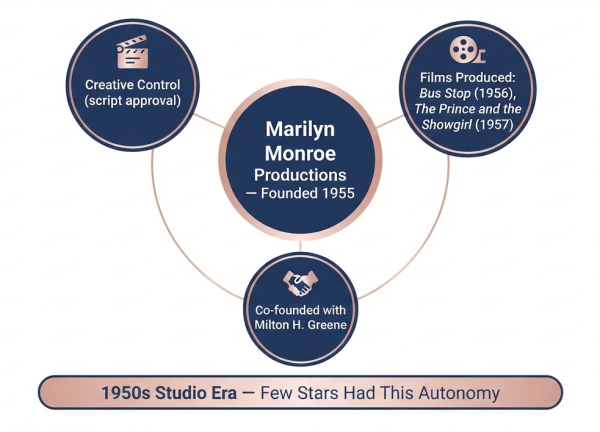
In 1955, Monroe co-founded Marilyn Monroe Productions with photographer Milton H. Greene. This made her one of the first major Hollywood stars — and among the first women in the industry — to establish an independent production company during the studio era, when studios maintained near-total control over contracted actors.
The company was not a vanity project. It gave Monroe concrete creative leverage: script approval, director consultation, and the ability to negotiate better contract terms with studios. It produced two films: Bus Stop (1956), in which Monroe gave what many critics consider her strongest dramatic performance, and The Prince and the Showgirl (1957), co-starring Laurence Olivier.
This was a sophisticated business and strategic move by any standard — achieved at a time when few male stars, let alone female stars, had successfully wrested creative control from the studio system. It reflects the kind of practical intelligence and long-term strategic thinking that standard IQ tests do not measure. For more on how business intelligence relates to cognitive profiles, see business success beyond traditional IQ.
The Actors Studio: Documented Intellectual Discipline
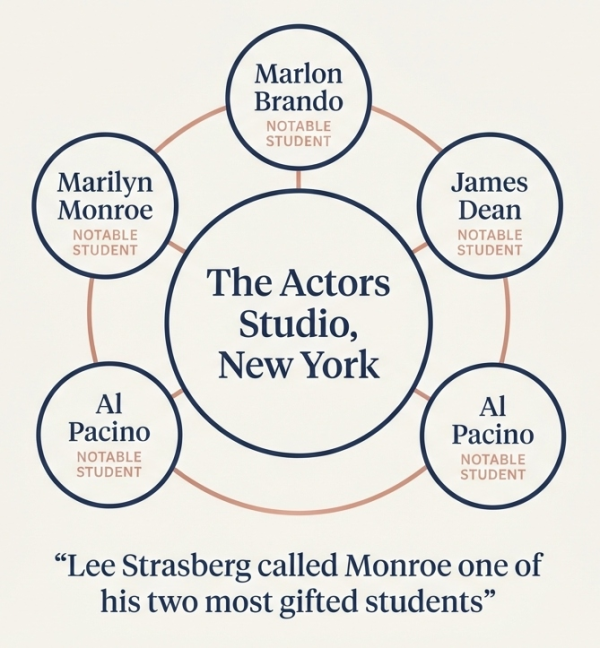
Monroe studied acting formally across two major relationships: with coach Natasha Lytess for years during her early career, and later — beginning in 1955 — with Lee Strasberg at the Actors Studio in New York. The Actors Studio trained Marlon Brando, James Dean, Al Pacino, Dustin Hoffman, and other actors widely regarded as the most technically accomplished of their generation.
Lee Strasberg's assessment of Monroe, documented by multiple biographers, was that she was among the two most naturally gifted students he had taught in his career. Method acting as practiced at the Actors Studio requires significant emotional excavation, memory work, psychological self-awareness, and the ability to translate internal emotional states into physical performance consistently. These are cognitively demanding disciplines — they are simply not the kind of cognition that IQ tests were designed to measure.
Four Documented Dimensions of Monroe's Intelligence
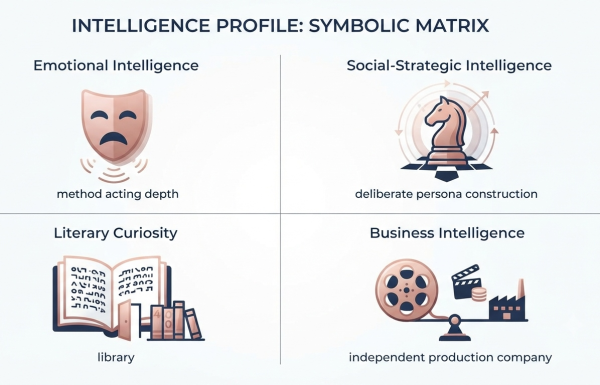
1. Emotional Intelligence
Monroe's on-screen work at her best — particularly in Bus Stop, Some Like It Hot, and The Misfits — demonstrates the ability to access and externalize complex emotional states with authenticity and precision. This is the domain Strasberg recognized in her. For more on how emotional intelligence compares to cognitive IQ, see the IQ vs EQ guide and take the EQ Test.
2. Social and Strategic Intelligence
Monroe's management of her public persona was deliberate and sophisticated. She constructed a specific image — soft-spoken, childlike, naive — while simultaneously cultivating a private intellectual life that she shared selectively. This gap between public persona and private self was strategic, not accidental. She understood how the Hollywood attention economy worked and operated within it on her own terms. This reflects the kind of social intelligence that Howard Gardner's framework describes as interpersonal intelligence — see the Multiple Intelligences Theory guide.
3. Literary and Philosophical Curiosity
Monroe's reading habits extended into psychoanalysis (she was in therapy for years and read extensively about Freudian theory), political and social philosophy, literary modernism, and poetry. These were private intellectual interests she pursued independently, not for professional benefit. The consistency and depth of this reading record across her career indicates genuine intellectual curiosity rather than social performance. For more on this type of intelligence, see the Linguistic Intelligence guide.
4. Business and Practical Intelligence
Founding an independent production company in 1955 — successfully negotiating with major studios from a position of creative strength — required understanding contract law, business negotiation, industry politics, and long-term career strategy. This practical intelligence is directly observable in the career decisions Monroe made during the peak years of her fame.
The "Dumb Blonde" Persona: Strategy, Not Reality
One of the most documented aspects of Monroe's public career is how consciously she constructed and deployed the naive, soft-voiced persona that became her public face. Colleagues who worked with her — directors, co-stars, and the writers who interviewed her — consistently described a private person who was perceptive, psychologically astute, and far more intellectually engaged than her screen roles suggested.
The deliberate gap between her public image and her private intellectual life is itself evidence of a specific kind of intelligence: the ability to understand what a social environment demands and to present oneself accordingly, while maintaining a separate private identity. This metacognitive self-awareness — understanding how others perceive you and managing that perception strategically — is associated with high social and cognitive functioning. For more on this dimension, see the Intrapersonal Intelligence guide.
Frequently Asked Questions
What was Marilyn Monroe's IQ?
No verified IQ score exists for Marilyn Monroe. The commonly cited figure of 168 has no documented source — no testing institution, psychologist, or biographical record supports it. The number exists in popular culture as a myth intended to counter the "dumb blonde" stereotype, not as a psychometric fact.
Did Monroe really have a 400-book personal library?
Multiple biographers who documented her personal belongings have confirmed that Monroe maintained an extensive private library. Books from her collection have included works by James Joyce, Dostoevsky, Whitman, Camus, Rilke, Freud, and others. The existence of a substantial, intellectually serious reading collection is well-documented across independent biographical sources.
What was Marilyn Monroe Productions?
In 1955, Monroe co-founded Marilyn Monroe Productions with Milton H. Greene, making her one of the first major Hollywood stars and among the first women to establish an independent production company during the studio era. The company gave her creative control and produced Bus Stop (1956) and The Prince and the Showgirl (1957).
Did Monroe study acting formally?
Yes. Monroe studied with coach Natasha Lytess for years, and later with Lee Strasberg at the Actors Studio in New York — the same institution that trained Marlon Brando, James Dean, and Al Pacino. Strasberg reportedly called her one of the two most naturally gifted students he had ever taught. Method acting is a cognitively and emotionally demanding discipline requiring psychological self-awareness and emotional precision.
Why does the IQ 168 claim persist if it's unverified?
The claim serves a specific cultural function: it rehabilitates a reputation that Hollywood deliberately trivialized. The number 168 is dramatic precisely because it exceeds commonly cited estimates for Einstein and Hawking — it asserts that Monroe was not just intelligent but definitively superior. The cultural motivation is understandable; the evidentiary basis is absent. The same pattern of unverified but culturally meaningful IQ numbers applies to most historical figures in the Celebrity IQ Database.

Comments
Share Your Thoughts