Search "Stephen Hawking IQ" and you will find the same answer repeated on thousands of websites: 160. But there is a problem with that number — Stephen Hawking never took a standardized IQ test, and no verified score exists. This article covers what the record actually shows, what Hawking himself said about IQ, what made his mind genuinely extraordinary, and why the number matters far less than his story. For context on how IQ is measured and what high scores actually mean, see the complete guide to IQ and the Celebrity IQ Database.
What Stephen Hawking Actually Said About His IQ
In a 2004 interview with the New York Times, a reporter asked Hawking what his IQ was. His response has been widely shared — and almost as widely ignored by the websites that continue to cite 160:
"I have no idea. People who boast about their IQ are losers."
This was not false modesty. Hawking was making a substantive point: the kind of intelligence that produces breakthroughs in theoretical physics — the ability to visualize four-dimensional spacetime geometry without writing, to hold entire cosmological models in working memory, to find new connections between general relativity and quantum mechanics — is not what IQ tests are designed to measure. He was not interested in a number that wouldn't have captured the most important aspects of his cognitive life.
Where Does the "IQ 160" Figure Come From?
The 160 figure appears to have originated from journalistic speculation, not any documented assessment. It is the same number frequently cited for Albert Einstein — also without verified documentation. Both Einstein and Hawking were almost certainly never administered a standardized IQ test in the modern sense. The number 160 in popular culture functions as a rough placeholder for "genius beyond ordinary measurement" — which is accurate enough as a cultural statement, but meaningless as a psychometric one.
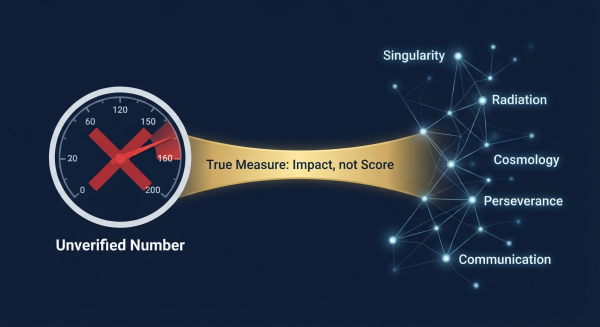
For comparison, IQ 160 would place someone at approximately the 99.997th percentile — roughly 1 in 31,000 people. Whether or not Hawking's score would have fallen there is unknowable. What is known is that his scientific output was consistently at the frontier of human understanding — a level of achievement that exists in a different category than any standardized test result. For context on the highest documented IQ scores in history, see the highest IQ in history guide.
What IQ Tests Actually Measure — and What They Miss
IQ tests measure specific cognitive capacities: abstract reasoning, verbal comprehension, working memory, processing speed, and pattern recognition. These are genuinely important abilities and predict a wide range of academic and professional outcomes. But they do not measure:
- Scientific intuition: The ability to sense the shape of a solution before the mathematics confirm it
- Theoretical imagination: The capacity to visualize physical processes — black holes, spacetime curvature, quantum fields — in the mind's eye without physical sensation
- Persistence under adversity: The willingness to continue intellectual work while losing physical function over decades
- Communicative genius: The ability to make the most abstract concepts in physics accessible to millions of non-specialists
- Creative synthesis: The capacity to connect domains — general relativity and quantum mechanics — that were considered fundamentally incompatible
These are the cognitive capacities that made Hawking historically significant. None of them appear in a standard IQ score. For more on the relationship between IQ and the broader landscape of human intelligence, see the guide on Multiple Intelligences Theory and IQ vs EQ.
Stephen Hawking's Scientific Contributions: What Actually Defines His Genius
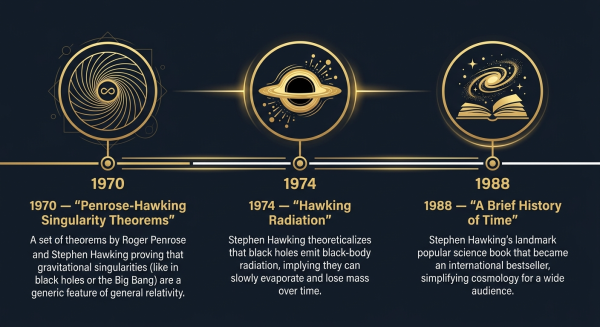
The Penrose-Hawking Singularity Theorems (1970)
Working with mathematician Roger Penrose, Hawking proved — using the mathematics of general relativity — that singularities are not mathematical quirks but physical realities: places where the known laws of physics break down, necessarily implied by Einstein's equations when applied to sufficiently dense matter. This work directly shaped the theoretical foundation of modern cosmology and earned Penrose the Nobel Prize in Physics in 2020 (Hawking had passed away in 2018 and the Nobel is not awarded posthumously).
Hawking Radiation (1974)
This is arguably the most important theoretical prediction in physics of the second half of the 20th century — and it has still never been directly observed. Hawking showed that black holes are not eternal: through a quantum mechanical process at the event horizon, virtual particle pairs are created, with one particle escaping as radiation (Hawking Radiation) and the other being absorbed by the black hole. Over astronomical time scales, this causes black holes to slowly evaporate and eventually disappear.
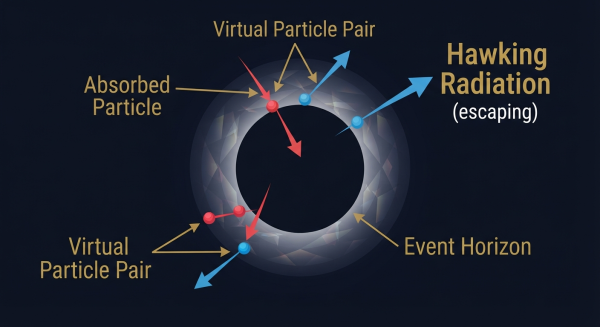
The significance: Hawking Radiation was the first theoretical framework to successfully connect general relativity, quantum mechanics, and thermodynamics in a single prediction — three of physics' most fundamental theories that had previously resisted unification. It remains one of the central targets of verification for any future "theory of everything."
A Brief History of Time (1988)
A book written entirely through a speech synthesizer, under conditions of severe physical limitation, that sold over 25 million copies and remained on the Sunday Times bestseller list for a record 237 weeks. It transformed public understanding of cosmology and demonstrated that Hawking's intelligence extended beyond theoretical physics into the rare ability to communicate the deepest ideas in science to a general audience — a form of intellectual achievement that IQ tests cannot measure at all.
The ALS Diagnosis: 55 Years of Output Against All Odds
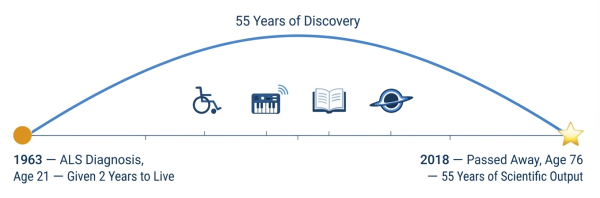
Hawking was diagnosed with motor neurone disease (ALS) in 1963 at age 21. He was given approximately two years to live. He lived for 55 more years — until March 14, 2018 — and produced most of his significant work after his physical decline was already severe. By the time he published his most celebrated theoretical work in the 1970s, he had lost the ability to write. By the time of A Brief History of Time, he could not speak without a synthesizer. His lectures and papers continued until the final years of his life.
This is not background color to his story — it is central to any honest assessment of his intelligence. The ability to sustain theoretical physics research for five decades while losing physical function is a form of cognitive achievement that exists outside any IQ measurement framework. It reflects something closer to what researchers describe as cognitive resilience — the maintenance of intellectual function under conditions that would disrupt or eliminate most people's ability to work at all.
Did Stephen Hawking Win the Nobel Prize?
No — and this is one of the most discussed gaps in scientific prize history. Despite being widely regarded as the most important theoretical physicist since Einstein, Hawking never received the Nobel Prize. The Nobel committee requires experimental verification of theoretical predictions, and Hawking Radiation — his most celebrated contribution — has never been directly observed or experimentally confirmed. The experimental temperatures required to detect it are far below what current technology can achieve in any context where black holes are present. Hawking passed away in 2018, and the Nobel is not awarded posthumously.
The irony: Hawking Radiation may be the most consequential unverified theoretical prediction in modern physics — a framework that almost all theoretical physicists accept as correct but that cannot yet be confirmed by observation. It is a reminder that genius sometimes operates ahead of the tools available to measure it. For more on how intelligence connects to scientific output and recognition, see the IQ vs creativity guide.
What Hawking's Story Actually Tells Us About Genius
The obsession with attaching a number to Hawking's intelligence reflects a broader cultural impulse to quantify greatness — to make genius measurable, rankable, and comparable. It is understandable. IQ provides a framework. But it also misrepresents what made Hawking singular.
His genius was not primarily about raw processing speed or abstract reasoning capacity — the things IQ tests do measure reasonably well. It was about the combination of:
- Theoretical imagination operating at a level that few people in any generation reach
- The ability to maintain that imagination under conditions of severe physical constraint
- The communicative intelligence to translate cosmological abstractions into ideas accessible to ordinary readers
- The scientific courage to publish predictions — like Hawking Radiation — that connect incompatible theoretical frameworks and invite decades of scrutiny
None of these qualities would have shown up reliably on a standard IQ test administered under time pressure with a pencil. That is not a criticism of IQ tests — they measure what they were designed to measure. It is a reminder that genius, in the sense Hawking embodied it, is a different category of phenomenon. For more on where IQ does and does not predict real-world outcomes, see IQ and income research and IQ vs problem-solving.
Frequently Asked Questions
What was Stephen Hawking's IQ?
No verified IQ score exists for Stephen Hawking. The commonly cited figure of 160 is an unverified estimate of unknown origin. When asked about his IQ in a 2004 New York Times interview, Hawking replied: "I have no idea. People who boast about their IQ are losers." No biographer or scientific publication has documented an actual IQ test result.
Why is 160 cited as Hawking's IQ everywhere online?
The figure appears to originate from journalistic speculation rather than any documented assessment. It is the same number frequently cited for Albert Einstein — also without verified documentation. In popular culture, 160 functions as a shorthand for "genius beyond ordinary measurement." It is culturally intuitive but psychometrically meaningless without a verified test source.
What were Hawking's most important scientific contributions?
His two most significant theoretical contributions were the Penrose-Hawking Singularity Theorems (1970), which proved singularities are physical realities implied by general relativity, and Hawking Radiation (1974), the theoretical prediction that black holes emit thermal radiation and gradually evaporate — the first framework to unify general relativity, quantum mechanics, and thermodynamics. He also authored A Brief History of Time (1988), which introduced cosmology to a mass audience. See the highest IQ in history guide for broader context on historically significant minds.
Why didn't Stephen Hawking win the Nobel Prize?
The Nobel committee requires experimental verification of theoretical predictions. Hawking Radiation — his most celebrated theoretical contribution — has never been directly observed or experimentally confirmed. Hawking passed away in 2018, and the Nobel Prize is not awarded posthumously. His work is widely considered Nobel-caliber by physicists, but the experimental verification requirement was never met during his lifetime.
How does Stephen Hawking compare to other high-IQ historical figures?
Like Hawking, most historically significant scientific figures — Einstein, Newton, Darwin — were never administered modern standardized IQ tests. Estimated IQ scores for these figures are reconstructed from biographical records and are inherently speculative. Explore the Albert Einstein IQ guide, the Isaac Newton IQ guide, and the full Celebrity IQ Database for detailed breakdowns of how these estimates are derived.

Comments
Share Your Thoughts