Emotional intelligence (EQ) has a characteristic that sets it apart from IQ: it is genuinely improvable in adulthood. Unlike cognitive ability, which is relatively stable after adolescence, EQ involves learnable skills, changeable habits, and trainable neural circuits. The research from neuroscience and organisational psychology is clear: specific EQ competencies improve with deliberate practice.
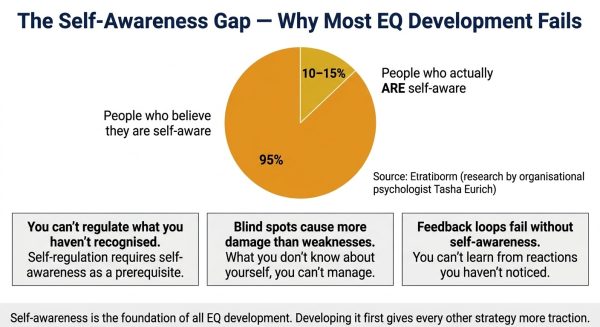
But before diving into strategies, one finding sets the stage for why this matters more than most people realise. Research by organisational psychologist Tasha Eurich found that 95% of people believe they are self-aware — but only 10–15% actually are by rigorous assessment. This gap between perceived and actual self-awareness is not just an interesting statistic. It explains why most EQ development efforts fail: people invest in the wrong areas because they don't accurately know where their EQ gaps are. The first and most important EQ skill to develop is self-awareness — because without it, everything else builds on a foundation of false assumptions.
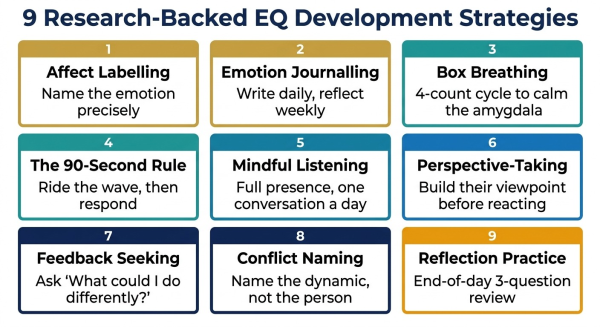
This guide covers nine research-backed strategies across all five EQ domains (Goleman's framework: self-awareness, self-regulation, motivation, empathy, and social skills), with specific implementation steps that can be integrated into a working day without requiring additional time beyond what you already spend on interactions and reflection.
Start Here: The Self-Awareness Foundation
Self-awareness is not introspection — it is not rumination, self-criticism, or extended internal monologue. It is the accurate perception of your emotional states, patterns, triggers, and their effects on your behaviour and on others. Most people are good at introspection but poor at self-awareness — they spend time thinking about themselves without generating accurate insight.
The self-awareness gap has a specific mechanism: we observe our behaviour from the inside but experience its effects from the outside. A manager who becomes terse under pressure feels stressed; their team experiences hostility. The gap between these two experiences — and the failure to bridge it — is the self-awareness problem. Developing genuine self-awareness requires external data, not just internal reflection.
The 9 Strategies: Domain by Domain
Strategy 1: Affect Labelling — Name the Emotion Precisely
Domain: Self-Awareness
Research by Torre and Lieberman (2018) demonstrated that the act of labelling an emotion — putting precise words to what you are feeling — reduces the intensity of that emotion's neural signal. This is called "affect labelling," and it activates the prefrontal cortex while reducing amygdala reactivity. Naming an emotion is not just conceptually clarifying — it is neurologically regulatory.
The key is precision. "I feel bad" is not affect labelling. "I feel embarrassed — specifically about how I handled the opening of that meeting, and I'm anticipating criticism" is affect labelling. The more precisely you name the emotion (distinguishing, say, frustration from disappointment, or anxiety from excitement), the stronger the regulatory effect.
Implementation: When you notice an emotional reaction, pause and name the emotion as precisely as you can. Not "stressed" — but "overwhelmed because I've committed to too many tasks and I'm anxious about not delivering." Start with three basic categories — pleasant, neutral, unpleasant — and practice refining from there.
Strategy 2: Emotion Journalling
Domain: Self-Awareness
Affective journalling — the practice of writing about emotional experiences as they occur or shortly after — strengthens the neural pathways associated with emotion recognition and self-regulation. Torre and Lieberman's research specifically supports written labelling as effective. Research published in clinical and counselling psychology literature consistently finds that expressive writing about emotional experiences reduces distress and improves emotional processing.
Implementation: At the end of each day, write three sentences: (1) "The most emotionally significant moment today was..." (2) "I felt [name the specific emotion] because..." (3) "I responded by [what did you do?] and the effect was [what happened]?" This takes three minutes and builds a pattern-recognition capability over weeks that self-reflection alone cannot produce.
For context on how inner speech and verbal processing relate to emotional awareness, see our guide on inner monologue and IQ.
Strategy 3: Box Breathing — Physiological Regulation
Domain: Self-Regulation
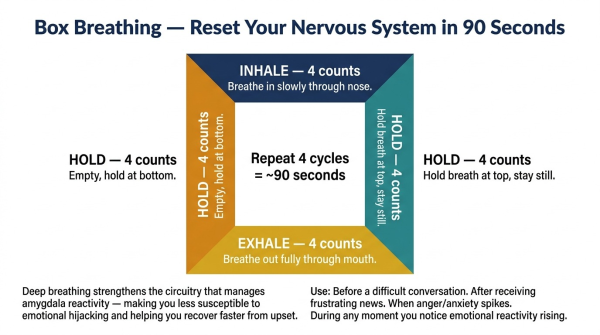
Before you can manage how you express an emotion, you need to regulate its physiological component. The amygdala — the brain's emotional alarm system — activates faster than conscious thought. When it fires, it floods the body with stress hormones that impair rational thinking. Breathing techniques provide a rapid, evidence-based mechanism for dampening this response.
Box breathing (four counts in, four counts hold, four counts out, four counts hold) activates the parasympathetic nervous system and directly reduces cortisol and adrenaline. Research confirms that deep breathing strengthens the prefrontal cortex circuitry that regulates amygdala reactivity, making you less susceptible to emotional hijacking over time.
Implementation: Use box breathing in three contexts: (1) before anticipated difficult conversations or presentations, (2) when you notice the first physiological signs of strong emotion (heart rate increase, muscle tension, the urge to speak quickly), and (3) as a daily morning practice for three minutes to build the baseline capacity. Four cycles of box breathing takes approximately 90 seconds.
Strategy 4: The 90-Second Rule
Domain: Self-Regulation
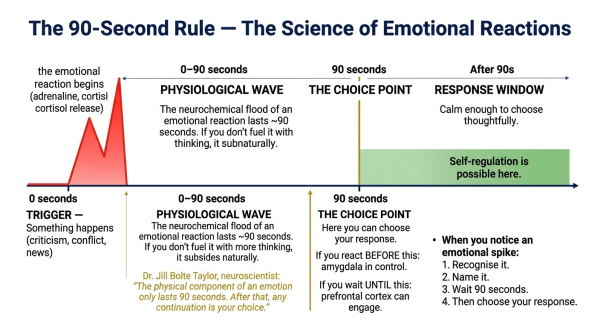
Neuroscientist Jill Bolte Taylor established that the physiological component of an emotional reaction — the neurochemical flood triggered by a stimulus — lasts approximately 90 seconds. After that, any continuation of the emotional state is maintained by thought patterns, not by fresh neurochemistry. This is the basis for the 90-second rule: the choice point for self-regulation is in the window between the trigger and the response.
If you react immediately when the emotional spike occurs, the amygdala is in control. If you wait — creating space through any technique that buys 90 seconds without fuelling the emotion with more thinking — the prefrontal cortex re-engages and a considered response becomes possible.
Implementation: When you notice an emotional spike, adopt a pause routine: name the emotion (Strategy 1), take three breaths, and wait. A physical cue helps — getting water, taking two steps backward, or simply pressing your feet into the floor. The goal is 90 seconds before responding. In practice, even 10–15 seconds makes a measurable difference compared to immediate reaction.
Strategy 5: Mindful Listening — Full Presence
Domain: Empathy
Research published in 2024 found that active listening techniques improved trust scores by over 25% in professional relationships. The difficulty: most people listen to respond rather than to understand. While someone is speaking, the typical listener is simultaneously composing their response, evaluating the statement, and managing their own emotional reaction to it — rather than attending fully to the other person.
Mindful listening — deliberate full-presence listening — is a practice, not just an intention. It involves deliberately putting away devices, suspending response-planning, and attending to the other person's tone, pace, facial expression, and word choice in addition to content. It is both a mindfulness practice (present-moment awareness) and a social awareness practice.
Implementation: Choose one conversation per day for full mindful listening: phone away, no mental response preparation, attend to non-verbal cues as much as words. After the conversation, ask yourself: "What emotion was the other person expressing beyond what they said explicitly? What were they not saying directly?" This takes no additional time — it is a change in how you use time already being spent.
Strategy 6: Perspective-Taking Before Reacting
Domain: Empathy
Empathy is not sympathy (feeling what someone feels) — it is the cognitive capacity to construct an accurate model of another person's emotional experience. This can be practiced deliberately. Before reacting to a colleague's difficult behaviour, a client's frustration, or a partner's withdrawal, pause to actively construct their perspective: "What is this person likely feeling right now, and why? What do they most need from this interaction?"
Research on fiction reading — which requires sustained perspective-taking by inhabiting characters' inner lives — shows that regular fiction readers have stronger theory of mind (the ability to model others' mental states) than non-readers. This is one of the most practical and evidence-supported indirect routes to empathy development.
Implementation: Before any significant interaction where you anticipate tension, take 60 seconds to explicitly write or mentally construct the other person's likely experience: "They are probably feeling X because Y. What they need from me is Z." This changes the quality of the interaction because it changes the orientation you bring to it.
Strategy 7: Feedback Seeking — Closing the Self-Awareness Gap
Domain: Social Skills / Self-Awareness
Because the self-awareness gap is fundamentally a problem of inside-versus-outside perspective, closing it requires external data. Systematic feedback-seeking is the most direct approach. The most effective feedback questions are specific and behavioural rather than general: not "how do you think I do as a manager?" but "in the team meeting yesterday, how did I come across when the project timeline discussion got tense?"
Implementation: Identify two or three people whose judgment you trust and whose experience of you is relevant. Ask them one specific, behavioural question per month: "When I do X, what effect does it have on you or the team?" or "What's one thing I could do differently in [specific context] that would help you most?" Build feedback-seeking into your regular interactions rather than treating it as an annual event.
Strategy 8: Conflict Naming — Addressing the Dynamic, Not the Person
Domain: Social Skills
One of the most practically impactful social skill developments is the ability to name an interpersonal dynamic rather than react to it. Most conflict escalation happens because people respond to the content of a difficult interaction rather than the dynamic driving it. Naming the dynamic — "I notice we keep circling back to this same disagreement without resolving it — can we talk about what's making it hard to land on something?" — interrupts the escalation pattern without attacking either party.
Implementation: When you notice a recurring conflict pattern with someone, identify the dynamic in writing before your next interaction: "The pattern is X. What they seem to need is Y. What I seem to be doing that escalates it is Z." Prepare one sentence that names the dynamic rather than the person's behaviour. Practice saying it aloud before using it.
Strategy 9: The End-of-Day Three-Question Review
Domain: All — integration practice
The most efficient comprehensive EQ practice is a brief end-of-day reflection that touches all five EQ domains in approximately three minutes. Three questions:
- "When was I most reactive today, and what triggered it?" (Self-awareness)
- "Where did I handle my emotions well, and what made that possible?" (Self-regulation / motivation)
- "Where could I have shown more empathy or social awareness — and what would I do differently?" (Empathy / social skills)
This takes three minutes. Done consistently over weeks, it builds the habit of reflective self-observation that is the neurological foundation of EQ development. Research on reflective journalling confirms that this kind of structured self-observation produces measurable changes in self-awareness and emotional regulation over 6–8 week periods.
The Key Principle: Consistency Over Intensity
The research on EQ development consistently emphasises one principle above all others: brief daily practice is more effective than periodic intensive effort. A three-minute daily journalling practice over eight weeks produces more measurable EQ change than a six-hour workshop once a quarter. The neuroscience is clear on why: the neural circuits that underlie emotional regulation and social awareness are built through repeated activation, not through single intensive experiences.
This means the most effective EQ development programme is one you actually sustain — not the most sophisticated one. Start with one strategy from the list above, implement it daily for two weeks, then add a second. Progress through the strategies systematically, building a habit stack over three to six months. The result is genuine, durable EQ development rather than temporary insight that fades.
EQ is trainable — genuinely and substantially trainable in adulthood, unlike IQ. The starting point is self-awareness: 95% of people believe they are self-aware, but only 10–15% actually are. The strategies that build EQ most effectively are specific, daily, and behavioural: affect labelling, emotion journalling, box breathing, the 90-second rule, mindful listening, perspective-taking, feedback-seeking, conflict naming, and the three-question review. None of these require more than a few minutes daily. All of them have research support. The key is consistency — brief daily practice over months beats intensive workshops quarterly. EQ development is not a destination; it is a practice that compounds.
For the research on what EQ predicts in the workplace, see our guide on EQ vs IQ in the workplace. For how EQ and IQ interact in specific professional contexts, see our career guides on CEOs, lawyers, and nurses. Take our free IQ test — no registration, results in under 20 minutes.
Frequently Asked Questions
Can you really improve your EQ?
Yes — EQ is substantially more trainable than IQ. Specific EQ competencies (self-awareness, emotional regulation, empathy, social skills) improve with deliberate practice. Unlike IQ, which is relatively stable after adolescence, EQ involves learnable skills and changeable habits that research confirms can develop meaningfully throughout adulthood.
How long does it take to improve emotional intelligence?
Meaningful EQ improvements typically require sustained practice over weeks to months. Affect labelling shows measurable neural effects within weeks. Mindfulness-based EQ studies show measurable changes at 8 weeks of consistent daily practice. Lasting changes in emotional regulation and interpersonal behaviour typically require 3–6 months of consistent practice.
What is the most important EQ component to develop first?
Self-awareness — because all other EQ skills depend on it. You cannot regulate emotions you haven't recognised. Only 10–15% of people are genuinely self-aware despite 95% believing they are. Starting with self-awareness — through affect labelling, journalling, and feedback-seeking — gives every subsequent strategy more traction.
Does mindfulness improve emotional intelligence?
Yes — mindfulness is one of the most evidence-backed EQ development practices. It trains the attentional awareness underlying self-awareness, builds the non-reactive observation space supporting self-regulation, and develops the present-moment focus enabling empathy. Research shows consistent mindfulness strengthens prefrontal cortex circuits involved in emotional regulation and reduces amygdala reactivity.
How do you develop empathy?
Most effectively through mindful listening and deliberate perspective-taking: putting devices away and listening for full emotional content in one conversation daily; actively constructing others' viewpoints before reacting; and regular fiction reading (which builds theory of mind — the cognitive ability to model others' emotional states). Empathy is a skill, not a trait — it improves with practice.

Comments
Share Your Thoughts