The popular image of the CEO is of an extraordinary intellect — the visionary genius who outthinks the competition. The research paints a more nuanced picture.
The best large-scale evidence comes from a landmark Swedish registry study by Adams, Keloharju, and Knupfer, which accessed cognitive test scores for 1.3 million men, including 26,000 CEOs. The finding: the median large-company CEO scored at the 83rd percentile of cognitive ability — approximately IQ 113. Top 17%. Not top 1%. Not remotely close to genius level.
Even more striking: research by psychologist Dean Keith Simonton suggests there is an optimal IQ for leadership effectiveness of approximately 1.2 standard deviations above the group mean — around IQ 120–125. A 2017 study published in the Journal of Applied Psychology found that above this threshold, additional IQ is associated with reduced leadership effectiveness. The smartest person in the room is often not the best person to lead it.
This is the "Goldilocks Effect" in CEO cognitive ability: not too low, not too high — an intermediate range that optimises the combination of strategic reasoning and human connection that leadership requires. This guide covers the data, the Goldilocks research, the C-suite cognitive hierarchy, and what actually predicts who becomes — and who succeeds as — a CEO.
The Data: What Research Shows About CEO IQ
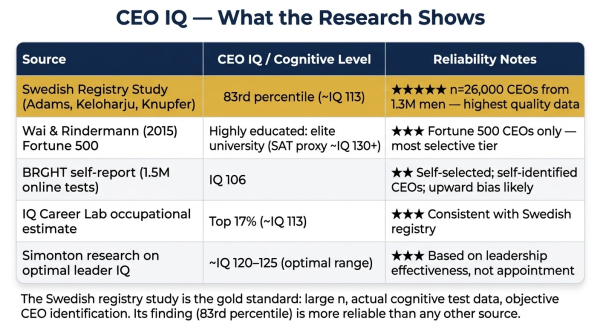
CEO IQ data is rarer and more contested than data for occupations like nursing or engineering, where larger samples exist in longitudinal datasets. The Swedish registry study is the only research with a truly large sample (26,000 CEOs) and actual cognitive test data:
| Source | CEO Cognitive Level | Quality |
| Swedish Registry (Adams, Keloharju, Knupfer) | 83rd percentile (~IQ 113) | ★★★★★ Gold standard — n=26,000 CEOs |
| Wai & Rindermann (2015) Fortune 500 | Highly educated; SAT proxy ~IQ 130+ | ★★★ Fortune 500 only — most selective tier |
| IQ Career Lab occupational estimate | Top 17% (~IQ 113) | ★★★ Consistent with Swedish registry |
| BRGHT self-report (1.5M online tests) | IQ 106 | ★★ Self-selected; likely upward bias |
| Simonton optimal leader IQ research | ~IQ 120–125 (optimal range for effectiveness) | ★★★ Different question: effectiveness, not appointment |
The Swedish registry finding deserves to be the anchoring number here. Its combination of sample size (26,000 CEOs drawn from 1.3 million men), actual cognitive test data (not self-report), and objective CEO identification makes it substantially more reliable than any other source. The finding — 83rd percentile, approximately IQ 113 — is also consistent with the IQ Career Lab occupational estimate and with the broader occupational IQ literature that places senior managers at approximately IQ 105–118.
The Wai and Rindermann (2015) Fortune 500 study finding — that Fortune 500 CEOs disproportionately attended elite universities (a proxy for high SAT/IQ) — does not contradict the Swedish registry figure; it reflects that the top-tier Fortune 500 CEO (a much more selective group) tends to have higher cognitive ability than the median CEO of all large companies. For context on what IQ 113 means, see our IQ 112 and IQ 115 guides.
The Goldilocks Effect: Why Too Much IQ Can Hurt Leadership
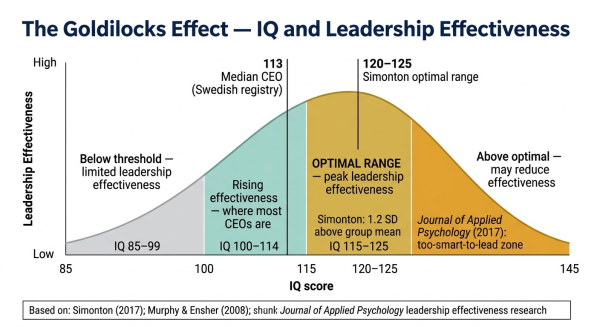
One of the most counterintuitive findings in leadership research is that the relationship between IQ and leadership effectiveness follows an inverted-U curve rather than a linear one. Higher IQ improves leadership effectiveness up to a point — and then begins to reduce it.
Professor Dean Keith Simonton of the University of California identified the optimal leader IQ as approximately 1.2 standard deviations above the group mean. For a group with an average IQ of 100–110 (typical of most organisational settings), this places the optimal leader IQ at approximately IQ 120–125. Above this level, leadership effectiveness begins to decline according to the research.
A 2017 study in the Journal of Applied Psychology confirmed this pattern empirically using a sample of 379 mid-level leaders across 30 mainly European countries. The study found that above a certain IQ threshold, higher IQ was associated with lower leadership effectiveness ratings from both supervisors and subordinates.
The proposed mechanisms for why very high IQ can hurt leadership are psychologically intuitive:
Communication gap. A leader with IQ 145 who naturally thinks at an abstract level may communicate in ways that their team — typically averaging IQ 100–110 — cannot readily follow. Effective leadership requires translating complex strategic thinking into clear, actionable direction for people who do not share the leader's cognitive framework. The more extreme the cognitive gap, the harder this translation becomes.
Overcomplication. Very high-IQ leaders may identify more complexity in problems than is operationally useful — generating solutions that are theoretically elegant but practically difficult for an organisation to execute. Simpler, clearer strategies that a whole organisation can align with are often more effective than cognitively sophisticated ones that only the CEO fully understands.
Impatience and connection. Leaders who process information much faster than their teams may struggle with the patience required for effective coaching, consensus-building, and the human relational processes that keep organisations functioning. Leadership is substantially a relationship between cognitive peers; extreme cognitive distance can erode the trust and followership it requires.
This finding reframes the common assumption that the smartest person should lead. The evidence suggests the best leader is typically not the smartest person — they are someone smart enough to navigate complexity and credible enough to command intellectual respect, but emotionally and communicatively connected enough to bring people with them.
For more on how IQ interacts with other aspects of leadership success, see our IQ vs EQ guide.
The C-Suite Cognitive Hierarchy: CTOs Score Highest, CEOs Don't
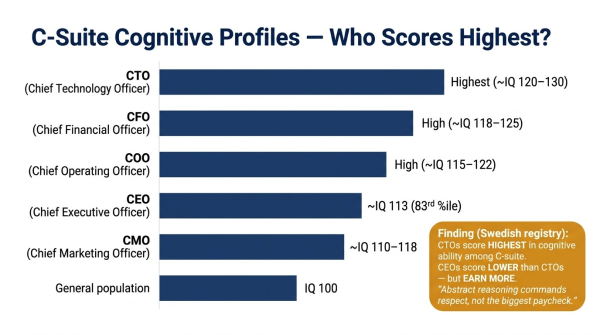
One of the most interesting specific findings from the Swedish registry research is the ranking of cognitive ability across C-suite roles. CTOs (Chief Technology Officers) score highest in cognitive ability among all C-suite roles — but earn the least. CEOs score lower than CTOs on cognitive ability, but earn substantially more.
This pattern is consistent across multiple research frameworks and has a clear interpretation: the CEO role and the CTO role optimise for different cognitive profiles. The CTO role optimises for abstract technical problem-solving — the kind of high-IQ analytical work that benefits most from raw cognitive ability. The CEO role optimises for strategic vision, stakeholder management, board relationships, culture-setting, and organisational leadership — a profile where emotional intelligence, communication ability, and political acumen are as important as cognitive ability, and where the optimal cognitive level is somewhat lower than for pure technical roles.
The finding that the smartest C-suite executive earns the least directly contradicts a naive "more IQ = more value" model. It supports the view that the market for executive talent rewards leadership capability — which peaks at a moderate cognitive level — more than pure analytical intelligence, which commands premium salaries in technical specialist roles but diminishing returns in general management.
Variation Across CEO Types
The 83rd percentile figure from the Swedish registry is a median for all large-company CEOs. Within this, there is meaningful variation:
Fortune 500 CEOs. The Wai and Rindermann (2015) study found that Fortune 500 CEOs are disproportionately drawn from elite universities — schools with median SAT scores corresponding to approximately IQ 130+. The cognitive profile of Fortune 500 CEOs appears to be higher than the median large-company CEO, likely in the IQ 120–130 range, reflecting the additional competitive filtering in reaching the top of the world's largest companies.
Founder-CEOs. Entrepreneurs who found and build companies — rather than being selected through corporate leadership pipelines — show a different cognitive pattern. The Swedish registry research itself suggests that entrepreneurial success is predicted by cognitive ability but that the relationship is more complex than for appointed CEOs. Research from Bergner (2020) found that cognitive ability predicts entrepreneurial status but not entrepreneurial performance — supporting the Goldilocks dynamic. Successful entrepreneurs like Bill Gates (IQ ~160) and Mark Zuckerberg (IQ ~152) are at the high end of the distribution and succeeded partly through surrounding themselves with complementary teams whose combined cognitive and leadership profiles filled their gaps.
Private company vs public company CEOs. The competitive filtering for leading a publicly traded Fortune 500 company is more intense than for leading a private company. The IQ distribution for all self-identified CEOs — which includes small business owners and entrepreneurs — is substantially wider and lower than for large-company CEOs specifically.
What Actually Predicts CEO Appointment and Success
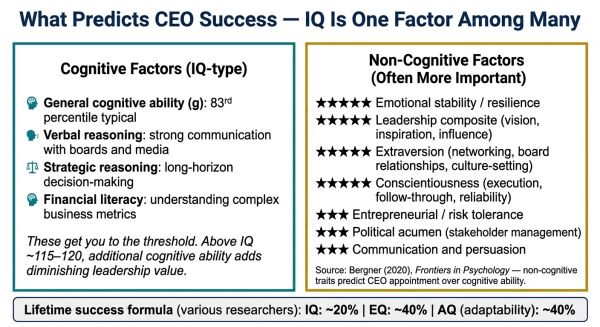
The Swedish registry study's most important finding was not about the level of CEO cognitive ability — it was about what predicts becoming a CEO relative to what IQ alone would predict. The research found that non-cognitive traits predict CEO appointment better than cognitive ability. The specific non-cognitive traits that most strongly predicted CEO selection were emotional stability, a composite leadership score, and extraversion.
Bergner's (2020) three-study research in Frontiers in Psychology confirmed this pattern: cognitive ability predicts leadership emergence and income, but Big Five personality traits (openness, conscientiousness, extraversion, agreeableness, emotional stability) add significant incremental validity beyond cognitive ability in predicting leadership level and performance. The personality traits added 8–15% of additional explained variance over and above cognitive ability.
The formula that various researchers suggest for lifetime leadership success: IQ contributes approximately 20%, while emotional intelligence (EQ) and adaptability/resilience (AQ) each contribute approximately 40%. This is not a precise psychometric finding but a useful order-of-magnitude framing that is consistent with the research evidence. Cognitive ability is the necessary foundation; character and emotional capability are what build the structure above it.
The median large-company CEO scores at the 83rd percentile of cognitive ability — approximately IQ 113 — based on the most rigorous available evidence from a Swedish registry study of 1.3 million men including 26,000 CEOs. This is the top 17%, not the top 1%: above average, but far from genius. Above approximately IQ 120–125, research by Simonton and the Journal of Applied Psychology suggests additional IQ may reduce rather than enhance leadership effectiveness. CTOs score higher on cognitive ability than CEOs but earn less — consistent with the Goldilocks Effect that optimal leadership IQ is intermediate, not maximal. Non-cognitive traits (emotional stability, leadership composite, extraversion, conscientiousness) predict CEO appointment more strongly than cognitive ability. The best CEO is not the smartest person — they are someone smart enough and emotionally equipped enough to bring everyone else with them.
For context on the IQ range most CEOs operate in, see our guides on IQ 112 and IQ 120. For the EQ–IQ relationship in leadership, see our IQ vs EQ guide. For how CEO IQ compares to other professions, see our average IQ by profession guide. Take our free IQ test — no registration, results in under 20 minutes.
Frequently Asked Questions
What is the average IQ of a CEO?
The best large-sample evidence — a Swedish registry study of 1.3 million men including 26,000 CEOs — places the median large-company CEO at the 83rd percentile (~IQ 113). This is the top 17%, not top 1%. Fortune 500 CEOs at the most selective level likely average higher (~IQ 120–130), while self-identified small-business CEOs average considerably lower.
Does IQ predict CEO success?
IQ predicts becoming a CEO more than it predicts CEO performance. Above approximately IQ 120–125, additional IQ may actually reduce leadership effectiveness (the Goldilocks Effect). Non-cognitive traits — emotional stability, leadership composite, extraversion, conscientiousness — predict CEO appointment and success more strongly than IQ above the threshold.
What is the Goldilocks Effect in CEO IQ?
Research by Simonton and a 2017 Journal of Applied Psychology study found leadership effectiveness peaks at approximately IQ 120–125 — about 1.2 standard deviations above the group mean. Below this is under-threshold; above this, communication gaps, overcomplication, and emotional disconnection may reduce effectiveness. The best leader is not the smartest person, but someone smart enough and people-connected enough.
Are CTOs smarter than CEOs?
Yes, on average. The Swedish registry research found CTOs score highest in cognitive ability among all C-suite roles — but earn the least. CEOs score lower than CTOs on cognitive ability but earn substantially more. The CEO role rewards leadership and strategic breadth; the CTO role rewards analytical depth. Both are valuable; the market prices them differently.
Can someone with a lower IQ become a CEO?
Yes. The 83rd percentile finding means 17% of the general population has higher cognitive ability than the median CEO. Leadership success is not linearly correlated with IQ above the basic threshold. Many successful founders and CEOs succeed through vision, emotional intelligence, persistence, and the ability to build and retain exceptional teams — not through raw cognitive firepower.

Comments
Share Your Thoughts