Of all the major professions in the national IQ dataset, nursing provides some of the most directly observed data. The National Longitudinal Survey of Youth 1979 (NLSY79) — the same dataset used for much of the occupational IQ research discussed throughout this site — includes registered nurses as a specific occupational category with a sample of n=155. That is a meaningful sample, and the result is the most directly measured estimate for the profession: registered nurses average IQ 104 (SD = 12.2, 61st percentile).
This single number, however, conceals something far more interesting about nursing as a profession: a 17-point IQ ladder across nursing credential levels, directly measured by NLSY79 data. Nursing aides average IQ 86.7 (19th percentile). Licensed practical nurses average IQ 95.1 (37th percentile). Registered nurses average IQ 104 (61st percentile). And advanced practice nurses — nurse practitioners, CRNAs, DNPs — are estimated at IQ 115–125, a range that overlaps substantially with physicians.
Nursing is therefore not a profession with a single cognitive profile. It is a hierarchy of credential levels, each with different educational requirements and cognitive filters, ranging from accessible entry-level roles (nursing aide) to highly selective advanced practice roles that require graduate education, independent clinical decision-making, and cognitive demands comparable to medicine.
This guide covers the data across all credential levels, what the NCLEX-RN measures and how it relates to IQ, what nursing actually requires cognitively, and why IQ is only part of what makes an excellent nurse.
The Data: IQ by Nursing Credential Level
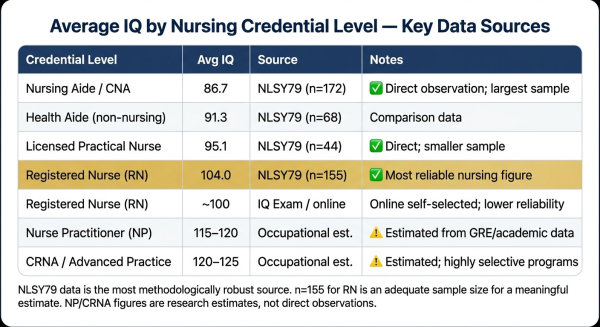
The NLSY79 data provides the most methodologically robust directly observed estimates for nursing occupations:
| Credential Level | Average IQ | Percentile | Source |
| Nursing Aide / CNA | 86.7 | 19th | NLSY79, n=172 (largest sample) |
| Licensed Practical Nurse (LPN) | 95.1 | 37th | NLSY79, n=44 |
| Registered Nurse (RN) | 104.0 | 61st | NLSY79, n=155 — most reliable nursing figure |
| Nurse Practitioner (NP) | ~115–120 (estimated) | ~84th–91st | Occupational estimate from graduate academic data |
| CRNA / Advanced Practice | ~120–125 (estimated) | ~91st–95th | Occupational estimate; highly selective programmes |
The pattern across these credential levels is clear and consistent: as credential level increases, average IQ rises — reflecting the progressive cognitive filtering of each successive educational programme and licensure examination. The 17-point span between nursing aides (IQ 86.7) and registered nurses (IQ 104) is one of the most dramatic within-occupation cognitive hierarchies documented in the NLSY79 data. Including advanced practice nursing extends this range to approximately 33–38 points from CNA to CRNA.
It is worth noting that the NLSY79 RN sample (n=155) is the most reliable figure here. This is a nationally representative longitudinal study from 1979 — meaning it captures registered nurses from the cohort born 1957–1964 who went on to build nursing careers. The SD of 12.2 is slightly narrower than the general population SD of 15, reflecting the modest cognitive banding of the profession. Several online sources give RN IQ estimates of approximately 100 — consistent with the NLSY79 figure within the margin of measurement uncertainty.
For context on what these IQ scores mean on the full scale, see our guides on IQ 90, IQ 105, and IQ 115.
Why Nursing Spans Such a Wide Cognitive Range
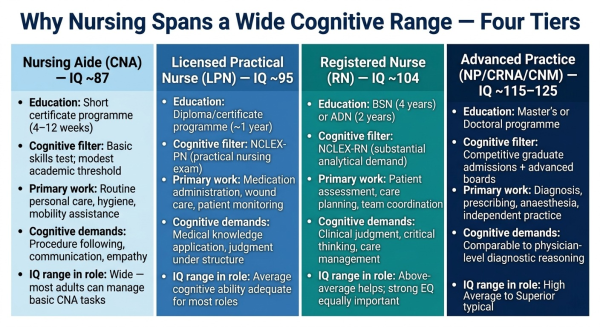
The wide IQ range across nursing credential levels reflects genuinely different cognitive demands and educational filters at each level:
Nursing Aide (CNA) — IQ ~87. Certified Nursing Assistant programmes are typically 4–12 weeks in duration and focus primarily on practical personal care skills: assisting with mobility, hygiene, feeding, and vital signs. The cognitive filter is modest — a basic skills test and a short training programme. The work is physically and emotionally demanding but involves limited complex medical reasoning. The IQ 86.7 NLSY79 figure reflects the population who enter this role: drawn from a broad socioeconomic range, with education levels ranging from some high school to some college, in a role that prioritises physical capability, reliability, and compassionate personal presence over analytical reasoning.
Licensed Practical Nurse (LPN) — IQ ~95. LPN programmes typically take approximately one year and train nurses to administer medications, provide wound care, and monitor patients under the supervision of registered nurses. The cognitive filter is the NCLEX-PN licensure exam, which requires applied medical knowledge and clinical reasoning. At IQ 95 (37th percentile), LPNs are near but slightly below the population mean — an accessible credential for people who have not been selected by four-year university admissions, but who have demonstrated sufficient clinical reasoning to pass national licensure.
Registered Nurse (RN) — IQ ~104. Registered nursing requires either a two-year Associate Degree in Nursing (ADN) or a four-year Bachelor of Science in Nursing (BSN). The cognitive filter is the NCLEX-RN — a substantially more demanding examination than the NCLEX-PN, requiring sophisticated clinical judgment, priority-setting under complexity, and application of medical knowledge across a wide range of clinical scenarios. At IQ 104, the average RN is slightly above the population mean, reflecting the cognitive selection of nursing school and NCLEX.
Nurse Practitioners and Advanced Practice (NP/CRNA/DNP) — IQ ~115–125. Advanced practice nursing requires a Master's degree or Doctor of Nursing Practice following a BSN — typically 6–8 years of education total. Nurse practitioners practise with prescriptive authority and independent clinical decision-making comparable to physicians in many specialties. CRNAs (Certified Registered Nurse Anesthetists) administer anaesthesia independently in many settings and complete some of the most selective graduate nursing programmes. The graduate admission filters for these programmes — GRE scores, BSN GPA, clinical experience — correspond to cognitive ability levels substantially above the RN average, likely in the IQ 115–125 range.
The NCLEX-RN: What It Measures and Its Relationship to IQ
The NCLEX-RN is not an IQ test, but it assesses cognitive abilities that correlate with IQ — particularly critical thinking, clinical judgment, and the application of medical knowledge to novel patient situations. The exam uses a computerised adaptive testing format (CAT) that adjusts difficulty based on the test-taker's performance, requiring more than rote memorisation of medical facts.
The NCLEX-RN pass rates vary by education level: BSN graduates consistently pass at higher rates than ADN graduates — a finding that likely reflects both the more extensive education and the higher average cognitive ability of those who complete four-year BSN programmes versus two-year ADN programmes. The NCLEX-RN's cognitive demands are real, but they are not equivalent to the abstract reasoning demands of the LSAT or GRE at the upper range. Most people in the IQ 95–115 range who receive adequate nursing education can pass NCLEX-RN.
This is precisely why the NLSY79 RN average of IQ 104 makes sense: it reflects a profession where the cognitive filter is real enough to produce a slight elevation above average, but not strong enough to push the average into the High Average range typical of lawyers, engineers, or physicians.
What Nursing Actually Requires: Cognitive and Non-Cognitive
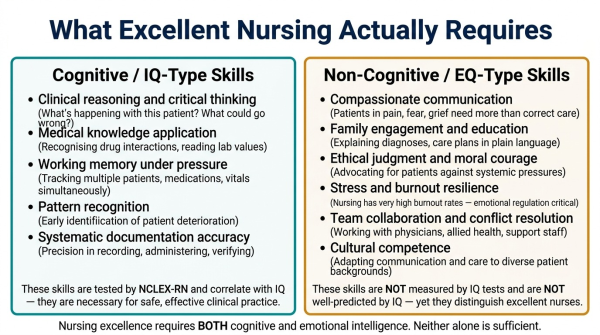
Understanding the cognitive demands of nursing requires distinguishing between what IQ tests measure and what nursing excellence actually requires — because they are not the same thing.
Cognitive demands that IQ correlates with. Clinical reasoning and critical thinking — the ability to rapidly integrate patient assessment data with medical knowledge to make safe care decisions — are the central cognitive demands of professional nursing. Recognising when a patient is deteriorating, identifying drug interaction risks, managing multiple patients with competing needs, and prioritising care under time pressure all draw on the analytical abilities that IQ tests measure. The NCLEX-RN tests these skills explicitly, which is why IQ predicts NCLEX performance better than it predicts many other aspects of nursing success.
Working memory is particularly important in nursing: holding multiple patient parameters in mind simultaneously — vital signs, medication schedules, pending orders, patient concerns — requires the cognitive scratchpad that the WAIS-IV Working Memory Index measures. For more on working memory and its cognitive role, see our IQ and memory guide.
Demands that IQ does not capture. The aspects of nursing that patients and nurses themselves most frequently identify as distinguishing excellent from adequate practice are not primarily cognitive: compassionate communication with frightened patients and grieving families; ethical courage in advocating for patients against institutional pressures; cultural competence in adapting care to patients from different backgrounds; resilience in managing the emotional weight of suffering and death; and collaborative team function with physicians, allied health professionals, and support staff. These are emotional intelligence, moral character, and interpersonal skill — not IQ. Nursing has extremely high burnout rates partly because these demands are immense and often invisible to compensation structures.
The research on what predicts nursing performance beyond the cognitive threshold is consistent: emotional intelligence, conscientiousness, compassion satisfaction (finding meaning in patient care), and stress coping predict career longevity and patient outcomes more reliably than cognitive ability above the NCLEX threshold. For more on the EQ-IQ distinction in professional contexts, see our IQ vs EQ guide.
Nursing IQ in Healthcare Context
| Healthcare Role | IQ Estimate | Notes |
| Physicians / Surgeons | 120–130 | Graduate medical education + board exams |
| CRNA / DNP | ~120–125 (est.) | Most selective advanced practice pathway |
| Pharmacists | ~112–120 | Pharmacy Doctorate + boards |
| Nurse Practitioners (NP) | ~115–120 (est.) | Graduate nursing + advanced practice boards |
| Registered Nurse (RN) | ~104 (NLSY79) | Direct measurement; 61st percentile |
| Licensed Practical Nurse (LPN) | ~95 (NLSY79) | Direct measurement; 37th percentile |
| Nursing Aide (CNA) | ~87 (NLSY79) | Direct measurement; 19th percentile |
Nursing sits in the middle of the healthcare cognitive hierarchy. At the CNA level, the average IQ is substantially below the population mean — reflecting the accessible entry-level character of that credential. At the RN level, the average is slightly above the mean. At the advanced practice level, nursing overlaps substantially with the physician range — a remarkable fact that reflects the genuine diagnostic and prescriptive responsibilities of nurse practitioners and CRNAs, who practice at a level of clinical complexity that the early history of nursing would not have anticipated. For comparison with the broader professional landscape, see our average IQ by profession guide.
Nursing is one of the most cognitively diverse professions documented in the NLSY79 data. Nursing aides average IQ 86.7 (19th percentile); licensed practical nurses average IQ 95.1 (37th percentile); registered nurses average IQ 104 (61th percentile) — a 17-point span across three credential levels, all directly observed in a nationally representative dataset. Advanced practice nurses extend this to an estimated IQ 115–125, overlapping with physicians. The modest elevation of RNs above the population average reflects a real but not dramatic cognitive filter through nursing school and NCLEX-RN. What distinguishes excellent nurses, however, is not primarily IQ above this threshold — it is the clinical judgment, emotional intelligence, compassionate communication, ethical courage, and stress resilience that the best nurses demonstrate, and that IQ tests do not measure.
For context on what specific IQ scores mean, see our guides on IQ 105 and IQ 112. For how nurses compare to other healthcare professions, see our average IQ by profession guide. For the EQ-IQ distinction in professional contexts, see our IQ vs EQ guide. Take our free IQ test — no registration, results in under 20 minutes.
Frequently Asked Questions
What is the average IQ of a nurse?
The NLSY79 — the most direct measurement available — places registered nurses at IQ 104 (n=155, 61st percentile). This is slightly above the population mean of 100. The range varies substantially by credential: nursing aides IQ ~87 (19th percentile), LPNs IQ ~95 (37th percentile), NPs/CRNAs estimated IQ 115–125.
Do nurses have higher IQ than average?
Registered nurses score slightly above the population average: IQ 104 vs population mean 100. This is a real but modest elevation — above average but not dramatically so. Advanced practice nurses (NPs, CRNAs) are estimated substantially higher (~IQ 115–125), reflecting additional graduate-level cognitive filtering.
What IQ is needed to become a nurse?
No formal IQ requirement exists. The primary cognitive filter is the NCLEX-RN licensure examination, which assesses clinical judgment and medical knowledge application. Most people with IQs in the Average range (90–110) who receive adequate nursing education can pass NCLEX-RN. Many nurses below the profession average succeed; what matters beyond cognitive threshold is clinical judgment, EQ, and conscientiousness.
Are nurse practitioners smarter than RNs?
On average, yes — NPs have completed graduate-level education involving additional academic and clinical cognitive filtering. Most estimates place NPs in the IQ 115–120 range, substantially above the RN average of 104. CRNAs, requiring the most selective programmes, likely average near IQ 120–125 — overlapping with the physician range.
What cognitive skills are most important for nursing?
Critical thinking and clinical judgment (integrating patient data with medical knowledge), working memory (tracking multiple patients simultaneously), and pattern recognition (identifying deterioration) are the primary IQ-type demands. But compassionate communication, ethical reasoning, stress resilience, and cultural competence — EQ-type skills — are equally critical for nursing excellence and patient outcomes.

Comments
Share Your Thoughts