In 1995, psychologist Daniel Goleman published Emotional Intelligence: Why It Can Matter More Than IQ and fundamentally changed how organisations think about talent. For the two decades that followed, "EQ over IQ" became something close to conventional wisdom in management circles — with training programmes, hiring criteria, and leadership development frameworks all pivoting toward emotional intelligence as the key to career success.
The research has since produced a more nuanced verdict — one that validates some of Goleman's core insights while debunking some of the most dramatic claims made in his name. The most consequential myth to debunk first: the claim that "EQ accounts for 80% of career success". This is not what the research shows. Van Rooy and Viswesvaran's meta-analysis found that IQ remains a better overall predictor of both work and academic performance than EQ. IQ's validity for complex job performance (r ≈ .51, Schmidt and Hunter, 1998) substantially exceeds EQ's documented predictive validity for general job performance.
But Goleman's core insight stands: above the cognitive threshold for any given role, emotional intelligence predicts outcomes that IQ does not — particularly leadership effectiveness, team cohesion, conflict resolution, and client relationship quality. The most effective approach is not "EQ vs IQ" but understanding when and for what each is most relevant.
This guide covers what EQ and IQ each actually measure, what the research shows about their respective predictive power at work, how this varies by role and career stage, and what the research supports about EQ development.
What IQ and EQ Actually Measure
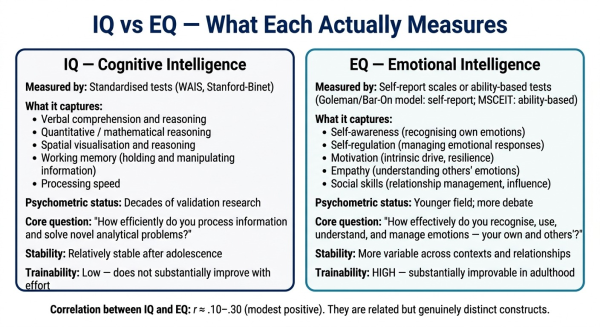
Before comparing their predictive power, it is worth being precise about what each construct actually captures:
IQ (Intelligence Quotient) measures cognitive abilities: verbal reasoning and comprehension, quantitative reasoning, spatial visualisation, working memory, and processing speed. It reflects how efficiently a person processes information and solves novel analytical problems. IQ is measured by validated standardised tests (WAIS-IV, Stanford-Binet 5) with decades of psychometric research supporting their reliability and validity. It is relatively stable after adolescence — adult IQ does not substantially change with effort or training in most cases. For more on IQ measurement, see our WAIS-IV guide and what IQ actually measures.
EQ (Emotional Quotient, or Emotional Intelligence) measures a different set of abilities: recognising your own emotions and those of others, regulating emotional responses, empathising effectively, and managing relationships with skill. Goleman's model breaks this into five components: self-awareness, self-regulation, motivation, empathy, and social skills. EQ is measured either by self-report scales (the most common commercial approach) or by ability-based tests (the MSCEIT, considered more psychometrically rigorous). EQ is substantially more trainable in adulthood than IQ — a critical practical difference.
The correlation between IQ and EQ is modest and positive — approximately r = .10–.30 in most studies. People with higher IQ tend to have slightly higher EQ on average, but the two constructs are genuinely distinct: you can be very high on one and average or low on the other.
The "80% of Success Is EQ" Myth — Debunked
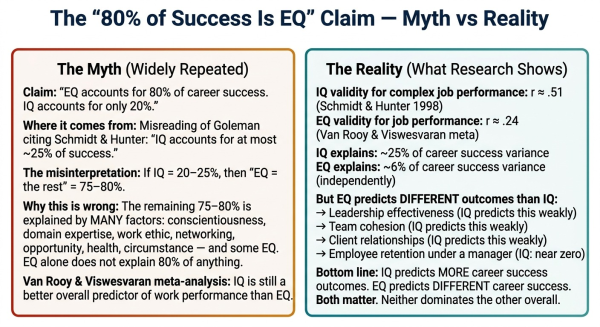
The most widely repeated claim in the EQ literature is that emotional intelligence accounts for 80% of career success. This claim is a misinterpretation of the research, and understanding why matters for applying the evidence appropriately.
The misinterpretation works like this: Goleman, citing Schmidt and Hunter (1998) and Sternberg (1997), noted that IQ accounts for approximately 20–25% of career success variance (with some estimates as low as 4–10%). From this, people conclude that "EQ must account for the remaining 75–80%." This reasoning is mathematically flawed. The remaining 75–80% of career success variance is explained by many factors: conscientiousness, domain expertise, work ethic, social capital, family background, geographic opportunity, health, timing, and yes — some portion by EQ. But EQ alone does not explain 80% of anything. As one critical analysis notes: "This claim is preposterous."
The actual meta-analytic evidence on EQ's predictive validity: Van Rooy and Viswesvaran's comprehensive meta-analysis found that while EQ does predict job performance, IQ is still a better overall predictor of both work and academic performance than EQ. EQ's incremental validity over IQ — how much additional performance variance it explains beyond what IQ already explains — is real but modest, approximately 3–5% in most studies.
This does not mean EQ is unimportant. It means the "EQ trumps IQ" framing is misleading — because IQ and EQ predict different outcomes in the workplace. The question should not be "which is more important overall?" but "which matters more for this role, at this stage, for this specific outcome?"
The Research Consensus: When Each Matters
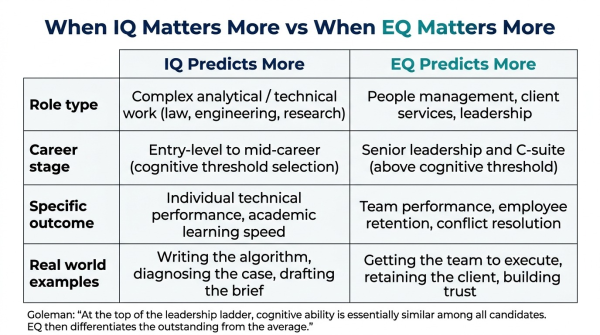
IQ predicts more strongly:
- Job performance in complex analytical and technical roles — the Schmidt and Hunter meta-analytic validity of r ≈ .51 for complex professional positions
- Academic performance and learning speed — IQ is the single best predictor of how quickly someone acquires new knowledge domains
- Individual technical performance in roles where information processing, problem-solving, and analytical reasoning are the primary job demands
- Career entry and progression into cognitively demanding professions (law, medicine, engineering, research)
EQ predicts more strongly:
- Leadership effectiveness — particularly in people-management roles. Goleman's analysis of competency models from approximately 500 global organisations found that 80–90% of the competencies differentiating high-performing executives from average executives were EQ-related rather than technical or IQ-type skills
- Team performance — EQ predicts how well teams collaborate, handle conflict, and maintain cohesion under stress
- Client relationship quality — the ability to build trust, understand client needs, and maintain long-term relationships is more EQ- than IQ-driven
- Employee retention under a manager — the well-documented finding that people leave managers, not companies, is essentially an EQ phenomenon: low-EQ managers create the dissatisfaction that drives resignation
- Mental health outcomes — EQ predicts life satisfaction, resilience, and psychological wellbeing outcomes that IQ does not
The career-stage dimension is particularly important. At career entry, cognitive ability is the primary differentiating factor because technical role performance and learning speed are the central demands. As careers progress toward senior leadership, the peer pool becomes increasingly homogeneous in cognitive ability — everyone at the senior executive level is smart — and EQ increasingly explains who performs best. This is the basis for the Goleman thesis about executive EQ: at the top levels of an organisation, IQ is essentially a shared baseline. EQ is what differentiates.
This pattern directly connects to the CEO IQ research discussed in our average IQ of CEOs guide: the median CEO is at the 83rd percentile in cognitive ability — well above average but not at the extreme top — while non-cognitive traits (emotional stability, leadership composite) predict CEO appointment more strongly than IQ does.
Goleman's Five Components: The EQ Framework
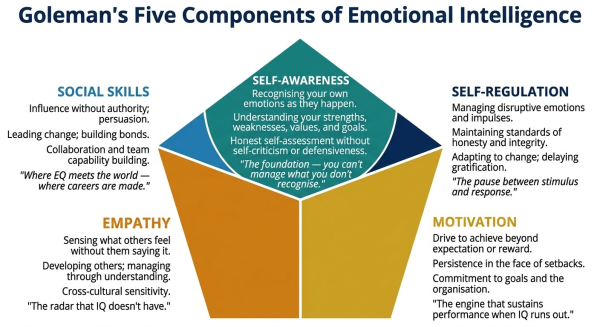
Goleman's five-component framework provides the most widely used map of what EQ encompasses in workplace contexts:
Self-awareness is the foundational component: the ability to recognise your own emotions as they occur, understand your strengths and weaknesses accurately, and have a realistic sense of your own capabilities without either over-confidence or unwarranted self-doubt. Managers with high self-awareness receive better performance ratings and have lower conflict rates with subordinates. It is the prerequisite for every other EQ component.
Self-regulation is the ability to manage disruptive emotions and impulses — to pause between stimulus and response, maintain standards of integrity under pressure, and adapt to changing circumstances without reactive decision-making. In leadership contexts, self-regulation is the difference between a leader who makes thoughtful strategic decisions under stress and one who reacts defensively or impulsively to challenges. Neurologically, self-regulation is associated with prefrontal cortex function — the same region most sensitive to sleep deprivation, as discussed in our sleep and IQ guide.
Motivation in Goleman's framework refers to intrinsic drive — pursuing achievement for its own sake rather than external rewards, maintaining optimism in the face of setbacks, and sustaining commitment to goals beyond the initial enthusiasm phase. Research consistently identifies conscientiousness (a Big Five personality trait that overlaps substantially with this component) as the strongest non-cognitive predictor of job performance across all occupational categories.
Empathy is the ability to sense what other people are feeling without them explicitly stating it — to read emotional subtext, understand how circumstances affect others' perspectives, and respond to people's emotional reality rather than just their stated positions. Empathy predicts client satisfaction, team trust, and negotiation effectiveness. It is fundamentally different from sympathy (feeling what someone feels) — it is the cognitive ability to model another person's emotional state accurately.
Social skills are the application of the other four components in interpersonal contexts: the ability to influence, persuade, inspire, build relationships, manage conflict, and build teams. This is where EQ meets the world. Research identifies social skills as the primary EQ component predicting leadership emergence, network quality, and long-term career advancement. Adam Grant's research on sales performance found that the highest-performing salespeople were neither highly introverted nor highly extraverted but "ambiverts" — people who balance outward social confidence with inward listening skill.
What the Research Supports About EQ Development
One of the most practically important differences between IQ and EQ is trainability. IQ is relatively stable after adolescence — adult IQ does not substantially change with effort in most cases. EQ is substantially more trainable — specific emotional intelligence competencies can be developed through targeted feedback, coaching, deliberate practice, and mindfulness-based approaches.
A 2023 study cited in MIT Sloan Management Review found that businesses implementing EQ development programmes improved team performance and decision-making efficiency by 25%. A 2022 Deloitte Insights survey linked emotionally intelligent leadership to lower employee turnover and higher productivity. These findings, while from proprietary research with their own methodological limitations, are broadly consistent with the academic literature on EQ training outcomes.
What EQ training does and does not do: it improves specific emotional regulation strategies, self-awareness habits, empathetic listening skills, and conflict resolution techniques. It does not produce wholesale personality transformation. The most effective EQ development approaches focus on specific, behavioural competencies rather than abstract "emotional intelligence" as a whole — helping a manager become better at receiving critical feedback, for example, rather than trying to raise their "EQ score" generically.
The research on EQ vs IQ at work supports a nuanced conclusion: both matter, for different outcomes, in different contexts. IQ is the stronger predictor of overall job performance, academic learning, and technical role success. EQ is the stronger predictor of leadership effectiveness, team cohesion, and interpersonal outcomes that IQ measures poorly. The popular claim that "EQ = 80% of success" is not supported by the data — it is a misreading of research that found IQ explains ~20–25% of success variance. The remaining variance is explained by many factors, of which EQ is one. The most practically useful framing: cognitive ability gets you into a role; above that threshold, emotional intelligence substantially determines how far you go and how much impact you have on the people around you.
For more on what IQ measures and predicts, see our guides on what IQ actually measures and IQ and income. For the profession-specific patterns of IQ and EQ in action, see our career guides on lawyers, CEOs, and doctors. Take our free IQ test to find out where your own cognitive profile sits.
Frequently Asked Questions
Does EQ matter more than IQ in the workplace?
It depends on the role and outcome. IQ is the stronger predictor of overall job performance (r ≈ .51 for complex roles). EQ predicts what IQ misses: leadership effectiveness, team cohesion, client relationships. For senior leadership above the cognitive threshold, EQ may be more differentiating. Neither universally dominates the other.
Is the "80% of success is EQ" claim true?
No — this is a widely repeated misinterpretation. The claim derives from research showing IQ explains ~20–25% of success variance, which was wrongly read as "EQ explains the rest." Meta-analysis (Van Rooy and Viswesvaran) shows IQ is still a better overall predictor of work performance than EQ. The remaining variance after IQ is explained by many factors, not EQ alone.
What does EQ predict that IQ doesn't?
EQ predicts: leadership effectiveness (Goleman: 80–90% of executive differentiators are EQ-related), team cohesion, client relationship quality, conflict resolution, employee retention under a manager, and mental health outcomes. These are the gaps in IQ's predictive coverage that EQ fills.
Can EQ be improved?
Yes — substantially more than IQ. EQ is highly trainable in adulthood through feedback, coaching, mindfulness, and deliberate practice on specific competencies (self-awareness, self-regulation, empathy, social skills). IQ is relatively stable after adolescence. This makes EQ development a high-ROI investment for individuals and organisations.
What are Goleman's five components of emotional intelligence?
Goleman's five EQ components: self-awareness (recognising own emotions), self-regulation (managing emotional responses), motivation (intrinsic drive and resilience), empathy (understanding others' emotions), and social skills (relationship management and influence). The first two are internal; the last two are relational; motivation bridges them.

Comments
Share Your Thoughts