In 2024, a study published in Psychological Science introduced a new term to cognitive science: anendophasia — the absence or near-absence of inner speech. The research, by Johanne Nedergaard of the University of Copenhagen and Gary Lupyan of the University of Wisconsin-Madison, confirmed what many people had quietly suspected but struggled to articulate: not everyone has an inner monologue, and the strength of that internal verbal voice varies substantially across individuals.
The study also generated a wave of popular commentary focused on a specific question: does having an inner monologue mean you're smarter? Does the absence of one mean lower intelligence? These questions touch on one of the oldest ideas in cognitive science — the relationship between language and thought — and the research provides clearer answers than most popular coverage suggests.
The short version: inner speech is associated with better performance on specific verbal cognitive tasks. It does not straightforwardly predict overall IQ. And the absence of inner speech — anendophasia — does not indicate reduced general intelligence. What it does affect is how certain verbal tasks are processed, not whether cognitive complexity is possible.
What Is Inner Speech? The Cognitive Science Definition
Inner speech — also called inner monologue, internal dialogue, silent self-talk, or verbal thinking — is the covert, silent form of language use that occurs inside the mind without being spoken aloud. It is not the same as "thinking" in general. It refers specifically to the verbal dimension of cognition: the experience of hearing words or sentences in one's mind while reasoning, planning, remembering, or processing an experience.
Researchers distinguish inner speech from several related phenomena:
- Inner speech — covert verbal experience; silent, internal, language-based
- Private speech — verbal thought spoken aloud (typically in children; sometimes in adults when solving difficult problems)
- Mental imagery — visual, spatial, or sensory mental representations; not language-based
- Aphantasia — the absence of visual mental imagery (distinct from anendophasia)
Inner speech is not a simple on/off phenomenon. Research using instruments like the Internal Representations Questionnaire (IRQ) shows that people vary continuously in how frequently they experience inner speech, how vivid it is, and how much they rely on it as a cognitive tool. Anendophasia — the term introduced by Nedergaard and Lupyan — describes the far end of this distribution: people who rarely or never experience anything resembling a verbal inner voice.
Vygotsky's Framework: Where Inner Speech Comes From
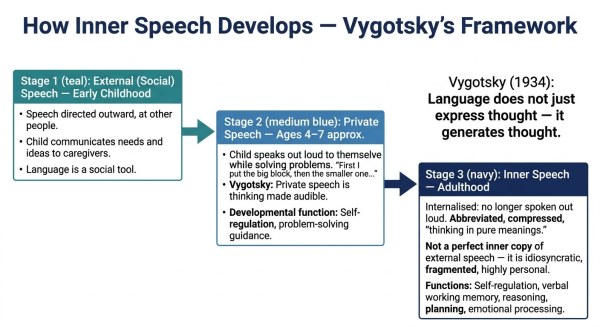
The most influential theoretical account of inner speech comes from Soviet developmental psychologist Lev Vygotsky, working in the 1930s. Vygotsky proposed that inner speech is not an innate feature of cognition — it develops through a specific developmental sequence, and it is fundamentally social in origin.
In Vygotsky's account:
Phase 1: External (Social) Speech. In early childhood, language is directed outward — at other people. Speech is a social tool for communication and for obtaining help from caregivers.
Phase 2: Private Speech (ages approximately 4–7). Children begin talking out loud to themselves while solving problems — "First the big block, then the smaller one..." This is thinking made audible. Private speech is not random or meaningless: it is the child's self-regulatory system, guiding action and problem-solving through language. Children who use more private speech during difficult tasks tend to perform better on them.
Phase 3: Inner Speech (adulthood). Private speech is gradually internalised — it goes underground, becoming the covert inner voice of adult cognition. Crucially, Vygotsky argued that inner speech is not simply a silent version of external speech. It is "thinking in pure meanings" — abbreviated, compressed, fragmentary, and highly idiosyncratic. Full sentences are rarely necessary; a single word or phrase carries rich associated meaning. Inner speech is to external speech what a private shorthand is to a formal letter.
Vygotsky's central claim — and the one that connects most directly to the IQ question — was that language does not just express thought: it generates thought. Inner speech, on this account, is not a mere accompaniment to cognition but a cognitive tool in itself, supporting self-regulation, working memory, planning, and verbal reasoning. Modern cognitive neuroscience has substantially confirmed that inner speech activates brain regions associated with speech production and language comprehension — it is not purely passive experience but an active process.
The 2024 Anendophasia Study: What It Actually Found
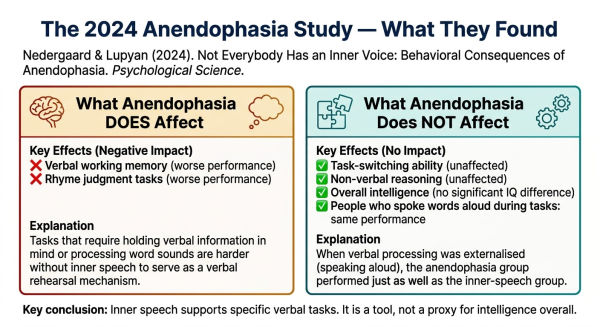
The 2024 Nedergaard and Lupyan study in Psychological Science is the most direct experimental evidence to date on whether the absence of inner speech affects cognitive performance. The findings are more nuanced than most popular coverage suggests.
What the researchers did. They recruited participants who had previously completed the Internal Representations Questionnaire (IRQ) — selecting people from the bottom 16% and top 40% of the Verbal factor, identifying groups with near-absent and strong inner speech respectively. These participants were then given cognitive tasks designed to probe verbal and non-verbal processing.
What they found:
People with near-absent inner speech (anendophasia) performed worse on:
- Verbal working memory tasks — tasks requiring holding verbal information in short-term memory while processing it
- Rhyme judgment tasks — tasks requiring phonological processing (determining whether two words rhyme)
People with near-absent inner speech performed identically on:
- Task-switching tasks — requiring cognitive flexibility and the ability to shift attention between different task rules
- Other non-verbal reasoning measures — no significant group differences on cognitive tasks that did not specifically require verbal processing
Critically: when the anendophasia group was allowed to speak the task words aloud during the verbal memory tasks — externalising the verbal processing that inner speech would normally support — they performed just as well as the inner-speech group. This suggests that inner speech serves as an internal verbal rehearsal mechanism, and that when this mechanism is absent, externalising the verbal processing compensates fully.
What this means. Inner speech appears to be a cognitive tool that facilitates specific verbal tasks — primarily those requiring the internal rehearsal of words and sounds. It is not a general requirement for cognitive complexity, and its absence does not indicate reduced overall intelligence. The cognitive impact of anendophasia is selective: it affects verbal-specific processing, not general reasoning or cognitive flexibility.
Note: A 2025 commentary by Andreas Lind in the same journal challenged whether the Nedergaard and Lupyan study actually demonstrated true anendophasia (complete absence of inner speech) versus simply lower self-reported reliance on it. This methodological debate highlights an important limitation: inner speech is notoriously difficult to study objectively because it is private, and self-report is the primary measurement tool available. The study's conclusions should be read as evidence about low versus high inner speech frequency, with some uncertainty about whether true complete absence exists at the studied prevalence.
Verbal vs Visual Thinking: Two Routes to Intelligence
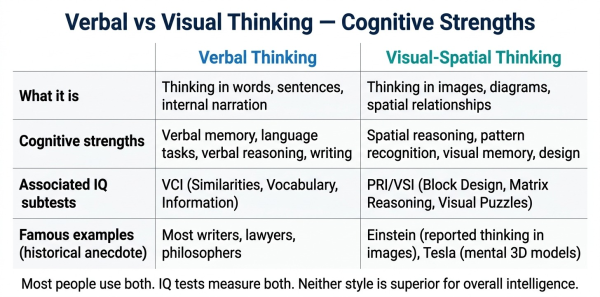
The dichotomy between verbal and visual thinking maps reasonably well onto the distinction between the Verbal Comprehension Index (VCI) and the Perceptual Reasoning Index / Visual Spatial Index (PRI/VSI) in the Wechsler Intelligence Scale — two independently measurable cognitive domains that both contribute to Full Scale IQ. For more on these indexes, see our WAIS-IV guide.
People with strong verbal inner speech — those for whom thinking frequently takes linguistic form — tend to show particular strengths in verbal comprehension, verbal reasoning, and verbal memory. These are the tasks most directly served by the inner speech mechanism.
People who report primarily visual or spatial thinking — those for whom reasoning takes the form of images, spatial relationships, and abstract patterns rather than words — tend to show particular strengths in perceptual reasoning, spatial analysis, and non-verbal pattern recognition. These strengths are no less cognitively sophisticated; they simply operate through different cognitive architecture.
The most cited historical example is Albert Einstein, who reportedly described his thinking as primarily visual and kinesthetic — working with "muscular" feelings and visual images, and only translating ideas into words and mathematical symbols secondarily. Einstein's genius is not in question. What his self-report illustrates is that verbal inner speech is not a prerequisite for high-level abstract cognition.
Similarly, Nikola Tesla described designing and testing his inventions entirely in mental imagery before building them — running what he described as mental simulations of machines that had never physically existed. His work on AC motors and electrical systems involved profound spatial and abstract reasoning without obvious dependence on verbal inner speech. For more on Tesla, see our profile: Nikola Tesla IQ.
Does Inner Speech Predict IQ? The Evidence Summary
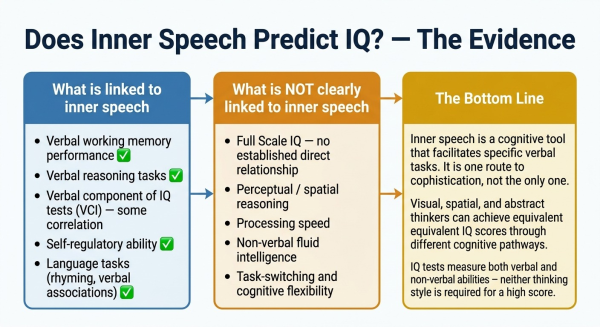
Synthesising the available evidence:
Inner speech is positively associated with verbal cognitive performance. People who report richer, more frequent inner speech tend to do better on verbal working memory tasks, verbal reasoning tasks, and language-dependent problem-solving. This is consistent with Vygotsky's framework: inner speech is a cognitive tool that provides an internal verbal rehearsal and self-regulation system. In tasks that specifically require verbal processing — including the Verbal Comprehension subtests of the WAIS-IV — inner speech provides a genuine cognitive advantage.
Inner speech is not a general predictor of IQ. The Nedergaard and Lupyan study found no significant overall cognitive ability difference between anendophasia and inner-speech groups on tasks that did not specifically require verbal processing. The relationship between inner speech and intelligence is domain-specific, not global. Full Scale IQ — which includes both verbal and non-verbal components — is not straightforwardly predicted by inner speech frequency.
The relationship is bidirectional. As one review of the literature notes, the relationship between inner speech and IQ is bidirectional: more developed cognitive abilities likely produce more sophisticated inner dialogue, and that inner dialogue in turn supports further cognitive development. This is consistent with Vygotsky's claim that language and thought develop together, each shaping the other — rather than inner speech being purely a product of intelligence or purely a cause of it.
Compensation is possible. The most important practical finding from the 2024 study is that anendophasia is not a fixed cognitive limitation. When people without inner speech are allowed to externalise verbal processing (speaking aloud), they perform identically to inner-speech users. This suggests that the verbal rehearsal mechanism provided by inner speech can be replaced by external speech — a finding with direct implications for education and work environments for people with anendophasia.
Practical Implications: What This Means for Self-Understanding
For people who have an inner monologue, the research suggests it is a cognitive resource — particularly valuable for verbal tasks, working memory, planning, and self-regulation. Using it deliberately — narrating problems to oneself, talking through decisions internally — appears to genuinely support cognitive performance on verbally demanding tasks. This is consistent with research on "self-talk" in sports psychology and learning science, where deliberate use of verbal inner speech improves performance on procedurally complex tasks.
For people without a strong inner monologue, the research suggests that this is a legitimate cognitive style rather than a deficit. The 2024 findings show that anendophasia affects verbal-specific task performance but not general reasoning or cognitive flexibility. If you think primarily in images, patterns, spatial relationships, or abstract sensory-motor representations, you are not cognitively limited — you are using a different cognitive architecture that has its own strengths in visual, spatial, and non-verbal reasoning. The cognitive pathway differs; the destination (complex, capable cognition) remains fully accessible.
For both groups, the research supports one practical conclusion: understanding your cognitive style — whether you're a verbal, visual, or mixed thinker — can help you design learning and problem-solving approaches that play to your architecture. For more on how IQ tests measure these different cognitive dimensions, see our WAIS-IV guide and our guide on what IQ actually measures.
Inner speech — the inner monologue — is a cognitive tool that supports specific verbal tasks: verbal working memory, verbal reasoning, phonological processing, and self-regulation through language. People with stronger inner speech have an advantage on these specific tasks. But inner speech is not a proxy for overall intelligence: IQ tests measure both verbal and non-verbal cognitive abilities, and people who think primarily in images, patterns, or spatial representations can achieve the same cognitive complexity through different cognitive routes. The 2024 anendophasia research confirms that not everyone has an inner voice — and that those who don't are not cognitively inferior, just cognitively different.
Find out where your own cognitive profile sits with our free IQ test — no registration, results in under 20 minutes. For more on how the cognitive abilities measured by IQ tests work, see our WAIS-IV guide, our Wechsler IQ test guide, and our guide on IQ vs EQ.
Frequently Asked Questions
Does having an inner monologue mean higher IQ?
Not directly. Inner monologue is associated with better performance on verbal-specific tasks — verbal working memory, verbal reasoning, phonological processing. But it does not predict Full Scale IQ overall. People without strong inner speech (anendophasia) perform equally well on non-verbal cognitive tasks and show no significant overall IQ difference in research studies.
What is anendophasia?
Anendophasia is the term introduced by Nedergaard and Lupyan in a 2024 study in Psychological Science for the absence or near-absence of inner speech. The study found that people with anendophasia had worse verbal working memory and rhyme judgment performance, but equivalent task-switching ability. When they spoke words aloud during verbal tasks, the performance gap disappeared — suggesting compensation through externalised verbal processing.
Is it normal to not have an inner monologue?
Yes. The 2024 research confirmed that inner speech frequency varies substantially across people, and some individuals experience little to no verbal inner speech. This is a legitimate variation in cognitive style, not a disorder or deficit. People with anendophasia appear to compensate with visual, spatial, or other non-verbal cognitive strategies.
Do intelligent people think in words or pictures?
Both — high intelligence does not require a specific thinking mode. Albert Einstein reported thinking primarily in images and spatial concepts; many high-IQ individuals report rich verbal inner speech. What research shows is that each mode supports different cognitive strengths: verbal thinking aids verbal tasks; visual-spatial thinking aids spatial and pattern-recognition tasks. IQ tests measure both.
What did Vygotsky say about inner speech and intelligence?
Vygotsky proposed that inner speech develops from childhood private speech (thinking aloud) and becomes a key cognitive tool for self-regulation, working memory, and verbal reasoning. His core insight — that language generates thought, not just expresses it — has been substantially confirmed by modern cognitive science. Inner speech is a cognitive scaffold, not merely a byproduct of thinking.

Comments
Share Your Thoughts