Discovering that your IQ score is below average can feel unsettling. Many people immediately wonder whether it means they are less capable, less intelligent, or at a disadvantage in life. In reality, a below-average IQ score is far more common — and far less limiting — than most people think. This article explains what a below-average IQ score really means, what it does not mean, and why it should not define your potential or future success. To better understand how IQ scores are calculated and interpreted, you may want to start with what IQ is and how intelligence quotient works.

What Does “Below Average IQ” Actually Mean?
IQ scores are standardised so that 100 represents the population average, with most people scoring close to that number. Intelligence follows a bell curve, meaning the majority of individuals cluster around the average rather than at the extremes. This concept is explained visually in the IQ scale from low to genius. About two-thirds of the population score between 85 and 115, which is considered the normal or average range of intelligence.
A “below average” IQ typically refers to scores between 70 and 84. While this range is lower than the population average, it still reflects normal cognitive functioning — it does not indicate intellectual disability, cognitive impairment, or an inability to live independently. As a simplified classification: 130+ is Gifted; 115–129 is Above Average; 100–114 is Average; 85–99 is Average (lower range); 70–84 is Below Average; below 70 is Significantly Below Average.
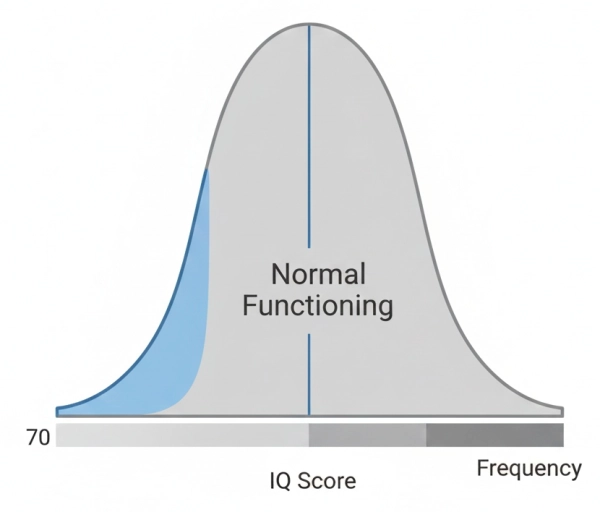
If your IQ falls between 70 and 84, you are still capable of learning, adapting, working, and managing everyday responsibilities. Our article on signs of a low IQ helps clarify common misconceptions around this topic.
Should You Be Worried?
No. A below-average IQ score by itself is not something to worry about. People with below-average IQs function normally in society and often develop effective ways of learning and problem-solving that suit their strengths. Many individuals in this range learn best through clear explanations, repetition, and practical examples; perform well in structured environments with defined expectations; excel in hands-on, technical, or routine-based tasks; build strong competence through experience and practice; and handle everyday problems and responsibilities without difficulty.
In real life, qualities such as reliability, communication skills, and adaptability often matter more than test scores. This is why research increasingly highlights the importance of emotional intelligence compared to IQ in long-term success.
Why IQ Is Often Overestimated
IQ is frequently treated as a measure of overall intelligence, but in reality, it evaluates only a limited set of cognitive abilities — mainly logical reasoning, verbal comprehension, pattern recognition, and working memory. IQ tests do not measure many important aspects of human ability, including creativity and original thinking, emotional intelligence, social and interpersonal skills, work ethic and self-discipline, persistence and resilience, leadership and influence, or practical, mechanical, or artistic intelligence. Strong emotional awareness and people skills can compensate significantly for lower scores on traditional cognitive tests.
The Difference Between IQ and Real-World Ability
In everyday life, success rarely depends on abstract reasoning or test performance alone. Instead, it depends on practical behaviours and habits: showing up consistently and meeting responsibilities, learning from real-world experience, communicating clearly and effectively, managing emotions, stress, and setbacks, and working cooperatively with others. Someone with a slightly below-average IQ but strong emotional intelligence and discipline often outperforms a higher-IQ individual who struggles with motivation or teamwork.
Can IQ Scores Be Misleading?
Yes. IQ scores are not perfectly precise and can be influenced by many external factors, including test anxiety or emotional stress, fatigue or lack of sleep, time pressure or distractions, unfamiliar or confusing test formats, and cultural or language differences. Because of this, a single test result should never be viewed as a permanent label — scores can fluctuate meaningfully depending on conditions at the time of testing.
Can You Still Be Successful With a Below-Average IQ?
Absolutely. People with below-average IQs succeed every day across a wide range of careers and lifestyles, including skilled trades and technical work, manufacturing and operations, healthcare support and caregiving, art, crafts, and creative professions, entrepreneurship and small business ownership, and sales, service, and customer-facing roles.

Real-world success is far more closely linked to habits, persistence, and mindset than to a single cognitive score.
How to Thrive Regardless of Your IQ Score
Rather than focusing on your IQ number, it is far more productive to focus on areas within your control: building practical, job-relevant skills; strengthening communication and social abilities; practising problem-solving in real-life situations; maintaining good physical health and managing stress; and committing to lifelong learning and personal growth. Research on whether IQ can be improved also suggests that cognitive performance is not fixed and can be supported through healthy habits and continued engagement.
The Bottom Line
Should you worry if your IQ is below average? No. A below-average IQ does not define your intelligence, limit your potential, or determine your future. It simply means you may process certain types of information differently, you may learn best through practical or hands-on approaches, and your strongest abilities may lie outside traditional IQ measurements. Intelligence is multifaceted, adaptable, and shaped by experience. Your choices, effort, and willingness to grow matter far more than any number on a test. Explore more in our IQ Guides collection.

Comments
Share Your Thoughts