An IQ of 73 falls in the Borderline range on the Wechsler Adult Intelligence Scale — the classification band between IQ 70 and IQ 79 that sits above the threshold associated with intellectual disability but below the Average range that begins at IQ 85. It corresponds to approximately the 3rd to 4th percentile of the general population.
This guide approaches IQ 73 with the same commitment to accuracy and honesty that applies throughout this series — but with particular care for the human context. A person reading this guide may be trying to understand a score of their own, a score of a child or family member, or the classification system itself. All of these are valid reasons. The information here is based on the psychometric and clinical research, presented without judgment and without false reassurance.
The most important things to understand about IQ 73 from the outset: it is not intellectual disability by itself (intellectual disability requires additional criteria beyond IQ score alone); it does indicate meaningful cognitive challenges in academic and certain occupational settings; and many people with scores in the Borderline range live independently, hold employment, and build fulfilling lives — particularly in environments that match their strengths and provide appropriate support.
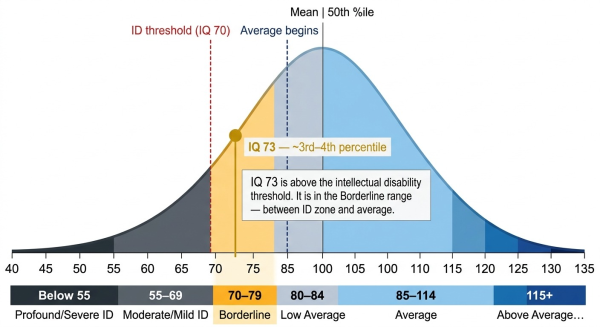
IQ 73 in Numbers: The Core Statistics
| Metric | Value at IQ 73 |
| Standard deviations below mean | −1.80 SD |
| Percentile | ~3rd to 4th |
| People scoring higher | ~96–97% of the general population |
| Wechsler classification | Borderline |
| Above ID threshold (IQ 70) by | 3 points |
| Below Low Average range (IQ 80) by | 7 points |
| Below Average range (IQ 85) by | 12 points |
| US population in Borderline range (IQ 70–79) | ~10–14 million people |
The Borderline range as a whole (IQ 70–79) represents approximately 6–8% of the general population — roughly 10–14 million Americans, and hundreds of millions of people worldwide. This is not a rare or unusual cognitive level — it is a significant segment of the population that experiences specific and well-documented challenges in educational and occupational settings, while also demonstrating the same full range of human strengths, relationships, creativity, and practical capability that any other cognitive group displays.
Borderline Intellectual Functioning vs Intellectual Disability: The Critical Distinction
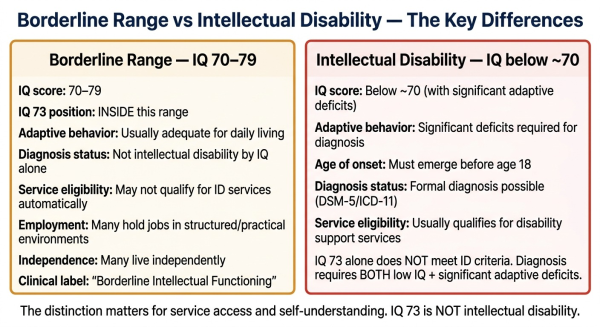
The most important clinical and practical distinction for IQ 73 is the difference between Borderline Intellectual Functioning (the classification that applies at IQ 73) and Intellectual Disability (ID, sometimes still called mental retardation in older literature).
Intellectual Disability (ID) — as defined by the DSM-5 and ICD-11 — requires three criteria to be met simultaneously:
- Significant deficits in intellectual functioning (typically IQ below approximately 65–75, depending on the specific assessment)
- Significant deficits in adaptive behaviour — the practical, social, and conceptual skills needed for independent daily functioning
- Onset during the developmental period (before age 18)
IQ score alone is not sufficient for an ID diagnosis. A person with IQ 73 who has adequate adaptive behaviour — who can manage basic daily life tasks, navigate social situations, handle personal care, and function independently in familiar environments — does not meet the criteria for intellectual disability regardless of the IQ score. This is an important and often misunderstood distinction.
Borderline Intellectual Functioning (BIF) is the clinical term for IQ scores in the 70–79 range. It is noted in the DSM-5 as a "V-code" condition warranting clinical attention — a condition that may cause difficulty and require support, without being a formal diagnostic category equivalent to a disorder. People with BIF typically:
- Function independently in daily living in familiar, structured environments
- May struggle significantly with complex academic content and abstract reasoning demands
- Often do well in practical, structured, or routine occupational roles
- May not automatically qualify for ID-related disability services, creating a "service gap" where they face challenges that average-functioning people do not face but may not receive the support that people with ID receive
The "service gap" associated with BIF is one of the most important and frequently documented concerns in the clinical literature: people in the Borderline range often have significant challenges but are not always identified or supported because they fall between the criteria for ID services and the typical threshold for "average" educational expectations.
What IQ 73 Means in Daily Life
Understanding what IQ 73 means in practice — beyond clinical classification — requires honesty about both the challenges it creates and the strengths and capabilities that coexist with it.
Areas Where Challenges Often Appear
Academic learning. Abstract academic content — particularly in mathematics, science, and language arts at secondary and tertiary level — often presents significant challenges for people in the Borderline range. The pace of instruction in standard educational settings is typically designed for students around the Average range, which can mean Borderline-range students fall progressively behind without additional support. Reading comprehension of complex texts, multi-step mathematical reasoning, and abstract verbal analysis are the areas where IQ 73 most reliably produces below-average performance.
Complex occupational demands. Jobs requiring significant abstract reasoning, rapid learning of complex new material, complex written instructions, or high-speed information processing will typically be challenging at IQ 73. This does not mean all demanding work is inaccessible — it means the specific cognitive demands of highly abstract or rapidly changing information-processing roles are above the level where IQ 73 performs most comfortably.
Navigating complex institutional systems. Healthcare bureaucracy, legal systems, government services, and other complex institutional environments often require the kind of reading comprehension, abstract reasoning, and verbal analytical skill that IQ 73 may find challenging without support. This can create cascading difficulties with access to services, benefits, and rights that more cognitively advantaged people navigate more easily.
Areas of Strength That Coexist With IQ 73
Practical and hands-on intelligence. Many people in the Borderline range show strong practical intelligence — the ability to learn by doing, to navigate familiar physical environments, to perform reliable work in structured settings. The relationship between IQ tests (which measure verbal and abstract analytical ability) and practical intelligence (which IQ tests do not fully capture) means that many people with IQ 73 are more capable in hands-on and procedural domains than their IQ score alone would predict.
Social and interpersonal ability. Emotional responsiveness, social warmth, reliability in relationships, and interpersonal care are not captured by IQ tests and are independent of analytical intelligence. Many people in the Borderline range demonstrate strong social bonds, effective parenting, loyal friendships, and meaningful community participation.
Performance in structured environments. Research consistently shows that people in the Borderline range perform significantly better in structured, predictable environments with clear expectations and consistent support than in environments requiring rapid adaptation to novel, abstract, or verbally complex demands. Environmental fit matters enormously for outcomes at this cognitive level.
Strengths, Challenges, and Supports
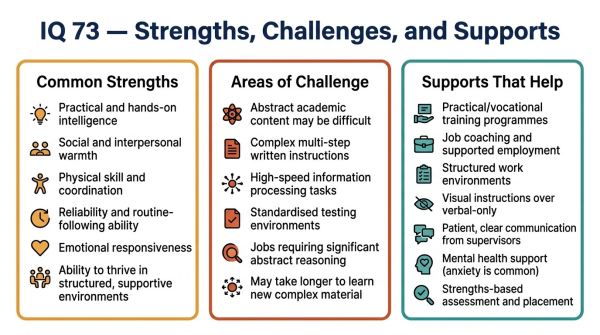
The practical landscape for someone at IQ 73 is shaped by the intersection of cognitive challenges with the supports and environments available. The research on outcomes for people in the Borderline range consistently shows that outcomes vary enormously depending on environmental factors — family support, educational quality, access to vocational training, economic stability, and community belonging — more than they are determined by the cognitive level alone.
Vocational paths that work well. Research on employment outcomes for Borderline-range individuals identifies several broad categories where structured, practical work is highly accessible: skilled and semi-skilled trades (with appropriate apprenticeship support), food production and hospitality, retail and warehouse work, personal care and community support roles, agricultural work, cleaning and facilities services, and many manufacturing and assembly roles. Many of these provide economic stability, social connection, and the personal satisfaction of consistent, valued contribution — outcomes that no IQ score predicts or precludes.
Support systems that make a difference. The clinical literature on BIF consistently identifies several types of support that meaningfully improve outcomes: vocational training that emphasises hands-on learning over abstract instruction; job coaching that helps with initial learning curves and workplace navigation; supported employment programmes that match role demands to capabilities; mental health support (anxiety and depression are more common in the Borderline range, often as a secondary consequence of chronic academic and social difficulty); and patient, consistent communication from educators, employers, and service providers who understand the cognitive profile.
For families navigating this for children, early identification and appropriate educational support are the most powerful levers available. See our guides on IQ testing for ages 6–12 for more on assessment and support in childhood.
The Measurement Question: How Reliable Is IQ 73?
An important practical caveat for anyone who has received an IQ score of 73: how reliable is any single IQ test score, and how much should it be weighted?
The standard error of measurement on most clinical IQ tests (including the WAIS-IV and WISC-V) is approximately ±5 points at the 95% confidence interval. This means a reported score of 73 reflects a confidence interval of approximately 68–78. A person who genuinely tests at IQ 73 might score anywhere in this range on different testing occasions. Near the IQ 70 threshold for intellectual disability consideration, this measurement error has particularly significant practical implications — a score of 73 might reflect a true ability level of 68 (below the ID threshold) or 78 (more clearly in the Borderline range).
For anyone whose score of IQ 73 has practical consequences — for educational placement, disability service eligibility, employment assessments, or legal proceedings — a comprehensive evaluation by a licensed clinical psychologist, including full assessment of adaptive behaviour and multiple cognitive measures, is much more informative than a single IQ score. The number alone, particularly at this range, should not be the sole basis for significant life decisions. For more on the reliability of IQ testing, see our guide on what IQ actually measures.
IQ 73 in Context: The Classification Landscape
| IQ Range | Classification | Percentile Range | Key Note |
| Below 55 | Extremely Low (Profound/Severe) | Below 0.1% | Significant disability; intensive support required |
| 55–69 | Extremely Low / Mild ID zone | 0.1%–2nd | Formal disability services typically available |
| 70–79 | Borderline | 2nd–8th | IQ 73 is HERE — between ID zone and average |
| 80–84 | Low Average | 9th–14th | Below average but not Borderline |
| 85–114 | Average | 16th–84th | Central 68% of population |
| 115–129 | High Average / Superior | 84th–98th | Above average range |
| 130+ | Very Superior / Gifted | 98th+ | Gifted range |
The table contextualises IQ 73's position: 3 points above the intellectual disability threshold, 7 points below the Low Average range, and 12 points below the Average range. For scores above this range, see our guides on the IQ 90, IQ 105, and IQ 112 scores. For the full distributional context, see our IQ scale explained.
IQ 73 sits in the Borderline range — the classification zone between average functioning and intellectual disability. It is not intellectual disability by itself; that diagnosis requires significant adaptive behaviour deficits in addition to a low IQ score. What IQ 73 does indicate is real and meaningful cognitive challenges in academic and complex occupational settings that benefit from appropriate support, occupational fit, and environmental structure. The research on outcomes at this cognitive level is consistent: what matters most is not the number, but the quality and nature of the support, the fit between the environment and the person's strengths, and the relationships and community that surround them.
For help understanding IQ scores in children, see our guide on IQ testing for ages 6–12. For broader context on the IQ scale, see our IQ scale explained and our guide on what IQ actually measures.
Frequently Asked Questions
What does an IQ of 73 mean?
An IQ of 73 falls in the Borderline range (IQ 70–79) on the Wechsler scale, at approximately the 3rd to 4th percentile. It indicates below-average cognitive functioning that may create meaningful challenges in academic and complex occupational settings. It is above the threshold associated with intellectual disability (IQ 70 with adaptive deficits) and does not by itself constitute a diagnosis of intellectual disability.
How rare is an IQ of 73?
IQ 73 corresponds to approximately the 3rd to 4th percentile — roughly 96–97% of the general population score higher. The Borderline range (IQ 70–79) as a whole represents approximately 6–8% of the population — about 10–14 million Americans. It is a significant, non-trivial segment of the population.
Is IQ 73 considered intellectually disabled?
No — not by itself. IQ 73 is in the Borderline range, above the intellectual disability threshold. A diagnosis of Intellectual Disability (ID) requires: (1) IQ below approximately 70, (2) significant deficits in adaptive behaviour, and (3) onset before age 18. IQ 73 alone does not meet these criteria.
What does the Borderline range mean in practice?
In practice, the Borderline range (IQ 70–79) is often called the "gray zone" between average functioning and intellectual disability. People in this range often: learn more slowly than peers; may struggle with highly abstract academic content; can typically manage daily living tasks independently; and often function well in structured, practical, or supportive environments. Many live independently and hold employment.
What support is available for people with IQ 73?
Supports include: educational accommodations (extended time, simplified instruction), vocational training and job coaching, supported employment programmes, independent living support services, and mental health services for anxiety and low self-esteem (both common in this range). Access varies by country — in the US, many formal disability services require IQ below 70, meaning Borderline-range individuals may need to specifically seek assessment and advocate for individual support arrangements.

Comments
Share Your Thoughts