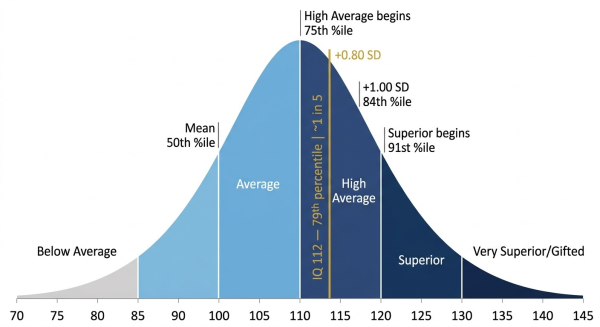
An IQ of 112 places you at approximately the 79th percentile — meaning you score higher than about 79 out of every 100 people in the general population. The Wechsler Adult Intelligence Scale classifies this as High Average intelligence. It represents 0.80 standard deviations above the population mean of 100, and roughly 1 in 5 people score at this level or above.
IQ 112 sits near the centre of the High Average band (IQ 110–119). It is 12 points above the population mean, 2 points above the High Average lower boundary at IQ 110, 3 points below the statistically significant +1 SD marker at IQ 115, and 8 points below the Superior range that begins at IQ 120. It is a genuinely above-average score associated with a wide range of professional and academic paths — and one where the research on non-cognitive factors is particularly relevant.
This guide covers what the research says about IQ 112: the population statistics, what it means for career and academic life, the roles where it aligns with professional averages, and why the non-cognitive factors — motivation, conscientiousness, domain expertise, and emotional intelligence — matter so much at this cognitive level.
IQ 112 in Numbers: The Core Statistics
| Metric | Value at IQ 112 |
| Standard deviations above mean | +0.80 SD |
| Percentile | ~79th |
| Frequency in general population | ~1 in 5 |
| In a room of 100 people | ~21 score at or above this level |
| In the United States (~335M) | ~70 million people |
| Wechsler classification | High Average |
| Gap to +1 SD marker (IQ 115) | 3 points |
| Gap to Superior range (IQ 120) | 8 points |
The comparison with adjacent reference points helps place IQ 112 precisely. IQ 110 (75th percentile, 1 in 4) is the lower boundary of the High Average band — 2 points lower than IQ 112. IQ 115 (84th percentile, 1 in 6, exactly +1 SD) is 3 points higher. IQ 120 (91st percentile, 1 in 11, beginning of Superior) is 8 points higher and the professional average for doctors, lawyers, and engineers. IQ 112 is meaningfully above average but in the same distributional neighbourhood as many common professional group averages. For the full scale, see our IQ scale explained.
The High Average Band: What It Means to Be Here
The High Average range (IQ 110–119) is one of the most practically important — and most under-discussed — bands on the IQ distribution. It is below the Superior range that most IQ score articles focus on, but it is the range where a large proportion of professionally active, academically engaged adults actually score.
Key characteristics of the High Average band at IQ 112:
Clearly above average. IQ 112 scores higher than approximately 79% of the general population. In most everyday environments — social settings, community groups, most workplaces — this represents a real and consistent cognitive advantage over the majority of people encountered. Information is processed somewhat faster than average, new material is absorbed with somewhat less effort, and analytical tasks are approached with somewhat more facility.
In the right zone for many professions. The estimated average IQ for teachers is approximately 110–115. For nurses, physiotherapists, and allied health professionals: approximately 110–115. For police supervisors and skilled trades managers: approximately 110–115. For business administrators and account managers: approximately 110–120. IQ 112 places a person at or near the cognitive centre of a wide range of professional groups — not above it (as with doctors or lawyers), not below it, but in the zone where these occupations naturally cluster. This makes IQ 112 particularly well-matched to many professional paths from a cognitive standpoint.
Not the most analytically intensive professional level. Fields with the highest average IQ — research science, surgery, elite legal practice, complex engineering research — average above IQ 120–130. IQ 112 is below these averages. This does not mean these fields are impossible at IQ 112, but it does mean that at IQ 112, the most cognitively demanding aspects of these roles will require more effort and sustained focus than for colleagues scoring significantly higher.
What IQ 112 Opens in Career and Academic Life
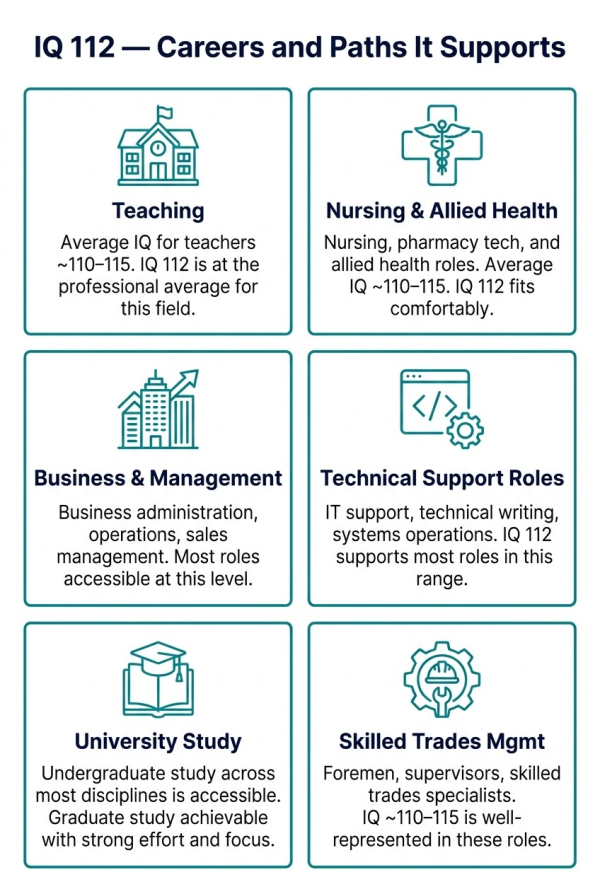
IQ 112 supports a broad and diverse range of career and academic paths:
Teaching and education. The estimated average IQ for schoolteachers is approximately 110–115, placing IQ 112 at the centre of the professional range for this field. Teaching is a cognitively multidimensional role — requiring subject knowledge, pedagogical skill, classroom management, and interpersonal sensitivity — and IQ 112 provides sufficient analytical capacity for the cognitive demands of the work.
Nursing and allied health. Nursing, pharmacy technician, physiotherapy, and allied health roles typically cluster in the IQ 110–115 range. IQ 112 sits comfortably within the cognitive profile associated with success in these fields. The analytical demands of healthcare roles — patient assessment, medication calculations, clinical protocol adherence — are well within reach at this level.
Business administration and management. Business analysis, operations management, account management, project coordination, and sales management roles typically fall within the IQ 110–120 range. IQ 112 is well-matched to the analytical and organisational demands of most business roles.
Technical support and IT. Computer support, systems operations, technical writing, and related IT roles — which require analytical troubleshooting, procedural learning, and systematic problem-solving — are well-supported at IQ 112.
University-level study. Undergraduate study across most disciplines is accessible at IQ 112, though demanding degree programmes in highly mathematical fields (pure mathematics, theoretical physics) tend to attract students averaging significantly higher. Graduate study is achievable in many fields with sustained effort, motivation, and appropriate study strategies.
For more on how IQ 112 compares to professional group averages, see our IQ 120 guide, which covers the professional cluster point in detail. For context on what comes above, see our IQ 115 guide.
What Matters More Than IQ at This Level
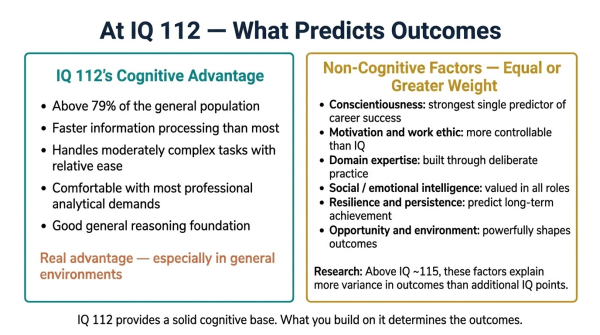
For anyone who has scored 112 and is wondering what this means for their potential, the most important piece of research-based guidance is this: at IQ 112, cognitive ability is a real but modest advantage, and non-cognitive factors are at least equally predictive of outcomes.
This is not an attempt to diminish the IQ score — it is an accurate description of what the research consistently shows. The landmark meta-analysis by Barrick and Mount (1991) covering over 100 studies on cognitive ability and job performance found that while cognitive ability predicts performance in complex roles, conscientiousness is an equally strong or stronger predictor across virtually all occupational categories. Research on educational attainment, career success, income, and life satisfaction consistently finds that at cognitive levels above approximately IQ 105–115, the incremental predictive value of additional IQ points decreases substantially while non-cognitive factors explain increasingly more of the remaining variance.
The specific non-cognitive factors with the strongest research support at IQ 112:
- Conscientiousness — the most powerful single personality predictor of career success across all fields: persistence, reliability, organisation, and follow-through
- Motivation and work ethic — intrinsic motivation to master a domain explains substantially more variance in expertise and achievement than IQ at this cognitive level
- Domain expertise — deliberate practice in a specific field builds the specialised knowledge that drives professional performance beyond what general cognitive ability predicts
- Emotional and social intelligence — valued in virtually all professional roles, independent of analytical IQ, and predictive of leadership effectiveness and relationship quality
- Resilience — the ability to persist through setbacks and maintain effort over time is a stronger predictor of long-term achievement than cognitive ability at this level
The practical message for someone at IQ 112: the score provides a solid cognitive foundation for a wide range of professional paths. What determines which of those paths is pursued with distinction is not additional IQ points — it is the quality of effort, focus, domain expertise, and character brought to the work. For more on this research, see our guides on IQ vs EQ, IQ and income, and can IQ be improved?
The Context Effect: IQ 112 in Different Environments
As with every IQ score, the practical experience of IQ 112 depends substantially on the environment:
In most everyday settings — the general population, most workplaces, most communities — IQ 112 at the 79th percentile represents a clear and genuine cognitive advantage over most of the people encountered. Information is processed faster than average, complex explanations are followed with somewhat more ease, and analytical tasks are approached with somewhat more facility than for the majority of peers.
In selective academic or highly analytical professional environments — where the average IQ of participants may itself be 115–120 or above — IQ 112 sits below the peer average. In a competitive graduate programme or a research-intensive workplace, a person at IQ 112 may find the fastest analytical thinkers in the room operating substantially above them. This shift from majority-leader to below-average within the group can be disorienting if not anticipated.
This context-dependence does not change the score's meaning — it illustrates that IQ is always relative to an environment. For more on this dynamic, see the context effect sections in our IQ 115 guide and IQ 120 guide.
IQ 112 in Context: The Full Comparison
| IQ Score | Percentile | Rarity | Classification & Key Note |
| 100 | 50th | 1 in 2 | Average — population mean |
| 110 | 75th | 1 in 4 | High Average begins |
| 112 | 79th | 1 in 5 | High Average — Top 21% |
| 115 | 84th | 1 in 6 | +1 SD marker / upper High Average |
| 119 | 89th | 1 in 9 | Upper boundary of High Average |
| 120 | 91st | 1 in 11 | Superior begins / professional average |
| 125 | 95th | 1 in 20 | Top 5% |
IQ 112 sits in the centre of the High Average band — 2 points above its lower boundary (IQ 110), 3 points below the +1 SD marker (IQ 115), and 8 points below the Superior range (IQ 120). For adjacent score guides, see our pages on IQ 115 and IQ 120. For the broader distributional context, see our IQ scale explained.
IQ 112 is at the 79th percentile — top 21%, 1 in 5 people, solidly in the High Average range. It is the cognitive level of a very large portion of the working professional population: teachers, nurses, skilled tradespeople, business administrators. It is a genuine cognitive advantage over the majority of the general population in most everyday settings. And it is, by the research evidence, a cognitive level at which what you build on the foundation — the domain expertise, the conscientiousness, the motivation, the emotional intelligence — explains outcomes at least as well as any additional IQ points could.
Find out where you sit with our free IQ test — no registration, results in under 20 minutes. For adjacent scores, see our guides on IQ 115 and IQ 120. For the full context, see our IQ scale explained.
Frequently Asked Questions
What does an IQ of 112 mean?
An IQ of 112 is classified as High Average on the Wechsler scale, at approximately the 79th percentile. It represents 0.80 standard deviations above the population mean of 100, corresponding to roughly 1 in 5 people. It is above average, in the top 21% of the general population, and at or near the average for many professional groups including teachers, nurses, and business administrators.
How rare is an IQ of 112?
IQ 112 corresponds to approximately the 79th percentile — roughly 1 in 5 people. In a room of 100 randomly selected people, approximately 21 would score at this level or above. In the United States, approximately 70 million people are expected to score at or above IQ 112.
Is IQ 112 considered High Average?
Yes. The Wechsler Adult Intelligence Scale classifies IQ 112 in the High Average range (approximately IQ 110–119). It is above the Average range (ending at IQ 109) and below the Superior range (beginning at IQ 120). It reflects genuine above-average cognitive ability with a real advantage over the majority of the general population in most settings.
What careers are associated with IQ 112?
IQ 112 is at or near the average for many professional groups: teaching (~110–115), nursing and allied health (~110–115), business administration and management (~110–120), and skilled trades supervision (~110–115). It also supports university-level study and many graduate programmes. At this level, motivation, domain expertise, and conscientiousness are as important as IQ in determining career outcomes.
Is IQ 112 good?
Yes. IQ 112 is above the population mean of 100 and at the 79th percentile — ahead of about 79% of the general population. It is classified as High Average, which reflects genuine cognitive ability above most people in most everyday settings. The most important research finding for people at this level: above approximately IQ 105–115, non-cognitive factors — conscientiousness, motivation, domain expertise, and emotional intelligence — are at least as important as IQ in determining life and career outcomes.

Comments
Share Your Thoughts