The relationship between IQ and income is one of the most consistently searched — and most consistently misunderstood — questions in the IQ literature. The research answer is precise: there is a real, positive, statistically robust correlation between cognitive ability and earnings, but it is a modest one that explains only a small fraction of why people earn what they earn.
The meta-analytic estimate, from Tavita Strenze's comprehensive 2007 review of longitudinal intelligence data, puts the IQ-income correlation at approximately r = .23. Squaring this gives r² = .053 — meaning IQ accounts for roughly 5% of the variance in income between individuals. The other 95% is explained by education, occupation, conscientiousness, geography, health, family background, social capital, timing, and dozens of other factors.
And the most counterintuitive finding in this literature, from Jay Zagorsky's 2007 analysis of the National Longitudinal Survey of Youth (NLSY79): IQ predicts income modestly — but the correlation between IQ and net worth (wealth) is not statistically distinguishable from zero. High-IQ individuals earn more on average, but they do not reliably accumulate more wealth. Earning power and wealth-building are different skills, and IQ measures the first better than the second.
The r = .23 Correlation: What It Actually Means
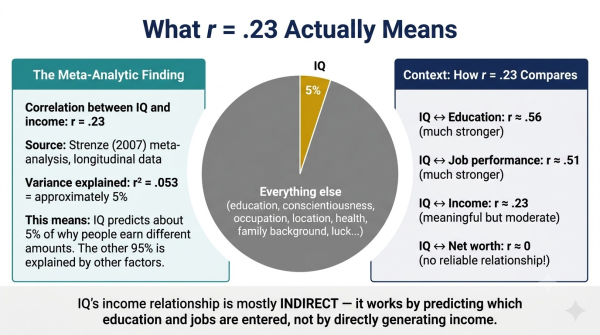
A correlation of r = .23 is real — it is not noise, and it has been replicated across multiple large datasets and countries. But understanding what r = .23 means practically is essential for not over-interpreting it.
In statistical terms, r = .23 means that if you square the correlation (r² = .053), IQ explains approximately 5.3% of the variance in income across individuals. The other 94.7% is explained by other factors. In practical terms, this means:
- Within any income bracket — low, middle, or high — you will find people spanning nearly the full range of cognitive ability
- Knowing someone's IQ score alone is a poor predictor of their income for any specific individual
- There is a genuine average tendency for higher-IQ people to earn more, but the range of actual outcomes around this tendency is very wide
To contextualise r = .23 in the broader intelligence research literature: the correlation between IQ and educational attainment is approximately r = .56 — much stronger. The correlation between IQ and job performance in cognitively demanding occupations is approximately r = .51 — also much stronger. The IQ-income relationship is notably weaker than either of these. Cognitive ability accounts for roughly 5% of the variance in earnings between individuals — real, but far smaller than the IQ-education correlation (r ≈ .56) or the IQ-job-performance correlation (r ≈ .51) measured in the same line of research.
The Zagorsky (2007) NLSY79 analysis estimated that each additional IQ point is associated with approximately $234–$616 in additional annual income — a meaningful average across the population, but one that comes with enormous individual variation and says nothing reliable about any specific person.
How IQ Influences Income: The Pathway Model
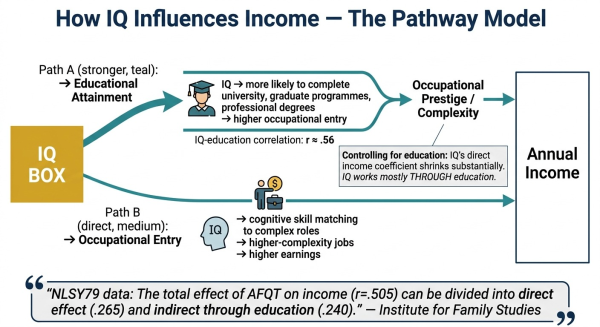
Understanding how IQ influences income is as important as understanding how much it does. The research consistently shows that IQ's income effect is predominantly indirect — it works by predicting which educational pathways and occupational roles are entered, not by directly generating earnings.
The pathway model that emerges from the NLSY79 and related longitudinal data looks approximately like this:
Path 1 (stronger): IQ → Educational attainment → Occupational entry → Income. IQ is a strong predictor of completing higher education (r ≈ .56). Educational attainment is a strong predictor of occupational prestige and complexity. Occupational complexity is a strong predictor of earnings. When researchers control for education in IQ-income regressions, the direct IQ coefficient shrinks substantially — meaning much of what IQ "does" for income is accomplished through education. As analysis from the Institute for Family Studies notes, the total effect of cognitive ability on income can be divided into a direct portion and an indirect portion mediated through education, with both portions meaningful.
Path 2 (weaker, direct): IQ → Occupational performance → Income. Separately from education, higher cognitive ability predicts better job performance in complex occupations (r ≈ .51), which can translate into raises, promotions, and higher lifetime earnings. This is a direct pathway, but it operates within occupations rather than across them, and is smaller than the education-mediated pathway.
The implication: IQ's income effect is largely a sorting mechanism — it sorts people into different educational and occupational tiers, and those tiers have different average earnings. Within any tier, IQ explains relatively little of who earns more than the average for that tier.
The Wealth Paradox: Why IQ Predicts Income but Not Wealth
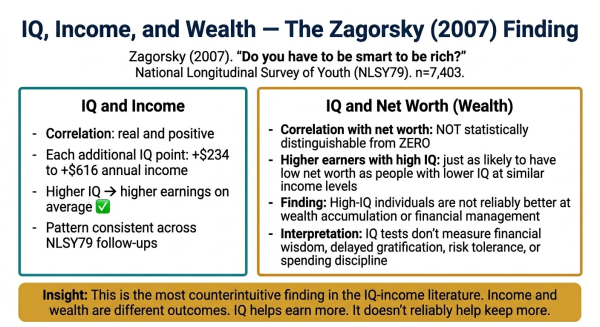
The most striking and least-discussed finding in the IQ-income literature is the divergence between how IQ relates to income and how it relates to net worth.
The correlation between IQ and salary is about twice as strong as the correlation between IQ and net worth, meaning intelligence is a better predictor of income than of overall wealth. More strikingly, the most counterintuitive finding in this literature comes from Jay Zagorsky's (2007) NLSY79 analysis: each additional IQ point predicts an estimated $234–$616 in additional annual income, but no statistically distinguishable difference in net worth.
The explanation Zagorsky offers is illuminating: high-IQ individuals are apparently not better at wealth accumulation. They earn more, but they are just as likely to spend it, accumulate debt, or mismanage finances as people with lower IQ at similar income levels. Wealth accumulation requires different skills from income generation: delayed gratification, financial discipline, risk calibration, investment decision-making, avoidance of overconsumption — none of which are directly measured by IQ tests.
This finding is consistent with the broader literature on the limits of IQ's predictive power. As Warren Buffett (IQ ~155) has noted, above a cognitive threshold, temperament matters more than intelligence for investment success. The temperament characteristics that produce wealth — patience, discipline, emotional regulation around financial decisions, systematic saving — are orthogonal to the analytical reasoning measured by IQ tests. For more on this, see our guide on IQ vs EQ.
What Explains the Other 95% of Income Variance
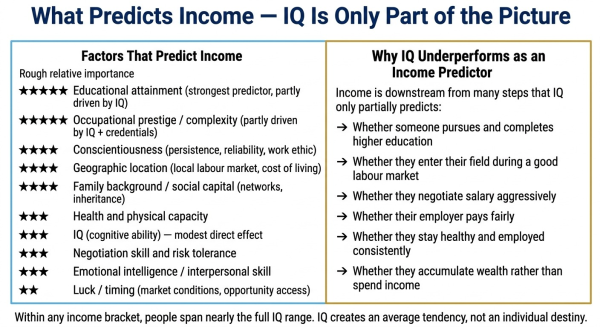
If IQ explains only 5% of income variance, understanding what explains the other 95% matters at least as much. The major additional predictors documented in the income research literature include:
Educational attainment. The strongest single predictor of income in most high-income country data. Partly correlated with IQ (higher IQ predicts completing more education), but with substantial independent variance — motivation, conscientiousness, family support, institutional access, and financial circumstances all predict educational attainment independently of IQ. For context on how education and IQ interact for different professions, see our guide on average IQ by profession.
Occupational prestige and complexity. Which occupation a person enters and stays in is the primary proximate determinant of income — far more predictive than any cognitive or personality measure. Occupation is itself predicted by IQ, education, social capital, geographic access, and family background.
Conscientiousness. The personality trait most consistently associated with career success across all occupational categories (Barrick and Mount, 1991). Reliable, persistent, organised people outperform less conscientious people with similar IQ in most occupational contexts. As explored in our IQ vs EQ guide, non-cognitive factors explain substantial variance in outcomes above the IQ threshold for any given role.
Geographic and labour market factors. Two people with identical IQ, education, and conscientiousness will earn dramatically different amounts if one lives in New York City and one in a rural area with limited professional employment. Labour market conditions, industry location, and regional cost-of-living all profoundly shape earnings independently of individual characteristics.
Family background and social capital. Network access, family financial support during education and career establishment, and the social connections that enable occupational entry all predict income substantially. These factors are correlated with IQ (because more educated parents tend to have higher-IQ children) but explain income variance independently.
Negotiation and risk tolerance. The willingness to negotiate salary, change jobs for pay improvements, and take calculated career risks predicts income substantially. These characteristics are not measured by IQ tests and explain meaningful income variance independently of cognitive ability.
The Threshold Effect: Where IQ's Income Relevance Changes
Research on the IQ-income relationship shows that the relationship is not perfectly linear across the full IQ range. Several findings suggest a threshold structure:
Below the threshold for professional occupational entry (approximately IQ 85–95): Cognitive ability is a substantial direct constraint on income because it limits which occupational tiers can be entered. At lower cognitive ability levels, the IQ-income relationship is stronger because cognitive demands genuinely gate access to higher-paying roles.
Above the professional entry threshold (approximately IQ 115–120): The relationship between incremental IQ points and incremental income becomes weaker. At IQ 120, a person can access virtually all professional occupational tiers. The additional income advantage of IQ 130 over IQ 120 is real but modest in most professional contexts — non-cognitive factors (conscientiousness, social skill, domain expertise, negotiation) explain more of the remaining variance.
This is the research basis for Warren Buffett's often-cited observation that above IQ 130, temperament matters more than intelligence for investment success. At the level where cognitive ability is sufficient for the task, additional cognitive ability predicts outcomes less reliably than the character and motivational factors that determine how those cognitive resources are deployed. See our IQ 120 guide for more on the professional cluster point where this threshold operates.
NLSY79: The Most Important Dataset in This Literature
Most of what we know about IQ and income in the United States comes from the National Longitudinal Survey of Youth 1979 (NLSY79) — a nationally representative study of 12,686 Americans who were 14–22 years old in 1979 and have been tracked biennially for over 40 years. Participants took the Armed Forces Vocational Aptitude Battery (ASVAB) early in the study, from which the AFQT score is derived as a cognitive ability proxy. Both Strenze (2007) and Zagorsky (2007) use NLSY79 data.
The NLSY79 has several strengths: large and nationally representative sample, longitudinal tracking over multiple decades, and a well-validated cognitive measure. Its limitations: the AFQT is not a full IQ test (it primarily measures verbal and mathematical ability), and US-based findings may not generalise fully to other countries with different educational and labour market structures.
IQ predicts income at approximately r = .23 — a real relationship that accounts for about 5% of the variance in earnings between individuals. Each IQ point is associated with approximately $234–$616 more in annual income on average. But IQ's income effect is largely indirect — it works by predicting which educational tiers and occupational roles are entered, not by directly generating earnings. Most strikingly: IQ predicts income more than twice as strongly as it predicts wealth (net worth), where the correlation is essentially zero. Earning more and keeping more are different skills. IQ helps with the first. The second requires what IQ tests don't measure — patience, financial discipline, and the temperament to convert income into lasting wealth.
For context on how these patterns relate to specific IQ score levels, see our guides on IQ 105, IQ 112, IQ 120, and IQ 136. For related guides on what IQ predicts and doesn't predict, see our IQ vs EQ guide and our average IQ by profession. Take our free IQ test to find out where your own cognitive profile sits.
Frequently Asked Questions
Does IQ predict income?
Yes — modestly. The meta-analytic correlation is approximately r = .23 (Strenze, 2007), meaning IQ accounts for about 5% of income variance between individuals. This is a real, replicated relationship, but it leaves 95% of income differences unexplained by IQ. IQ predicts income mainly by predicting which educational and occupational pathways are entered.
How much does each IQ point increase income?
Zagorsky's 2007 NLSY79 analysis estimated approximately $234–$616 more in annual income per additional IQ point. This is a population average association, not a guarantee for any individual. The wide range reflects different model specifications.
Does higher IQ mean more wealth?
No — or not reliably. Zagorsky (2007) found the correlation between IQ and net worth was not statistically distinguishable from zero. High-IQ earners are just as likely to have low net worth as lower-IQ earners at similar income levels. Wealth accumulation requires financial discipline and patience that IQ tests don't measure.
Is IQ the best predictor of income?
No. Educational attainment (r ≈ .56 with IQ, far stronger income predictor), occupational prestige, conscientiousness, geographic location, and family background all explain substantial income variance independently of IQ. The IQ-income correlation (r ≈ .23) is notably weaker than the IQ-education (r ≈ .56) or IQ-job performance (r ≈ .51) correlations.
Can someone with lower IQ earn more than someone with higher IQ?
Yes — very commonly. At r = .23, there is enormous overlap in earnings across the IQ range. A person with IQ 105 and high conscientiousness, strong social skills, domain expertise, and entrepreneurial initiative will typically earn substantially more than a person with IQ 135 who lacks these characteristics. IQ creates an average tendency, not an individual destiny.

Comments
Share Your Thoughts