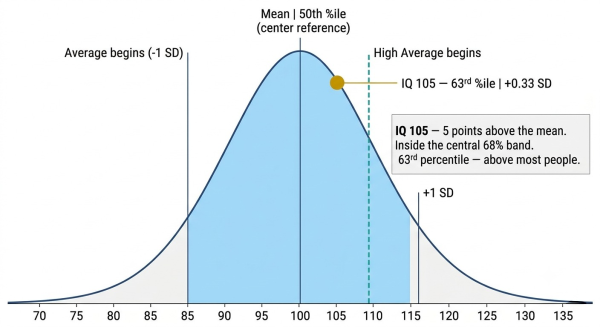
An IQ of 105 places you at approximately the 63rd percentile — meaning you score higher than about 63 out of every 100 people in the general population. The Wechsler Adult Intelligence Scale classifies this as Average intelligence. It represents 0.33 standard deviations above the population mean of 100.
IQ 105 sits slightly above the exact population mean of 100, near the centre of the Average band (IQ 85–114). It is the most commonly occurring cognitive range in the human population — the zone where most people live and work, build careers and families, and navigate the demands of everyday life. "Average" in psychometric terms does not mean mediocre or insufficient. It means within the central band of human cognitive functioning that contains approximately 68% of all people who have ever taken a standardised IQ test.
This guide covers what the research says about IQ 105: the population statistics, what the Average classification actually means at this level, what careers and life paths are associated with it, and why the non-cognitive factors are especially decisive at this score level.
IQ 105 in Numbers: The Core Statistics
| Metric | Value at IQ 105 |
| Standard deviations above mean | +0.33 SD |
| Percentile | ~63rd |
| People scoring lower | ~63% of the general population |
| People scoring higher | ~37% of the general population |
| In the United States (~335M) | ~124 million score at or below IQ 105 |
| Wechsler classification | Average |
| Distance above population mean (IQ 100) | 5 points |
| Distance to High Average (IQ 110) | 5 points |
IQ 105 is positioned almost precisely equidistant between the population mean (IQ 100, 50th percentile) and the High Average boundary (IQ 110, 75th percentile) — 5 points from each. Its neighbours in the guides we have published help contextualise it: IQ 90 (25th percentile, lower Average) is 15 points below; IQ 108 (70th percentile, upper Average) is 3 points above; IQ 112 (79th percentile, High Average) is 7 points above. For the complete distributional picture, see our IQ scale explained.
What "Average" Actually Means at IQ 105
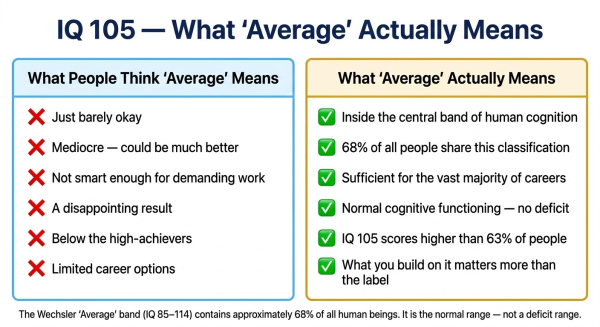
The word "average" carries considerable cultural baggage that the psychometric definition does not. In everyday use, "average" often implies mediocrity — being undistinguished, not exceptional, not good enough. In IQ testing, "Average" has a precise and specific meaning: within the central classification band that contains the majority of the human population.
The Wechsler Average band (IQ 85–114) spans 29 IQ points and contains approximately 68% of all people. It is the cognitive range in which most doctors, lawyers, engineers, teachers, tradespeople, parents, artists, athletes, community leaders, and ordinary people of extraordinary character have lived their entire lives. The most important and meaningful human achievements — raising children well, building lasting communities, creating beauty, providing care, maintaining relationships — are overwhelmingly accomplished within this cognitive range.
IQ 105 at the 63rd percentile means: you score above 63% of the general population. You are above the exact centre of the distribution by 5 points. You are not at the high end of human cognitive ability — but you are above most people you will encounter in most everyday settings, and well within the cognitive range that research consistently associates with success across the full breadth of human life.
The research on what IQ predicts and does not predict is clear: across the Average range (IQ 85–114), the predictive power of specific IQ differences for real-world outcomes is relatively modest, and non-cognitive factors — personality, motivation, opportunity, relationships — explain the majority of variance in who achieves what. As explored in detail in our guides on IQ vs EQ and IQ and income, the connection between IQ and income, career success, and life satisfaction is positive but modest in the central range of the distribution.
IQ 105 and the Famous Historical Context
One of the most frequently cited statistics in IQ research is worth revisiting here: IQ 105 is approximately the estimated average IQ of US military officers during World War II (based on Army General Classification Test data). It is within the range associated with effective leadership, competent management, and successful professional practice across a very wide range of fields.
More concretely: Napoleon Bonaparte's estimated IQ is approximately 140–145 — but his army was led at every level by officers and NCOs whose cognitive range would have overlapped substantially with IQ 105. The practical execution of complex military campaigns depends on the collective intelligence of the entire organisation, the vast majority of which operates at cognitive levels that include IQ 105 and the broader Average range.
Many of history's most accomplished people in practical, artistic, interpersonal, and vocational domains would fall within the Average range. IQ measurement was not invented to identify who has value or potential — it was invented to identify children who needed additional educational support. Its use as a measure of human worth or life potential is a misapplication of a statistical tool. For more on this, see our guide on what IQ actually measures.
What Determines Outcomes at IQ 105
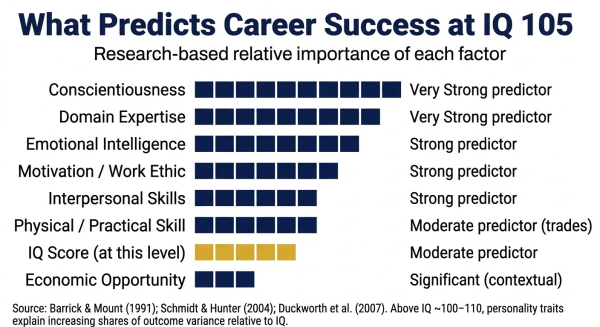
The research on what predicts outcomes at IQ 105 is unambiguous. At this cognitive level — in the upper-middle portion of the Average band — the non-cognitive factors that research consistently identifies are at least as important as, and in many contexts more important than, the IQ score itself:
Conscientiousness. The landmark Barrick and Mount (1991) meta-analysis found conscientiousness to be the only personality trait that predicts job performance consistently across all occupational categories. At IQ 105, where the cognitive advantage over the mean is modest (0.33 SD), a person with high conscientiousness will typically outperform a person with higher IQ but lower conscientiousness in most real-world contexts over a career. Conscientiousness — persistence, reliability, organisation, follow-through — is the single most powerful non-cognitive predictor of outcomes across all IQ levels.
Domain expertise. The research on expertise consistently shows that deliberate practice in a specific field explains performance in that field far more reliably than general cognitive ability above a basic threshold. A person at IQ 105 who spends 10 years mastering a specific trade, skill, or professional domain will typically outperform a person at IQ 115 who has not developed equivalent expertise. The investment of sustained effort into domain mastery compounds over time in ways that IQ scores do not.
Emotional and interpersonal intelligence. EQ — the ability to understand and manage one's own emotions, and to effectively navigate social and emotional relationships with others — is independent of analytical IQ and predicts outcomes in leadership, management, sales, care, teaching, and most client-facing roles at least as powerfully as IQ does. For more on this, see our IQ vs EQ guide.
Motivation and work ethic. Angela Duckworth's research on grit — the combination of passion and perseverance for long-term goals — consistently shows that grit predicts achievement in competitive educational and occupational settings even after controlling for IQ. At IQ 105, where the raw cognitive advantage is modest, the quality and consistency of effort matters enormously.
Physical and practical intelligence. In skilled trades, sports, crafts, and many practical vocations, physical coordination, spatial awareness, and practical judgment are primary competencies that standardised IQ tests do not adequately measure. Many of the most skilled and economically successful tradespeople and practitioners operate within the Average IQ range, with their distinctive competencies in practical domains that general IQ tests were not designed to capture.
Career and Academic Life at IQ 105
IQ 105 opens the broadest possible range of career paths. The research on minimum cognitive thresholds by occupation shows that the vast majority of jobs in most modern economies are cognitively accessible at IQ 105:
- Virtually all skilled trades: plumbing, electrical, carpentry, mechanics, HVAC
- Most service management roles: retail, hospitality, food service, logistics
- Most administrative and office support roles
- Most sales and client service roles
- Healthcare support roles: medical assistant, healthcare administration, care work
- Technical support and operations
- Most vocational and applied degree programmes
- Elementary school teaching (with appropriate credentials)
- Police, fire, and protective services
- Construction and facilities management
- Agriculture and horticulture
University study is accessible at IQ 105 in most applied, social science, arts, education, and vocational fields. The most mathematically intensive academic programmes require above-average cognitive entry levels, but most degree programmes available at regional universities and community colleges are navigable at IQ 105 with sustained effort and appropriate support.
The most cognitively demanding professional roles — academic research, complex engineering, surgery, elite legal practice — tend to attract candidates whose average IQ is significantly above 105. IQ 105 is not excluded from these fields entirely, but it places a person at the lower end of the cognitive range typically represented, requiring greater effort to compensate for the cognitive gap with the average peer.
IQ 105 in Context: The Full Comparison
| IQ Score | Percentile | Classification | Key Note |
| 90 | 25th | Average | Lower Average — 25th percentile |
| 95 | 37th | Average | Lower-middle Average |
| 100 | 50th | Average | Population mean |
| 105 | 63rd | Average | IQ 105 — 5 points above mean |
| 108 | 70th | Average | Upper Average — top 30% |
| 110 | 75th | High Average | High Average begins |
| 115 | 84th | High Average | +1 SD — statistical anchor |
| 120 | 91st | Superior | Professional average for doctors / lawyers |
The table shows IQ 105 precisely: 5 points above the mean, 5 points below High Average, inside the central band of the population distribution. For adjacent score guides, see our pages on IQ 90, IQ 108, and IQ 112. For the full scale, see our IQ scale explained.
IQ 105 is at the 63rd percentile — slightly above the population mean, inside the central Average band that contains approximately 68% of all human beings. It is the cognitive level at which most of humanity's practical, social, creative, and vocational life has always been built. What the research most consistently shows about life at IQ 105 is not what the number limits — but what the person brings alongside it. Conscientiousness, domain expertise, emotional intelligence, and sustained effort explain more variance in outcomes at this cognitive level than the 5-point difference between IQ 105 and IQ 100, or between IQ 105 and IQ 110. The score is a starting point, not a destination.
Find out where your own cognitive profile sits with our free IQ test — no registration, results in under 20 minutes. For adjacent scores, see our guides on IQ 108 and IQ 112. For broader context on what IQ scores mean, see our guides on what IQ actually measures and IQ vs EQ.
Frequently Asked Questions
What does an IQ of 105 mean?
An IQ of 105 is classified as Average on the Wechsler scale, at approximately the 63rd percentile. It represents 0.33 standard deviations above the population mean of 100 — 5 points above the exact mean, inside the central Average band (IQ 85–114) that contains approximately 68% of all people. It is not a cognitive deficit — it is normal cognitive functioning in the upper-middle portion of the central distribution.
How rare is an IQ of 105?
IQ 105 is not rare at all. Approximately 63% of people score at or below IQ 105, and about 37% score higher. In the United States, approximately 124 million people score at or below IQ 105. It represents the most common range of cognitive functioning for working adults.
Is IQ 105 considered average?
Yes. IQ 105 is firmly within the Wechsler Average classification (IQ 85–114). It is 5 points above the exact population mean of 100 — in the upper-middle portion of the central band. "Average" in psychometric terms means within the normal range shared by approximately 68% of all people — not mediocre, not insufficient, and not a reflection of any cognitive deficit.
Is IQ 105 good?
IQ 105 scores above approximately 63% of the general population — above the exact mean. In everyday terms this is genuinely above-average. The research consistently shows that at this cognitive level, what shapes outcomes most is not the precise score but the conscientiousness, motivation, domain expertise, and interpersonal skill of the person who holds it. The score is sufficient for a very broad range of fulfilling and successful life paths.
What careers are accessible at IQ 105?
IQ 105 provides cognitive access to the broadest possible range of careers: skilled trades, service management, administrative roles, healthcare support, sales, transportation, construction, agriculture, hospitality, and most vocational degree programmes. Most careers in most modern economies are accessible at this cognitive level. Non-cognitive factors — conscientiousness, domain expertise, and interpersonal skill — are at least as important as IQ in determining career outcomes at this level.

Comments
Share Your Thoughts