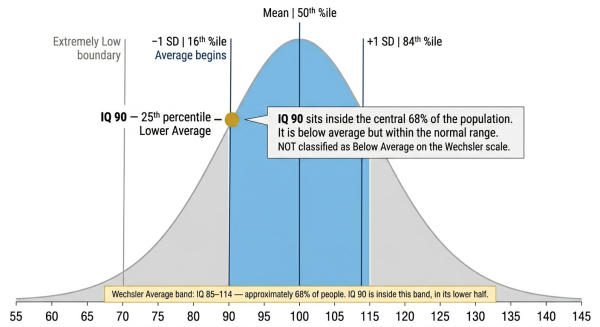
An IQ of 90 places you at approximately the 25th percentile — meaning approximately 75 out of every 100 people in the general population score higher than 90, and approximately 25 score at 90 or below. The Wechsler Adult Intelligence Scale classifies this as Average intelligence. It represents 0.67 standard deviations below the population mean of 100.
That phrase — "0.67 standard deviations below the mean" — is the accurate statistical description. What it does not mean is that IQ 90 represents a cognitive deficit, a learning disability, or an obstacle to a productive and fulfilling life. IQ 90 is inside the Average range (IQ 85–114), the classification band that contains approximately 68% of the entire population. The vast majority of human beings live and work within this range. Many fulfilling, economically stable, and personally meaningful lives are built at IQ 90 and at cognitive levels below it.
This guide covers what the research says about IQ 90: the population statistics, what the Average classification actually means, what careers and life paths are accessible, and why non-cognitive factors are particularly important at this cognitive level.
IQ 90 in Numbers: The Core Statistics
| Metric | Value at IQ 90 |
| Standard deviations from mean | −0.67 SD (below mean) |
| Percentile | ~25th |
| Frequency in general population | ~25% score at or below this level |
| In a room of 100 people | ~75 score higher; ~25 score at or below |
| In the United States (~335M) | ~84 million people score at or below IQ 90 |
| Wechsler classification | Average |
| Distance from population mean (IQ 100) | 10 points below |
| Distance from High Average (IQ 110) | 20 points below |
The context matters significantly for IQ 90. The Wechsler Average band (IQ 85–114) spans 29 IQ points and contains approximately 68% of the general population — this is the single largest classification band. A person at IQ 85 and a person at IQ 109 both carry the same "Average" classification label. IQ 90 sits in the lower half of this band, 5 points above the Average lower boundary at IQ 85, and 10 points below the population mean at IQ 100. For more on where IQ 90 fits in the full distribution, see our IQ scale explained.
What the Average Range Actually Means
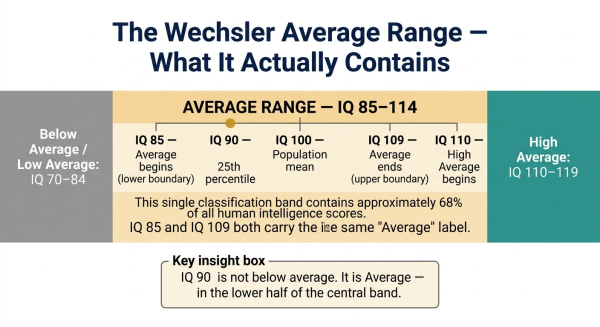
The most important thing to understand about IQ 90 is what the "Average" classification represents — and does not represent.
What it means: IQ 90 reflects cognitive functioning within the broad normal range of human intelligence. People at IQ 90 can learn new skills, follow complex instructions, reason through multi-step problems, manage finances, navigate bureaucratic systems, and perform the cognitive demands of a very wide range of occupational and social roles. "Average" in IQ terminology does not mean "barely adequate" — it means "within the central band that contains the majority of human beings."
What it does not mean: IQ 90 is not classified as Below Average, Low Average, or Borderline — those classifications begin at IQ 84 and below. It is not associated with intellectual disability (which begins below IQ 70). It does not indicate a learning disorder or cognitive impairment. A person at IQ 90 does not require special educational accommodations by definition — their cognitive functioning is within the normal range.
The research on what happens at IQ 90 in the real world is consistent with this framing. Studies on occupational success, life satisfaction, and social functioning consistently find that the differences in outcomes between IQ 90 and IQ 100 — while real and measurable at a population level — are modest compared to the differences explained by personality, motivation, social skills, physical health, family stability, and economic opportunity. At IQ 90, you are not cognitively disadvantaged relative to the majority of humanity — you are within the same broad cognitive band as most people who have ever built careers, raised families, and contributed to communities. For more on the relationship between IQ and life outcomes, see our guides on IQ vs EQ and IQ and income.
The Symmetry With IQ 110
One useful way to understand IQ 90's position is through its symmetric partner: IQ 110. IQ 90 and IQ 110 are both 10 points from the population mean of 100, but in opposite directions. IQ 110 is the lower boundary of the High Average band; IQ 90 sits in the lower half of the Average band.
This comparison is illuminating. IQ 110 (75th percentile) is widely described in research and popular writing as "above average" and associated with competent academic and professional performance. IQ 90 (25th percentile) is its precise mirror: the same distance from the mean, the same relationship to the distribution, just on the other side. The cognitive difference between IQ 90 and IQ 110 — 20 IQ points, or about 1.3 standard deviations — is real and measurable. It does not make IQ 90 cognitively deficient. It places IQ 90 in the lower portion of the normal range, just as IQ 110 is in the upper portion of it.
See our IQ 112 guide for what the High Average range looks like from inside, and our IQ 115 guide for the +1 SD reference point, to understand the distributional context IQ 90 sits within.
What IQ 90 Opens in Career and Daily Life
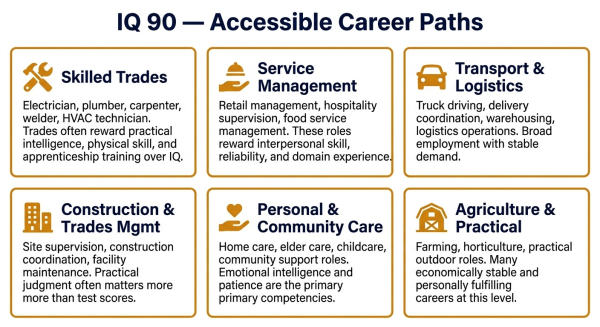
IQ 90 provides access to a wide range of occupational paths. The research on minimum cognitive thresholds by occupation finds that the great majority of careers — including many that are economically stable, personally fulfilling, and socially valued — are accessible at IQ 90 or below:
Skilled trades. Electricians, plumbers, carpenters, welders, HVAC technicians, and related skilled tradespeople are consistently among the most economically stable working professionals in most economies. These trades reward practical intelligence, physical skill, and apprenticeship-based learning at least as much as verbal or abstract reasoning. The cognitive demands of skilled trades — reading technical diagrams, following complex sequences, problem-solving on the job — are well within cognitive reach at IQ 90.
Service management. Retail management, hospitality supervision, food service management, and related roles require interpersonal skill, scheduling and inventory judgment, and customer service competence. These roles are accessible and performed successfully by many people at IQ 90. Leadership and management in these fields is substantially more dependent on interpersonal intelligence, reliability, and domain experience than on abstract analytical IQ.
Transport and logistics. Truck driving, delivery coordination, warehousing, and logistics operations represent major employment sectors with broad cognitive accessibility. The cognitive demands — navigation, safety compliance, route optimisation, basic inventory management — are well within reach at IQ 90.
Construction and facilities. Site support, construction coordination, facility maintenance, and property management roles draw on practical judgment, spatial awareness, and reliable execution. IQ 90 is entirely consistent with competent performance in these fields.
Personal and community care. Home care, elder care, childcare, community support, and similar roles are primarily dependent on emotional intelligence, patience, empathy, and reliability rather than abstract analytical IQ. These are among the most socially valuable roles in any community, and they are built by people across the full range of cognitive ability levels.
University-level study is cognitively challenging but not categorically inaccessible at IQ 90 — particularly in applied, vocational, and practical fields where success depends heavily on effort, attendance, and domain engagement. That said, highly abstract degree programmes in mathematics, theoretical science, or research-intensive fields tend to require cognitive levels significantly above IQ 90 to navigate comfortably. For most trade and vocational qualifications, IQ 90 is more than sufficient.
What Matters More Than IQ at This Level
At IQ 90, the research is unambiguous about the relative importance of cognitive and non-cognitive factors in determining outcomes. While cognitive ability does predict some variance in occupational performance even in the Average range, the factors that explain the most variance in real-world success at this cognitive level are decidedly non-cognitive:
- Conscientiousness — the most powerful single personality predictor of career success across all IQ levels; particularly important at IQ 90 where cognitive advantage is not available to compensate for low effort or poor reliability
- Interpersonal and emotional intelligence — in service, care, trade, and community roles, EQ is a primary competency that IQ tests do not measure
- Physical skill and practical intelligence — many high-value, economically stable careers reward spatial, mechanical, and physical capability that is independent of abstract analytical IQ
- Domain expertise — deliberate practice and accumulated experience in a specific field build knowledge and judgment that predict performance far more reliably than IQ above a basic threshold
- Resilience and work ethic — persistence through difficulty and consistent effort over time are among the strongest predictors of long-term outcomes across all cognitive levels
- Social and family support — economic and social environment explain enormous variance in outcomes that IQ does not capture; a supportive environment amplifies what any cognitive level can achieve
As explored in our guide on can IQ be improved?, the most reliable way to improve cognitive outcomes at any IQ level is not to change the number but to optimise the non-cognitive factors that research consistently shows to be highly influential and within personal and environmental control. See also our guide on IQ vs EQ.
IQ 90 in Context: The Full Comparison
| IQ Score | Percentile | Classification | Key Note |
| 70 | 2nd | Extremely Low | Threshold for significant cognitive difficulty |
| 85 | 16th | Average (begins) | −1 SD — lower boundary of central range |
| 90 | 25th | Average | Lower half of Average band |
| 100 | 50th | Average | Population mean |
| 109 | 73rd | Average (ends) | Upper boundary of Average band |
| 110 | 75th | High Average | Above-average classification begins |
| 115 | 84th | High Average | +1 SD — upper edge of central 68% |
The table shows IQ 90 within its natural context: inside the Average band, 10 points below the population mean, and 20 points below the High Average range. For guides on adjacent and higher score ranges, see our pages on the IQ 112, IQ 115, and IQ 120 guides. For the guide on the lower boundary of the Average range, see our IQ 73 guide.
IQ 90 is at the 25th percentile — inside the Average range, in the lower half of the central band that contains approximately 68% of all human beings. It is not a cognitive deficit. It is not associated with learning disability. It indicates cognitive functioning within the broad normal range. The careers, relationships, and life outcomes available to someone at IQ 90 are wide and varied — shaped far more by conscientiousness, interpersonal skill, practical intelligence, and sustained effort than by the 10-point gap between this score and the population mean. Most of what makes a life go well is not measured by IQ tests.
Find out where your own cognitive profile sits with our free IQ test — no registration, results in under 20 minutes. For adjacent scores, see our guide on the average range and our IQ 112 guide. For broader context on what IQ scores mean, see our guides on what IQ actually measures and the IQ scale explained.
Frequently Asked Questions
What does an IQ of 90 mean?
An IQ of 90 is classified as Average on the Wechsler scale, at approximately the 25th percentile. It represents 0.67 standard deviations below the population mean of 100. It is inside the Average classification band (IQ 85–114), which contains approximately 68% of all people. It is not a cognitive deficit — it indicates normal cognitive functioning in the lower half of the central distribution band.
How rare is an IQ of 90?
IQ 90 is not rare. Approximately 25% of people score at IQ 90 or below, and approximately 75% score higher. About 84 million Americans are expected to score at or below IQ 90. It is a commonly occurring cognitive level within the broad normal range.
Is IQ 90 considered low?
No. IQ 90 is within the Average classification on the Wechsler scale (IQ 85–114). It is below the population mean of 100 but is not classified as Below Average or Low Average — those classifications begin at IQ 84 and below. IQ 90 indicates normal cognitive functioning, in the lower portion of the central band.
What careers are accessible with an IQ of 90?
IQ 90 is accessible for a wide range of careers including skilled trades (electrician, plumber, carpenter), service management (retail, hospitality, food service), transport and logistics, construction and facilities, and personal and community care. Research consistently shows that at this cognitive level, conscientiousness, interpersonal skill, domain expertise, and work ethic are at least as important as IQ in determining career outcomes.
What is the difference between IQ 90 and IQ 100?
IQ 90 (25th percentile) and IQ 100 (50th percentile) differ by 10 points and 0.67 standard deviations. Both are within the Average classification on the Wechsler scale. The practical difference in most everyday cognitive and occupational contexts is real but modest. Both reflect normal cognitive functioning — IQ 90 in the lower half of the Average band, IQ 100 at the exact centre.

Comments
Share Your Thoughts