Most people who take an IQ test want to know the same thing: is my score good? The answer depends on what you mean by “good” — and understanding how IQ scores are distributed makes that question much easier to answer. This guide explains what a good IQ score looks like, how scores are classified, and what they actually mean in everyday life.
What Is Considered a Good IQ Score?
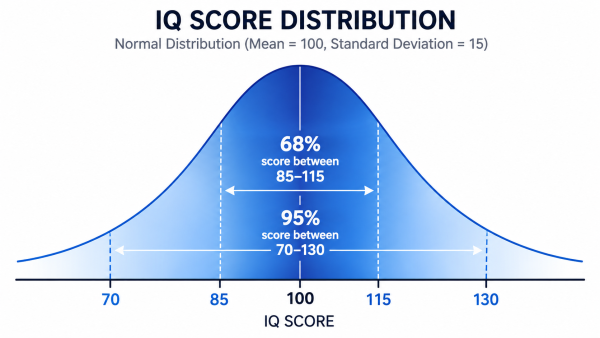
IQ tests are designed so that the average score is always 100, with a standard deviation of 15. This means the majority of people — around 68% — score between 85 and 115. A score above 100 is technically above average, but “good” in a practical sense usually means something higher than that.
Most researchers and psychologists consider an IQ score of 110 or above to be solidly above average, and a score of 120 or higher to reflect strong cognitive ability. These ranges are associated with faster learning, better academic performance, and stronger problem-solving across a wide variety of situations. You can explore what specific scores mean in our IQ Scores guide.
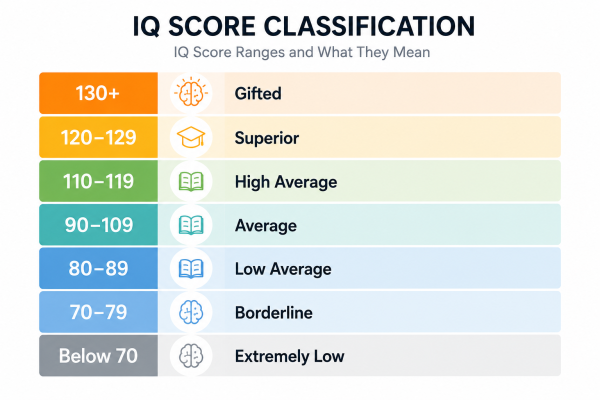
IQ Score Classification Table
| IQ Score Range | Classification | Population |
| 130 and above | Very Superior / Gifted | Top 2% |
| 120–129 | Superior | Top 9% |
| 110–119 | High Average | Top 25% |
| 90–109 | Average | Middle 50% |
| 80–89 | Low Average | Bottom 25% |
| 70–79 | Borderline | Bottom 9% |
| Below 70 | Extremely Low | Bottom 2% |
These classifications follow the standard used by most professionally administered IQ assessments, including the Wechsler Adult Intelligence Scale (WAIS) and the Stanford-Binet. As explained in the IQ scale explained from low to genius, these ranges reflect meaningful differences in how people process and apply information.
Is 100 a Good IQ Score?
A score of exactly 100 is average by definition — it represents the midpoint of the population. This does not mean it is bad. An average IQ is sufficient for the vast majority of careers and life outcomes. Many people with IQs around 100 become successful professionals, business owners, and community leaders. The relationship between IQ and real-world outcomes is explored in depth in IQ vs academic achievement.
Is 110 a Good IQ Score?
Yes — an IQ of 110 places you in roughly the top 25% of the population. People in this range tend to learn quickly, adapt well to new information, and perform above average in most academic and professional settings. This score is more than sufficient for a wide range of intellectually demanding careers. See best careers for people with an IQ of 110–120 for practical guidance.
Is 120 a Good IQ Score?
An IQ of 120 is considered superior — placing you in roughly the top 9% of the population. At this level, most people can handle complex analytical tasks, thrive in intellectually demanding environments, and learn new skills faster than average. It is well within the range associated with professional success in fields like law, medicine, engineering, and finance.
Is 130 a Good IQ Score?
An IQ of 130 or above is classified as very superior or gifted, placing you in the top 2% of the population. This is the threshold commonly cited for entry into high-IQ societies such as Mensa. People in this range often show exceptional reasoning ability and a natural aptitude for abstract thinking. You can read more in high-IQ societies and their requirements.
What Makes an IQ Score “Good” in Practice?
A good IQ score is relative to the context you are comparing yourself to. In highly competitive academic programs or elite research environments, the average candidate may have an IQ well above 120. In general professional or social contexts, an IQ between 100 and 115 is entirely sufficient for high performance.
It is also important to remember that IQ measures only a specific set of cognitive abilities — primarily logical reasoning, pattern recognition, working memory, and processing speed. It does not measure creativity, emotional intelligence, social skill, motivation, or practical wisdom. As discussed in IQ vs EQ, emotional intelligence often predicts success in people-centered roles more reliably than cognitive ability alone.
How Reliable Is Your IQ Score?
IQ scores are estimates, not fixed labels. A single test taken on a single day reflects your performance under those specific conditions — not an unchangeable ceiling. Factors such as sleep, anxiety, familiarity with the test format, and the testing environment can all affect results, as covered in what affects your IQ test results.
Most psychologists recommend treating IQ scores as a range rather than a precise number, with a margin of error of roughly 5 points in either direction on a well-administered professional test. Free online tests tend to have wider margins and should be interpreted more loosely, as explained in are free online IQ tests accurate?
Average IQ by Age, Country, and Profession
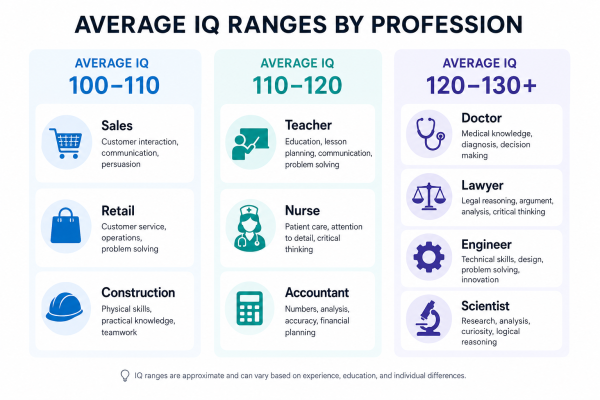
What counts as a “good” score also depends on who you are comparing yourself to. Average IQ tends to peak in young adulthood and gradually changes with age — a pattern explored in average IQ by age. Scores also vary meaningfully by country due to differences in education, nutrition, and testing methodology, which is why we maintain a detailed IQ by country database. And within professions, average IQs differ significantly — see, for example, what IQ doctors typically have.
Can You Improve Your IQ Score?
Core cognitive ability is relatively stable in adults, but test performance can be meaningfully improved through preparation, better sleep, reduced anxiety, and familiarity with question formats. The distinction between improving your score and improving your underlying IQ is explained clearly in can you improve your IQ test score short-term? and can IQ be improved?
Final Answer: What Is a Good IQ Score?
A score above 110 is solidly above average and sufficient for success in most demanding careers. A score above 120 is superior and places you in the top 9% globally. A score above 130 is considered gifted and puts you in the top 2%. But the most important thing to understand is that IQ is a tool, not a verdict. It measures a specific slice of human ability — and many of the qualities that determine long-term success, satisfaction, and impact fall entirely outside its scope. Explore more in our IQ Guides collection.

Comments
Share Your Thoughts