Physicians and surgeons occupy the highest directly measured position in the occupational IQ dataset. The NLSY79 data (cogn-iq.org) places the average physician/surgeon at IQ 123.7 — the 94th percentile — based on n=30, making it the highest-IQ occupation directly observed in a nationally representative longitudinal survey. Multiple converging sources place physicians in the IQ 120–130 range overall, with variation across specialties spanning from general practitioners (~IQ 120) to academic research physicians and neurosurgeons (~IQ 130+).
The professional and academic consensus is clear: medicine is among the most cognitively filtered professions in existence. Medical school admission requirements — particularly MCAT performance, undergraduate GPA, and the sheer volume of material that must be mastered before entry — function as one of the most intensive cognitive selection processes in any field. The result is that the average physician is well into the Superior range on the Wechsler scale.
But a 2023 article in the Cambridge Quarterly of Healthcare Ethics raised a provocative question: are medical schools selecting too far above the cognitive threshold that clinical practice actually requires? The paper argued that the MCAT and GPA thresholds at top medical schools are substantially above the level at which students fail licensing exams or clinical training — meaning medicine may be selecting for cognitive ability well beyond what safe, excellent patient care actually needs, potentially at the cost of excluding empathetic, ethical, communication-skilled candidates who score slightly lower on analytical measures.
This guide covers the data on physician IQ, the variation by specialty, the MCAT as a cognitive filter, and the "too smart for medicine" debate that the research has opened.
The Data: Physician IQ Across Sources
| Source | Physician IQ Estimate | Quality |
| NLSY79 direct measurement (cogn-iq.org) | IQ 123.7 (94th percentile) | ★★★★★ Direct observation; n=30 (small sample caveat) |
| Hauser NLSY79 compilation | ~IQ 120 | ★★★★ Nationally representative; multiple studies |
| Cambridge QHE (2023, citing Hauser) | ~IQ 120 | ★★★★ Academic citation; US physician average |
| Occupational IQ research (range) | IQ 120–130 | ★★★ Convergent across multiple sources |
| WAIS-IV professional degree (MD/JD) | IQ ~114 | ★★★ Broader category — includes JD, pulling average lower |
The NLSY79 figure of IQ 123.7 comes with a caveat: n=30 is a small sample. With a sample this size, the 95% confidence interval is wide — potentially ±8–10 IQ points. The figure is the best direct observational measurement available, but should be read as a central estimate with substantial uncertainty. The convergent evidence from multiple sources in the IQ 120–130 range provides more confidence than any single figure.
The WAIS-IV "professional degree" figure of IQ 114 is lower because it combines MD and JD holders in a single education-level category, and law school graduates (whose average IQ is slightly lower than physicians') pull the combined figure down. Physician-specific data consistently places doctors above this combined category. For context on what these IQ ranges mean, see our guides on IQ 120, IQ 122, and IQ 128.
IQ by Medical Specialty: Where the Data and Proxies Point
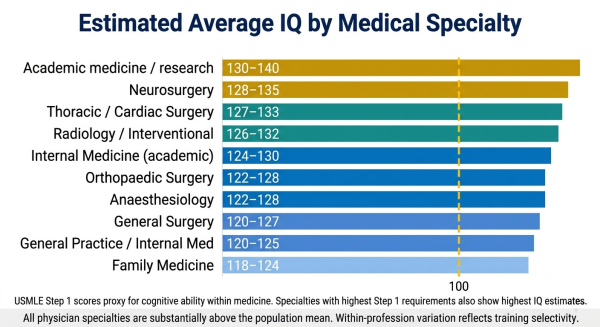
The within-medicine variation in cognitive ability is substantial. While all physician specialties sit well above the population mean, there is an approximately 15-point spread between the highest- and lowest-IQ specialties within medicine — comparable to the spread within engineering.
The best available proxy for within-medicine cognitive ability variation is USMLE (United States Medical Licensing Examination) Step 1 scores required for competitive residency matching. Specialties with the most selective residency matching — neurosurgery, thoracic surgery, interventional radiology, dermatology — require the highest Step 1 scores, and Step 1 performance correlates strongly with general cognitive ability.
Academic medicine and research physicians at leading institutions represent the highest cognitive tier within medicine. Researchers publishing in high-impact journals, academic department chairs, and NIH-funded investigators are drawn disproportionately from the most cognitively capable medical graduates. This group likely averages IQ 130+.
Neurosurgery and cardiac surgery consistently require the highest Step 1 scores for residency matching and involve the most cognitively demanding combination of technical spatial reasoning (three-dimensional operative anatomy), medical knowledge, and real-time decision-making under pressure. Both likely cluster in the IQ 127–135 range.
General practice and family medicine, while drawing from highly capable physicians, are somewhat less cognitively selective at the residency matching stage than the most competitive specialties. These physicians still average well into the Superior range (~IQ 118–125), but the distribution is slightly broader and somewhat lower than academic or surgical specialties.
The MCAT as Medicine's Cognitive Filter
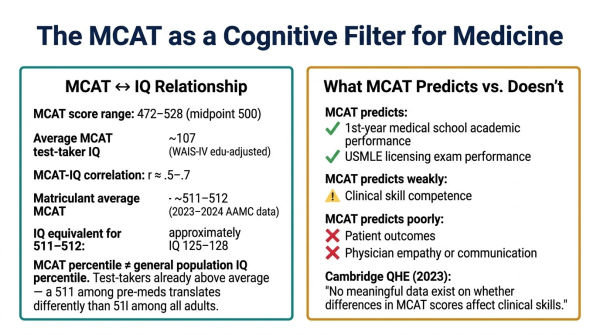
The MCAT (Medical College Admission Test) functions as the primary cognitive filter for medical school admission in the United States and Canada. It is not an IQ test — it measures biological and biochemical sciences, physical sciences, psychological and social foundations, and critical analysis and reasoning — but it correlates substantially with general cognitive ability (r ≈ .5–.7).
Understanding MCAT-to-IQ conversion requires accounting for who takes the MCAT: college graduates planning to apply to medical school, a population with above-average cognitive ability relative to the general public. Cogn-IQ.org estimates the average MCAT test-taker has an IQ of approximately 107 (education-adjusted). A median MCAT score of 500 therefore corresponds to approximately IQ 107 in absolute terms — which already places the average MCAT taker above the general population mean.
The average MCAT score of medical school matriculants (those who actually enrol) is approximately 511–512 (AAMC 2023–2024 data). This score, drawn from a population whose average is already approximately IQ 107, corresponds to approximately IQ 125–128 in the general population — consistent with the physician IQ estimates from direct occupational measurement.
What the MCAT predicts: first-year medical school academic performance (reliably), USMLE licensing exam performance (well), and residency match competitiveness (substantially). What it predicts poorly: clinical skill, bedside manner, diagnostic accuracy in complex real-world cases, and most crucially — patient outcomes. The relationship between MCAT score and the quality of clinical care a physician delivers is weak and inconsistently documented.
Are Doctors Too Smart for Medicine? The Cambridge Ethics Argument
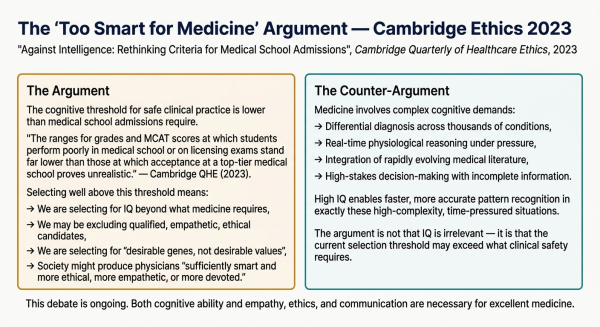
A 2023 article in the Cambridge Quarterly of Healthcare Ethics, titled "Against Intelligence: Rethinking Criteria for Medical School Admissions," made one of the most challenging arguments in recent medical education literature. The authors argued that current medical school admissions criteria — MCAT scores and undergraduate GPAs at leading schools — are set far above the cognitive threshold that clinical practice actually requires for patient safety.
The specific argument: the MCAT and GPA scores at which students fail medical school or perform poorly on licensing exams are substantially lower than the scores required for admission to top medical schools. This means the admissions threshold is set above what training and licensing outcomes would necessitate. The implication is that medical schools are not selecting at the minimum cognitive threshold for safe practice; they are selecting for cognitive ability as a proxy for merit in a competition that rewards test performance — and in doing so, they may be systematically excluding candidates who are sufficiently intelligent for clinical medicine but bring greater empathy, communication skill, or ethical commitment than the selected candidates.
The authors quoted in the article: "The result is a pool of physicians who are too smart for our own good, when instead society might produce physicians who are sufficiently smart and more ethical, more empathetic, or more devoted."
This argument is not simply anti-intellectual. It draws on a genuine body of evidence showing that above a cognitive threshold, the qualities that predict patient outcomes — communication, empathy, ethical reasoning, clinical judgment under uncertainty — are not well predicted by MCAT scores or IQ. It also echoes the broader threshold research discussed in our CEO IQ guide: above the entry threshold, character and interpersonal ability explain more variance in excellence than additional cognitive horsepower.
The counter-argument is also substantive: medicine genuinely involves high cognitive demands that benefit from substantial analytical capacity — pattern recognition across thousands of diagnostic possibilities, rapid integration of evolving evidence, complex pharmacological reasoning, and high-stakes decisions under time pressure and information uncertainty. The cognitive demands of, say, managing a septic patient with multiple organ failure or reading a complex ECG are real and substantial. Whether the optimal cognitive threshold for excellent medical practice is lower than current admission standards require is an open empirical question.
What IQ Does and Doesn't Predict in Medical Careers
The evidence on IQ and medical career success follows a familiar pattern from the broader occupational psychology literature:
IQ predicts: academic performance in medical training. MCAT scores and USMLE performance correlate strongly with general cognitive ability. The cognitive demands of memorising and integrating enormous volumes of medical knowledge are real, and cognitive ability is a meaningful predictor of how efficiently this is accomplished.
IQ predicts weakly: clinical skill and patient outcomes. Multiple studies have found weak relationships between MCAT scores and clinical performance assessments. A 2009 study found that academic performance (GPA) predicted lawyering skills (r = 0.46) better than LSAT — the analogous finding in medicine is that cognitive credentials predict licensing exam performance but not clinical skills grades comparably well.
IQ does not substantially predict: patient trust, communication quality, clinical empathy. The aspects of medicine that patients most value and that predict the quality of the doctor-patient relationship — whether the physician listens, explains clearly, shows compassion, and respects the patient's perspective — are not well predicted by IQ. These are emotional intelligence and character traits that the MCAT does not measure and that research on medical training increasingly identifies as central to excellent medical care.
Physicians average IQ 120–130, making medicine one of the most cognitively filtered professions documented in occupational research — the NLSY79 direct measurement places physicians at IQ 123.7 (94th percentile). This reflects the genuine cognitive demands of medical training and the intensive selection processes of medical school admission and residency matching. Within medicine, a 10–15 point IQ spread exists between the most cognitively selective specialties (neurosurgery, academic medicine) and less selective ones (family medicine). The MCAT correlates r ≈ .5–.7 with IQ and predicts licensing exam performance well but clinical outcomes poorly. A 2023 Cambridge ethics paper raises the provocative question of whether medicine selects above the cognitive threshold that safe clinical practice requires — potentially at the cost of excluding empathetic, ethical, communication-skilled candidates. Above the clinical competence threshold, what makes a great doctor may be less IQ and more the human qualities that IQ cannot measure.
For context on what the physician IQ range means, see our guides on IQ 120, IQ 122, and IQ 128. For comparison with other healthcare professionals, see our average IQ of nurses guide. For the broader profession comparison, see our average IQ by profession guide. For the IQ-EQ relationship in professional contexts, see our IQ vs EQ guide. Take our free IQ test — no registration, results in under 20 minutes.
Frequently Asked Questions
What is the average IQ of a doctor?
The NLSY79 direct measurement places physicians at IQ 123.7 (94th percentile). Multiple occupational IQ sources converge on IQ 120–130 as the physician range, with surgeons and academic physicians at the high end. This makes medicine one of the most cognitively filtered professions documented in research.
What IQ do you need to become a doctor?
No formal IQ requirement exists. The primary cognitive filter is the MCAT, which correlates r ≈ .5–.7 with IQ. Average medical school matriculant MCAT (~511–512) corresponds to approximately IQ 125–128 in general population terms. However, research suggests the cognitive threshold for safe clinical practice may be substantially lower than what top medical schools require.
Which medical specialty has the highest IQ?
Academic research physicians and neurosurgeons cluster at the highest IQ levels within medicine — estimated IQ 128–140+. USMLE Step 1 scores (the primary residency selection metric) proxy for cognitive ability: specialties with the highest Step 1 requirements (neurosurgery, thoracic surgery, interventional radiology) show the highest estimated IQ profiles.
Are doctors smarter than lawyers?
Data suggests physicians average slightly higher IQ than lawyers. NLSY79 places physicians at IQ 123.7 vs lawyer estimates of IQ 115–130 (central estimate ~120–125). The overlap is substantial — many lawyers have higher IQ than many physicians — but the physician average appears 3–5 points above the lawyer average in most studies.
Does IQ predict medical career success?
IQ predicts academic performance and licensing exams well. It predicts clinical skill and patient outcomes weakly. A 2023 Cambridge Quarterly of Healthcare Ethics paper argued that above the clinical competence threshold, empathy, communication, and ethics explain more variance in physician quality than additional cognitive ability.

Comments
Share Your Thoughts