Engineering is one of the most cognitively demanding fields in the modern economy — but "engineering" describes a remarkably diverse range of specialties, from software engineers writing machine learning algorithms to civil engineers designing road drainage systems. These specialties have different cognitive demands, and they attract people with different cognitive profiles. The result is a profession with an average IQ substantially above the population mean — but with a 15-point spread between the highest- and lowest-IQ specialties within engineering itself.
The overall range across engineering disciplines is approximately IQ 112–130, with research engineers and aerospace engineers at the top and civil and industrial engineers somewhat lower, though still substantially above the general population average of 100. Understanding this within-profession variation is more informative than a single "average engineer IQ" number.
At the same time, the research on what actually predicts success once engineers are on the job provides an important counterweight. Research cited by the American Society of Mechanical Engineers (ASME) found that once engineers are hired, IQ has "zero relationship with success" — while emotional and social intelligence "significantly predicts an engineer's effectiveness." The cognitive filter for entering engineering is real and substantial; what it filters for predicts career performance less reliably than the traits IQ doesn't measure.
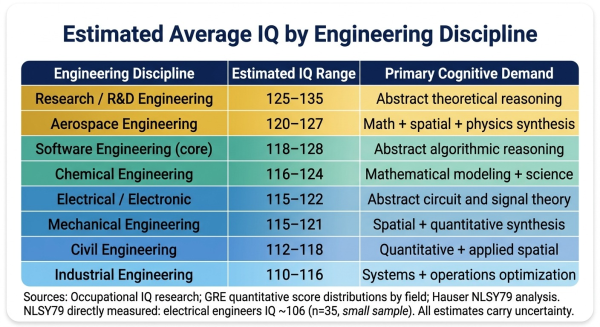
IQ by Engineering Discipline: The Data
No single study has directly administered IQ tests to a nationally representative sample of all engineers. The estimates used here come from three converging sources: occupational IQ mapping from Hauser's NLSY79 analysis, GRE quantitative score distributions by field (with GRE correlating approximately r = 0.7 with IQ), and general occupational IQ research reviewed across multiple sources.
| Engineering Discipline | Estimated IQ Range | Notes |
| Research / R&D Engineering | 125–135 | Overlap with research scientist category |
| Aerospace Engineering | 120–127 | High math + physics synthesis demands |
| Software Engineering (core) | 118–128 | Wide range; algorithm/ML roles at high end |
| Chemical Engineering | 116–124 | Strong quantitative and scientific modeling |
| Electrical / Electronic Engineering | 115–122 | NLSY79 direct measure: IQ 105.8 (n=35, small sample) |
| Mechanical Engineering | 115–121 | High spatial + quantitative synthesis demands |
| Civil Engineering | 112–118 | More applied; broader practitioner range |
| Industrial Engineering | 110–116 | Systems / operations focus; somewhat lower filter |
Note on the NLSY79 electrical engineer figure: The NLSY79 dataset (cogn-iq.org) gives an observed IQ of 105.8 for electrical engineers based on n=35 — a sample too small to be reliable, given that the measurement is drawn from a general longitudinal study that happened to catch 35 people in this occupation. The broader evidence from GRE scores and occupational research places electrical engineers substantially higher (~115–122). The NLSY79 figure is reported for transparency about what the most direct observational data shows, while acknowledging its significant sampling limitation.
The GRE Quantitative approach provides a useful validation method: engineering graduate students average GRE Quantitative scores of approximately 157–162 depending on the subfield, with software, electrical, and aerospace at the upper end. A GRE Quantitative score 0.5 standard deviations above the average GRE test-taker — who is already above average in cognitive ability — converts to approximately IQ 118 using the r = 0.7 GRE-IQ correlation. This is consistent with the estimates in the table above.
For context on what these IQ ranges mean cognitively and professionally, see our guides on IQ 115, IQ 120, and IQ 128.
Why Engineering Disciplines Have Different IQ Profiles
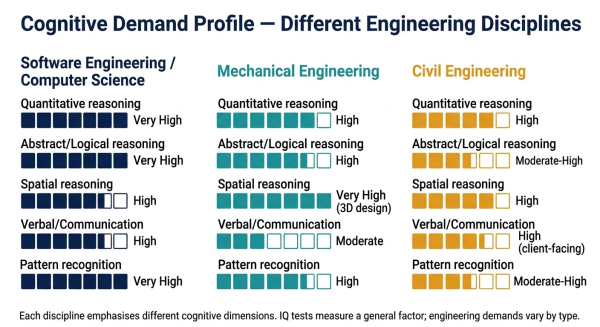
The variation in IQ estimates across engineering disciplines reflects genuine differences in the cognitive demands each specialty places on practitioners:
Software Engineering and Computer Science. The most cognitively abstract engineering discipline — at the algorithmic and systems design level. Software engineering at the frontier (machine learning architecture, cryptographic systems, operating systems, compiler design) requires the kind of abstract symbolic reasoning and pattern recognition that correlates most directly with fluid intelligence. The barrier is not physical understanding of materials or systems but the ability to reason about abstract data structures, algorithms, and computational complexity. This is why software engineering clusters near the high end of the engineering IQ distribution, and why the most selective software engineering roles (Google, DeepMind, OpenAI) are among the most cognitively demanding jobs in any industry.
Aerospace Engineering. Combining advanced mathematics, theoretical physics, materials science, and three-dimensional spatial reasoning at high precision levels, aerospace engineering is among the most cognitively demanding engineering disciplines in its foundational demands. The tolerance for error is essentially zero in aerospace — a calculation error that is acceptable in civil engineering can be catastrophic in aircraft design — which demands both high accuracy and high reasoning ability.
Chemical Engineering. Chemical engineering requires sophisticated mathematical modelling of reaction kinetics, thermodynamics, and fluid dynamics at the molecular and process level. The abstract mathematical demands are high, though the spatial demands are somewhat lower than aerospace or mechanical engineering.
Mechanical Engineering. Mechanical engineering is distinctive for its particularly high spatial reasoning demands — designing three-dimensional mechanical systems, analysing stress and strain in physical structures, and visualising complex machine dynamics. Mechanical engineers typically score high on the spatial/visuospatial components of cognitive assessments, making them a subgroup where spatial IQ may be as important as general IQ. For context on how spatial reasoning is measured in IQ tests, see our WAIS-IV guide.
Civil Engineering. Civil engineering combines substantial quantitative demands (structural analysis, hydraulic calculations, material property analysis) with practical, applied problem-solving in real-world constraints. It tends to draw from a broader cognitive range than aerospace or software engineering — highly capable people at the top, but a longer tail of competent practitioners who succeed through systematic application of established methods rather than novel theoretical reasoning.
How IQ Filters Into Engineering School — and Stops Predicting After
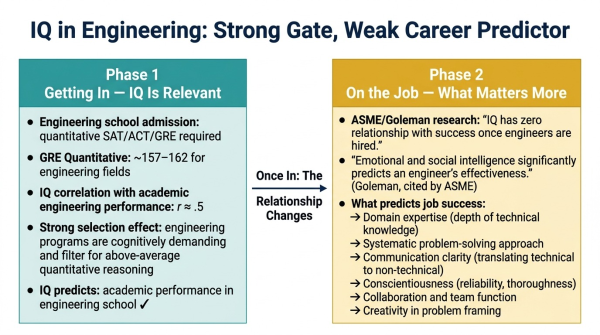
The mechanism by which engineers end up cognitively above average is the same as for lawyers and doctors: selective academic admission that filters candidates through cognitively demanding coursework. Engineering programmes — particularly in mathematics-intensive disciplines — require a level of quantitative reasoning that many people below the average engineering IQ cannot sustain through four or more years of calculus, differential equations, physics, and domain-specific technical content. The attrition is not random: students with lower quantitative reasoning ability drop out of engineering programmes at higher rates, which pushes the graduating engineer population toward the higher-IQ end of those who entered.
This selection mechanism produces the above-average IQ profile documented in research. But the critical question for anyone thinking about an engineering career — or evaluating engineers — is whether IQ continues to predict performance after this selection has occurred.
Research cited by ASME gives a striking answer. Psychologist Daniel Goleman, whose work on emotional intelligence has been extensively discussed in engineering management contexts, found that for engineers already in their jobs: "Emotional and social intelligence has been shown to significantly predict an engineer's effectiveness, and that same research shows that IQ has zero relationship with success."
This finding — consistent with the broader occupational psychology literature on threshold effects in cognitively demanding professions — has a straightforward interpretation. Once a population has been cognitively filtered through an engineering programme, everyone remaining has demonstrated sufficient cognitive ability for the work. Within that already-cognitively-capable group, the remaining variance in who becomes an excellent, good, or mediocre engineer is explained by non-cognitive factors: how systematically they approach problems, how effectively they communicate with non-technical stakeholders, how well they collaborate in teams, how conscientiously they verify their work, and how creatively they frame problems.
For more on how the threshold effect works across professions, see our average IQ by profession guide and our guide on IQ and income.
Software Engineers: The Highest IQ Subgroup in Engineering
Among all engineering disciplines, software engineering working in abstract algorithm-intensive roles deserves special mention as the highest-IQ subgroup. Several lines of evidence converge on this:
GRE Quantitative scores for computer science and software engineering graduate programmes are consistently among the highest of any academic discipline — alongside mathematics and physics. The selective hiring processes at top technology companies (competitive algorithm tests, multiple rounds of abstract reasoning assessments) function as a second cognitive filter applied on top of academic qualification. The specific demands of software engineering at the frontier — algorithmic complexity reasoning, type systems, formal verification, machine learning mathematics — are among the most abstractly demanding cognitive tasks in regular occupational use.
Software engineers at FAANG-level companies (Google, Meta, Apple, Amazon, Netflix) and elite research labs are estimated by most occupational IQ research at IQ 125–135, placing them in the Superior to Very Superior range. This is not because software engineering as a profession is uniquely brilliant — it is because the most cognitively demanding tier of software engineering functions as a cognitive tournament, selecting from the upper tail of an already above-average pool.
Engineering IQ in Professional Context
| Profession | Estimated IQ Range | Classification |
| Research Scientists (STEM) | 125–135 | Superior to Very Superior |
| Physicians / Surgeons | 120–130 | Superior to Very Superior |
| Research Engineers / R&D | 125–135 | Superior to Very Superior |
| Aerospace Engineers | 120–127 | Superior |
| Software Engineers (core) | 118–128 | Superior |
| Lawyers / Attorneys | 115–130 | High Average to Superior |
| Mechanical Engineers | 115–121 | High Average to Superior |
| Civil Engineers | 112–118 | High Average |
Engineers as a professional class compare directly with lawyers and doctors in IQ range, with the highest-demand engineering specialties (research, aerospace, software at the algorithmic frontier) occupying the same cognitive tier as research scientists and surgeons. The cognitive diversity within engineering — from the abstract mathematical demands of research engineering to the applied practical demands of civil engineering — means that "engineering" as a label covers a wider IQ range than most other professional designations.
Engineers average IQ 112–130 depending on discipline — well above the population mean of 100, with a roughly 15-point spread from the lowest- to highest-IQ specialties within engineering. Research and aerospace engineers cluster with research scientists and physicians at the top of occupational IQ distributions. Software engineers in algorithm-intensive roles occupy a similar tier. Civil and industrial engineers are also substantially above average, though somewhat lower within the profession. But once engineers are in the field, IQ shows essentially zero relationship with job success — domain expertise, systematic problem-solving approach, communication clarity, conscientiousness, and emotional intelligence explain the variance that IQ cannot.
For context on what these IQ ranges mean, see our guides on IQ 115, IQ 120, and IQ 128. For how engineering compares to other professions, see our average IQ by profession guide. Take our free IQ test — no registration, results in under 20 minutes.
Frequently Asked Questions
What is the average IQ of an engineer?
The average IQ of engineers ranges from approximately IQ 112–130 depending on discipline. Research and aerospace engineers cluster at the high end (~125–135); software engineers in algorithm-intensive roles at ~118–128; mechanical and electrical engineers at ~115–122; civil and industrial engineers at ~110–118. All engineering disciplines are substantially above the population average of 100.
Which type of engineer has the highest IQ?
Research engineers, aerospace engineers, and software engineers in algorithm-intensive roles (machine learning, systems design) tend to have the highest estimated IQ within engineering — approximately IQ 118–135. These disciplines demand the most abstract mathematical and logical reasoning that correlates most directly with cognitive ability.
Do engineers have higher IQs than doctors?
Broadly comparable. Both professions are well above average. Research engineers and surgeons have the most similar profiles (~high 120s to low 130s). Doctors tend to score higher on verbal reasoning; engineers higher on spatial and quantitative reasoning. The distributions overlap substantially — comparing them as if one profession is categorically smarter is not well-supported.
Does IQ predict engineering career success?
IQ predicts engineering school performance well. But research cited by ASME found IQ has "zero relationship with success" once engineers are hired. Emotional intelligence, domain expertise, systematic problem-solving, communication skill, and conscientiousness explain the variance in engineering career performance that IQ does not predict.
What IQ do you need to become an engineer?
No formal IQ requirement exists. The main cognitive filter is quantitative performance in maths and science at school level and university entry exams. People with IQs below the profession average can and do succeed as engineers, particularly in more applied specialties. The IQ distribution within engineering is wide.

Comments
Share Your Thoughts