Maria Salomea Skłodowska was 10 years old when her mother died of tuberculosis. She was growing up in Warsaw under Russian imperial occupation — the Russian government had banned Polish-language instruction in schools and forbidden women from attending university. When she and her sister Bronisława wanted to continue their education after secondary school, the only option available to them was a clandestine underground institution that moved between private homes to avoid arrest: the Flying University.
From those secret rooms in occupied Warsaw, through a decade of poverty and manual labour in Paris, through the isolation and processing of several tons of pitchblende to extract a fraction of a gram of a previously unknown element, Marie Curie became the only person in history to win the Nobel Prize in two different scientific fields — Physics in 1903 and Chemistry in 1911. She remains, 90 years after her death, the only individual to hold this distinction.
Her IQ is estimated at 180–200. The estimate is retroactive — no IQ test was ever administered to her, and standardised intelligence assessment was barely in its infancy during her lifetime. What is not retroactive is the achievement record. This article examines the mind behind it: what it could do, what it overcame, and what it cost.
What Was Marie Curie's IQ?
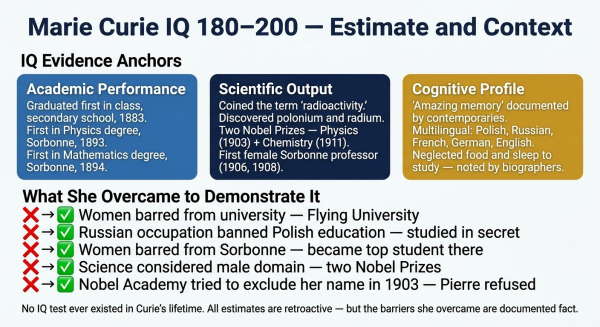
Marie Curie's IQ is most commonly estimated at 180–200, across a range of biographical and analytical sources. Individual citations include 180, 185, 190, and 200 — the variation reflecting the same methodological uncertainty that applies to all historical IQ estimates for figures who predated standardised testing.
The most academically defensible approach — following the historiometric methodology of Catharine Cox's 1926 study of historical geniuses (explored in detail in our articles on Leonardo da Vinci and Nikola Tesla) — would use documented early intellectual development as the primary anchor. The available biographical evidence for Curie includes:
- Documented extraordinary memory from early childhood, noted by teachers and family
- Graduated first in her secondary school class in Warsaw, 1883
- Learned physics and chemistry in secret through the Flying University under conditions of significant stress and risk
- Graduated first in her Physics degree at the Sorbonne, 1893
- Graduated second in her Mathematics degree at the Sorbonne, 1894
- Multilingual: Polish, Russian, French, German, and English
- Contemporaries documented her as neglecting food and sleep to study — an intensity of focus associated with high cognitive drive
This profile is consistent with IQ in the 180–195 range by historiometric estimation. The 200+ figures on some sites are unsupported by any specific methodology. For more on why historical IQ estimates are inherently imprecise, see our guide on the highest IQ of all time.
The Flying University: Intelligence Under Occupation
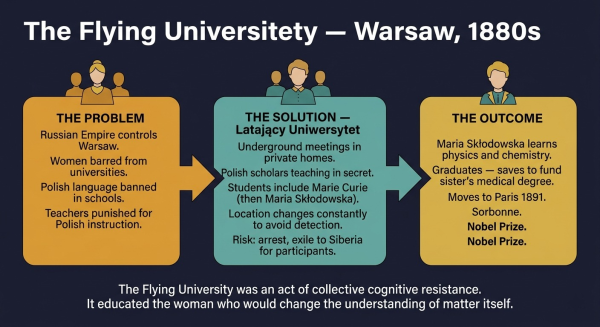
The starting point for understanding Marie Curie's intelligence is not Paris or the Nobel Prize. It is Warsaw in the 1880s — a city under Russian imperial control in which her father, Władysław Skłodowski, taught mathematics and physics at schools where teachers were required to switch instantly from Polish to Russian whenever a government official appeared. The children in these schools, Marie later wrote, understood that "a single conversation in Polish, or an imprudent word, might seriously harm not only themselves but also their families."
The Russian government prohibited women from attending university within its entire empire. After graduating first in her secondary school class in 1883, Maria Skłodowska had no legal pathway to higher education. She and her sister Bronisława joined the Flying University — the Latający Uniwersytet — a clandestine network of illegal underground classes taught by Polish scholars in secret locations that changed regularly to avoid detection. Participants faced the risk of arrest and exile to Siberia. The curriculum covered mathematics, natural sciences, history, and literature — subjects the Russian authorities explicitly sought to suppress.
The Flying University is not merely a biographical detail. It is the foundational demonstration of the kind of intelligence Marie Curie possessed — not just analytical ability, but the willingness to pursue knowledge under conditions of genuine personal risk, the persistence to build a scientific foundation in secret without the institutional support that male European scientists took for granted, and the clarity of vision to understand that the investment was worth the cost before any evidence of payoff existed. For more on how this kind of intellectual drive relates to measured intelligence, see our guide on IQ vs problem-solving.
From Warsaw to Paris: The Road to the Sorbonne
Maria Skłodowska's path to Paris was not a simple departure — it was a years-long collaborative project between her and her sister. She and Bronisława made an agreement: Maria would work as a governess in Poland to fund Bronisława's medical studies in Paris, and then Bronisława would fund Maria's studies in return. Maria worked as a governess for five years — teaching herself advanced mathematics independently during that time — before finally arriving in Paris in 1891 at age 24.
At the Sorbonne, she enrolled as a student in physics. She described her first experience of uninhibited study in a letter: "It was like a new world opened to me, the world of science, which I was at last permitted to know in all liberty." She rented a small, poorly heated room near the university, surviving on so little food that she occasionally fainted from hunger. She finished first in her Physics licence in 1893 and second in her Mathematics licence in 1894 — results that placed her among the top students in the entire institution.
She met Pierre Curie in 1894, while seeking laboratory space for research. He was eight years older, already an established physicist, and so taken with her scientific mind that he offered to share his own laboratory. They married in 1895. Their collaboration produced the most consequential series of scientific discoveries of the late 19th century.
The Discovery of Radioactivity: A Logical Revolution
Marie Curie's scientific genius is most clearly visible not in the years of physical labour that isolated radium, but in the conceptual leap that identified what to look for.
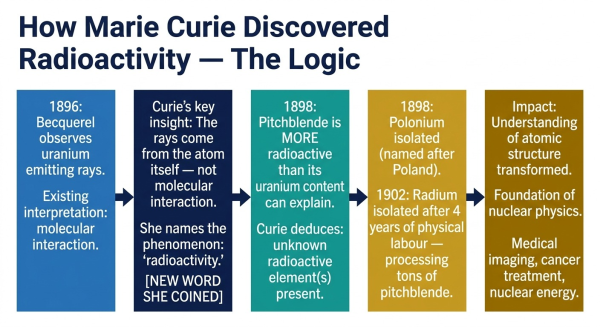
In 1896, Henri Becquerel had observed that uranium spontaneously emitted rays capable of fogging photographic plates. The prevailing interpretation was that this emission was a product of molecular interaction — something that happened between uranium atoms and other atoms in its environment.
Curie identified a different possibility: that the emission was a property of the uranium atom itself, independent of its molecular environment. This was a radical proposition — it implied that atoms were not the inert, indivisible units that 19th-century chemistry assumed, but dynamic structures with internal properties that could emit energy. She named this property radioactivity — a word she coined — and set out to test whether other elements shared it.
The critical step came when she began studying pitchblende — the mineral ore in which uranium occurs naturally. She discovered that pitchblende was significantly more radioactive than its uranium content alone could explain. The logical inference was precise: there must be other radioactive elements present in pitchblende, previously unknown, contributing to the excess radioactivity. She deduced the existence of these elements before isolating any physical sample of them.
Pierre set aside his own research to join the investigation. Together, in 1898, they announced the existence of two new elements: polonium (named after Marie's occupied homeland Poland) and radium. Isolating radium proved extraordinarily laborious — processing several tons of pitchblende to extract milligrams of material. Marie's doctoral thesis, completed in 1903, described the isolation of radium in pure form for the first time. It is widely considered one of the most important doctoral dissertations in the history of science.
The term "radioactivity" entered scientific vocabulary through her coinage. The conceptual framework she established — that atomic structure determines physical properties including energy emission — became a foundation of 20th-century physics. For more on how this type of breakthrough insight relates to cognitive ability, see our guide on multiple intelligences.
The First Nobel Prize — and the Attempt to Exclude Her
In 1903, the Nobel Committee for Physics considered awarding the prize to Henri Becquerel and Pierre Curie for the discovery of radioactivity. Marie Curie's name was not initially included in the nomination. Pierre was informed and explicitly refused to accept the prize unless Marie was included as a co-recipient. The Nobel Committee added her name. She became the first woman to receive the Nobel Prize — but only because her husband demanded it.
This episode is a window into the institutional environment in which Marie Curie worked. Her intelligence was not only deployed against scientific problems; it was constantly deployed against the social assumption that scientific intelligence was a male property. The Nobel attempted exclusion of 1903 is one of the most documented instances of this assumption in scientific history — and Pierre's insistence on her co-receipt is one of the most documented acts of male allyship in the same period.
The Second Nobel — and the Langevin Scandal
After Pierre's death in a street accident in 1906 — he was struck by a horse-drawn wagon — Marie Curie inherited his academic chair at the Sorbonne, becoming the institution's first female professor. She threw herself into continued research, continued teaching, and the long effort to isolate radium in metallic form — achieved in 1910 in collaboration with André Debierne.
In 1911, she was awarded the Nobel Prize in Chemistry — the sole recipient — for the discovery of polonium and radium and the isolation of radium. She became the first person to win the Nobel Prize twice, and the only person ever to win it in two different scientific disciplines. She remains, to this day, the only individual with this distinction.
The 1911 Nobel was awarded in the same year that her relationship with physicist Paul Langevin — her husband's former student, who was separated from his wife — became public knowledge. The French press attacked her savagely, combining xenophobia (she was Polish, not French) with moral condemnation. The Nobel Committee chairman Svante Arrhenius wrote to her suggesting she decline the prize until her personal reputation was "cleared." She wrote back: "the prize has been awarded for the discovery of radium and polonium. I believe that there is no connection between my scientific work and the facts of private life." She attended the ceremony in Stockholm and delivered her Nobel lecture as planned.
Mobile X-Ray Units and World War One
One of the most overlooked aspects of Marie Curie's work is its direct lifesaving application. When World War One began in 1914, she recognised immediately that X-ray equipment — then fixed in urban hospitals — could save lives in battlefield surgery if it could be brought to the wounded. She developed mobile X-ray units — "petites Curies" — mounted in modified vehicles that could be driven to battlefield hospitals across France. She trained 150 women operators to use the equipment and herself drove one of the units to the front.
It is estimated that these mobile units assisted in over one million medical examinations during the war. This is applied intelligence operating in the most direct possible way: recognising a life-or-death problem, identifying a technical solution, and deploying it at scale under conditions of extreme urgency.
The Radioactive Notebooks: Intelligence at a Fatal Cost
At the time Marie Curie was conducting her research, the biological hazards of radiation were not understood. She routinely carried test tubes of radioactive isotopes in her pockets and her coat. She stored radioactive materials in her desk drawer. She worked for decades without protective equipment in a poorly ventilated laboratory that was contaminated with radioactive materials.
She died on 4 July 1934, at age 66, from aplastic anemia — almost certainly caused by decades of radiation exposure. Her personal research notebooks from the 1890s remain radioactive to this day. They are stored in lead-lined boxes at the Bibliothèque nationale de France, accessible only to researchers who sign a liability waiver and agree to wear protective equipment. The notebooks that documented the discovery of radioactivity are themselves so contaminated by it that they cannot safely be handled without protection 130 years after they were written.
The irony is complete: the woman who identified radioactivity did not survive it, because the understanding of its biological hazards came partly from her own work — and arrived too late to protect her.
How Curie Compares to Other Historical Scientific Geniuses
| Person | Est. IQ | Field | Unique Distinction |
| Marie Curie | 180–200 | Physics + Chemistry | Only person to win Nobel in 2 different sciences |
| Albert Einstein | ~160 | Physics | Special and General Relativity; Nobel 1921 |
| Isaac Newton | ~190 | Mathematics, Physics | Calculus, laws of motion, universal gravitation |
| Nikola Tesla | ~160–200 | Electrical Engineering | AC power system; 300+ patents; died broke |
| Leonardo da Vinci | 180–220 | All domains | Greatest polymath — no Nobel equivalent existed |
The comparison with Einstein is particularly notable. Einstein's estimated IQ of approximately 160 — lower than Curie's estimated range — reflects a different type of cognitive profile: exceptional theoretical intuition operating within a single domain (physics). Curie's profile reflects exceptional analytical intelligence operating across two distinct scientific disciplines simultaneously, combined with extraordinary experimental rigour and physical persistence. If anything, the comparison suggests that the standard estimates of Einstein's IQ relative to Curie's have historically been inverted by institutional bias — Einstein's cultural status inflated his estimated IQ while Curie's was underestimated by the same forces that tried to exclude her name from her first Nobel.
Marie Curie's IQ of approximately 180–200 is a retroactive estimate of a mind that learned physics in a secret underground school under threat of Siberian exile, graduated first from the Sorbonne, coined the word radioactivity, discovered two elements, and won the Nobel Prize in two separate sciences over 95 years before any other person achieved a single one of those things. The estimate is imprecise. The achievement is not.
Take our free IQ test to find out where your own analytical profile sits. For more on how historical IQ estimates are constructed, see our guides on Leonardo da Vinci and the highest IQ of all time. Explore our full Celebrity IQ database.
Frequently Asked Questions
What was Marie Curie's IQ?
Marie Curie's IQ is most commonly estimated at 180–200. No IQ test was ever administered to her — she lived from 1867 to 1934, and standardised intelligence testing was in its earliest infancy during her lifetime. All estimates are retroactive, based on documented early intellectual development, academic performance, and scientific output. A historiometric estimate consistent with Catharine Cox's 1926 methodology would place her in the 180–195 range.
Why was Marie Curie the only person to win two Nobel Prizes in two sciences?
Marie Curie won the Nobel Prize in Physics in 1903 (shared with Pierre Curie and Henri Becquerel) for research on radioactivity, and the Nobel Prize in Chemistry in 1911 (sole recipient) for the discovery of radium and polonium and the isolation of radium. No other person has won the Nobel Prize in two different scientific fields in the 125+ years of the prize's existence.
What was the Flying University?
The Flying University (Latający Uniwersytet) was a clandestine underground educational institution operating in Warsaw under Russian imperial occupation in the 1880s. The Russian government prohibited women from attending university and suppressed Polish education. The Flying University met secretly in private homes, taught by Polish scholars, and offered women — including Marie Curie — access to higher education that was otherwise legally forbidden. Participants risked arrest and exile to Siberia.
How did Marie Curie discover radioactivity?
Curie made the crucial conceptual leap that uranium's ray emission was a property of the atom itself — which she named radioactivity. When she found pitchblende more radioactive than its uranium content alone could explain, she deduced the existence of unknown radioactive elements. This logic led to the isolation of polonium (1898) and radium (1902) after years of intensive physical and chemical processing of tons of ore.
How did Marie Curie die?
Marie Curie died on 4 July 1934, age 66, from aplastic anemia — almost certainly caused by decades of radiation exposure without protective equipment. Her personal research notebooks remain radioactive today, stored in lead-lined boxes at the Bibliothèque nationale de France, accessible only to researchers who sign a liability waiver and wear protective equipment.

Comments
Share Your Thoughts