Mr. Bean has never been officially assigned an IQ in the show's canon. He doesn't need one. His intelligence — or apparent lack of it — is communicated entirely through physical comedy: the perplexed squint, the elaborate workaround, the catastrophic solution to a trivial problem. He is one of the most globally recognised characters in television history, understood without words in every country where the show has aired, because his behaviour communicates something more fundamental than language can.
But here is the question that searches for "Mr. Bean IQ" are actually asking: how smart is he, really? And the more interesting follow-up: how does the intelligence of the character compare to the intelligence of the man who created and plays him — Rowan Atkinson, Oxford electrical engineer, estimated IQ 178?
The answer reveals something genuinely interesting about what intelligence is, how it is expressed, and why the gap between actor and character in this case may be the largest in entertainment history.
What Is Mr. Bean's Estimated IQ?
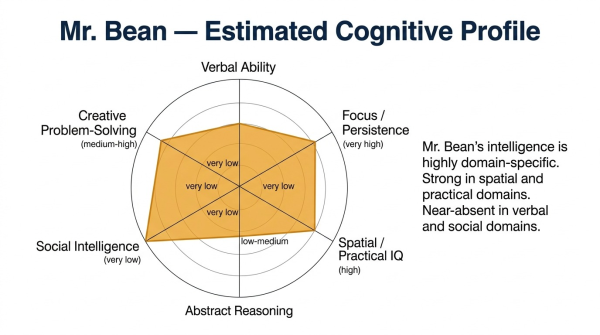
Mr. Bean is a fictional character. No canonical IQ score exists. But based on the cognitive profile depicted across the 14 episodes of the original ITV series (1990–1995) and the subsequent films, cognitive analysts and psychology researchers have estimated his functional intelligence at approximately IQ 70–80 — placing him in the Borderline Intellectual Functioning range.
This estimate is based on the following observable characteristics:
- Near-zero verbal communication — Bean speaks rarely and minimally. His communication is almost entirely non-verbal: gesture, expression, and action. Verbal ability is one of the strongest individual predictors of general IQ on tests like the WAIS, and its absence in Bean's repertoire is a consistent signal
- Significant social obliviousness — Bean consistently fails to read social situations, anticipate other people's responses, or understand how his actions appear from the outside. This reflects poor social cognition and theory of mind — the ability to model other people's mental states
- Concrete rather than abstract reasoning — Bean approaches every problem as a physical, spatial challenge rather than a social or verbal one. He does not think through consequences; he acts and observes the outcome
- Strong spatial and practical intelligence within a narrow domain — the elaborate contraptions, the precise physical timing, the resourceful repurposing of objects — these suggest above-average spatial and mechanical intelligence in a highly specific domain
The overall profile is not uniformly low IQ. It is a domain-specific cognitive profile — very low verbal and social intelligence, moderate-to-high spatial and practical intelligence — which is why Bean's solutions often work in physical terms while catastrophically failing in social ones. For a real-world parallel, see our guide on IQ 75 and our broader discussion of multiple intelligences.
The 100-Point Gap: Actor vs Character
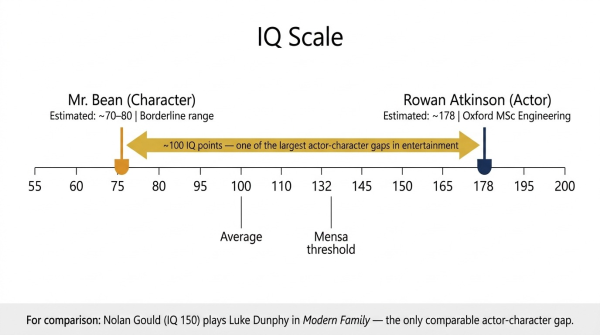
Rowan Atkinson's IQ is estimated at approximately 178 — based on his MSc in Electrical Engineering from The Queen's College, Oxford, his thesis on Self-Tuning Control Systems, and confirmed by his extraordinary technical precision in performance. This estimate is explored in detail in our full profile of Rowan Atkinson's IQ.
The estimated gap between character and actor is therefore approximately 100 IQ points — from the 5th percentile (Mr. Bean, ~IQ 75) to the 99.99th percentile (Rowan Atkinson, ~IQ 178). This is one of the largest estimated actor-character intelligence gaps in entertainment history. For comparison:
| Actor | Actor Est. IQ | Character | Character Est. IQ | Gap |
| Rowan Atkinson | ~178 | Mr. Bean | ~70–80 | ~100 pts |
| James Woods | ~180 | Lester Diamond (Casino) | ~105 | ~75 pts |
| Nolan Gould | 150 | Luke Dunphy (Modern Family) | ~90 | ~60 pts |
| Tom Hanks | ~115–130 | Forrest Gump | 75 | ~40–55 pts |
The Atkinson-Bean pairing stands alone at the top of this table. The stark difference between Mr. Bean and Rowan Atkinson is, arguably, what makes the question of his real-life IQ so compelling. Mr. Bean is a character of few words, relying almost entirely on physical comedy and exaggerated facial expressions. He often finds himself in everyday situations that he manages to complicate in hilariously absurd ways. Rowan Atkinson, in real life, is a highly educated, articulate, and private individual with a very sharp mind, who simply embodies the character for performance.
Mr. Bean's Internal Logic: Resourceful Within His Own Rules
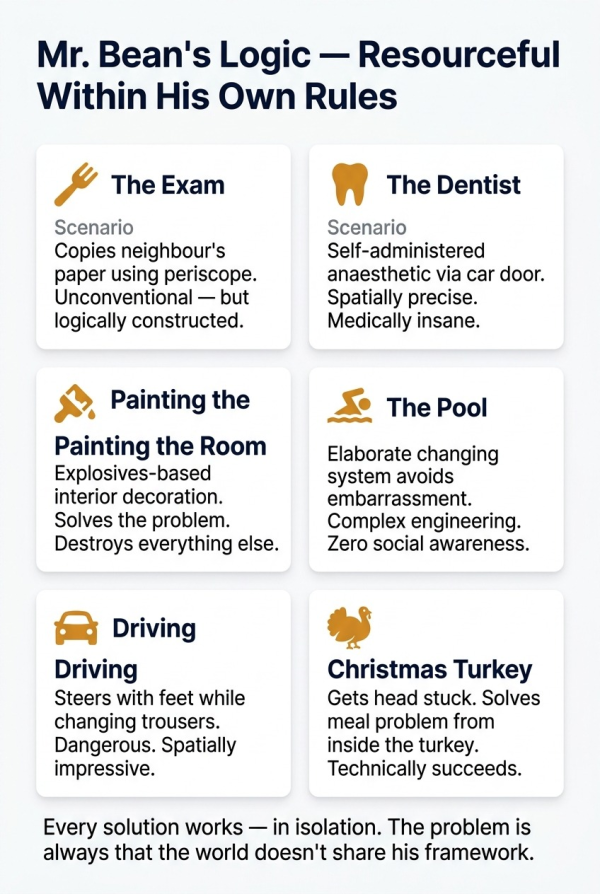
The most important insight about Mr. Bean's intelligence is that he is not randomly foolish. His humour does not arise from general cognitive failure — it arises from the systematic collision between his precise internal logic and the world's expectations.
Consider the exam episode. Bean is caught with a cheat sheet and then, rather than simply copying, constructs an elaborate periscope system to copy his neighbour's answers without being seen. The solution is complex, spatially demanding, and technically executed with precision. It fails — spectacularly — but not because it was poorly designed. It fails because Bean did not consider that the solution itself would be more conspicuous than the original problem.
Or the dentist episode, in which Bean, facing a tooth that needs anaesthetic before extraction, administers his own anaesthetic via the slamming of a car door against his cheek. The spatial reasoning is, in its own perverse way, sound. The execution is precise. The outcome is catastrophic — but internally consistent with how Bean models the world.
This pattern repeats across every episode: Bean identifies a problem, constructs an elaborate solution using available physical resources, executes it with spatial precision, and then encounters the social, verbal, or consequence-based failure that his framework never accounted for. As The Genius Index described Atkinson's approach: he approaches comedy not as an art, but as an engineering problem that needs to be solved. Mr. Bean's solutions are engineered — they just fail to account for the human variables outside Bean's internal model.
In cognitive science terms, this is a profile consistent with high perceptual reasoning combined with severely impaired social cognition — a combination that researchers have associated with certain autism spectrum presentations rather than simple low IQ. Bean is not uniformly cognitively limited. He is cognitively asymmetric: brilliant in spatial domains, absent in social ones. For more on how these different intelligence types relate, see our guide on multiple intelligences.
How Atkinson Built the Character: Engineering Mr. Bean
Rowan Atkinson became involved with the Oxford University Dramatic Society and the Oxford Revue, famous breeding grounds for British comedic talent. It was here that he met Richard Curtis, a future writing partner, and began to develop the silent, physical comedy style that would later define Mr. Bean.
The character drew on a lineage of silent film comedians — Buster Keaton, Jacques Tati, Charlie Chaplin — who understood that physical comedy requires more precise cognitive design than verbal comedy, not less. When you cannot use words to signal intent, pace, or punchline, every physical element must carry the full weight of the humour. The timing of a glance, the precise angle of a slouch, the exact moment of hesitation before a catastrophic decision — these require extraordinary spatial and temporal precision to produce the intended effect.
Bean is essentially a silent movie character dropped into the modern world. Atkinson's Oxford engineering training — specifically his work on self-tuning control systems, which involve modelling how a system should adjust its own behaviour based on feedback — provided an unusual cognitive framework for thinking about performance. A self-tuning control system adjusts its parameters in response to how its environment responds. A skilled physical comedian adjusts their timing, intensity, and physical positioning based on how an audience responds. The cognitive operation is analogous.
Atkinson has noted that playing Mr. Bean is stressful and exhausting — that he does not enjoy the process in the way actors often enjoy inhabiting characters. This is partly because the character requires maintaining a precise internal model of how Bean would perceive and respond to every situation — a model that is fundamentally alien to how Atkinson himself thinks — while simultaneously managing the extreme physical demands of the performance. It is, in engineering terms, a demanding control problem: maintaining a complex simulated cognitive state while processing real-time environmental feedback and adjusting physical output accordingly. For more on this connection, see our full profile of Rowan Atkinson's IQ.
Is Mr. Bean Stupid, or Just Different?
The question matters more than it might appear, because the answer affects how we understand both the character and the real people who share cognitive profiles that the character resembles.
The most precise answer: neither uniformly stupid nor simply different — but cognitively asymmetric in a way that produces consistent failure in specific domains.
Mr. Bean's failures are not random. They are predictable from his cognitive profile:
- He will always find a physical solution when a social solution exists — because social solutions require modelling other people's mental states, which he cannot do
- His physical solutions will often work in isolation — because his spatial intelligence is relatively intact
- His physical solutions will always fail socially — because he cannot predict how they appear to observers who do not share his internal model
- He will never learn from these failures — because learning from social feedback requires the same social cognition he lacks
This pattern is not low IQ in the general sense — it is a specific cognitive profile, and one that produces very specific, very predictable outcomes. The comedy works precisely because it is consistent. Bean's world operates by rules that the audience comes to understand, and the humour arises from the audience's ability to predict — one step ahead of Bean — exactly how his solution is going to produce the wrong outcome in the right way.
Designing a character this consistent, this precise, and this universally legible required exactly the kind of systems thinking that Atkinson's engineering training produced. For more on how cognitive profiles like Bean's map onto real intelligence frameworks, see our guide on cognitive flexibility and IQ vs problem-solving.
The Largest Actor-Character IQ Gaps in Entertainment
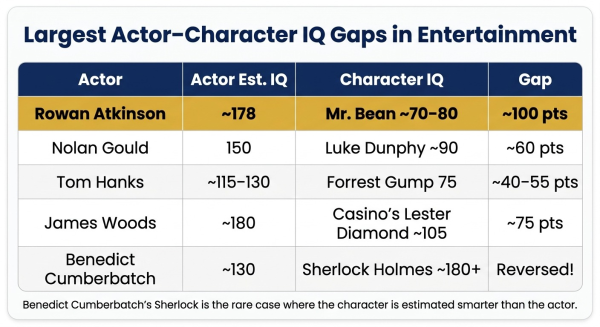
The Atkinson-Bean pairing sits at the extreme end of the actor-character intelligence gap spectrum. The table above shows the most notable comparisons. One inversion is worth noting: Benedict Cumberbatch playing Sherlock Holmes — where the character is estimated smarter than the actor — is the rare case where the intelligence gap runs in the opposite direction. Most actor-character intelligence gaps run the other way: smart people playing fools. Atkinson-Bean is simply the most extreme example.
The only genuinely comparable real-world case is Nolan Gould (IQ 150) playing Luke Dunphy in Modern Family — a Mensa member playing a loveable dim character across 11 seasons. But even that gap, at approximately 60 IQ points, is substantially smaller than the estimated 100-point Atkinson-Bean separation. As Gould himself put it in his Twitter bio: "I am not a dummy, I just play one on TV." Atkinson could say the same — at roughly twice the cognitive distance.
Mr. Bean's IQ is estimated at approximately 70–80 — Borderline Intellectual Functioning with high spatial ability and near-zero social cognition. Rowan Atkinson's IQ is estimated at approximately 178 — Profoundly Gifted, Oxford-educated, engineering-trained. The ~100-point gap between them is not just the most extreme actor-character intelligence separation in entertainment history. It is also the clearest demonstration that building a convincing fool requires more intelligence than almost any other creative task — because you have to understand every mistake before you can design it precisely enough to be funny.
Curious where your own intelligence profile sits? Take our free IQ test — no registration, results in under 20 minutes. For the full story of Rowan Atkinson's remarkable real-life intelligence, see our dedicated profile of Rowan Atkinson's IQ. Explore more in our Celebrity IQ database.
Frequently Asked Questions
What is Mr. Bean's IQ?
Mr. Bean has no official IQ score in the show's canon. Based on his depicted cognitive profile — minimal verbal communication, near-zero social intelligence, strong spatial and practical ability — analysts estimate his functional intelligence at approximately IQ 70–80, placing him in the Borderline Intellectual Functioning range. His intelligence is highly domain-specific rather than uniformly low.
What is Rowan Atkinson's IQ?
Rowan Atkinson's IQ is estimated at approximately 178, based on his MSc in Electrical Engineering from The Queen's College, Oxford. This places him in the Profoundly Gifted range — approximately 100 IQ points above Mr. Bean's estimated profile. For the full analysis, see our article on Rowan Atkinson's IQ.
How was Mr. Bean created?
Mr. Bean was created by Rowan Atkinson and Richard Curtis, first appearing on ITV in January 1990. Atkinson developed the character partly during his time at Oxford, drawing on silent film comedians like Buster Keaton and Jacques Tati. The show ran for 14 episodes between 1990 and 1995, deliberately using near-zero dialogue to make the character universally accessible across languages.
Is Mr. Bean stupid or just different?
Neither fully. Mr. Bean's comedy arises from the systematic collision between his precise internal logic and the world's expectations. Within his own framework, he is highly resourceful — demonstrating spatial intelligence and focused problem-solving. What he lacks is social intelligence and verbal ability, combined with an inability to predict how his solutions appear to others. This profile more closely resembles cognitive asymmetry than simple low IQ.
What is the intelligence gap between Mr. Bean and Rowan Atkinson?
Approximately 100 IQ points — from an estimated IQ of 70–80 (Mr. Bean, Borderline range) to an estimated IQ of 178 (Rowan Atkinson, Profoundly Gifted). This makes the Atkinson-Bean pairing one of the largest estimated actor-character intelligence gaps in entertainment history — comparable only to Nolan Gould (IQ 150) playing Luke Dunphy, but at nearly twice the estimated gap.
Comments
Share Your Thoughts