An IQ of 75 is one of the most misunderstood scores on the intelligence spectrum. Many people who receive this result feel confused, discouraged, or unsure what it actually means for their life. This guide is designed to address that directly — with accurate information, honest context, and a clear focus on what is genuinely possible.
The short answer: an IQ of 75 presents real cognitive challenges in specific areas, particularly abstract reasoning and academic learning. But it does not define what a person can achieve, how they can contribute, or what kind of life they can build. Many people with scores in this range live independently, hold steady employment, and maintain meaningful relationships. What matters most is understanding the challenges clearly and accessing the right support.
What Does an IQ of 75 Mean?
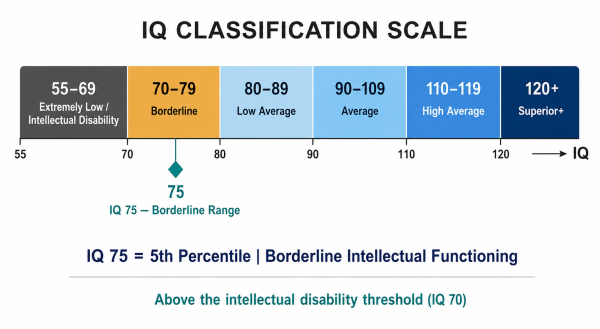
On standardised IQ tests such as the Wechsler Adult Intelligence Scale (WAIS) and Stanford-Binet — both using a mean of 100 and standard deviation of 15 — a score of 75 falls 1.67 standard deviations below the mean. The Wechsler scale classifies this as the Borderline range (IQ 70–79).
This places IQ 75 at approximately the 5th percentile, meaning roughly 95 out of every 100 people score higher. It sits between two recognised categories:
- Above: the Low Average range begins at IQ 80, where cognitive demands of most standard academic and professional environments become more manageable
- Below: the Intellectual Disability threshold begins at approximately IQ 70, where significant adaptive functioning impairments are also typically present
This in-between position is clinically significant. People with IQ 75 are often not identified as needing specialist support — they do not meet the threshold for intellectual disability services — yet they frequently struggle in educational and workplace environments designed for average cognitive ability. This gap between what is expected and what is comfortable is one of the most important things to understand about this score. For a full picture of how the IQ scale is structured, see our IQ scale explained guide.
Is IQ 75 an Intellectual Disability?
No. This is one of the most important distinctions to understand clearly.
Intellectual disability — as defined by both the DSM-5 and the World Health Organisation — requires two criteria to be met simultaneously: a measured IQ below approximately 70, and significant impairments in adaptive functioning across conceptual, social, and practical domains. An IQ score alone is not sufficient for diagnosis.
IQ 75 sits above the typical intellectual disability threshold. The clinical term most often applied is Borderline Intellectual Functioning (BIF) — a condition recognised in the DSM-5 as a focus of clinical attention, affecting an estimated 10–14% of the population depending on the diagnostic cutoff used. Research published in Frontiers in Psychology describes BIF as characterised by heterogeneous cognitive difficulties that significantly affect academic performance and social functioning, but that are frequently unrecognised and unsupported precisely because they fall outside the intellectual disability diagnostic category.
This means many people with IQ 75 navigate their challenges largely without formal acknowledgement — which can compound the difficulty significantly.
How IQ 75 Compares to Nearby Scores
| IQ Score | Classification | Percentile | Population % |
| 70 | Extremely Low / Borderline ID threshold | 2nd | ~2% |
| 75 | Borderline ★ | 5th | ~5% |
| 80 | Low Average | 9th | ~9% |
| 85 | Low Average | 16th | ~16% |
| 90 | Average | 25th | ~25% |
The gap between IQ 75 and IQ 85 is meaningful in everyday cognitive terms. IQ 85 — the Low Average range — is the approximate threshold at which most standard academic and vocational training becomes manageable without specialist support. The 10-point difference between IQ 75 and IQ 85 represents approximately two-thirds of a standard deviation — a real and practically significant gap. If you are curious about what adjacent scores look like, see our guides on IQ 70 and IQ 85.
What Are the Real Challenges at IQ 75?
Understanding the genuine challenges associated with IQ 75 is important — not to discourage, but to ensure the right support is in place. Research on Borderline Intellectual Functioning consistently identifies the following areas of difficulty:
Academic Learning
Abstract academic subjects — mathematics beyond basic arithmetic, analytical reading, formal writing, and science — are typically difficult to master at pace with standard curriculum expectations. Most children with IQ 75 are classified as slow learners and may require more time, more repetition, and more concrete instruction to reach the same learning outcomes. Our guide on IQ and academic struggles explores this in detail.
Working Memory
Below-average working memory makes it harder to follow multi-step instructions, retain new information under time pressure, and switch between tasks without losing track. This affects performance in fast-paced work environments and in any setting that requires holding multiple competing demands in mind simultaneously.
Processing Speed
Slower information processing means more time is needed to understand new material, respond to questions, and adapt to changing situations. This is not a fixed limit — structured environments with clear procedures and consistent routines significantly reduce the impact of lower processing speed.
Abstract Reasoning
Tasks that require identifying patterns in novel situations, working with hypothetical scenarios, or applying rules to unfamiliar contexts are consistently more challenging at IQ 75 than in the average range. Concrete, practical reasoning — working with tangible materials and familiar procedures — is typically much stronger.
Social Cognition
Research on BIF shows that children in this range sometimes show delayed development of Theory of Mind — the ability to understand other people's perspectives and intentions. This can create social friction that compounds the academic and vocational challenges already present.
What Are the Strengths at IQ 75?
A score of 75 on a standardised IQ test reflects specific cognitive abilities measured under specific conditions. It does not measure — and therefore does not predict — a wide range of capacities that are equally important for a good life:
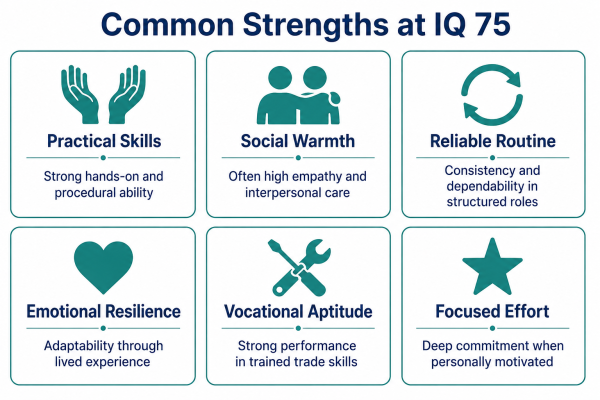
- Practical and procedural skill — many people with IQ 75 develop strong hands-on abilities in trades, care work, food service, and technical roles. These skills are built through repetition and experience rather than abstract instruction, and they compound effectively over time
- Social warmth and empathy — interpersonal warmth and the ability to connect with others emotionally are not measured by IQ tests and are not predicted by IQ scores. Many people in the Borderline range demonstrate strong social and emotional sensitivity
- Reliability and consistency — structured roles with clear expectations and consistent routines often produce stable, dependable performance
- Resilience — navigating environments that were not designed with your cognitive profile in mind builds real adaptive strength over time
- Focused practical motivation — when matched with work that is genuinely meaningful and appropriately structured, many people with IQ 75 demonstrate deep commitment and consistent effort
The relationship between IQ and real-world success is far more complex than any single number suggests. For a fuller picture, see our guides on IQ vs EQ and can people with lower IQ scores succeed?
Can Someone With IQ 75 Live Independently?
Yes — and this is important to state clearly. Independent living is not determined by IQ score alone. It is determined by adaptive functioning: the practical ability to manage daily tasks, maintain relationships, handle money, navigate work, and make decisions in real-world contexts.
Research on Borderline Intellectual Functioning consistently shows that many people in this range live independently, hold long-term employment, and maintain stable social relationships — particularly when their environment provides appropriate structure and their vocational choices align with their practical rather than abstract strengths.
The key variables that support independent living at IQ 75 include:
- Early identification and appropriate educational support during school years
- Vocational training programmes that build concrete, transferable skills
- Employment environments with structured routines, clear procedures, and consistent supervision
- Social support networks — family, friends, or community — that provide a safety net during periods of difficulty
- Access to services and resources without stigma or unnecessary barriers
For parents of children with scores in this range, our guide to supporting a child with a lower IQ score provides detailed, practical guidance.
Suitable Career Paths for IQ 75
Research on cognitive thresholds in occupational performance shows that the minimum IQ for successful performance varies significantly by role complexity. Many stable, dignified, and rewarding careers have cognitive thresholds well within the range of IQ 75 — particularly in structured, practical, and procedural domains.
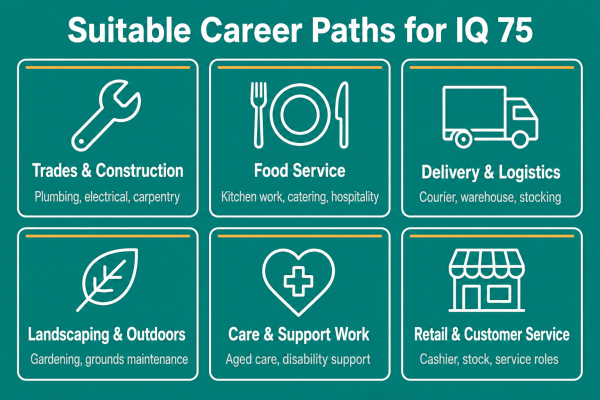
| Career Field | Why It Fits | Key Success Factor |
| Trades & Construction | Procedural, hands-on, skill built through practice | Vocational training + mentorship |
| Food Service & Hospitality | Structured routines, concrete tasks, social interaction | Consistent environment + clear procedures |
| Delivery & Logistics | Familiar routes, physical activity, limited abstract demand | Routine + physical stamina |
| Landscaping & Grounds | Outdoor, physical, visual results, low abstract demand | Practical skill + physical endurance |
| Care & Support Work | Empathy-driven, procedural, meaningful human connection | Emotional warmth + training |
| Retail & Customer Service | Social interaction, structured tasks, consistent environment | Clear routine + interpersonal skill |
Supported employment programmes — which pair individuals with job coaches who help with on-the-job learning, communication, and workplace navigation — have shown strong outcomes for people in the Borderline range. If you are exploring career options, our guide on jobs where EQ beats IQ is also highly relevant, as emotional intelligence and interpersonal skill are strong independent assets at any cognitive level.
How to Improve Cognitive Performance at IQ 75
While core IQ is relatively stable across adulthood, cognitive performance — the actual thinking ability expressed in daily life — can improve meaningfully through consistent lifestyle and environmental support. Neuroplasticity research confirms that the brain retains capacity for growth and adaptation across the lifespan. For more on this, see our guide on neuroplasticity and cognitive development.
Evidence-based strategies that support cognitive performance at IQ 75 include:
- Consistent, quality sleep — one of the most powerful and accessible levers for cognitive performance. Even modest improvements in sleep consistency produce measurable gains in working memory and processing speed
- Regular aerobic exercise — produces BDNF (brain-derived neurotrophic factor), which supports neuroplasticity and has been shown to improve fluid reasoning over time. See our guide: how exercise affects the brain
- Structured learning with repetition — presenting new material in concrete, step-by-step formats with adequate practice time produces stronger retention than abstract instruction delivered at pace
- Reducing cognitive load in the environment — organised living spaces, clear daily routines, and simplified decision-making structures free cognitive resources for the tasks that matter most
- Building on practical strengths — investing time and energy in vocational skills that align with natural practical aptitude compounds more effectively than attempting to overcome abstract reasoning weaknesses directly
For children specifically, our guide on can IQ improve in children? reviews the research on early intervention and environmental enrichment in depth.
What to Do If You Have Just Received This Score
If you have recently received an IQ score of 75 — for yourself or for a child — the most important first step is to seek a full psychological evaluation from a qualified professional. A standardised IQ test alone does not provide a complete picture of cognitive ability, adaptive functioning, or potential. A comprehensive assessment will identify specific cognitive strengths and weaknesses, rule out contributing factors such as learning disabilities or attention disorders, and inform practical recommendations for educational and vocational support.
A single IQ score is not a life sentence. It is one data point — measured on one day, under specific conditions, with specific tools. Context, support, and effort matter enormously. Many people initially assessed with scores in the Borderline range have gone on to live full, stable, and meaningful lives with the right combination of vocational training, social support, and environments matched to their genuine strengths.
For parents navigating this for a child, our guide on whether parents should worry about their child's IQ offers grounded, practical perspective. Our IQ testing for kids guide explains what professional assessment involves and what to expect from the process.
Final Thoughts: IQ 75 Is a Starting Point, Not a Ceiling
An IQ of 75 is a real cognitive challenge — particularly in environments designed around average cognitive ability. The difficulties in abstract reasoning, working memory, and processing speed are real and deserve to be taken seriously, not minimised or dismissed.
At the same time, this score is not the full picture of who a person is, what they can do, or what they can build. Practical intelligence, emotional warmth, resilience, and the ability to develop genuine skill through experience are not captured by IQ tests — and they are not less real or less valuable.
IQ 75 tells you where additional support is needed. It does not tell you what is possible. What is possible depends on the support available, the strengths developed, and the choices made — and those are not determined by any number.
If you would like to understand the full picture of your cognitive profile, our free IQ test provides a baseline measurement. For emotional intelligence — which operates independently of IQ and is equally important for life outcomes — our free EQ test offers a separate assessment.
Frequently Asked Questions
What does an IQ of 75 mean?
An IQ of 75 is classified as Borderline on the Wechsler scale and corresponds to approximately the 5th percentile. It sits between the Average range and the Intellectual Disability threshold, and indicates cognitive abilities that may require additional support in academic and professional settings. Most people with IQ 75 are capable of independent living and meaningful employment with appropriate support.
Is IQ 75 considered an intellectual disability?
No. Intellectual disability is typically diagnosed at IQ 70 or below, combined with significant impairments in adaptive functioning. IQ 75 sits above that threshold. The appropriate clinical term is Borderline Intellectual Functioning (BIF) — a recognised condition affecting approximately 10–14% of the population.
Can someone with IQ 75 live independently?
Yes. Many people with IQ 75 live independently, hold steady employment, and maintain fulfilling social relationships. Success is most strongly supported by appropriate vocational training, structured environments, and support networks aligned with practical rather than abstract strengths.
What jobs can someone with IQ 75 do?
People with IQ 75 often thrive in trades, food service, delivery and logistics, landscaping, care work, and retail — structured, practical roles with clear procedures and consistent routines. Success is most likely in environments that develop and reward hands-on skills rather than abstract reasoning. See also our guide on jobs where EQ beats IQ.
How can someone with IQ 75 improve their cognitive performance?
Consistent sleep, regular aerobic exercise, structured learning with adequate repetition, and building on practical vocational strengths all support cognitive performance meaningfully. Neuroplasticity research confirms that focused skill development produces real functional gains regardless of baseline IQ. See our guide on can IQ be improved?

Comments
Share Your Thoughts