Neil deGrasse Tyson is one of the most recognizable scientists alive — an astrophysicist who has made black holes, dark matter, and the origins of the universe accessible to millions of people through television, podcasts, and public speaking. Online estimates of his IQ range from 123 to 160, but none of these numbers have been verified by any public record. This article examines what is documented — his academic record, career achievements, and observable cognitive profile — and what remains speculation. For context on how IQ is measured and how celebrity estimates are derived, see the complete guide to IQ and the Celebrity IQ Database.
The Core Fact: No Verified IQ Score
Tyson has never publicly released results from a standardized IQ test, and no documented score appears in any verified biographical or institutional source. The estimates of 123, 145, 160, and other numbers that circulate online have no cited origin in psychometric testing. They are extrapolations from his academic credentials and career profile — the same process used for other figures in the Celebrity IQ Database.
In public discussions about intelligence and science education, Tyson has consistently emphasized curiosity and evidence-based reasoning over claims of innate intellectual superiority. He has spoken frequently about the value of being comfortable with uncertainty and with not knowing — positioning open inquiry as more intellectually important than any measure of raw ability. This disposition is consistent with his scientific worldview, not with attaching significance to a personal IQ score.
The Verified Record: Educational Background
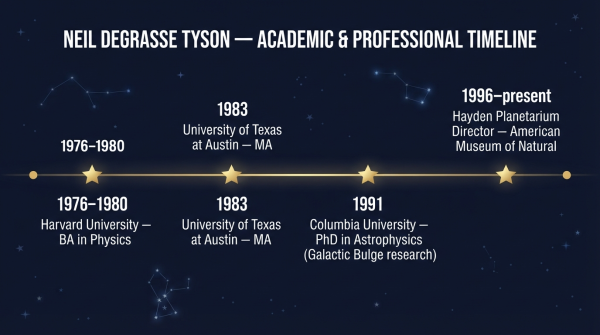
Tyson's academic record is documented and provides genuine cognitive evidence:
- 1980 — BA in Physics, Harvard University: Tyson entered Harvard's physics program, where he was also active in crew rowing and dance — evidence of broad engagement rather than narrow specialization
- 1983 — MA, University of Texas at Austin: Continued graduate studies in astronomy
- 1991 — PhD in Astrophysics, Columbia University: His doctoral dissertation focused on the galactic bulge — the densely packed central region of the Milky Way — examining the structure and stellar populations of this complex astrophysical system
- 1996–present — Frederick P. Rose Director, Hayden Planetarium, American Museum of Natural History: A position involving both research direction and major public engagement responsibility
A PhD in Astrophysics from Columbia University requires demonstrated mastery of advanced mathematics, computational modeling, data analysis, and theoretical physics — all highly demanding cognitive domains. Completion of this degree, and directorship of a major public science institution, provides indirect evidence of well above-average analytical and verbal intelligence. It does not map to a specific IQ number. For context on how academic credentials relate to cognitive ability, see the guide on average IQ by education level.
The Cosmos Legacy: Science Communication as a Distinct Cognitive Domain
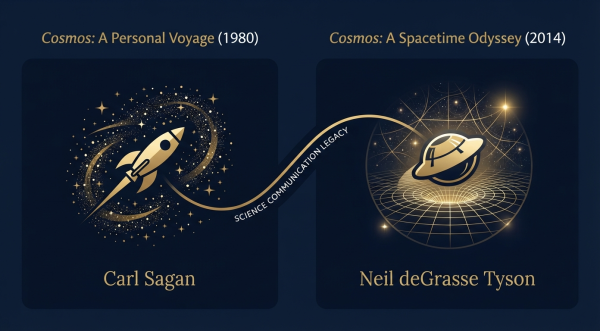
In 2014, Tyson hosted Cosmos: A Spacetime Odyssey — the Emmy-winning reboot of Carl Sagan's landmark 1980 series — reaching an estimated 135 million viewers in 181 countries in its first season. He has described Carl Sagan as one of the most important influences on his own career trajectory, having exchanged letters with Sagan as a teenager interested in astrophysics.
Effective science communication at this scale is a genuinely rare and demanding cognitive task. It requires:
- Deep domain expertise in the subject matter being communicated
- The ability to identify which analogies and framings will make abstract concepts accessible without misrepresenting them
- Calibrating complexity to different audience backgrounds in real time
- Maintaining scientific accuracy under the pressure of entertainment formats and public scrutiny
This combination — domain expertise plus exceptional verbal and social intelligence — is what makes science communicators like Tyson (and Sagan before him) rare. The same domain knowledge without communication ability remains locked in specialist literature. The same communication ability without domain knowledge produces inaccuracy. Both are required simultaneously. For more on this dimension, see the Linguistic Intelligence guide.
Four Cognitive Strengths Documented in Tyson's Career
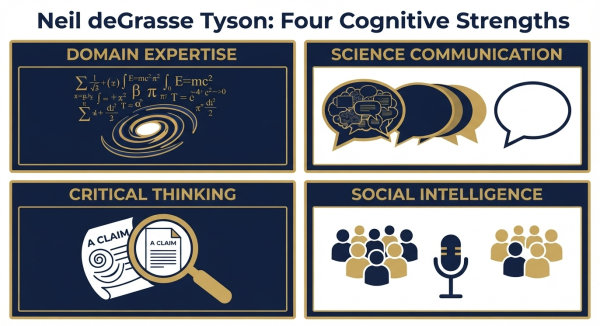
1. Domain Expertise and Mathematical Reasoning
A PhD in Astrophysics and ongoing research directorship require sustained high-level mathematical and spatial reasoning — the cognitive domains that IQ tests measure most directly. Galactic structure research involves computational modeling of complex multi-variable systems and interpretation of large astronomical datasets. This work requires the kind of abstract pattern recognition and working memory capacity that IQ tests assess. For more on how mathematical and spatial reasoning are measured, see the guide on verbal and nonverbal intelligence tests.
2. Science Communication Ability
Hosting Cosmos to 135 million viewers, producing and hosting the StarTalk podcast across hundreds of episodes, and making regular appearances across television and radio formats demonstrates exceptional verbal and social intelligence. The ability to sustain high-quality technical communication across diverse contexts over decades is evidence of cognitive endurance and adaptability — not just initial verbal ability.
3. Critical Thinking and Epistemological Reasoning
Tyson's public career has involved sustained engagement with scientific misinformation — flat-earth claims, astrology, pseudoscience — approached consistently through evidence evaluation and logical analysis rather than emotional reaction. This reflects what cognitive researchers describe as epistemic rationality: the ability to reason about the reliability of claims and the quality of evidence. This is a distinct cognitive capacity from raw IQ, though related to it. For context, see IQ vs critical thinking.
4. Social and Pedagogical Intelligence
Effective teaching — whether in a lecture hall or on a television series — requires modeling how other people think, identifying where their understanding breaks down, and constructing explanations that bridge from what they know to what they don't. This pedagogical intelligence is distinct from domain expertise: many brilliant researchers are poor teachers. Tyson's track record in mass science education demonstrates strong social cognition alongside his analytical abilities. For more on this dimension, see the EQ Test and the IQ vs EQ guide.
What Tyson's Career Profile Suggests About His IQ
Based on the indirect evidence available — Harvard BA in Physics, Columbia PhD in Astrophysics, successful research career, and exceptional cross-format science communication ability — Tyson's cognitive profile is consistent with scores well above the population average. The domains where his abilities are most clearly demonstrated (abstract reasoning, verbal comprehension, working memory) are precisely the domains that IQ tests measure.
What specific number this corresponds to cannot be accurately stated. The estimates of 145–160 that circulate online are plausible as rough ranges, but they are extrapolations, not measurements. The honest answer to "what is Neil deGrasse Tyson's IQ?" is: well above average, consistent with elite academic credentials in a mathematically demanding field, and unverified as any specific number.
The more interesting question is not what his IQ score might be — it is why the combination of scientific rigor and public communication ability is so rare, and what cognitive profile makes it possible.
Frequently Asked Questions
What is Neil deGrasse Tyson's IQ?
No verified IQ score exists for Tyson. Online estimates of 123 to 160 lack documentation — he has never publicly released standardized test results. His academic record (Harvard BA Physics, Columbia PhD Astrophysics) and career achievements provide indirect evidence of well above-average intelligence, but no specific IQ number can be accurately attributed to him.
Where did Tyson get his PhD?
Tyson earned his PhD in Astrophysics from Columbia University in 1991. His doctoral dissertation examined the galactic bulge — the densely packed central region of the Milky Way. He also holds a BA in Physics from Harvard University (1980) and an MA from the University of Texas at Austin.
What type of intelligence does Tyson's career demonstrate?
Tyson's career demonstrates strong mathematical and spatial reasoning (required for astrophysics research), exceptional verbal and linguistic intelligence (science communication to mass audiences), critical thinking and epistemological rigor (systematic evidence evaluation), and social and pedagogical intelligence (effective teaching across diverse contexts). For context on these dimensions, see Multiple Intelligences Theory.
How does Tyson relate to Carl Sagan?
Tyson has identified Carl Sagan as one of the most important influences on his scientific career and his commitment to public science education. As a teenager interested in astrophysics, Tyson corresponded with Sagan, who invited him to visit Cornell. Tyson later hosted Cosmos: A Spacetime Odyssey (2014), the reboot of Sagan's landmark 1980 series. Both share the rare combination of scientific expertise and mass-audience communication ability that defines great science communicators.
Is Tyson a research scientist or primarily a communicator?
Both. Tyson has maintained a research career through his directorship of the Hayden Planetarium and has published peer-reviewed work in astrophysics. He is also one of the most prolific science communicators alive, having hosted Cosmos, produced hundreds of StarTalk podcast episodes, and made countless media appearances. The combination is unusual — most research scientists do not communicate at this scale, and most science communicators do not maintain active research careers. For context on how research-level expertise relates to IQ, see average IQ by profession.

Comments
Share Your Thoughts