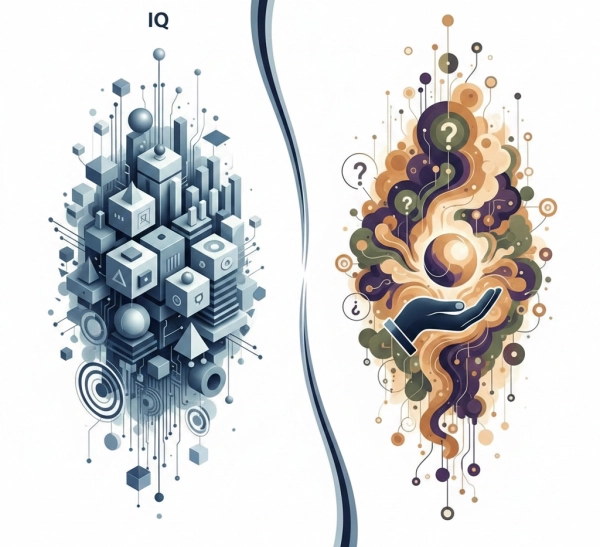
IQ and critical thinking are often used interchangeably, but they represent different aspects of human cognition. While IQ measures general cognitive ability under structured conditions, critical thinking reflects how effectively a person evaluates information, questions assumptions, and makes reasoned decisions in real-world situations. Understanding the difference helps explain why high intelligence does not always lead to good judgement — and why strong critical thinkers are not always those with the highest IQ scores.
What Is IQ?
IQ (Intelligence Quotient) is a standardised score designed to measure general mental ability. It focuses on how efficiently a person processes information, recognises patterns, and applies logical reasoning under controlled conditions. A full conceptual overview is available in What Is IQ? A Complete Guide to Intelligence Quotient.
Most IQ tests evaluate logical and abstract reasoning, pattern recognition and visual-spatial awareness, processing speed and working memory, and numerical and mathematical reasoning. These abilities are commonly assessed through verbal and nonverbal tests of intelligence and are reflected in assessments like the international standard IQ test. IQ is particularly useful in structured environments where problems are clearly defined, rules are fixed, and correct answers exist — one reason it remains relevant in recruitment IQ tests. However, IQ reflects cognitive potential, not how that potential is applied. It does not account for judgement, values, or how people evaluate information in uncertain or emotionally charged contexts.
What Is Critical Thinking?
Critical thinking is the ability to analyse information objectively, evaluate evidence carefully, and make reasoned judgements rather than relying on assumptions or intuition alone. It emphasises how you think, not how fast you think. Key components include evaluating the credibility and reliability of sources, identifying logical fallacies and weak arguments, distinguishing facts from opinions and assumptions, weighing evidence before drawing conclusions, and recognising personal biases and cognitive blind spots. These abilities overlap strongly with skills such as cognitive flexibility and reflective reasoning, which are not directly measured by IQ tests. Unlike IQ, critical thinking is a learned skill that improves through education, experience, and deliberate practice.
How IQ and Critical Thinking Are Related
IQ can support critical thinking by enabling faster comprehension of complex ideas, stronger logical analysis, and better pattern recognition. Individuals with higher IQs may find it easier to follow detailed arguments or detect inconsistencies in reasoning — especially in analytical tasks related to problem-solving aptitude. That said, IQ does not automatically produce critical thinking. Someone may understand an argument perfectly yet fail to question its assumptions or examine the quality of its evidence. Critical thinking requires intentional effort, scepticism, and self-reflection — qualities that fall outside the scope of traditional IQ measurement. In practice, IQ provides mental tools, while critical thinking determines how responsibly and effectively those tools are used. This mirrors the broader distinction explored in IQ vs problem-solving skills.
Where IQ Falls Short
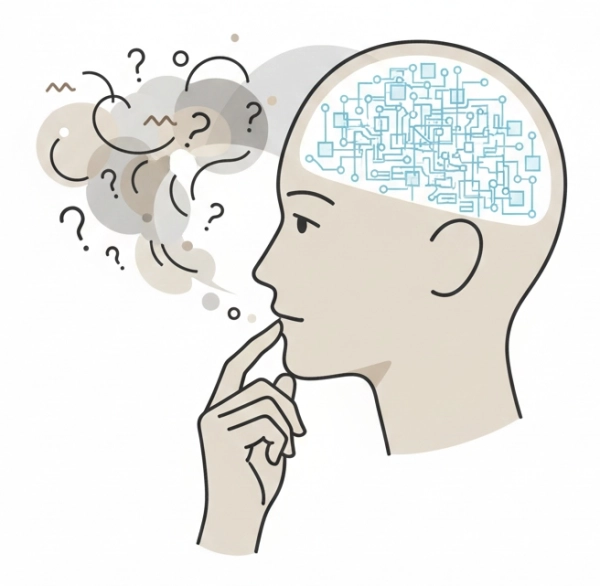
IQ tests do not measure several abilities that are essential to strong critical thinking: awareness of cognitive and emotional biases, willingness to question personal beliefs, ethical reasoning and moral judgement, contextual understanding of real-world situations, and openness to changing one’s mind. Because of this, individuals with very high IQs can still fall prey to misinformation, overconfidence, or flawed reasoning. Intelligence without reflection can lead to rationalising poor conclusions rather than challenging them — a pattern often seen when IQ vs EQ is unbalanced.
Why Critical Thinking Matters More in Real Life
In everyday life, critical thinking often matters more than raw intelligence. Real-world decisions are rarely neat or fully defined — they involve uncertainty, conflicting information, emotional pressure, and social consequences. Strong critical thinkers are better equipped to evaluate news, media, and online claims; make informed personal, financial, and professional decisions; resist manipulation, propaganda, and misinformation; and navigate complex ethical, political, and social issues. In workplaces and leadership contexts, sound judgement and reflective thinking often predict success more reliably than IQ alone.
Developing Critical Thinking Skills
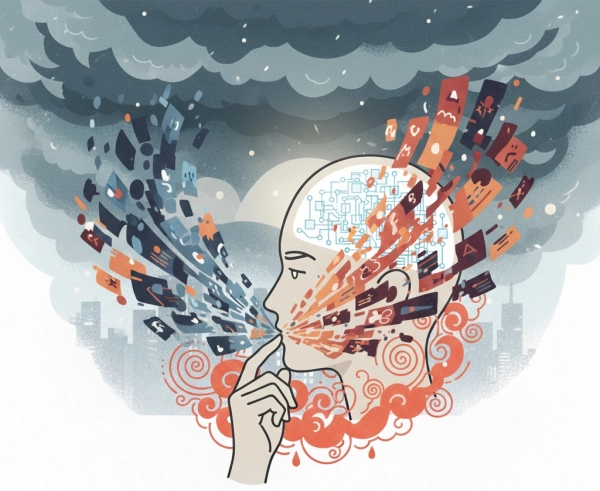
Unlike IQ, which tends to remain relatively stable over time, critical thinking skills can be developed at any age. Practical ways to strengthen critical thinking include reading diverse viewpoints (especially those you disagree with), practising logical reasoning and argument analysis, asking "why," "how," and "what evidence supports this?", reflecting on past decisions and learning from mistakes, and slowing down thinking to avoid emotional or impulsive judgements. Research on neuroplasticity of the brain suggests that these habits can meaningfully improve reasoning and decision-making over time.
IQ and Critical Thinking: A Better Perspective
IQ and critical thinking are not competitors but complements. IQ provides the cognitive capacity to understand complex information, while critical thinking determines whether that understanding leads to sound conclusions. In the modern world — where information is abundant but reliability varies — critical thinking is often the more decisive skill. Explore more in our IQ Guides collection.

Comments
Share Your Thoughts