Tony Stark — genius, billionaire, playboy, philanthropist — is Marvel's most iconic intellectual. He is the man who built a functional powered suit of armour in a cave with a box of scraps. The man who solved time travel in an afternoon. The man whose last act was wielding the power of six Infinity Stones to save the entire universe, knowing it would kill him.
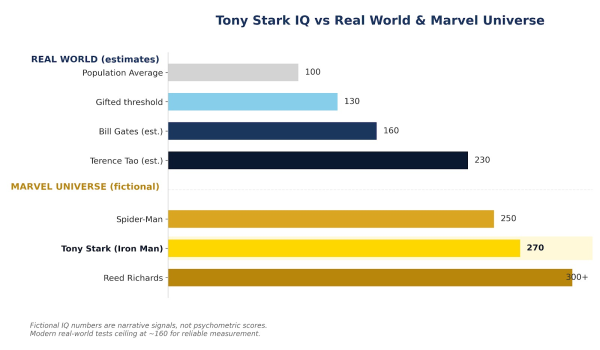
His IQ is most commonly estimated at 270 — a figure derived from fan analysis and assessments that place him as the pre-eminent scientific genius in the Marvel Cinematic Universe. Marvel has never officially stated a specific number in canon, but 270 is the consensus among Marvel analysts and reflects the portrayed scale of his abilities across the comics and films.
This article examines what that number means in Marvel lore, how Tony Stark's genius actually works, how it compares to Batman's IQ of 192 in DC canon, and what real-world cognitive science can tell us about the type of intelligence Stark represents.
What Is Tony Stark's IQ in Marvel Canon?
Marvel has not officially published a specific IQ number for Tony Stark in any canonical source. The figure of 270 comes from fan analysis and third-party assessments — most notably from Looper, whose analysts estimated his IQ "in the neighbourhood of 270, which in practical terms is pretty much off the scale." Comic-book community consensus typically places him between 250 and 270, based on the range and impossibility of his intellectual achievements.
In Marvel Comics canon, Stark is confirmed to have entered MIT at age 15 and earned dual Master's degrees in Electrical Engineering and Physics by age 17. He is consistently ranked among the top five smartest humans in the Marvel Universe — typically behind Reed Richards (IQ 300+), Bruce Banner, and Hank Pym in the comics, but positioned as the pre-eminent genius of the MCU films where those characters play smaller roles.
The 270 figure — like all extreme fictional IQ claims — is a narrative signal, not a psychometric measurement. It communicates: this character operates at an intellectual level that defies normal human limits and should be understood as the most capable engineer and applied scientist in this story. For context on why real-world IQ scores above 160 are difficult to verify, see our guide on the highest IQ of all time and the IQ scale explained.
Tony Stark's Academic Background: What Marvel Canon Establishes
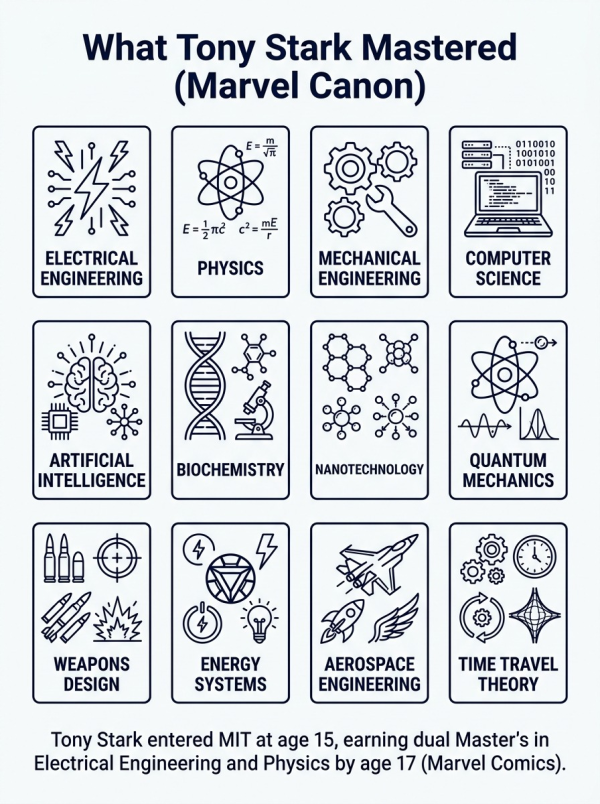
In Marvel Comics canon, Tony Stark's academic record establishes him as one of the most thoroughly educated fictional characters in superhero history:
- Entered MIT at age 15 — as a boy genius admitted under exceptional circumstances
- Dual Master's degrees in Electrical Engineering and Physics — both completed by age 17
- Subsequently demonstrated mastery in mechanical engineering, computer science, artificial intelligence, biochemistry, nanotechnology, aerospace engineering, quantum mechanics, and theoretical physics
- In Avengers: Endgame — cracked the theoretical and mathematical problem of quantum realm time navigation, described as a problem of theoretical physics and higher-dimensional mathematics that Bruce Banner, despite years of working on it, could not solve
The breadth of disciplines is intentionally impossible by real-world standards. Even the most gifted real human beings specialise — no one achieves genuine mastery across engineering, physics, AI, biochemistry, and quantum mechanics simultaneously. This breadth is part of what makes Stark a fictional genius rather than a realistic one: his character is designed to be the answer to any technical problem the story requires. For a comparison with a fictional character who uses intelligence differently, see our article on Batman's IQ of 192.
The Five Greatest Genius Feats in the MCU
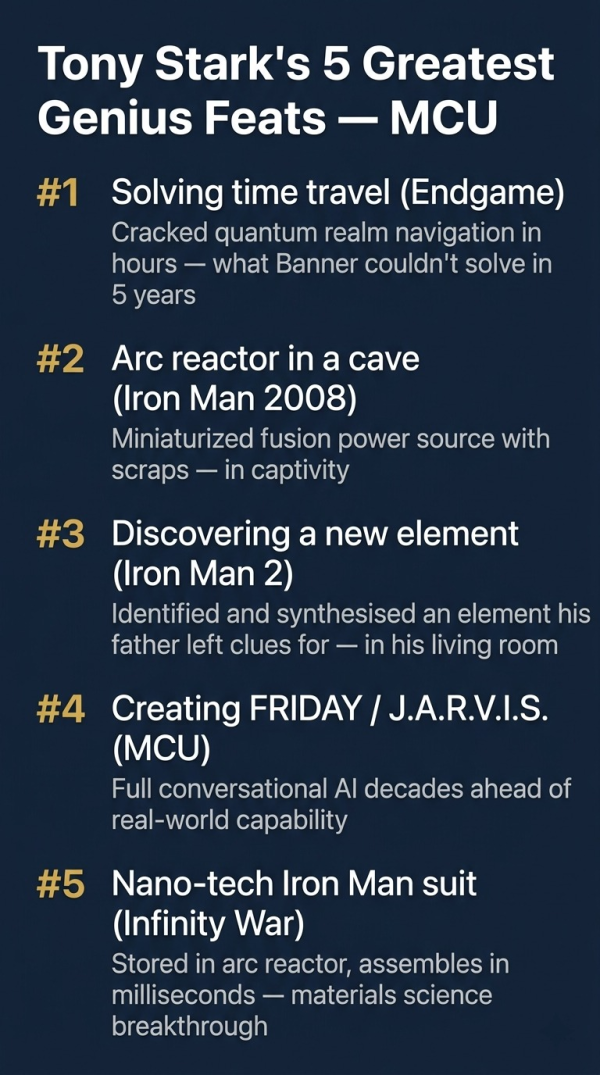
Rather than debating the exact number, it is more illuminating to examine the specific intellectual achievements that make Stark's fictional intelligence compelling:
1. Solving Time Travel (Avengers: Endgame)
The most striking demonstration of Stark's genius in the MCU is not his armour — it is his solution to the quantum realm navigation problem in Endgame. Bruce Banner, with a PhD in gamma radiation and years of work on the problem with the full resources of the Avengers' facility, could not crack the mathematics of navigating the quantum realm for time travel. Stark, in a single evening while recovering from the events of Infinity War, working on a holographic display in a remote lakehouse, solved it. The scene is deliberately written to establish a cognitive hierarchy: Banner is exceptional, Stark is beyond Banner. This is the clearest single statement of Stark's IQ in the MCU.
2. Arc Reactor in a Cave (Iron Man, 2008)
Stark's first and most famous genius moment: captured by terrorists, given a workshop and a box of weapon parts, he constructs a miniaturised fusion power source and a functional suit of powered armour — simultaneously saving his own life and engineering his escape. The arc reactor alone — a compact source generating three gigajoules per second — represents a level of energy engineering that has no real-world equivalent. What makes this scene work dramatically is not just the invention but the resourcefulness: Stark is solving multiple problems simultaneously under lethal time pressure, with minimal materials.
3. Discovering a New Element (Iron Man 2)
When palladium poisoning from his arc reactor begins to kill him, Stark discovers a new element his father had left as a hidden message in a 1974 World's Fair model — then synthesises it using a particle accelerator he builds in his garage. He identifies the element's theoretical properties, constructs the device to create it, and saves his own life — in a single montage. The scene compresses decades of materials science into an afternoon and is one of the most overtly "genius porn" moments in the MCU.
4. JARVIS and FRIDAY — Artificial Intelligence
Tony Stark designed and built two fully conversational AI systems — JARVIS and its successor FRIDAY — that operate at a level decades beyond anything currently possible. JARVIS manages Stark Tower's systems, pilots Iron Man suits autonomously, conducts real-time threat analysis across multiple data streams, and engages in natural conversation indistinguishable from a human assistant. In real cognitive science terms, building a general-purpose AI of this capability would require advances in computer science, neuroscience, and cognitive architecture that remain unsolved research problems. Stark treats it as a weekend project.
5. The Nano-Tech Iron Man Suit (Avengers: Infinity War)
By Infinity War, Stark's suit is stored in a small disc on his chest and assembles around him in milliseconds from nanoparticles. The engineering this implies — programmable matter that can form complex articulated mechanical structures on command, respond to neural input, repair itself, and interface with an AI — represents a convergence of materials science, nanotechnology, and computer engineering that does not exist and has no clear path to existence in the current state of science.
Tony Stark vs Batman: Engineering Genius vs Detective Genius
| Character | Universe | Est. IQ | Intelligence Domain |
| Reed Richards (Mr. Fantastic) | Marvel | 300+ | Theoretical science, dimensional physics |
| Tony Stark (Iron Man) | Marvel | 270 | Engineering, applied science, AI |
| Hank Pym (Ant-Man) | Marvel | ~240+ | Quantum physics, robotics |
| Lex Luthor | DC | 225 | Scientific genius, strategic manipulation |
| Batman (Bruce Wayne) | DC | 192 | Detective, strategy, psychological |
The comparison with Batman is the most frequently debated in fan communities — and it is instructive precisely because the two characters represent completely different types of genius. Stark's IQ of 270 (Marvel) is numerically higher than Batman's 192 (DC), but what they do with their intelligence is fundamentally different:
- Stark creates. His intelligence is primarily generative — producing new technologies, new solutions, new systems that did not previously exist. He is a maker
- Batman anticipates. His intelligence is primarily analytical — understanding how systems fail, how opponents think, and how to position himself for any contingency before it arises. He is a planner
A direct confrontation between the two would not simply be decided by the higher IQ number. It would depend on context: in a technological arms race, Stark's engineering superiority would likely dominate. In a strategic scenario with time for preparation, Batman's contingency planning — and his well-documented willingness to plan for every conceivable threat, including teammates — would be a formidable counter. This distinction between types of intelligence is explored in our guide on IQ vs problem-solving.
What Would Tony Stark's Intelligence Look Like in the Real World?
Translating Stark's cognitive profile into real-world terms reveals what is plausible, what is exaggerated, and what the character is actually designed to embody:
- The real-world closest analogue is someone like Elon Musk — a person who applies high analytical intelligence across multiple engineering domains simultaneously (electric vehicles, space launch vehicles, neural interfaces, AI), who can engage at a technical level with specialists in each field, and who treats problems others consider intractable as engineering challenges rather than fundamental limitations. Musk's estimated IQ of ~155 provides a real-world floor for what Stark's profile would require. For a full comparison, see our guide on Elon Musk's IQ
- What is plausible: entering MIT at 15, holding multiple engineering degrees by 20, building technology companies, developing genuinely novel engineering solutions — all documented in real people. See Dolph Lundgren for a real example of dual elite-level achievement
- What is impossible: the specific achievements — miniaturised fusion reactors, programmable nanoparticle armour, time travel, synthesising new elements in a garage — are not constrained by intelligence. They are constrained by physics. No IQ enables what does not yet have a theoretical pathway
- The real constraint is not intelligence — it is physics. Stark's genius is written to be the answer to any problem the story needs solved. Real genius is constrained by what the laws of physics permit
For more on the real-world limits of even the highest IQ, see our guide on the highest IQ of all time and what those scores actually produced.
The Most Human Thing About Tony Stark's Genius
What makes Tony Stark a compelling character is not the IQ number. It is the arc — the way his genius evolves from being a liability into a gift. Early Stark uses his intelligence for himself: weapons contracts, personal glory, escaping consequences. His genius is real but undirected, serving ego rather than purpose.
By Avengers: Endgame, the same intelligence is deployed entirely in service of others — solving time travel to undo Thanos's genocide, spending years refining the solution while raising a daughter, and ultimately giving his life to execute it. The man who once said "I am Iron Man" as a declaration of ego ends his story saying the same words as an act of final sacrifice.
In cognitive science terms, this arc maps onto the research on IQ vs EQ: raw cognitive ability becomes most valuable when paired with emotional intelligence and purpose. Stark's IQ of 270 was constant throughout. What changed was the direction it pointed.
Tony Stark's IQ of 270 is Marvel's way of saying: whatever technical problem this story needs solved, this character can solve it. The number is a narrative permission slip. What makes the character worth caring about is not what he can build — it is what he chose to build it for.
Curious where your own analytical profile sits? Take our free IQ test — no registration, results in under 20 minutes. For more fictional genius comparisons, see our articles on Batman's IQ and explore our full Celebrity IQ database. To understand what real-world intelligence at the highest levels looks like, see our guide on IQ 160.
Frequently Asked Questions
What is Tony Stark's IQ?
Tony Stark's IQ is most commonly estimated at 270 based on fan analysis and Marvel assessments. Marvel has not officially stated a specific number in canon. The 270 figure reflects his portrayed abilities — mastery of engineering, physics, AI, and time travel theory — placing him as the smartest human in the MCU.
Is Tony Stark smarter than Batman?
In fictional canon comparisons, Stark's estimated 270 is numerically higher than Batman's 192. But the two characters apply their intelligence differently: Stark creates technology, Batman plans and anticipates. A direct comparison depends entirely on context — technology race vs strategic confrontation — rather than the raw IQ gap.
What degrees does Tony Stark have?
In Marvel Comics, Tony Stark entered MIT at age 15 and earned dual Master's degrees in Electrical Engineering and Physics by age 17. He subsequently demonstrated mastery in AI, biochemistry, nanotechnology, quantum mechanics, aerospace engineering, and the theoretical physics required to solve time travel in Endgame.
Who is smarter — Tony Stark or Reed Richards?
In Marvel Comics, Reed Richards (Mr. Fantastic) is generally ranked as the smartest human with an IQ above 300. Stark is typically 4th or 5th among Marvel's smartest humans in the comics. In the MCU specifically, Stark is the pre-eminent genius — Reed Richards plays a much smaller role in the films.
What is Tony Stark's most impressive intellectual achievement?
Solving time travel in Avengers: Endgame — cracking the quantum realm navigation problem that Bruce Banner, with years of work and Hulk-enhanced brain capacity, could not solve. Stark solved it in hours while recovering from battle injuries, establishing the clearest hierarchy of intelligence in the entire MCU.

Comments
Share Your Thoughts